





Why balance lithium cells: a leisure vehicle guide
Discover why balance lithium cells is crucial for your leisure vehicle's battery performance and longevity. Maximize your off-grid power today!
TL;DR:
- Battery cell imbalance causes a 20 to 30% reduction in usable capacity and develops gradually due to chemical differences, temperature variations, and uneven cycling. Proper monitoring, regular balancing, and quality active or passive BMS protect against early degradation, safety risks, and performance loss in leisure vehicle batteries. Maintaining balanced cells through periodic checks and suitable balance circuitry extends battery lifespan, improves reliability, and ensures optimal off-grid power.
Your lithium battery may appear to be working fine while quietly losing up to 30% of its usable capacity. This is the reality of cell imbalance, a condition that develops gradually in any multi-cell lithium pack and is one of the most common reasons leisure vehicle owners find their batteries underperforming well before the end of their expected lifespan. Understanding why balance lithium cells matters is not optional maintenance knowledge; it is foundational to getting reliable off-grid power from your campervan, motorhome, or boat. This guide covers what imbalance is, what it costs you in real terms, and what you can do about it.
Table of Contents
- What is lithium cell imbalance and why does it happen?
- How imbalance affects your battery’s performance and safety
- Passive vs active balancing: which suits your leisure vehicle?
- Practical steps to monitor and balance your lithium cells effectively
- Maintaining balanced cells: key to longer battery life and reliable off-grid power
- Why many leisure vehicle owners underestimate the importance of balancing — and how to get it right
- Upgrade your leisure vehicle’s battery setup with Skyenergi solutions
- Frequently asked questions
Key Takeaways
| Point | Details |
|---|---|
| Cell imbalance definition | Lithium cells differ slightly in capacity and age, causing voltage imbalances over time. |
| Performance impact | Imbalanced cells reduce usable battery capacity by up to 30% and can cause sudden range drops. |
| Balancing methods | Passive balancing dissipates energy as heat; active balancing transfers charge to weaker cells efficiently. |
| Regular monitoring | Check cell voltages routinely and balance cells to maintain battery health and safety. |
| Lifespan extension | Proper balancing can extend leisure vehicle battery life by two to three times through even cell wear. |
What is lithium cell imbalance and why does it happen?
A lithium battery pack is made up of multiple individual cells wired together. In an ideal world, every cell would age at exactly the same rate and hold the same voltage at all times. In practice, that never happens. Microscopic chemical differences are amplified over cycles, temperature changes, and time, causing individual cells to diverge. Some lose capacity faster. Some self-discharge at slightly different rates. The result is a pack where cells sit at different voltage levels, particularly noticeable at the top and bottom of a charge cycle.
In leisure vehicles specifically, the problem is made worse by several factors:
- Uneven charging. Shore power, solar via MPPT controllers, and alternator-based DC-to-DC chargers all introduce charging at different rates and durations, which stresses cells unevenly.
- Temperature variation. A battery under a rear seat or in a wheel arch experiences temperature gradients that affect individual cells differently. Heat accelerates capacity fade in exposed cells.
- Irregular usage cycles. A motorhome used intensively for a summer road trip and then stored for six months will experience far more imbalance development than one used consistently year-round.
- Self-discharge differences. Even at rest, cells drift apart in voltage. A pack left in storage without periodic charging will develop measurable imbalance.
Following a good battery maintenance workflow from the outset reduces the rate at which imbalance develops, though it cannot be eliminated entirely. If you are new to lithium systems, understanding the benefits of lithium batteries helps set the right expectations about what is still a superior chemistry, provided it is properly managed.
How imbalance affects your battery’s performance and safety
The consequences of cell imbalance are not abstract. They show up directly in how far you can drive, how long your 12V appliances run overnight, and how reliably your system behaves under load.
Key fact: Cell imbalance causes a 20 to 30% reduction in usable energy, because weak cells hit their upper voltage limit before stronger cells are fully charged, and their lower voltage limit before stronger cells are discharged.
This has a specific, frustrating effect. Your battery management system (BMS) monitors each cell individually and stops charging when any single cell reaches its upper voltage threshold. If one cell is weaker and reaches that threshold earlier, the entire pack stops charging prematurely. You never fill the full capacity. The reverse happens on discharge: the weakest cell drops to the minimum voltage cut-off first, and the BMS disconnects the pack even though stronger cells still have energy in reserve.
Under high current draw, the situation deteriorates further. Voltage spreads over 2V under load can cause near failure and drastic range drops in aged lithium packs, particularly under the kind of sustained loads that running a compressor fridge or a high-wattage inverter demands.
The practical consequences for leisure vehicles include:
- Shorter overnight runtime from your leisure battery, even when it reads “full” at the start of the evening.
- Unexpected BMS cut-off during use, which can reset inverters, shut down fridges, or cause electrical fault alarms.
- Accelerated cell degradation as the weakest cell repeatedly hits voltage extremes while others remain in a safer range.
- Increased heat generation in cells operating outside their optimal voltage band, raising the risk of thermal incidents in enclosed vehicle spaces.
A good lithium battery management system protects the pack from the worst outcomes, but a BMS responds to problems rather than preventing them. It cannot rebalance cells on its own without active or passive balancing circuitry. If you are seeing repeated low-voltage warnings or erratic capacity readings, start with troubleshooting your lithium system before assuming a cell has failed outright.
Passive vs active balancing: which suits your leisure vehicle?
There are two established lithium cell balancing techniques, and the distinction matters when choosing a battery or BMS for a leisure vehicle application.
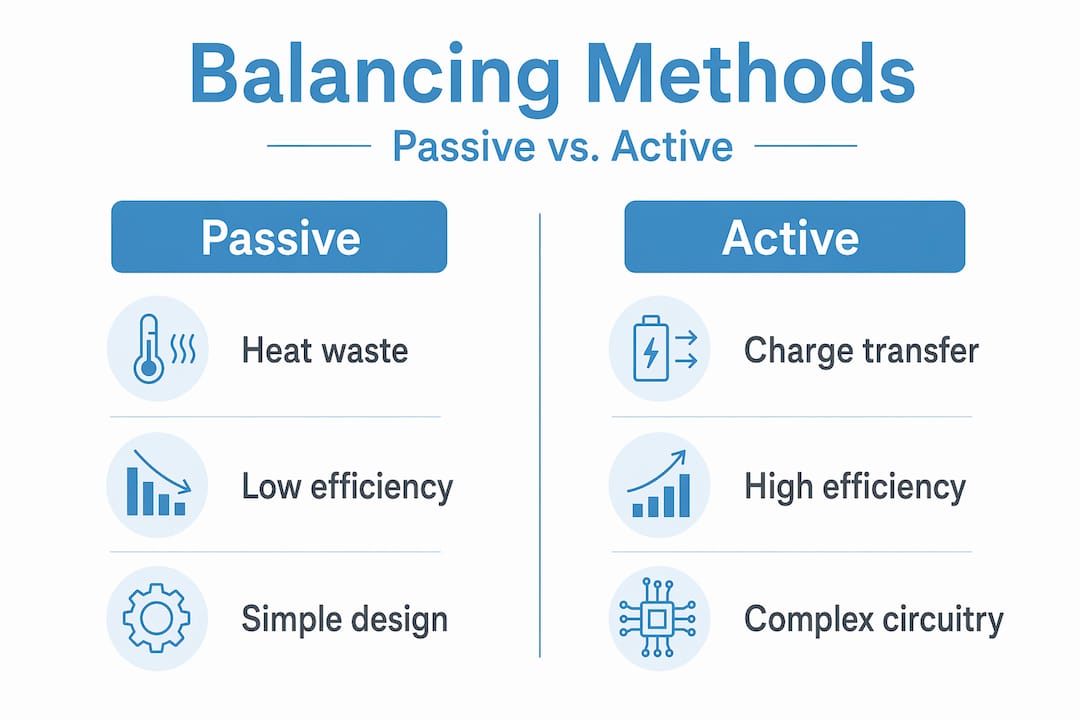
Passive balancing works by bleeding off excess charge from higher-voltage cells as heat, using resistors, until all cells reach the same voltage. It is the more common method in consumer-grade batteries. It is reliable and simple, but it only operates near the top of a charge cycle and wastes the energy it dissipates.
Active balancing works differently. Rather than discarding the surplus charge from stronger cells, it transfers that energy to weaker cells using capacitors or inductors. This improves overall pack efficiency and can operate throughout the charge and discharge cycle, not just at the top.
| Feature | Passive balancing | Active balancing |
|---|---|---|
| Energy efficiency | Low (energy wasted as heat) | High (energy redistributed) |
| Cost | Lower | Higher |
| Balancing window | Top of charge only | Throughout charge and discharge |
| Best suited for | Smaller, lower-cycle packs | High-capacity, frequently cycled packs |
| Heat generated | More | Less |
| Complexity | Simple | More complex circuitry |
Passive balancing dissipates excess charge as heat, while active balancing transfers charge between cells, making it significantly more efficient for demanding applications.

For most leisure vehicle owners running a single 100Ah to 200Ah lithium leisure battery with occasional deep cycling, passive balancing within a quality BMS is adequate. For those running larger banks of 400Ah or more, frequently cycling their batteries with solar and shore power, or living full-time in a motorhome, active balancing offers measurable benefits in both runtime and longevity.
Pro Tip: When comparing lithium batteries, check whether the integrated BMS uses passive or active balancing and at what current it operates. A passive balancing current of 50mA is common but slow. Some premium units balance at 200mA or more, which makes a practical difference in how quickly cells are equalised after irregular charging.
The role of a BMS in energy storage extends well beyond simple over-voltage protection. Understanding what a battery management system does for long-term cell health will help you assess whether the BMS in your current battery is adequate for your usage pattern.
Practical steps to monitor and balance your lithium cells effectively
Knowing that balancing matters is one thing. Doing it correctly is another. Here is a practical approach for leisure vehicle owners.
- Install a BMS with cell-level monitoring. Many quality lithium leisure batteries include a Bluetooth-enabled BMS that lets you view individual cell voltages via a smartphone app. Use app-monitored BMS to check cell voltages after installation and periodically during use. Loose wiring can mimic imbalance readings, so always verify connections first.
- Set a voltage difference threshold alert. A spread of up to 0.05V between cells is normal during operation. Anything above 0.1V warrants attention and can cause BMS cut-off errors or premature shutdowns.
- Perform a full charge cycle periodically. Charge your battery to 100% using your primary charger and hold it there for an hour or two. This gives the BMS balancer its best window to equalise cells.
- Check and tighten all inter-cell and terminal connections. Resistance at connections causes localised voltage drops that can be misread as cell imbalance. This is a simple step that is frequently overlooked.
- Use manual top-balancing where necessary. Manual balancing using hobby chargers can restore voltage differences to within 0.02 to 0.05V. A difference exceeding 0.1V consistently indicates a cell that is either degraded or suffering from a connection issue.
- Schedule an annual full balance check. Before the start of each travel season, charge to full and monitor cell voltages across the pack. This is the most effective preventative measure for leisure vehicle batteries.
Pro Tip: If your battery does not have a Bluetooth BMS, a basic cell voltage monitor that plugs into a balance lead is an inexpensive way to get per-cell readings without specialist equipment. Available from most electronics suppliers, these take seconds to read and cost very little.
For guidance on physical setup, the lithium battery installation guide covers correct wiring practice, and BMS selection for leisure vehicles helps you match protection features to your specific system requirements.
Maintaining balanced cells: key to longer battery life and reliable off-grid power
The long-term case for balancing is straightforward. Balanced cells extend battery lifespan by two to three times in leisure vehicle applications through even wear distribution across the pack.
Consider what even wear actually means in practice. When all cells are balanced, none of them are repeatedly pushed to voltage extremes while others remain within a safer operating range. This reduces stress on individual cells, slows the growth of internal resistance, and prevents the capacity fade that makes a “100Ah” battery feel like 70Ah within a few years.
The benefits of maintaining balanced lithium cells include:
- Prevention of premature pack shutdown, caused by a single weak cell tripping the BMS cut-off.
- Reduced heat generation across the pack during both charge and discharge cycles.
- Slower capacity fade, extending the number of usable cycles before the pack drops below 80% of rated capacity.
- Improved safety, by preventing individual cells from reaching overcharge or deep discharge conditions that increase thermal risk.
- More accurate state-of-charge readings, since a balanced pack behaves more predictably and the BMS can calculate remaining capacity with greater accuracy.
For anyone relying on off-grid power in a leisure vehicle, this is not just about saving money on replacement batteries. It is about knowing your system will perform when you need it, whether that is running a diesel heater through a cold Scottish night or keeping a fridge cold on a week-long summer trip. Maintaining a regular battery maintenance schedule is the simplest way to keep your cells in balance and your system reliable.
Why many leisure vehicle owners underestimate the importance of balancing — and how to get it right
There is a widespread assumption that lithium batteries are maintenance-free. This is partly true compared to lead-acid, which requires electrolyte checks and regular equalisation charges. But “lower maintenance” is not the same as “no maintenance,” and this distinction catches a significant number of leisure vehicle owners out.
The pattern is consistent. A battery performs well for the first two seasons. By the third, runtime seems shorter but nothing has obviously failed. By the fourth, the BMS is cutting off unexpectedly, range feels noticeably reduced, and the owner assumes the battery has simply worn out. In many cases, the pack still has usable cells. The issue is imbalance that was never addressed. A couple of annual balance sessions may have extended the useful life by years.
The other misconception is that a quality BMS will handle everything automatically. A BMS will protect your cells from the worst outcomes. It will not correct years of accumulated voltage divergence without balancing circuitry actively working on the pack. Passive balancing at 50mA simply cannot keep pace with imbalance that develops in a 200Ah pack cycled daily.
Proactive balancing, combined with regular voltage monitoring through a good BMS app, is the difference between a pack that lasts three years and one that delivers seven or more. The return on investment from maintaining balance is significant. Replacement lithium cells or packs are expensive. A reliable BMS built for leisure vehicle energy independence that includes active balancing is considerably cheaper over a five-year horizon than replacing a prematurely degraded pack.
The owners who get the most from their lithium systems are not necessarily the ones who bought the most expensive batteries. They are the ones who check their cell voltages every few months, charge to full before storage, and act on early warning signs rather than waiting for a failure.
Upgrade your leisure vehicle’s battery setup with Skyenergi solutions
Balancing your lithium cells starts with having the right hardware in place. A quality charger, a well-integrated BMS, and reliable monitoring tools are what turn the theory in this guide into practical, day-to-day results for your leisure vehicle.

Skyenergi supplies a range of products specifically suited to achieving and maintaining cell balance in off-grid leisure vehicle systems. A Victron solar panel and MPPT charge controller bundle delivers consistent, well-regulated charging that supports intelligent balancing conditions. For a fully integrated approach, the solar power electrics system from SRNE includes battery-to-battery charging, inverter, and monitoring in a single turnkey solution. Add a Victron VE.Direct interface for real-time battery data access on the move, keeping you informed of cell health at all times.
Frequently asked questions
Why do lithium battery cells become unbalanced over time?
Lithium cells become unbalanced due to small manufacturing differences, temperature variations, self-discharge rates, and uneven ageing, which cause some cells to lose capacity faster than others. These factors are amplified over cycles and time, making imbalance inevitable in any multi-cell pack.
What are the risks of running a lithium battery pack with unbalanced cells?
Unbalanced cells can reduce usable capacity by up to 30%, cause early battery shutdowns, and accelerate cell degradation. Cell imbalance directly limits how fully the pack can be charged and discharged, reducing both safety and runtime.
How often should leisure vehicle lithium batteries be balanced?
For most leisure vehicle applications, balancing should be checked every few months and performed thoroughly at least once per year during a full charge cycle. Regular balancing, especially after heavy usage or storage, is recommended to maintain peak performance.
What is the difference between passive and active cell balancing?
Passive balancing dissipates surplus charge from stronger cells as heat, while active balancing transfers that charge to weaker cells. Active balancing is more efficient and better suited to high-capacity or frequently cycled leisure vehicle packs.
Can balancing fix permanently damaged lithium cells?
Balancing cannot restore capacity to cells with permanent damage or elevated internal resistance. High internal resistance cells require replacement; balancing works only when cells are fundamentally healthy but have drifted apart in voltage.
Recommended
Prev post

Lithium battery lifespan factors: what you need to know
Updated on 19 May 2026
Next post

Smart battery system features for off-grid power
Updated on 17 May 2026


