





Smart battery system features for off-grid power
Discover the essential features of smart battery systems for off-grid power. Make informed choices for campers, boats, and more!
TL;DR:
- Choosing a smart battery system involves understanding its core features, such as advanced BMS, active cell balancing, and precise SoC estimation, which ensure safety and reliability in off-grid or marine use.
- Features like Bluetooth monitoring and specialized protections for cold environments significantly enhance user control and battery longevity in demanding conditions.
Choosing the right battery system for a campervan, motorhome, or boat is not straightforward. The features of smart battery systems vary considerably between products, and selecting the wrong combination can mean poor runtime, reduced battery life, or unexpected failures in remote locations. This article covers the key smart battery management features you need to understand, from battery management systems and cell balancing through to real-time monitoring and marine-grade capabilities, so you can make a properly informed decision.
Table of Contents
- Battery management system: the heart of smart batteries
- Active cell balancing: rapid equalisation for longer battery life
- Precise state-of-charge estimation methods
- Integrated monitoring and communication for user control
- Specialised features for marine and off-grid applications
- Comparison of key smart battery system features
- Why true smart battery performance goes beyond specifications
- Discover smart battery solutions for your campervan or boat
- Frequently asked questions
Key Takeaways
| Point | Details |
|---|---|
| BMS central role | The Battery Management System monitors and regulates cell performance to ensure safety and extend battery life. |
| Active balancing benefit | Active cell balancing quickly and efficiently equalises charge between cells, maximising usable battery capacity. |
| Accurate SoC essential | Advanced state-of-charge estimation methods improve reliability and runtime prediction for off-grid users. |
| Real-time monitoring | Communication features allow users to remotely monitor and control battery status, enhancing management. |
| Specialist features matter | Marine and campervan batteries often include self-heating and high discharge rates suited to challenging environments. |
Battery management system: the heart of smart batteries
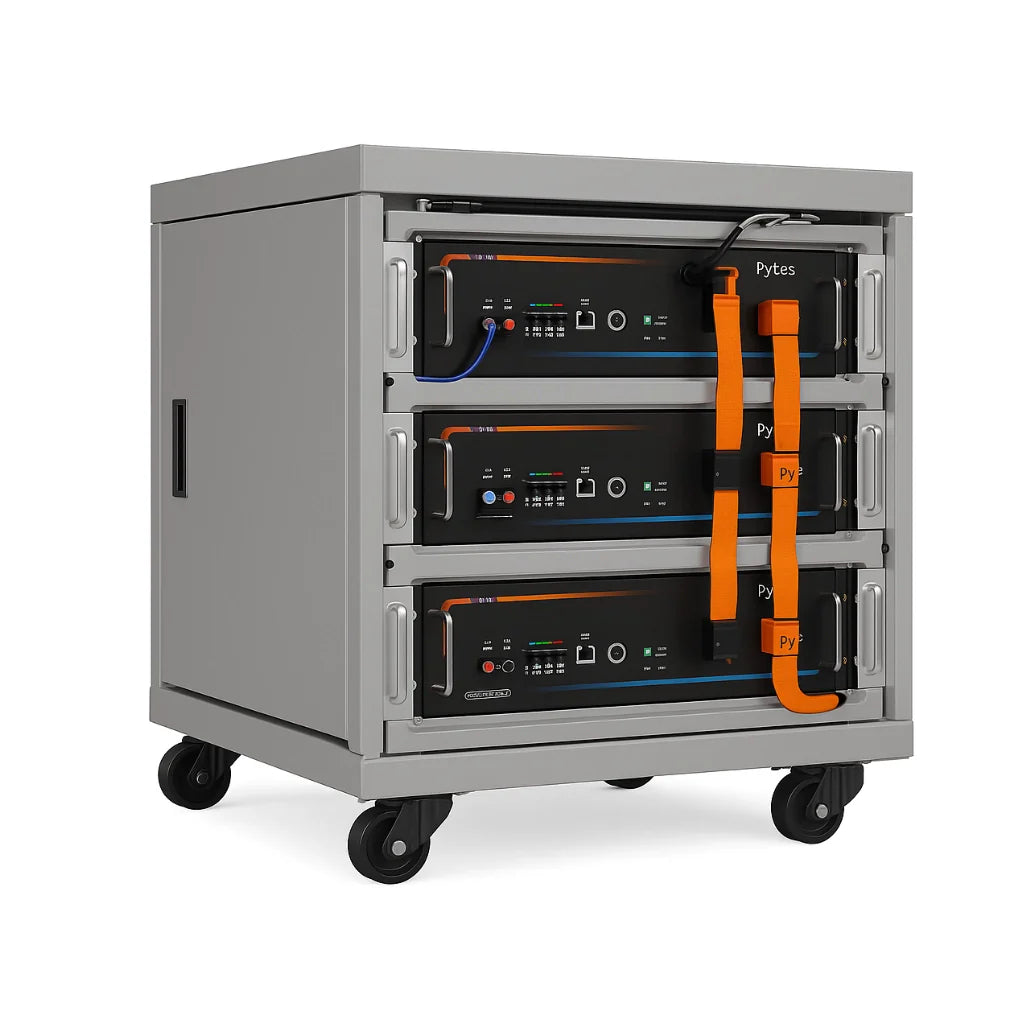
The Battery Management System, or BMS, is the core technology that separates a smart battery from a conventional one. It continuously measures what is happening inside the battery pack and responds in real time to protect it and get the most from every charge cycle. As smart lithium battery technology confirms, smart battery systems integrate a BMS that constantly monitors cells and regulates charging and discharging to optimise performance and safety.
Understanding the battery management system importance helps clarify why it matters so much for off-grid use. Without a BMS, lithium cells can be damaged through overcharging, deep discharge, or thermal stress, all of which permanently reduce capacity.
Core BMS functions in smart battery systems:
- Voltage monitoring: Tracks individual cell voltage in real time to prevent overcharge or over-discharge
- Current monitoring: Measures charge and discharge current to enforce safe operating limits
- Temperature sensing: Detects overheating and cold conditions that could damage cells or reduce efficiency
- Cell balancing: Equalises charge across all cells to prevent capacity loss from imbalances
- Fault protection: Triggers automatic shutdown for short circuits, overvoltage, and thermal events
- Communication output: Sends live status data to displays, apps, or external controllers
A quality BMS also contributes to low self-discharge rates and extends overall battery life, often delivering 2,000 to 5,000 charge cycles in well-managed lithium iron phosphate (LiFePO4) packs. For campervan and boat owners who depend on their batteries daily, this directly translates into years of added reliability.
Active cell balancing: rapid equalisation for longer battery life
Individual cells within a battery pack are never perfectly identical. Manufacturing tolerances, temperature gradients, and usage patterns cause cells to drift apart in charge level over time. Left unaddressed, the weakest cell in a pack limits the usable capacity of the entire system. This is where cell balancing becomes critical.
There are two approaches: passive and active. Passive balancing bleeds excess charge from stronger cells as heat, which is slow and wastes energy. Active balancing transfers charge between cells, correcting imbalances quickly and efficiently, unlike passive balancing which dissipates energy as heat and takes considerably longer.
For owners running high-capacity packs of 200Ah or more, as is common in campervans and narrowboats, active balancing means the entire pack capacity is usable rather than being restricted by one lagging cell. It also reduces heat generation inside the battery enclosure, which matters in confined spaces.
Benefits of active cell balancing for off-grid users:
- Faster equalisation, typically completing in under an hour versus several hours with passive methods
- No wasted energy during balancing, preserving range and runtime
- Lower thermal output during balancing, improving safety in enclosed battery compartments
- Maintains pack capacity more effectively over hundreds of cycles
- Better performance during high-demand loads, such as running an inverter or bow thruster
Pro Tip: When comparing smart battery products, ask the supplier specifically whether the BMS uses active or passive balancing. Many budget units only feature passive balancing, which becomes a meaningful disadvantage as packs age.
Understanding active balancing in leisure vehicle batteries is particularly relevant for UK owners who may not be charging daily and rely on stored capacity across multiple days.
Precise state-of-charge estimation methods
State of Charge (SoC) is simply the percentage of energy remaining in your battery, equivalent to a fuel gauge. But measuring it accurately in a lithium battery is harder than it sounds. Voltage alone is an unreliable indicator because LiFePO4 cells maintain a relatively flat voltage curve across most of their discharge range, making voltage readings almost meaningless for predicting remaining runtime.
Smart battery systems address this with coulomb counting, which tallies the current flowing in and out of the battery over time to calculate SoC. More advanced implementations go further. Advanced SoC estimation uses trapezoidal integration and capacity degradation compensation to reduce drift errors and improve battery runtime prediction accuracy.
This matters practically. A system that drifts by 10 to 15 percent in its SoC reading can cause you to run appliances well past a safe discharge threshold, damaging cells through over-discharge or leaving you with less reserve than expected.
What to look for in smart battery SoC estimation:
- Coulomb counting with current sensor accuracy of at least 0.5 percent
- Capacity fade compensation: the system recalibrates as the battery ages, keeping readings relevant
- Temperature correction: accounts for reduced capacity in cold conditions, critical for winter trips
- Regular recalibration: the system corrects accumulated drift at full charge or full discharge points
- User-readable output: SoC displayed in percentage form via app or display, not just raw voltage
These state-of-charge estimation methods are part of what justifies the cost premium of a genuine smart battery over a basic lithium pack with no onboard intelligence.
Integrated monitoring and communication for user control
Knowing what your battery is doing in real time is one of the most practical features of a smart battery system. What is smart energy monitoring in this context? It is the ability to see live data on voltage, current, temperature, state of charge, and fault alarms, either on a dedicated display unit or through a smartphone app.

Smart battery systems communicate via Bluetooth, CAN, SMBus, or RS485, enabling mobile app monitoring, alarm notifications, and intelligent multi-stage charging. These communication protocols serve different purposes.
Common communication interfaces and their uses:
- Bluetooth: Direct connection to a smartphone app, no extra hardware needed, ideal for individual leisure batteries
- CAN bus: Used in more complex multi-battery systems, enables communication with inverters and MPPT controllers
- RS485: Common in larger installations and residential energy storage systems
- SMBus: A simpler protocol found in smaller smart battery packs
Smart battery communication features also enable multi-stage charging algorithms. Rather than applying a fixed charge current, the charger adapts based on live battery data, switching between bulk, absorption, and float stages appropriately.
How to use Bluetooth monitoring on a smart battery:
- Download the manufacturer’s app on your smartphone
- Enable Bluetooth and open the app near the battery
- Pair with the battery’s BMS module using the device code
- View live voltage, current draw, SoC percentage, and temperature
- Set alarm thresholds for low SoC or high temperature to receive push notifications
- Review historical charge and discharge cycles in the app’s data log
This level of visibility means you can catch a problem such as a parasitic drain or a faulty charger before it causes damage, rather than discovering it when the battery is flat.
Specialised features for marine and off-grid applications
Not all smart batteries are built for the same conditions. Campervans parked in Scottish winters and narrowboats moored on exposed stretches of canal face environmental demands that a standard smart battery may not handle well. Specialist features exist specifically for these situations.
Some smart batteries integrate temperature self-heating to operate in sub-zero conditions and offer continuous high discharge rates with long design lives suitable for marine and leisure vehicles. Self-heating is a practical necessity when ambient temperatures drop below 0°C because lithium cells cannot accept charge safely at sub-zero temperatures and suffer permanent damage if forced to do so.
Key specialty features for off-grid batteries:
- Self-heating: Internal heating element activates below a threshold temperature, typically 0°C, enabling safe charging
- High continuous discharge: Rates of 1C to 2C (100A to 200A continuous from a 100Ah pack) to support inverters and high-draw loads
- Extended design life: Marine-grade batteries rated for 15 years or 3,000 to 5,000 cycles at 80 percent depth of discharge
- IP-rated enclosures: Protection against moisture and spray ingress, essential for marine installations
- Vibration resistance: Reinforced internal construction to withstand engine vibration and wave motion
For marine battery reliability features, these specifications translate into far lower long-term ownership costs despite a higher upfront price.
Pro Tip: If your campervan or boat is stored or used in winter, self-heating capability is not a luxury. It prevents a scenario where a cold overnight soak leaves your battery unable to accept charge from solar panels the following morning.
| Feature | Standard smart battery | Marine/off-grid grade |
|---|---|---|
| Self-heating | Rarely included | Common |
| Continuous discharge rate | 0.5C to 1C | 1C to 2C |
| Design life | 5 to 10 years | 10 to 15 years |
| Enclosure rating | IP20 to IP44 | IP55 to IP67 |
| Vibration resistance | Standard | Reinforced |
Comparison of key smart battery system features
This comparison covers the main approaches across the feature areas discussed, to help you match a system to your actual needs.
| Feature | Basic approach | Advanced smart approach | Advantage |
|---|---|---|---|
| BMS monitoring | Voltage and current only | Voltage, current, temperature, impedance | Advanced offers earlier fault detection |
| Cell balancing | Passive (heat dissipation) | Active (energy transfer) | Active: faster, no energy waste |
| SoC estimation | Voltage-based | Coulomb counting with drift compensation | Advanced: more accurate runtime forecasting |
| Communication | None or LED indicators | Bluetooth, CAN, RS485, app monitoring | Smart: full user visibility and alarms |
| Cold temperature | No protection | Self-heating below 0°C | Essential for UK winter use |
| Discharge capability | 0.5C typical | Up to 2C continuous | High rate needed for inverter loads |
The comparison of BMS features shows that the gap between basic and advanced implementations is significant in real-world use, not just on a specification sheet.
Why true smart battery performance goes beyond specifications
Feature lists are easy to produce. Delivering on them consistently in real-world conditions is considerably harder. Our experience supplying batteries for campervans and marine applications across the UK points to a few areas where specification claims and actual performance frequently diverge.
SoC accuracy is the most common example. Many products claim precise state-of-charge readings, but accurate SoC claims must be scrutinised for the quality of current sensing and drift management, which are critical for real-world reliability. A BMS using a low-quality current shunt with 2 percent measurement error will accumulate significant SoC drift within a week of normal use.
Active balancing is another area where implementation quality matters as much as its presence. A BMS rated for 200mA balancing current on a 300Ah pack will take many hours to correct a significant imbalance. A unit rated for 2A to 5A balancing on the same pack will correct it in under an hour. Both are described as “active balancing” in marketing materials.
The features that genuinely deliver value are the ones that work continuously without user intervention: real diagnostics, accurate monitoring, and automatic protection. Impedance spectroscopy, for example, measures internal resistance to predict cell degradation before capacity loss becomes noticeable. Very few leisure battery products offer this, but it is exactly the kind of practical smart battery advice that separates a system you can rely on from one that simply looks good in a brochure.
Our recommendation: prioritise verified monitoring accuracy, active balancing current ratings, and proven communication compatibility with your existing system over headline figures for cycle count or capacity.
Discover smart battery solutions for your campervan or boat
Skyenergi supplies a curated range of smart lithium battery systems built around the features covered in this article, including integrated BMS with Bluetooth monitoring, active cell balancing, and products suited to both leisure and marine environments.

Our range includes Skyenergi’s own lithium leisure batteries, the SRNE turnkey energy solution for leisure vehicles, and Victron-compatible components, all sourced directly from manufacturers to keep pricing competitive without compromising on capability. Whether you are fitting out a motorhome, upgrading a narrowboat, or building a reliable off-grid power system, smart battery solutions at Skyenergi are selected to cover the features that matter most for UK conditions. Browse the range and get in touch with our team for guidance on the right specification for your setup.
Frequently asked questions
What makes a battery management system “smart”?
A smart BMS actively monitors and controls cell voltage, current, and temperature while communicating status, balancing cells, and protecting against faults to optimise safety and lifespan. It uses algorithms to adapt to real-time conditions rather than applying fixed charge and discharge limits.
Why is active cell balancing better than passive balancing?
Active balancing redistributes energy rather than dissipating it as heat, correcting imbalances in about an hour compared to many hours with passive balancing. This is especially important for large capacity packs in campervans and boats where passive balancing simply cannot keep up.
How do smart batteries estimate the state of charge accurately?
Smart batteries use coulomb counting combined with trapezoidal integration and capacity degradation compensation to lower errors and provide more reliable charge status. This approach remains accurate as the battery ages, unlike simple voltage-based methods.
Can I monitor my smart battery remotely?
Yes. Smart battery systems communicate via Bluetooth and other interfaces to provide live status and alarms through apps or connected devices. Many systems also allow threshold alerts, so you are notified before a fault becomes a problem.
Recommended
Prev post

Why balance lithium cells: a leisure vehicle guide
Updated on 18 May 2026
Next post

The role of lithium in mobile power for off-grid adventures
Updated on 16 May 2026


