





Solar panel sizing explained: a practical 2026 guide
Master solar panel sizing explained with our 2026 guide! Learn how to calculate system capacity for your energy needs and optimize your setup.
Solar panel sizing is the process of calculating the ideal system capacity and panel count to meet your household or off-grid electricity needs, based on annual consumption, location sunlight, and panel specifications. Getting this calculation right determines whether your system covers your bills or leaves you short. Most modern residential panels fall between 400W and 450W, and understanding how those units translate into a working system is where most DIY projects either succeed or stall. This guide covers the core formula, the variables that shift the numbers, and the practical decisions you face when planning a real installation.
What factors influence the number of solar panels you need?
The number of panels your system requires is not fixed by house size. Home square footage does not determine solar panel needs. Your actual electricity consumption is the primary input, and everything else adjusts around it.
Several variables interact to produce your final panel count:
- Annual electricity consumption. Pull your last 12 months of bills and total the kWh figure. A typical UK three-bedroom home uses between 3,500 and 5,000 kWh per year.
- Peak sun hours. This is not total daylight. It is the number of hours per day when irradiance reaches 1,000 W/m². The UK averages roughly 2.5 to 3.5 peak sun hours depending on location and season.
- System efficiency losses. Efficiency losses of 15 to 20% are standard across residential systems, caused by inverter conversion, wiring resistance, temperature derating, soiling, and gradual panel degradation. This produces a working efficiency factor of 0.80 to 0.85.
- Panel wattage. Higher wattage panels produce more output per unit, which directly reduces the number of panels required. A 450W panel produces 12.5% more than a 400W panel, which matters when roof space is limited.
- Roof orientation and tilt. South-facing roofs at 30 to 35 degrees receive optimal sunlight. East or west orientations require 15 to 20% more panels to compensate for lower output. North-facing roofs are generally unsuitable for the UK.
- Shading. Trees, chimneys, and neighbouring structures reduce effective production. Even partial shading on one panel in a series string can reduce total string output by 10 to 30%.
- Future load planning. Adding an electric vehicle or heat pump increases annual demand by 3,000 to 5,000 kWh. If you plan to add either within the next few years, factor that into your initial sizing.
- Export limits and net metering caps. Grid operators in the UK often cap export at 3.68 kW for single-phase connections. Generating well above that without storage means excess production earns little or nothing.
Pro Tip: Check your smart meter data or energy supplier app for monthly consumption figures rather than relying on estimated annual averages. Seasonal variation matters, particularly if you use electric heating.
How to use the solar panel sizing formula with worked examples

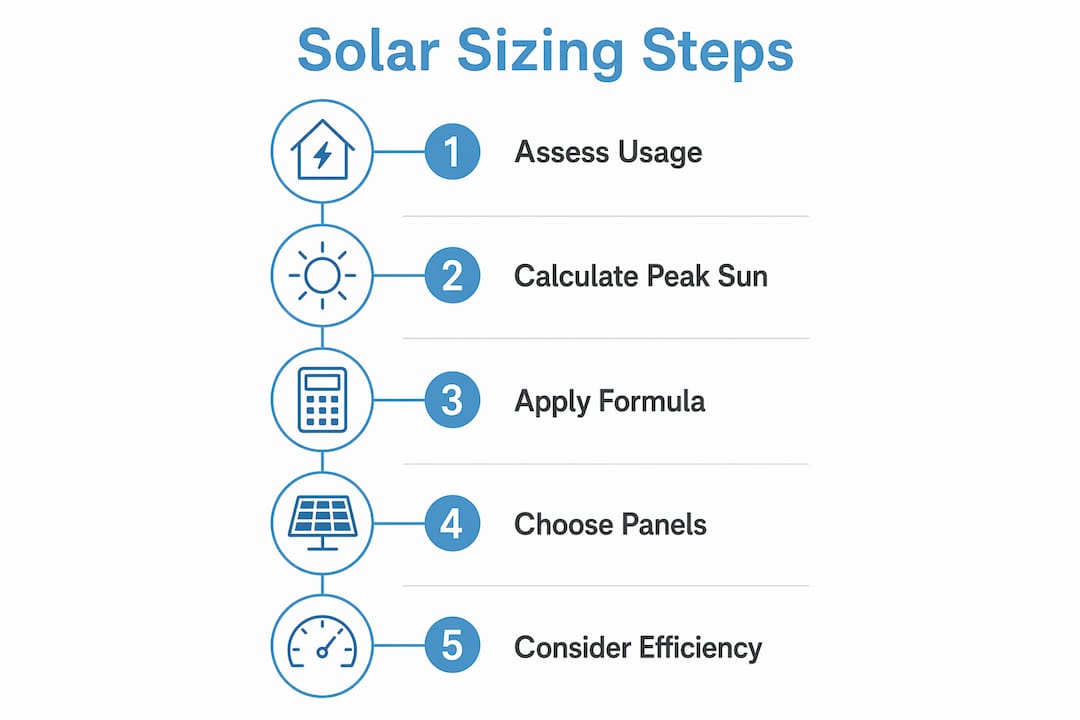
The core formula for calculating system size is straightforward. System size in kW equals annual kWh consumption divided by the product of peak sun hours per day, 365 days, and a system efficiency factor of 0.85.
Follow these steps in sequence:
- Determine annual kWh usage. Check your electricity bills or smart meter history. For this example, use 4,200 kWh per year.
- Obtain peak sun hours for your location. Use PVGIS (the EU’s Photovoltaic Geographical Information System) to get accurate irradiance data for your postcode. For a mid-England location, assume 2.8 peak sun hours per day.
- Select your efficiency factor. Use 0.85 for a well-designed system with quality components. Use 0.80 if you expect significant shading or older wiring.
- Calculate system size in kWp. Apply the formula: 4,200 ÷ (2.8 × 365 × 0.85) = 4,200 ÷ 867.7 = 4.84 kWp.
- Select panel wattage and calculate panel count. Divide system size by individual panel output. Using 400W panels: 4,840W ÷ 400W = 12.1 panels. Always round up. You need 13 panels.
The table below shows how location affects panel count for the same 4,200 kWh annual consumption:
| Location | Peak sun hours/day | System size (kWp) | Panels required (400W) |
|---|---|---|---|
| South England | 3.2 | 4.24 | 11 |
| Midlands | 2.8 | 4.84 | 13 |
| Scotland | 2.4 | 5.65 | 15 |
A typical European three-bedroom home using 3,500 to 5,000 kWh per year requires roughly 10 to 16 panels at 400W each, depending on location. That range exists entirely because of peak sun hours variation, not because the homes are different sizes.
Pro Tip: Run your PVGIS calculation using the “optimal tilt” setting first to establish a baseline, then re-run it at your actual roof pitch to see the real-world output difference before committing to a panel count.
Understanding solar charge efficiency is equally relevant for off-grid and leisure vehicle setups, where the same formula applies but battery capacity and charge controller sizing add further variables.
Standard sizing vs oversizing: which approach suits you?
Choosing between sizing to your current consumption and oversizing for future demand is one of the most consequential decisions in system design. Both approaches have clear trade-offs.
Standard sizing targets 100% offset of current annual consumption. This balances upfront cost against payback period and avoids generating surplus power that earns minimal export income. Experienced installers cap offset at 100 to 110% of annual usage to maximise return on investment and avoid utility export penalties.
Oversizing by 20 to 50% makes sense only when specific future loads are confirmed. An EV charger or heat pump adds 3,000 to 5,000 kWh of annual demand. Sizing for that now avoids a costly second installation later. Without those planned loads, oversizing slows your payback and generates excess power that earns lower export rates once you exceed net metering caps.
| Scenario | Recommended approach | Reason |
|---|---|---|
| Current consumption only | Standard sizing (100% offset) | Fastest payback, no wasted capacity |
| EV or heat pump planned | Oversize by 20 to 50% | Avoids second installation cost |
| Battery storage included | Modest oversize (10 to 20%) | Battery absorbs surplus before export |
| Limited roof space | Standard sizing with high-wattage panels | Maximise output per square metre |
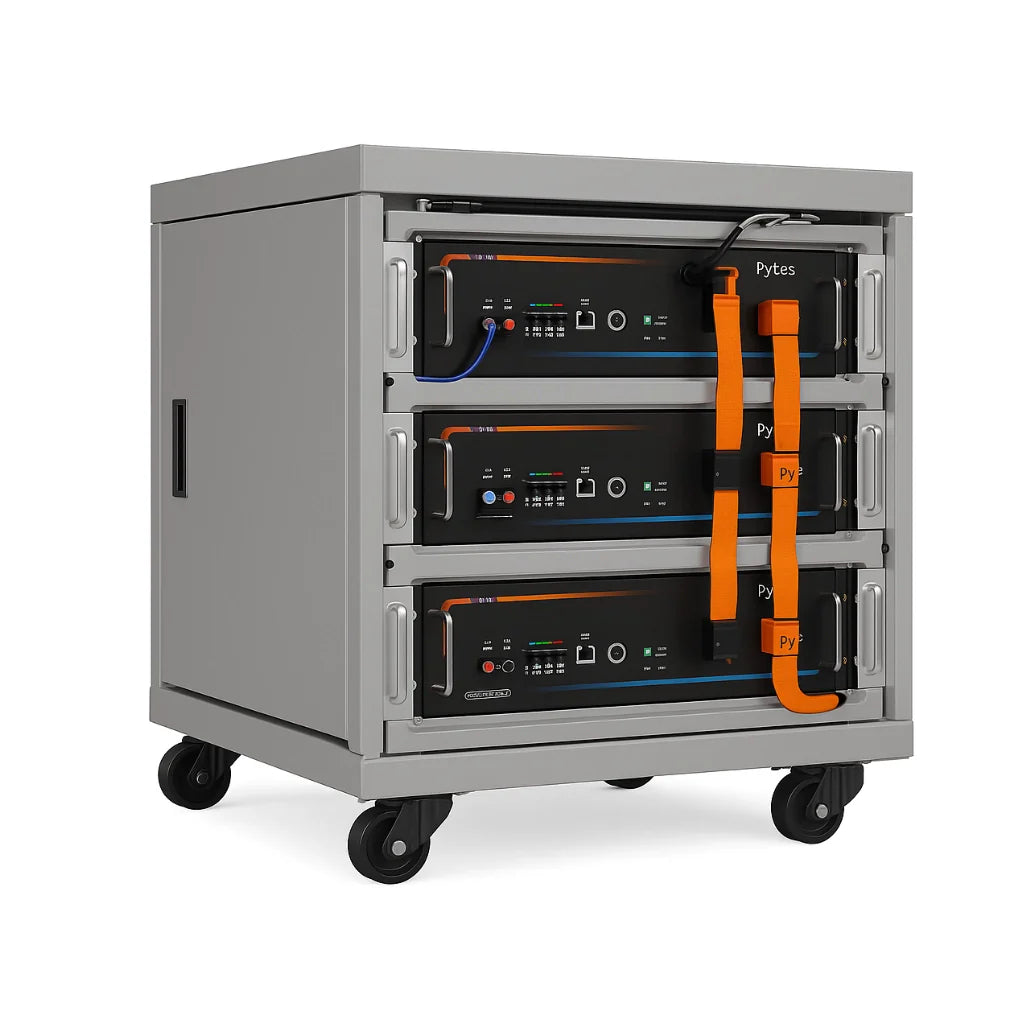
Battery storage changes the calculus. A lithium battery bank absorbs surplus daytime generation and discharges it in the evening, making modest oversizing financially justifiable even without a confirmed future load. Without storage, surplus generation above the export cap produces negligible financial return.
Practical considerations for installation layout and panel placement
Calculating the right system size on paper is only half the task. Fitting that system onto a real roof introduces constraints that can change your panel count or configuration.
- Usable roof area. Fire codes require setbacks of approximately 18 inches from roof edges, ridges, and obstructions. These setbacks reduce usable roof space by 20 to 30% compared to the total roof area. Measure the net usable area before confirming your panel count.
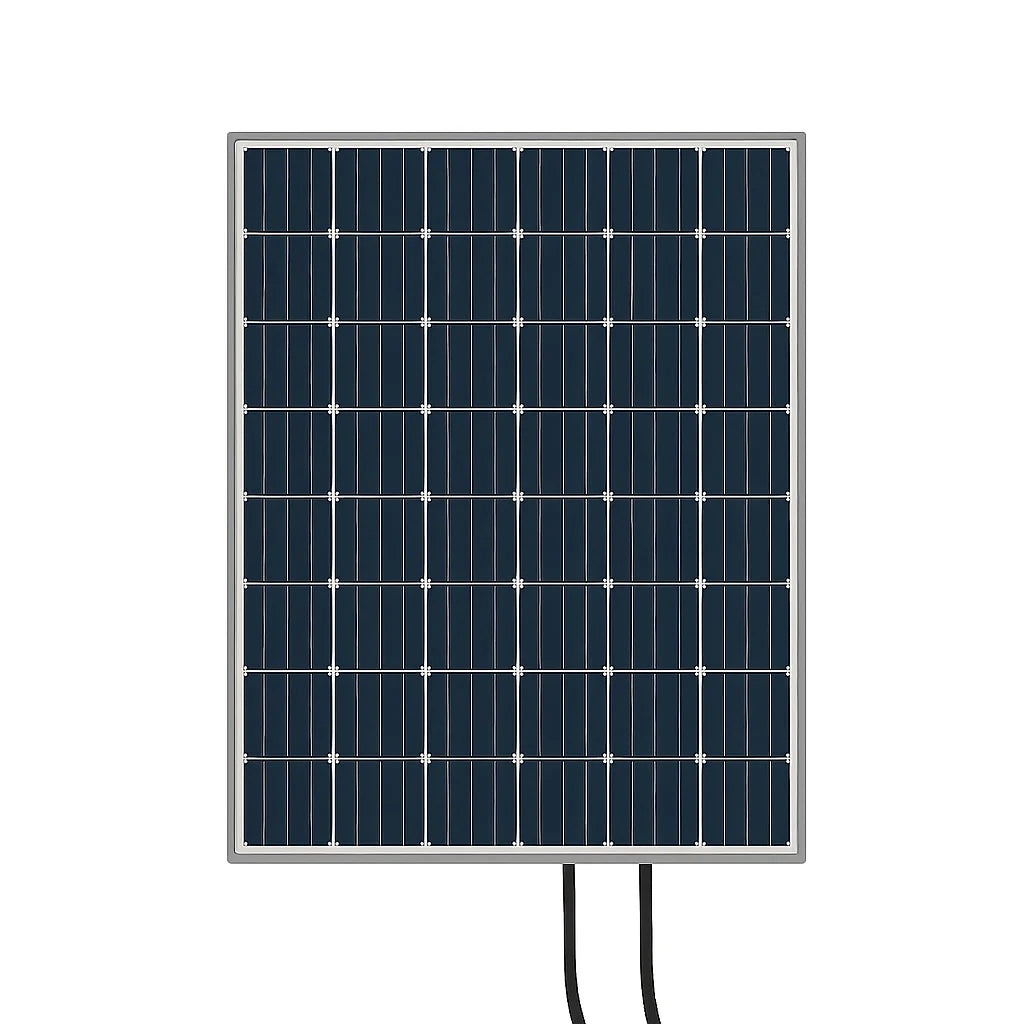
- Panel physical dimensions. A standard residential panel measures approximately 1.7 m by 1 m. At that size, 13 panels require roughly 22 square metres of clear, unobstructed roof space. Confusing physical panel size with system capacity or wattage is one of the most common procurement errors in DIY projects.
- Shading and string configuration. If any panels will be partially shaded during peak hours, avoid wiring them in a series string with unshaded panels. Microinverters or DC power optimisers allow each panel to operate independently, preventing one shaded panel from dragging down the output of the entire array.
- DC/AC ratio. The DC/AC ratio between 0.8 and 1.2 is the recommended range for residential systems. A ratio above 1.2 causes clipping, where the inverter cannot process all available DC power and production is lost. A ratio below 0.8 means the inverter is oversized for the array and operates inefficiently at partial load.
- Tilt and spacing. For fixed roof-mount systems, the roof pitch determines your tilt angle. For ground-mount or flat-roof systems, aim for 30 to 35 degrees for UK latitudes. Allow inter-row spacing of at least 1.5 times the panel height to prevent self-shading in winter when the sun is low.
Pro Tip: Use PVGIS or a tool like PVsyst to model your specific roof layout before purchasing panels. Inputting your actual roof dimensions, tilt, and orientation takes 20 minutes and can prevent a costly mismatch between your calculated system size and what physically fits.
For a broader view of how sizing integrates with off-grid system design, the residential off-grid system types guide from Skyenergi covers the key configuration decisions in detail.
Key takeaways
Accurate solar panel sizing requires dividing your annual kWh consumption by your location’s peak sun hours, 365 days, and a system efficiency factor of 0.85, then dividing the result by your chosen panel wattage and rounding up.
| Point | Details |
|---|---|
| Use the correct formula | Divide annual kWh by peak sun hours × 365 × 0.85 to get system size in kWp. |
| Location changes panel count | Moving from south England to Scotland adds two to four panels for identical consumption. |
| Oversize only with a plan | Add 20 to 50% capacity only if an EV or heat pump is confirmed within two years. |
| Roof space is always less than expected | Fire code setbacks remove 20 to 30% of total roof area from usable mounting space. |
| Match inverter to array size | Keep the DC/AC ratio between 0.8 and 1.2 to avoid clipping and wasted production. |
Why most DIY sizing mistakes are avoidable
John here. After working through dozens of off-grid and residential sizing queries, the single most common mistake is treating roof size as a proxy for solar need. It is not. Two homes with identical roof areas can have consumption figures that differ by a factor of three, depending on occupancy, appliances, and heating type. Start with your bills, not your roof.
The second mistake is sizing for today without any thought for tomorrow. You do not need to oversize speculatively, but if you know an EV is coming in 18 months, designing a system that cannot accommodate it without a second installation is a false economy. The marginal cost of adding two or three extra panels during the original installation is far lower than returning to site later.
What I find underappreciated in most guides is the DC/AC ratio. DIYers often select an inverter based on system kWp alone, without checking whether the ratio falls within the 0.8 to 1.2 range. An oversized inverter running at 60% capacity for most of the day is not a conservative choice. It is a design error that costs you production and money across the system’s lifetime.
Use PVGIS. It is free, accurate, and takes your exact coordinates and roof tilt into account. There is no reason to estimate peak sun hours from a regional average when precise data is available at no cost.
— John
Victron solar panels and MPPT controllers at Skyenergi
If your sizing calculations point to a high-output system, Skyenergi stocks the Victron 610W solar panel with smart MPPT charge controller as a complete kit for residential and off-grid installations.

The Victron 610W panel delivers high wattage per unit, reducing the total panel count your roof needs to carry. Paired with a Victron SmartSolar MPPT controller, the system includes Bluetooth monitoring for real-time performance tracking. The kit is compatible with lithium battery banks and Victron-compatible components across the Skyenergi range. It suits both new builds and retrofits where maximising output from limited roof space is the priority.
FAQ
How do I calculate how many solar panels I need?
Divide your annual kWh consumption by your location’s peak sun hours multiplied by 365 and by 0.85. Then divide the resulting kWp figure by your chosen panel wattage and round up to the nearest whole panel.
What is a good system efficiency factor to use?
Use 0.85 for a well-designed system with quality components and minimal shading. Drop to 0.80 if the installation involves older wiring, significant shading, or sub-optimal roof orientation.
Does house size determine how many solar panels I need?
No. Electricity consumption, not house size, determines panel count. A smaller home with high appliance usage can require more panels than a larger home with efficient occupants.
Should I oversize my solar system for future use?
Oversize by 20 to 50% only if a confirmed load increase such as an EV or heat pump is planned. Without a specific future load, oversizing beyond 110% of current consumption slows payback and generates surplus power that earns minimal export income.
What is the DC/AC ratio and why does it matter?
The DC/AC ratio compares your solar array’s DC output to your inverter’s AC capacity. A ratio between 0.8 and 1.2 is optimal. Exceeding 1.2 causes clipping, where the inverter discards usable energy because it cannot process the full array output.
Recommended
Prev post

Energy storage upgrade ideas for leisure and off-grid
Updated on 11 June 2026
Next post

Portable energy storage explained: a 2026 guide
Updated on 09 June 2026


