







BMS for energy independence in UK leisure vehicles
Discover the crucial role of BMS in energy systems for UK leisure vehicles. Ensure battery performance and safety for your off-grid adventures!
TL;DR:
- A battery management system (BMS) acts as the control layer that ensures safe, efficient, and long-lasting battery performance for off-grid leisure vehicles. It continuously monitors cells’ voltage, temperature, and current, preventing damaging conditions and enabling diagnostics, safety features, and smart energy management. Prioritizing a well-configured BMS is essential for maximizing battery lifespan, safety, and full utilization of high-capacity lithium systems.
Most campervan and motorhome owners spend hours researching battery capacity and cell chemistry, yet overlook the system that actually determines whether those batteries perform safely and last. A battery management system (BMS) is the control layer sitting between your cells and your electrical loads, and without a well-configured one, even the best lithium battery can fail early, overheat, or simply stop working when you need it most. Understanding how a BMS works, what features to prioritise, and how modern smart systems go beyond basic protection is essential knowledge for any serious off-grid leisure vehicle owner in the UK.
Table of Contents
- What is a battery management system and why does it matter?
- How BMS keeps leisure vehicles safe: Lessons from grid-scale power
- Modern BMS: From local protection to smart energy management
- Bringing it together: Practical benefits of having the right BMS in your vehicle
- Why leisure vehicle owners should rethink BMS priorities
- Upgrade your off-grid energy with advanced BMS solutions
- Frequently asked questions
Key Takeaways
| Point | Details |
|---|---|
| BMS ensures battery safety | A BMS prevents dangerous overcharge, over-discharge, and overheating by continually monitoring critical battery parameters. |
| Advanced BMS provide smart management | Modern BMS use connectivity, analytics, and remote monitoring to maximise efficiency, lifespan, and reliability. |
| Proper BMS means fewer surprises | With the right BMS, you’ll enjoy longer battery life, more reliable off-grid energy, and instant alerts before minor issues become major disruptions. |
| Prioritise BMS over battery upgrades | A smart BMS often yields greater day-to-day benefits than simply swapping to bigger or ‘better’ batteries. |
What is a battery management system and why does it matter?
A BMS is, in practical terms, the nervous system of your battery installation. It continuously reads data from your cells and responds to changing conditions in real time. Without it, there is no meaningful layer of control between your battery and potential damage.
The use of BMS in off-grid energy setups covers four core functions: monitoring, protection, efficiency improvement, and user information. These are not separate tasks. They work together to keep your system running within safe, productive parameters at all times.
As planning guidance for BESS confirms, a BMS acts as the control layer that continuously monitors cell or group voltage, current, and temperature, and enforces safe operating limits. That applies whether you are running a grid-scale installation or a 200Ah lithium bank in a campervan.
Core BMS functions at a glance:
- Voltage monitoring per cell and across the pack
- Temperature sensing at multiple points
- Current measurement for charge and discharge rates
- Cell balancing to equalise stored energy across cells
- Fault detection and automatic shutdown
- State of charge (SoC) and state of health (SoH) reporting
- Communication with chargers, inverters, and display units
What happens without a BMS? Cells drift apart in voltage. One cell reaches maximum charge while others lag behind. Overcharging begins, heat builds, and in lithium chemistries, the consequences can be serious. Under-discharge is equally damaging. A single cell reaching zero volts while others still hold charge causes irreversible internal damage.
BMS are essential for keeping battery operation within safe limits, preventing costly or dangerous failures.
Longer battery life with BMS is not a marketing claim. It is a direct consequence of preventing the out-of-limit conditions that degrade cells prematurely.
Pro Tip: Never bypass your BMS to squeeze extra power from your battery bank. Doing so can irreversibly damage cells and void warranties. The BMS limits exist to protect your investment, not restrict it.
How BMS keeps leisure vehicles safe: Lessons from grid-scale power
High-profile battery fires in grid-scale energy storage facilities have pushed regulators and engineers to treat thermal management as the top priority in any battery system. The same principles apply directly to your leisure vehicle, just at a smaller scale.
UK battery safety standards for 2026 reflect this shift. Thermal detection, isolation capability, and remote shutdown are now considered baseline requirements rather than optional upgrades.
As NFCC guidance for grid-scale lithium BESS makes clear, a key role of BMS in lithium battery systems is protecting against hazardous thermal conditions, including acting as an early-warning mechanism via temperature detection and enabling remote isolation or shutdown when a fault is detected. This is not just relevant for warehouse-sized systems. It matters for any lithium installation, including the one under your campervan bed.
Comparing BMS safety functions: Grid-scale vs leisure vehicles
| Safety function | Grid-scale BESS | Leisure vehicle BMS |
|---|---|---|
| Temperature monitoring | Multi-zone sensor arrays | Per-cell or pack-level sensors |
| Cell balancing | Active and passive balancing | Passive balancing (most units) |
| Remote shut-off | Centralised SCADA control | App or Bluetooth command |
| Event alerts | Automated incident logging | Push notifications via app |
| Regulatory compliance | BS EN IEC 62933, NFCC | BS EN 62619, IEC 62133 |
The key takeaway from this comparison is that the functional goals are identical. The technology scales down, but the requirement for early warning, isolation, and safe shutdown remains the same.
For practical installation workflow guidance, the temperature operating range of your chosen BMS should be matched carefully to the environment your vehicle operates in. A system rated to cut off below 0°C will protect cells during a cold UK winter but may also interrupt charging on a frosty morning unless the BMS supports a low-temperature charge recovery mode.
Key safety features to look for in a BMS:
- Operating temperature range (charge and discharge separately)
- Isolation and circuit-breaking capability on fault
- Configurable alert thresholds
- Clear reset protocols after shutdown events
- Compliance references relevant to UK leisure vehicle use
Pro Tip: Set your BMS alert preferences to notify you immediately of any abnormal battery metrics via your control panel or paired app. Catching a temperature spike early is far easier to deal with than responding to a full thermal event.
Modern BMS: From local protection to smart energy management
Early battery management systems did one thing well: they stopped your battery from being destroyed. They were reactive. A fault occurred, a threshold was breached, and the BMS cut the circuit. That was the full extent of their role.
Modern BMS architecture is fundamentally different. Advanced BMS and intelligent BMS concepts extend beyond local protection to include higher-level energy management, diagnostics, and fault or lifespan prediction using computing and connectivity, including edge-cloud architectures. This shift is motivated by efficiency, reliability, and lifecycle goals.
For leisure vehicle owners, this translates into practical, measurable benefits.
Classic vs smart BMS: A comparison
| Feature | Classic BMS | Modern/Smart BMS |
|---|---|---|
| Primary function | Fault protection | Protection and optimisation |
| Connectivity | None | Bluetooth, CAN bus, RS485, Wi-Fi |
| Diagnostics | Basic fault flags | Detailed cell-level data logs |
| Energy prediction | None | SoC and SoH trend forecasting |
| Control interfaces | Physical switches | App, cloud dashboard, integration |
| Maintenance insight | Reactive | Predictive |
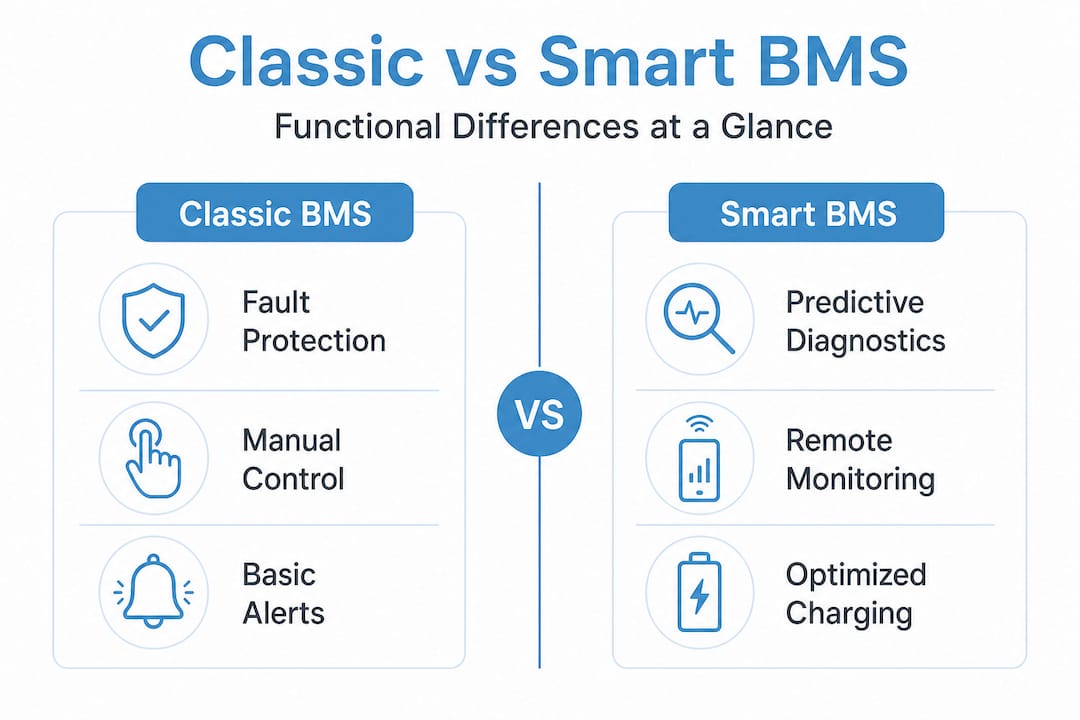
The shift from reactive to predictive is the critical one. A smart BMS does not just tell you that something has gone wrong. It identifies patterns that suggest something is about to go wrong, giving you time to act before a trip is cut short or a cell is lost.
BMS and off-grid independence are increasingly linked because of these diagnostic capabilities. Knowing your battery’s state of health before you leave home is fundamentally different to discovering a degraded cell mid-journey.
Integration with broader energy platform systems is also becoming more common. Smart BMS units communicate with MPPT charge controllers, DC/DC converters, inverter-chargers, and solar monitoring platforms, creating a coordinated energy ecosystem rather than a collection of independent components.
Steps to get the most from modern BMS features:
- Choose a BMS that is compatible with your existing components, particularly your inverter-charger and charge controller
- Enable remote monitoring via Bluetooth or the manufacturer’s app from day one
- Review diagnostic reports regularly, not just when something seems wrong
- Act on alerts promptly, even minor ones, as early intervention prevents escalation
- Update firmware when available to access improved algorithms and features
The role of BMS in energy storage has moved well beyond a passive safety device. It is now an active management tool that, when used correctly, extends battery life, maximises usable capacity, and supports confident off-grid operation.
Pro Tip: Opt for a BMS with an app or cloud dashboard. Even if you are not technically inclined, well-designed interfaces put critical information at your fingertips. You should be able to see your battery’s voltage, temperature, and state of charge at a glance, without needing to open an electrical panel.
Bringing it together: Practical benefits of having the right BMS in your vehicle
The real-world case for a quality BMS comes down to what it prevents and what it enables. Both matter equally for leisure vehicle owners who depend on their battery system for comfort, safety, and independence.
Consider a realistic UK example. A motorhome owner replaces an ageing lead-acid setup with a BMS-protected 200Ah lithium bank. The lithium chemistry alone increases usable capacity from roughly 50% depth of discharge to 80-90%, but it is the BMS that makes this possible safely. Without it, using that additional capacity risks permanent cell damage. With it, the full benefit is accessible. The result: two additional days off-grid on the same physical footprint.
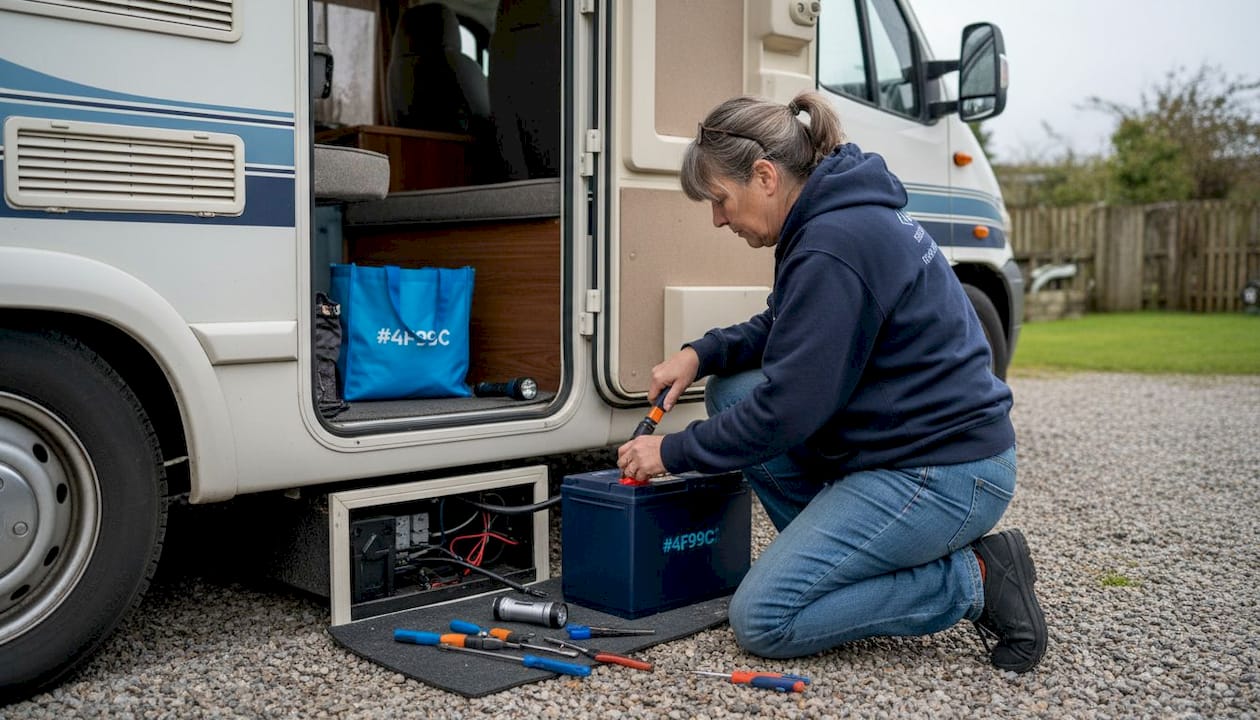
High-performance lithium batteries deliver their full potential only when paired with a BMS that is correctly configured for the application. Undersizing the BMS, mismatching communication protocols, or ignoring balancing specifications negates much of the advantage that lithium chemistry offers.
Research indicates that battery health monitoring with BMS directly supports life-cycle optimisation and reliability in stored energy solutions. In practical terms, this translates to up to 70% longer battery lifespan compared to unmanaged or poorly managed systems.
Concrete benefits of a well-specified BMS:
- Improved safety through thermal monitoring and automatic shutdown
- More usable energy via accurate SoC reporting and deep discharge prevention
- Protection against over-voltage during charging from solar or shore power
- Automated alerts before problems escalate to failures
- Simplified troubleshooting through detailed fault logs and cell-level data
- Extended battery life through cell balancing and cycle tracking
For real-world battery setups in UK vehicles, compatibility is a key selection criterion. Your BMS must communicate with your charge controller and inverter. Victron-compatible systems, for example, use VE.Direct or VE.Can protocols. SRNE systems use their own CANbus integration. Mixing incompatible protocols leads to loss of the coordinated control that makes smart systems valuable.
Quick checklist for choosing a BMS:
- Compatibility with your battery chemistry and cell configuration
- Communication protocol matching your inverter and charge controller
- Temperature monitoring range suitable for UK operating conditions
- User interface quality and app availability
- Manufacturer support and firmware update history
- Compliance with relevant UK and EU standards
Battery troubleshooting tips become far more straightforward when your BMS provides detailed fault history. Rather than guessing which component is causing a problem, you can review logs and identify the sequence of events leading to an issue.
Why leisure vehicle owners should rethink BMS priorities
There is a persistent pattern in the leisure vehicle community. Buyers spend significant time comparing battery brands, cell chemistries, and capacity figures. They will argue at length about LiFePO4 versus NMC chemistry or the merits of 100Ah versus 200Ah banks. Yet the BMS, which ultimately determines how safely and effectively those cells perform, is often selected as an afterthought or accepted as part of a bundled kit without scrutiny.
This is a misalignment of priorities. The cells define the potential of your battery system. The BMS determines how much of that potential is actually accessible, and for how long.
We have seen cases where a journey was cut short not because of battery failure in the traditional sense, but because a poorly configured BMS made a conservative fault call based on inaccurate temperature data. A calibrated, modern BMS with better sensor placement and configurable thresholds would have recognised the reading as a sensor anomaly rather than a genuine threat. The battery was fine. The BMS was not up to the job.
This is not an isolated scenario. As battery technology matures, the gap between a good BMS and a basic one is growing. Within the next five years, smart BMS capability will almost certainly be the most cited factor in long-term vehicle battery reliability. The trend is already visible in how manufacturers and integrators discuss system performance.
The deep dive on BMS impact supports this view clearly. The management layer is where system intelligence lives. Treating it as a secondary consideration is the single most common mistake in DIY and semi-professional leisure vehicle builds.
Invest in the BMS as seriously as you invest in the cells. Prioritise communication compatibility, diagnostic quality, and support availability. A well-chosen BMS will outlast multiple battery replacements and provide the data needed to manage each generation of cells more effectively than the last.
Upgrade your off-grid energy with advanced BMS solutions
Skyenergi supplies a range of BMS-ready systems and components designed for UK leisure vehicle applications, from campervans to motorhomes and marine setups. Whether you need a complete plug-and-play solution or individual components to upgrade an existing installation, the product range covers the full scope.

The complete inverter and battery system from the SRNE range integrates inverter-charging, battery-to-battery charging, and monitoring in a single turnkey package. For solar integration, the solar and charge controller kit pairs a 610W Victron solar panel with a Smart MPPT charge controller for efficient, monitored charging. System integrators working with Victron components will find the VE.Direct to RS232 interface useful for connecting Victron devices to external monitoring platforms. Contact Skyenergi directly for guidance on building a fully integrated, BMS-managed energy system for your vehicle.
Frequently asked questions
What happens if my BMS fails during a trip?
Failure can lead to loss of battery protection, posing risks of overcharging or deep discharging. As confirmed by planning guidance for BESS, a BMS enforces protective thresholds and triggers safe shutdowns when parameters are breached, so a failed BMS removes those protections entirely. Modern leisure vehicle systems often shut down key loads or alert you before serious damage occurs.
Can I retrofit a BMS into an old leisure vehicle battery setup?
Yes, most recent lithium setups support BMS retrofits, but compatibility and physical fit should always be confirmed with your supplier before purchasing.
What BMS features should I prioritise for safety?
Prioritise temperature monitoring, fault detection, automated shutdown, and remote alerting. NFCC guidance confirms that temperature detection and remote isolation are critical safety measures in lithium battery systems.
Do BMS work with both lithium and lead-acid batteries?
BMS are most essential and widely used with lithium batteries, but purpose-built versions do exist for advanced lead-acid setups where charge control and monitoring are required.
How does BMS contribute to longer battery life?
By keeping cells balanced, preventing unsafe charging or discharging, and detecting potential faults early, a BMS extends battery life significantly. Planning guidance for BESS confirms that BMS supports battery health monitoring, cycle efficiency, and lifecycle optimisation in stored energy solutions.
Recommended
Prev post

Marine energy storage explained: off-grid boating guide
Updated on 10 May 2026
Next post

Troubleshoot campervan power systems with confidence
Updated on 08 May 2026


