





Role of BMS in Energy Storage – Why It Matters
Role of BMS in energy storage, importance for lithium systems, Bluetooth monitoring, risks of mismanagement, and benefits for UK off-grid setups.
Every British campervan owner knows the hassle of unreliable power when living off-grid, yet over 80 percent of lithium battery failures are linked to poor management systems. With the rising demand for weekend escapes and long-term road adventures, securing dependable energy is more than just a convenience—it is safety and peace of mind. This article reveals how intelligent battery management systems can dramatically improve lithium battery performance, helping you travel further, stay longer, and maximise your energy independence.
Table of Contents
- Defining Battery Management Systems in Energy Storage
- Core Functions of BMS in Lithium Batteries
- Types of BMS Technologies and Monitoring Options
- Ensuring Safety and Battery Longevity Off-Grid
- Risks of Poor BMS Integration in Campervans
Key Takeaways
| Point | Details |
|---|---|
| Importance of BMS | A Battery Management System is crucial for ensuring safe and efficient operation of batteries in various applications, including campervans. |
| Core Functions | BMS monitors voltage, temperature, state of charge, and balances cells to optimise battery performance and longevity. |
| Types of BMS | Centralised, modular, and distributed BMS architectures offer different benefits for energy storage requirements based on scale and complexity. |
| Risks of Poor Integration | Inadequate BMS integration can lead to severe risks, including thermal runaway, premature battery degradation, and potential system failure. |
Defining Battery Management Systems in Energy Storage
A Battery Management System (BMS) represents the intelligent control centre for energy storage technologies, serving as a critical safeguard and performance optimisation mechanism. At its core, a BMS monitors and regulates battery performance across multiple complex parameters, ensuring safe and efficient operation in diverse applications from campervans to renewable energy systems.
The fundamental purpose of a BMS involves comprehensive battery health monitoring through continuous voltage and current tracking. This sophisticated electronic system performs several essential functions:
- Precise voltage monitoring for each battery cell
- Temperature regulation and thermal management
- State of charge estimation
- Cell balancing to prevent uneven degradation
- Protection against overcharging and deep discharge
- Real-time performance data collection and analysis
BMS technologies have become increasingly sophisticated, transforming how energy storage systems operate. By providing detailed battery lifecycle management, these systems can significantly extend battery lifespan and maintain optimal performance. Modern BMS platforms integrate advanced algorithms that predict potential failures, adjust charging parameters dynamically, and provide comprehensive insights into battery health.
Pro tip: When selecting a battery system for your campervan, always prioritise models with integrated Bluetooth monitoring capabilities, enabling real-time performance tracking and proactive maintenance.
Core Functions of BMS in Lithium Batteries
Battery Management Systems (BMS) serve as the critical neural network for lithium batteries, performing a complex array of sophisticated monitoring and protection functions. These intelligent electronic controllers are designed to ensure the optimal performance, safety, and longevity of lithium battery systems across various applications, from campervans to renewable energy installations.
The primary functions of a BMS encompass multiple layers of battery protection and performance optimisation. Advanced monitoring technologies enable comprehensive oversight through several key mechanisms:
- Precise voltage monitoring for individual battery cells
- Real-time temperature regulation across multiple zones
- Continuous current flow measurement and control
- Comprehensive state of charge (SOC) and state of health (SOH) assessment
- Protective mechanisms against electrical anomalies
- Cell balancing to prevent uneven battery degradation
Critical safety features form the backbone of BMS functionality. Electronic control units continuously track critical battery parameters, preventing potentially dangerous scenarios such as overcharging, overheating, and short-circuit conditions. By dynamically adjusting charging parameters and providing predictive maintenance insights, modern BMS technologies significantly extend battery lifecycle and maintain peak performance across challenging environmental conditions.

Pro tip: When selecting a lithium battery system for your campervan, prioritise models with multipoint temperature sensors and advanced cell balancing capabilities to ensure maximum reliability and longevity.
Types of BMS Technologies and Monitoring Options
Battery Management Systems (BMS) have evolved into sophisticated technologies with multiple architectural approaches designed to meet diverse energy storage requirements. Advanced BMS architectures represent critical innovations in battery performance and reliability, offering different configurations to address specific operational challenges.
Three primary BMS architectural approaches dominate current energy storage technologies:
-
Centralised BMS: - Single control unit managing entire battery pack
- Cost-effective for smaller systems
- Simple design with straightforward implementation
-
Modular BMS:
- Scalable architecture with independent monitoring modules
- Flexible configuration for varying battery pack sizes
- Enhanced redundancy and fault tolerance
-
Distributed BMS:
- Decentralised monitoring across individual battery cells
- Superior fault detection capabilities
- Optimal for complex, large-scale battery systems
Emerging monitoring technologies are transforming BMS capabilities through intelligent integration of artificial intelligence, machine learning, and Internet of Things (IoT) connectivity. These advanced systems provide real-time performance tracking, predictive maintenance insights, and unprecedented levels of battery health monitoring across various applications from campervans to renewable energy installations.
Here is a comparison of the main BMS architecture types and their ideal use cases:
| BMS Type | Key Characteristics | Typical Applications |
|---|---|---|
| Centralised | Single controller, basic fault detection | Small-scale storage, basic campervans |
| Modular | Scalable modules, strong redundancy | Medium-sized battery banks, fleets |
| Distributed | Cell-level monitoring, advanced diagnostics | Large, complex systems, renewable grids |
Pro tip: When selecting a BMS for your campervan, prioritise systems with IoT connectivity and multi-point temperature sensors to ensure comprehensive battery performance and longevity.
Ensuring Safety and Battery Longevity Off-Grid
Off-grid energy systems demand meticulous battery management to guarantee reliable performance and extended operational lifespan. Lithium-ion battery systems require comprehensive lifecycle management to mitigate potential risks and maximise energy storage efficiency in challenging environments like campervans and remote installations.
Critical safety considerations for off-grid battery systems encompass multiple strategic approaches:
- Precise thermal management to prevent overheating
- Continuous voltage and current monitoring
- Advanced protection against electrical anomalies
- Regular state-of-health diagnostics
- Environmental adaptation strategies
- Proactive maintenance protocols
Advanced battery management technologies have revolutionised off-grid energy storage by introducing sophisticated monitoring capabilities. These innovations enable real-time performance tracking, predictive maintenance, and intelligent protection mechanisms that significantly reduce the risk of thermal runaway and unexpected system failures. Modern BMS platforms integrate machine learning algorithms to provide unprecedented insights into battery health, allowing campervan owners to anticipate and prevent potential performance degradation.
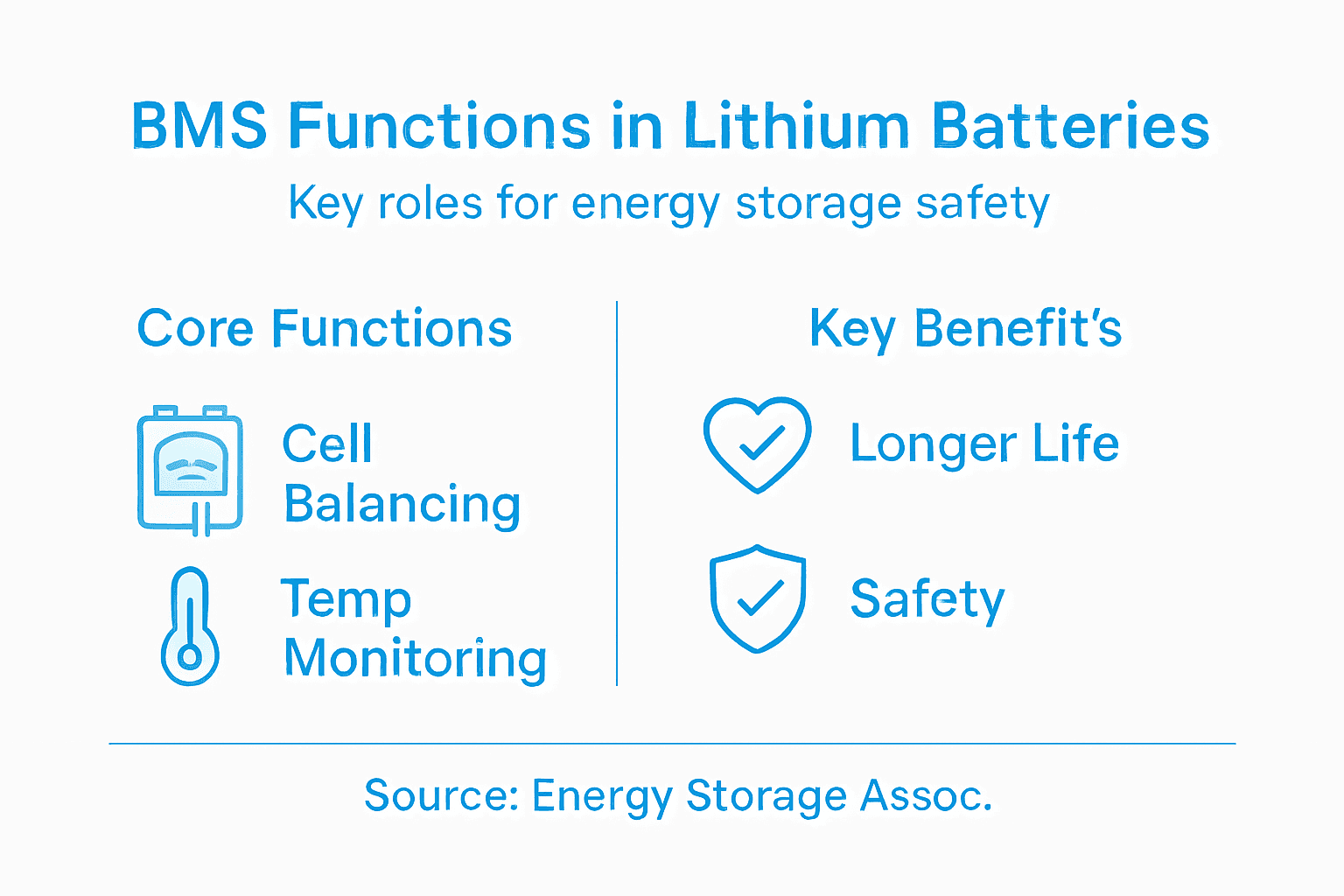
Pro tip: Install a battery management system with Bluetooth monitoring capabilities to track your battery’s performance in real-time and receive early warnings about potential issues during your off-grid adventures.
Risks of Poor BMS Integration in Campervans
Poor Battery Management System (BMS) integration represents a significant safety and performance risk for campervan electrical systems. Inadequate BMS implementation can transform a reliable power source into a potential hazard, compromising both vehicle functionality and user safety.
The primary risks associated with substandard BMS integration include:
- Uncontrolled thermal runaway
- Premature battery cell degradation
- Unpredictable power interruptions
- Reduced battery lifespan
- Increased fire risk
- Compromised electrical system reliability
- Potential electrical system failure
Campervan owners must recognise that battery management is far more complex than simply installing a battery. Each lithium battery pack requires sophisticated electronic monitoring to prevent cell imbalances, manage charging cycles, and maintain optimal operating temperatures. Without precise electronic management, lithium batteries can experience catastrophic failures that might result in complete power loss or potentially dangerous situations during remote travels.
Below is a summary of critical risks from poor BMS integration and their potential impacts in campervans:
| Risk Factor | Potential Impact on Campervan | Example Scenario |
|---|---|---|
| Thermal runaway | Fire outbreak, system destruction | Battery overheats during charging |
| Cell imbalance | Reduced capacity, premature failure | Inconsistent cell voltage readings |
| Electrical anomalies | Unreliable power delivery | Unexpected shutdown of appliances |
| Incompatible BMS hardware | Complete system failure, hazards | Incorrect BMS for battery chemistry |
Pro tip: Always verify the compatibility and quality of your Battery Management System before installation, ensuring it matches your specific battery chemistry and campervan electrical requirements.
Discover Reliable Battery Management Solutions for Safer Energy Storage
Managing lithium batteries without a precise Battery Management System can lead to safety risks like thermal runaway or premature battery failure as highlighted in the article. If you want to avoid unpredictable power interruptions and protect your investment, your campervan or off-grid system needs intelligent monitoring with cell balancing, temperature regulation and real-time performance tracking.

Skyenergi offers a comprehensive range of high-performance lithium batteries and off-grid power solutions designed with integrated Battery Management Systems, many featuring Bluetooth monitoring. Experience enhanced battery longevity, continuous safety, and effortless system integration with trusted products for campervans, motorhomes, and residential use. Take control of your energy independence today with Skyenergi and explore our carefully engineered solutions to keep your power reliable and safe. Visit our homepage, or learn more about battery technology with our product selection and expert advice to discover what fits your needs.
Frequently Asked Questions
What is a Battery Management System (BMS) and why is it important?
A Battery Management System (BMS) is an electronic control system that monitors and manages the performance of a battery pack. It ensures safe operation by regulating key parameters such as voltage, temperature, and state of charge, significantly extending battery lifespan and optimising performance across various applications.
How does a BMS improve battery safety?
A BMS enhances battery safety by implementing critical protection features such as monitoring for thermal runaway, preventing overcharging and deep discharges, and providing real-time performance data. These safety mechanisms help to mitigate risks associated with battery failures.
What types of BMS architectures are available for energy storage systems?
There are three primary BMS architectures: Centralised BMS, which uses a single control unit for the entire battery pack; Modular BMS, featuring independent monitoring modules for scalability; and Distributed BMS, which decentralises monitoring to individual cells for superior fault detection capabilities.
How can I ensure my off-grid battery system performs optimally?
To ensure optimal performance in an off-grid battery system, implement a BMS with comprehensive lifecycle management features. This includes precise thermal management, continuous monitoring of voltage and current, and proactive maintenance protocols to prevent potential failures.
Recommended
Prev post

Solar Battery Terms Explained: Power for Off-Grid Life
Updated on 09 January 2026
Next post

7 Types of Off-Grid Battery Systems for UK Campervans
Updated on 07 January 2026


