






The role of solar array capacity in off-grid systems
Discover the crucial role of solar array capacity in off-grid systems. Learn to optimize your setup for reliable, year-round energy.
Solar array capacity is defined as the total peak wattage a photovoltaic (PV) system can produce under Standard Test Conditions (STC), and it is the single most important variable in determining whether an off-grid system meets your energy demands year-round. The industry term is “installed peak capacity,” measured in kilowatts peak (kWp). Get this figure wrong and your batteries run flat in January. Get it right and your system runs reliably through the worst winter weeks. The role of solar array capacity extends beyond raw power output. It governs battery sizing, inverter selection, system efficiency, and the cost of any future expansion. This article covers how to calculate it correctly, how it interacts with storage, and why intentional oversizing often pays for itself.
How is solar array capacity calculated for off-grid systems?
Solar array sizing is calculated by dividing your daily energy load by the product of worst-month peak sun hours (PSH) and a system derate factor of roughly 0.75. That 0.75 accounts for real-world losses including dust accumulation, wiring resistance, heat derating, and inverter inefficiency. The formula is straightforward, but the inputs require care.
The calculation follows this sequence:
- Calculate your daily load in watt-hours. Add up every appliance, its wattage, and its daily hours of use. Sizing must account for all appliances, daily usage patterns, and system inefficiencies, not just the headline consumption figure.
- Find your worst-month PSH. Use a solar irradiance database such as PVGIS for your location. In the UK, worst-month PSH in December can drop to 1.0–1.5 hours in northern regions.
- Apply the derate factor. Divide your daily load by (worst-month PSH × 0.75) to get the required array size in watts.
- Convert to panel count. Divide the array size by the wattage of your chosen panel.
As a worked example: a daily load of 12,000 Wh with 3.5 PSH and 75% efficiency requires a 4.6 kW array. That translates to roughly ten 460 W panels. A typical off-grid family home in the US or equivalent UK setup needs 10–15 kW capacity and 50–80 kWh of LiFePO4 battery storage for adequate autonomy.
Sizing on annual average sunlight is a common and costly mistake. Worst-month irradiance must guide sizing to avoid system failure in winter, often requiring arrays 30–50% larger than an average-based calculation would suggest. That gap is not a buffer. It is the difference between a functional system and one that leaves you without power in February.

Pro Tip: Use PVGIS or the NASA POWER database to extract monthly irradiance data for your exact location. Never rely on regional averages from a brochure.
What is the relationship between solar array capacity and battery storage?
Array capacity and battery storage are interdependent. You cannot size one correctly without knowing the other. Battery size is determined by your daily load, your target days of autonomy, and the usable depth of discharge (DoD) of your chosen battery chemistry.
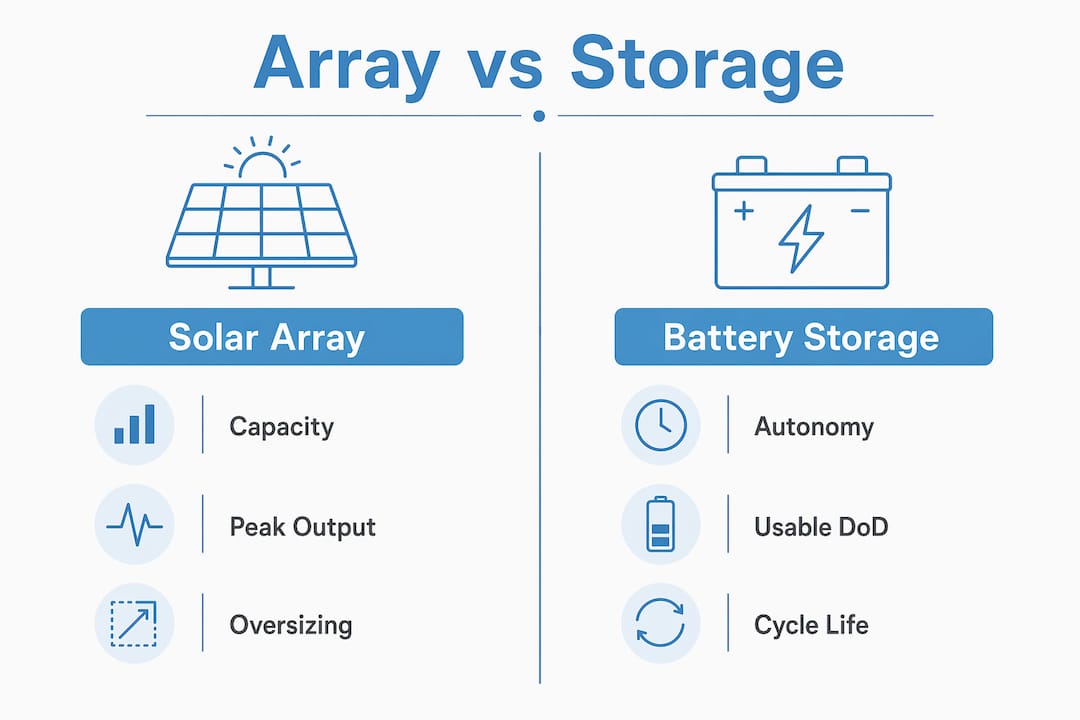
Industry standards recommend a minimum of three days of battery autonomy, with five days considered standard for year-round off-grid homes. For a 2 kWh per day load using LiFePO4 with three days of autonomy, battery sizing sits at approximately 7 kWh. That figure shifts significantly depending on battery type.
| Battery type | Usable DoD | Cycle life (approx.) | Impact on array sizing |
|---|---|---|---|
| LiFePO4 (lithium iron phosphate) | 85% | 3,000–6,000 cycles | Smaller array needed for same usable capacity |
| Lead-acid (AGM/GEL) | 50% | 500–1,200 cycles | Larger array needed; more frequent recharge required |
The array-to-battery ratio is a critical but often overlooked metric. An array-to-battery ratio below 1.2 risks inadequate recharge during poor weather, driving deep cycling that shortens battery lifespan. A ratio of 1.2 or higher is the recommended minimum for off-grid systems. In practice, slightly oversizing the array relative to the battery bank is one of the most cost-effective ways to extend battery life.
Key considerations for array-to-battery balance:
- LiFePO4 batteries accept higher charge rates, allowing faster recovery from overnight discharge.
- Lead-acid batteries require a more conservative charge profile, placing greater demand on the array during limited daylight hours.
- Undersizing the array forces the battery into repeated deep cycles, which shortens battery lifespan regardless of battery quality.
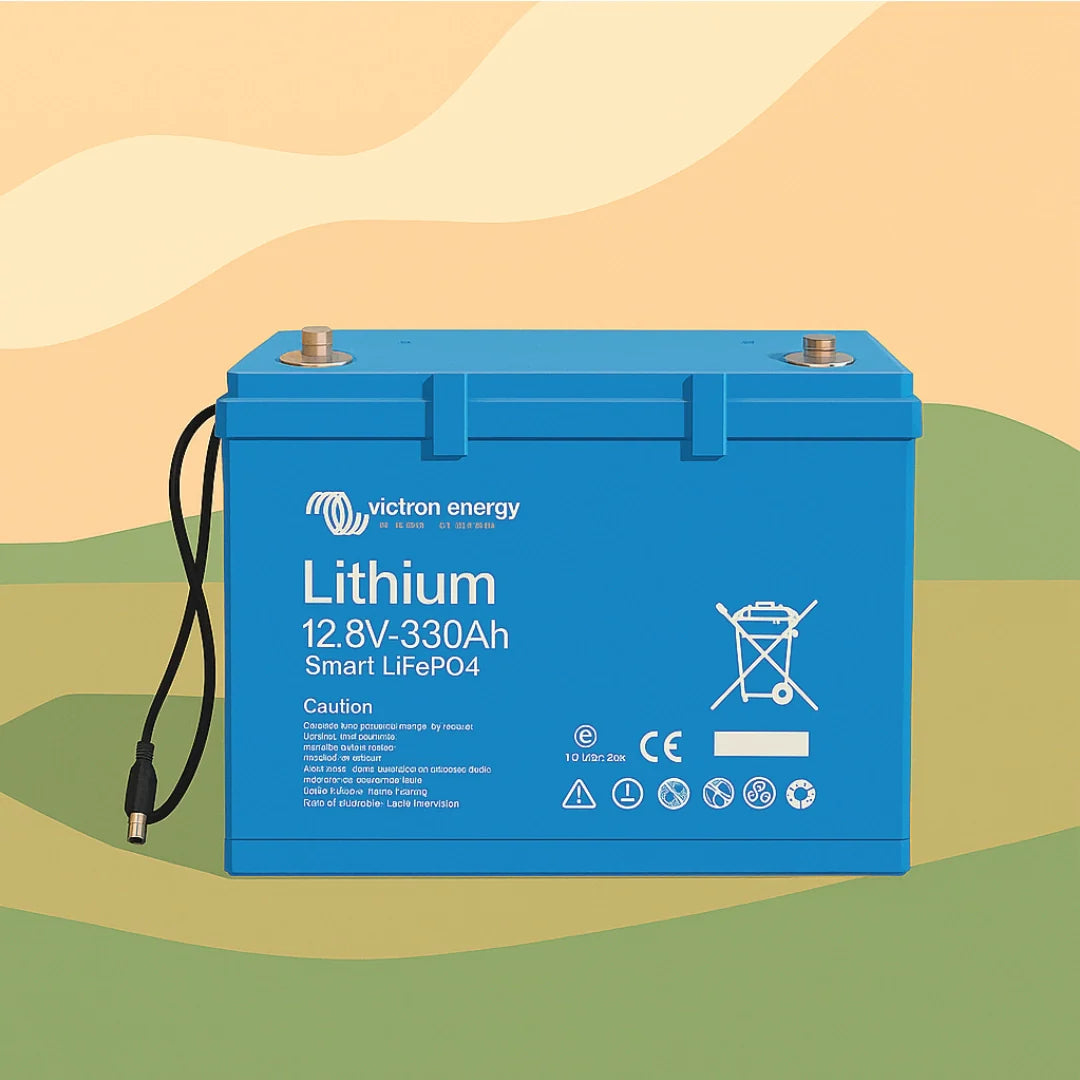
Understanding the benefits of lithium batteries for off-grid use makes the case for LiFePO4 clear: higher usable capacity from the same physical size means your array works more efficiently for every kilowatt-hour stored.
Pro Tip: When using LiFePO4, calculate your battery bank on 85% DoD. When using lead-acid, use 50%. Mixing these figures with the wrong chemistry is one of the most common sizing errors in off-grid builds.
Why oversizing solar array capacity is often worth it
Oversizing a solar array is defined as installing more peak capacity than your current daily load strictly requires. This is not poor planning. It is deliberate future-proofing, and the economics support it strongly.
Oversizing is cost-effective when you anticipate future additions such as EV chargers or heat pumps, because adding panels during the initial installation costs significantly less than a separate retrofit project. Electrification trends including EVs and heat pumps within a five-year horizon make oversizing at build stage a financially sound decision for most households.
There are additional technical reasons to oversize beyond load growth:
- Module degradation. Monocrystalline panels degrade at approximately 0.77% per year, polycrystalline at around 0.36%. Over a 25-year system life, a monocrystalline array loses roughly 17% of its original output. Building in a capacity buffer at installation offsets this without requiring panel replacement.
- DC:AC ratio optimisation. DC solar arrays are typically oversized 10–30% over inverter AC rating to improve inverter efficiency. This means the inverter operates at or near its rated output for more hours per day, improving overall daily energy yield even if some midday power is clipped.
- Seasonal resilience. A larger array recovers battery banks faster after overcast periods, reducing the number of consecutive low-charge days.
The cost argument against oversizing is usually framed around panel cost per watt. In 2026, solar panel prices have fallen to the point where the incremental cost of adding 20–30% more capacity at installation is modest relative to the long-term performance gains. If you are already paying for scaffolding, mounting hardware, and an installer’s time, the marginal cost of additional panels is low.
For off-grid campervans and motorhomes, where roof space is the binding constraint rather than budget, oversizing means selecting higher-efficiency monocrystalline panels to maximise output per square metre rather than simply adding more panels.
How does solar array capacity affect system efficiency and energy management?
Solar array performance is not measured by peak output alone. The performance ratio (PR) is the standard metric: it compares actual energy output to the theoretical maximum, expressed as a percentage. Well-designed off-grid systems typically achieve a PR of 75–85%. Poor cable sizing, shading, or mismatched components pull this figure down.
Inverter clipping at high DC:AC ratios can distort standard performance ratio metrics, but clipping-corrected PR metrics now allow accurate assessment of real system performance. This matters because a system with a DC:AC ratio of 1.3 will show apparent clipping losses on paper while delivering better daily energy yield than a perfectly matched system. The metric must match the design intent.
| DC:AC ratio | Clipping risk | Inverter efficiency gain | Recommended use case |
|---|---|---|---|
| 1.0 | None | Minimal | Grid-tied, stable irradiance |
| 1.1–1.3 | Low to moderate | Significant | Off-grid, variable UK irradiance |
| Above 1.4 | High | Diminishing returns | Not recommended for most systems |
Energy management in off-grid systems with surplus generation requires a strategy. Options include diverting excess power to an immersion heater via a power diverter relay, charging secondary battery banks, or simply accepting curtailment. Smart battery system features such as Bluetooth monitoring and programmable charge profiles allow you to manage surplus intelligently rather than wasting it.
“As solar capacity penetration increases, the role of capacity shifts towards managing grid constraints and integrating storage for surplus daily generation.” pv magazine USA, 2026
This observation applies directly to off-grid systems at a smaller scale. Once your array consistently produces more than your battery can absorb, the design challenge shifts from generation to management.
Key takeaways
Solar array capacity determines system reliability, battery longevity, and long-term energy independence. Size it on worst-month peak sun hours, not annual averages, and build in a buffer for degradation and future loads.
| Point | Details |
|---|---|
| Size on worst-month PSH | Use December irradiance data for UK systems to avoid winter shortfalls. |
| Apply the 0.75 derate factor | Account for heat, dust, wiring, and inverter losses in every calculation. |
| Maintain array-to-battery ratio above 1.2 | Ratios below 1.2 cause deep cycling and reduce battery lifespan. |
| Oversize for degradation and future loads | Module degradation and EV charging demand make initial oversizing cost-effective. |
| Monitor performance ratio | Use clipping-corrected PR metrics for high DC:AC ratio systems to assess real output. |
Sizing solar arrays: what I have learned from real off-grid builds
Having worked through off-grid system designs ranging from single-panel campervan setups to multi-kilowatt residential installations, the pattern that causes the most problems is consistent: people size on average annual sunlight and then wonder why their batteries are flat every January.
The worst-month rule is not conservative. It is correct. I have seen systems sized on 4.0 PSH annual average that needed a full generator backup through December and January because the actual December PSH at their location was 1.2. That is not a minor shortfall. It is a system that does not function as designed for two months of the year.
The second lesson is about oversizing. The instinct to minimise upfront cost is understandable, but the maths rarely support it over a ten-year horizon. Adding two or three extra panels at installation costs a fraction of what a retrofit costs once the roof is done and the cables are run. If there is any chance of adding an EV charger or a heat pump within five years, size for it now. The residential off-grid system types that hold up best over time are the ones where the designer thought about year five, not just year one.
The third point is about battery chemistry. LiFePO4 changes the sizing maths significantly. The 85% usable DoD versus 50% for lead-acid means you need a smaller physical battery bank for the same autonomy, which in turn means your array recharges it faster. The whole system becomes more efficient. If you are still sizing around lead-acid assumptions, revisit the numbers.
— John
Build a reliable off-grid array with Skyenergi

Skyenergi supplies the components needed to put these sizing principles into practice. The Victron 610 W solar panel with smart MPPT charge controller bundle gives you high-output monocrystalline panels paired with Victron’s MPPT technology, which maximises energy harvest across variable UK irradiance conditions. The smart MPPT controller integrates directly with Victron battery monitors and GX devices, giving you real-time performance data and precise charge control. Whether you are building a campervan system or a residential off-grid setup, Skyenergi stocks the panels, controllers, and LiFePO4 battery options to match your calculated array size. Explore the full range and configure your system today.
FAQ
What does solar array capacity mean?
Solar array capacity is the total peak power output of a PV system under Standard Test Conditions, measured in kilowatts peak (kWp). It defines the maximum electricity the system can generate and is the starting point for all off-grid system sizing.
Why use worst-month peak sun hours for sizing?
Sizing on annual average sunlight underestimates winter shortfalls. Worst-month irradiance must guide sizing to prevent system failure in low-light months, often requiring arrays 30–50% larger than average-based calculations suggest.
What array-to-battery ratio should I target?
An array-to-battery ratio of 1.2 or higher is recommended for off-grid systems. Ratios below 1.2 risk insufficient recharge during poor weather, causing deep battery cycling and reduced lifespan.
How does panel degradation affect long-term capacity?
Monocrystalline panels degrade at approximately 0.77% per year, meaning a 10 kWp array loses around 1.7 kWp over 25 years. Building a capacity buffer at installation compensates for this without requiring panel replacement mid-system life.
What is inverter clipping and does it reduce efficiency?
Inverter clipping occurs when DC array output exceeds the inverter’s AC rating. At DC:AC ratios of 1.1–1.3, clipping causes minor midday losses but improves overall daily energy yield by keeping the inverter at peak efficiency for longer periods.
Recommended
Prev post

Battery bank design: a practical guide for DIY builds
Updated on 13 June 2026
Next post

Energy storage upgrade ideas for leisure and off-grid
Updated on 11 June 2026


