






How BMS powers off-grid energy independence: 85% of failures
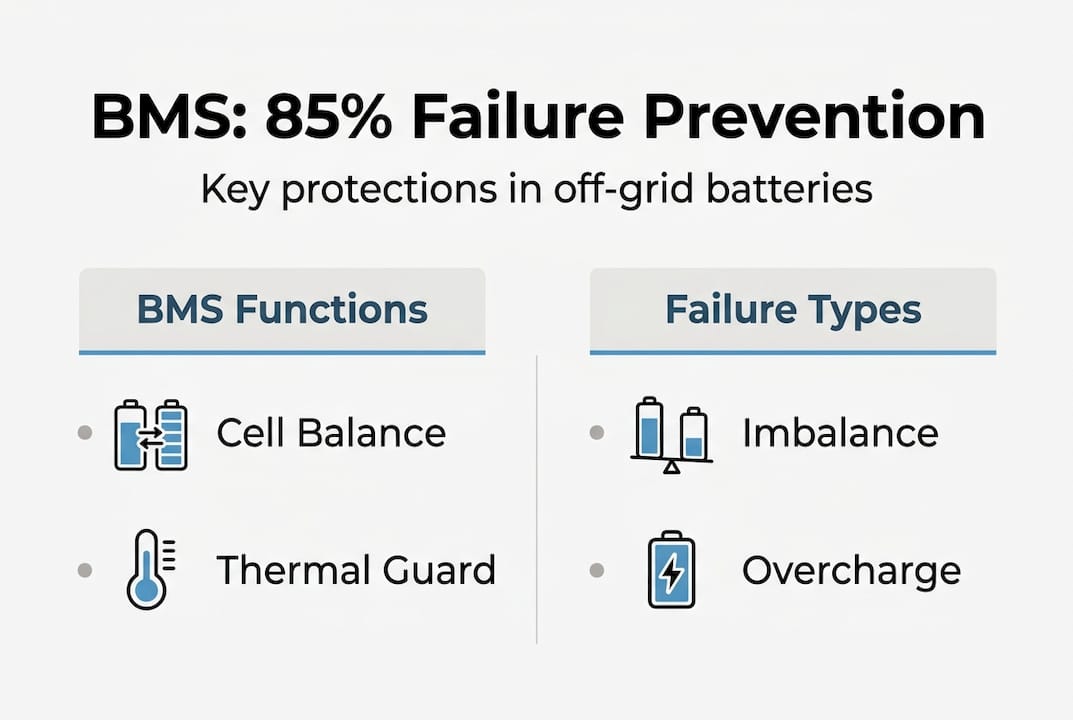
85% of off-grid battery failures stem from BMS issues, not cell quality. Learn how to configure, tune, and monitor your BMS for reliable UK leisure vehicle power.
TL;DR:
- Most off-grid battery failures are due to poor BMS configuration, not cell quality.
- A well-tuned BMS protects cells from overcharge, over-discharge, thermal stress, and faults, extending battery life.
- Adjusting BMS settings and ensuring proper integration is crucial for reliable, long-lasting leisure off-grid systems.
Most campervan and motorhome owners assume battery failures come down to a dodgy cell or a cheap brand. The reality is quite different. 85% of off-grid failures trace back to poor Battery Management System configuration, not the battery itself. A BMS is the control layer sitting between your cells and the rest of your electrical system. Get it right, and your lithium battery bank becomes a genuinely reliable power source. Get it wrong, and even the most expensive cells will let you down at the worst possible moment. This article covers what a BMS does, why it matters for UK leisure vehicles and off-grid setups, and how to configure one properly.
Table of Contents
- What is a BMS and why does it matter off-grid?
- Core functions of BMS in off-grid and leisure vehicle systems
- Balancing cells and extending battery lifespan
- Optimising and tuning your BMS for real-world use
- A fresh perspective: Why most off-grid battery issues start with BMS, not the battery
- Where to find top BMS-ready off-grid solutions
- Frequently asked questions
Key Takeaways
| Point | Details |
|---|---|
| BMS is essential | The battery management system is the key technology for battery safety, performance, and energy independence off-grid. |
| Integration matters | A properly integrated BMS coordinates with inverters, chargers, and solar controllers to prevent common faults. |
| Tune for real life | Factory BMS settings are rarely perfect; adjusting them for your usage and climate unlocks more capacity and reliability. |
| Cell balancing extends life | Active cell balancing ensures every cell delivers optimal power and dramatically increases battery lifespan in demanding off-grid systems. |
What is a BMS and why does it matter off-grid?
A Battery Management System is the electronic circuit responsible for monitoring and protecting your battery pack. It sits between the cells and the external circuit, reading data continuously and stepping in when something goes wrong. Without one, lithium cells are genuinely dangerous. They do not tolerate overcharge or deep discharge the way lead-acid batteries do.
A BMS monitors voltage, current, temperature, SOC, and SOH across every cell in your pack. SOC stands for state of charge. SOH stands for state of health. These two metrics tell you how much energy is available right now and how much capacity the pack retains over its lifetime.
The core protections a BMS provides include:
- Overcharge protection: Cuts off charging when cell voltage reaches its upper limit
- Over-discharge protection: Disconnects loads before cells drop below a safe minimum voltage
- Overcurrent protection: Trips the circuit if current draw exceeds the rated limit
- Thermal protection: Shuts down charging or discharging when temperature goes outside safe bounds
- Short-circuit protection: Responds in milliseconds to prevent catastrophic cell damage
For UK leisure vehicle owners, these BMS safety functions are not optional extras. British winters push temperature cutoffs to their limits. Variable solar input from UK skies means charging profiles fluctuate constantly. Without proper protection, cells degrade rapidly or fail entirely.
“The BMS is the brain of any off-grid energy system. Without it, you are not managing your battery, you are gambling with it.”
A well-configured BMS also contributes to longer battery life by preventing the micro-damage that accumulates from repeated over-discharge or thermal stress. The BMS protection importance cannot be overstated in systems where you are relying on stored energy for days at a time, far from a mains connection.
Common battery failure modes that a BMS directly prevents include cell imbalance, thermal runaway, and cumulative over-discharge damage. Each of these is avoidable with the right configuration.
Core functions of BMS in off-grid and leisure vehicle systems
A BMS does more than protect individual cells. In a properly integrated system, it acts as the coordinator between your battery bank, inverter, charger, and solar controller. When a fault occurs, the BMS does not just disconnect the battery. It signals the inverter to stop drawing power and alerts the charger to pause. This coordinated response is what BMS integration with inverters and chargers achieves in practice.
| BMS function | Why it matters off-grid |
|---|---|
| Voltage monitoring | Prevents overcharge and deep discharge in variable solar conditions |
| Current limiting | Protects cells during high-demand loads like inverters and compressor fridges |
| Temperature management | Critical for UK winters where charging below 0°C damages LiFePO4 cells |
| State of charge tracking | Accurate SOC prevents unexpected shutdowns mid-trip |
| Cell balancing | Equalises voltages to maintain full pack capacity over time |
| Fault signalling | Communicates with inverters and chargers to coordinate safe shutdown |
When a fault is detected, a typical BMS response follows this sequence:
- Detect the fault condition (overvoltage, undervoltage, overcurrent, or thermal event)
- Disconnect the relevant circuit (load side, charge side, or both)
- Log the fault event with timestamp and parameters
- Send an alert via CAN bus, RS485, or Bluetooth to the monitoring system
- Wait for the fault condition to clear before allowing reconnection
Bluetooth monitoring is particularly useful in leisure battery setups where the battery bank is mounted under a bed or in a locker. You can check cell voltages, SOC, and fault history from your phone without opening a hatch.
For more complex off-grid battery systems, the BMS communicates over CAN bus or RS485 with the inverter-charger. Victron BMS integration via VE.Bus is a well-documented example of this coordinated architecture.
Pro Tip: Before commissioning any UK lithium battery system, verify that your BMS communicates directly with your inverter-charger. A BMS that only disconnects the battery without signalling the inverter can cause voltage spikes that damage both components.
Balancing cells and extending battery lifespan
Cell balancing is one of the most underappreciated functions of a BMS. Even cells from the same manufacturing batch will develop slightly different capacities over time. Under repeated charge and discharge cycles, these small differences grow. The weakest cell in the pack reaches its voltage limit first, triggering a premature shutdown before the rest of the pack is depleted.
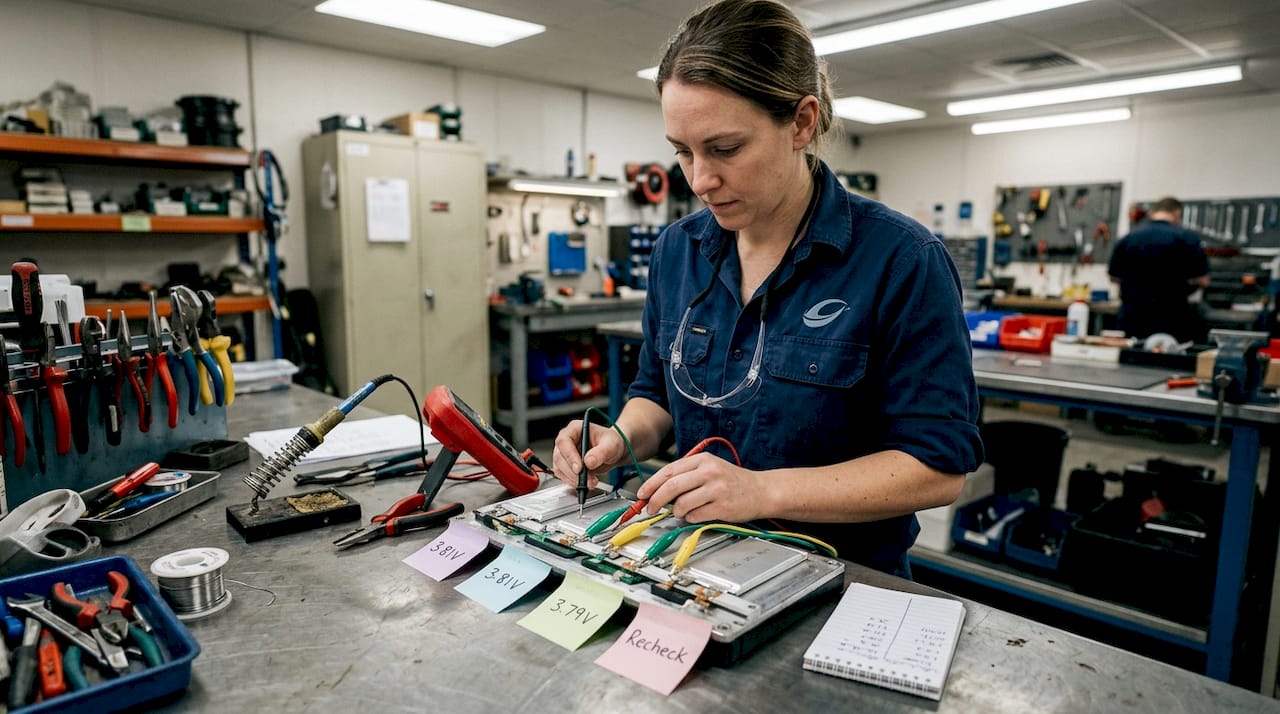
Cell balancing by BMS equalises voltages across all cells, preventing capacity loss that would otherwise accumulate silently over months of use.
| Balancing type | How it works | Cost impact | Efficiency |
|---|---|---|---|
| Passive balancing | Bleeds excess energy from higher-voltage cells as heat | Lower cost | Some energy wasted |
| Active balancing | Transfers energy from stronger cells to weaker ones | Higher cost | More efficient, less heat |
For most lithium battery setups in campervans and motorhomes, passive balancing is adequate. Active balancing becomes worthwhile in larger packs with higher cycle counts.
Symptoms of inadequate cell balancing include:
- Premature low-voltage shutdowns at what appears to be 30 to 40% SOC
- Reduced runtime compared to the battery’s rated capacity
- One cell consistently reaching full charge before the others
- Accelerated capacity fade over 12 to 18 months
- Unexpected BMS trips during moderate loads
For UK users, the ability to extend battery life through consistent balancing is directly tied to winter resilience. Cold temperatures reduce available capacity. A well-balanced pack retains more usable energy at low temperatures than an unbalanced one of the same nominal capacity. The cell balancing explained principles apply equally to leisure batteries and residential storage systems.
Optimising and tuning your BMS for real-world use
Factory default BMS settings are a starting point, not a finished configuration. Manufacturers set conservative cutoffs to cover a wide range of use cases and protect themselves from warranty claims. In practice, these defaults often cause problems in real-world off-grid scenarios.
Voltage sag is the most common culprit. Under heavy loads, cell voltage drops temporarily below the resting voltage. If your BMS cutoff is set too tight, this transient sag triggers a shutdown even though the battery still has usable capacity. Adaptive tuning unlocks up to 35% more capacity by accounting for this behaviour.
Empirical results from adaptive BMS tuning are striking. Outages dropped from several per month to zero, usable capacity rose from 60% to 95% of rated capacity, and LiFePO4 lifespan extended by two to three times compared to systems running factory defaults.
Follow this sequence when tuning your BMS:
- Record your actual load profile. Note peak current draw from your inverter, fridge, and any other high-draw appliances
- Measure cell voltage under load. Compare resting voltage to voltage under your peak load
- Set your low-voltage cutoff 0.1 to 0.15V below your minimum loaded voltage to avoid nuisance trips
- Check cell delta at full charge. A delta above 20mV indicates a balancing issue to address before tuning cutoffs
- Adjust temperature cutoffs for your climate. Set low-temperature charge cutoff at 5°C for UK winters to protect LiFePO4 cells
- Perform a full charge cycle monthly to recalibrate SOC and allow the balancer to equalise cells
For your installation workflow, document your settings before and after tuning. This creates a baseline for future diagnostics.
Pro Tip: When following solar setup tips for UK leisure vehicles, always cross-reference your MPPT controller’s absorption voltage with your BMS high-voltage cutoff. Leave at least 0.2V of margin between the two to prevent the BMS from interrupting the charge cycle prematurely.
A fresh perspective: Why most off-grid battery issues start with BMS, not the battery
There is a persistent belief in the leisure vehicle community that buying a premium-branded cell solves reliability problems. It does not. A high-quality LiFePO4 cell with a poorly configured BMS will underperform a mid-range cell with a properly tuned one. 85% of failures trace back to BMS configuration, not cell defects.
What experience consistently shows is that most real-world faults, unexpected shutdowns, apparent capacity loss, and inverter trips, are BMS configuration issues. The cell is fine. The settings are not.
UK users should prioritise systems with adaptable, monitorable BMS over those with impressive cell specifications and a locked firmware. Bluetooth visibility matters. The ability to adjust cutoffs matters. A BMS you cannot read or tune is a liability, regardless of the brand name on the cell.
Proactive diagnosis using your BMS data is the most effective maintenance strategy available. Check your off-grid checklist regularly and treat BMS logs as the primary diagnostic tool, not a secondary one.
Where to find top BMS-ready off-grid solutions
For UK leisure vehicle owners ready to build or upgrade a properly integrated off-grid system, Skyenergi supplies vetted, BMS-integrated solutions designed for real-world British conditions.

The complete off-grid system from Skyenergi includes a 3kVA inverter-charger, battery-to-battery charger, and monitoring, all pre-configured to work together. For Victron-based builds, the Victron EasySolar-II integrates MPPT, inverter-charger, and GX monitoring in a single unit with full BMS communication. Solar panel bundles including the Victron panel and controller are also available, with Bluetooth-enabled MPPT controllers that coordinate directly with compatible BMS units.
Frequently asked questions
What does a BMS actually do in an off-grid system?
A BMS continuously monitors cell voltage, current, temperature, SOC, and SOH and disconnects charging or loads when any parameter exceeds safe limits. It is the primary protection layer between your battery cells and the rest of the system.
Do I need to adjust BMS settings or is factory default fine?
Factory defaults are conservative and often cause nuisance shutdowns or limit usable capacity. Cutoff tuning beyond factory settings can improve usable capacity by up to 35% and significantly reduce fault events.
Why does my inverter disagree with the BMS’s state of charge reading?
SOC estimation drifts approximately ±1% per week between the BMS and inverter without periodic full-charge recalibration. A monthly full charge cycle corrects this drift and keeps both readings accurate.
Is cell balancing really that important for leisure batteries?
Yes. Cell balancing equalises voltages across the pack, preventing premature shutdowns and capacity loss that accumulates over years of off-grid cycling. It is particularly important for UK users who rely on the battery through winter months with reduced solar input.
Recommended
Prev post

Energy storage checklist for UK leisure vehicles 2026
Updated on 04 April 2026
Next post

Install lithium campervan batteries: UK step-by-step guide
Updated on 02 April 2026


