





Lead Acid Battery Disadvantages for Campervans
Lead acid battery disadvantages for campervans explained. Discover why lithium beats lead acid on weight, DoD, and lifespan. Find the right upgrade today.
Table of Contents
- Why Lead Acid Batteries Struggle in Campervans
- Leisure Battery Depth of Discharge: Where Lead Acid Falls Short
- Weight, Space and Payload: The Physical Cost of Lead Acid
- Charging, Voltage Drop and Cold Weather Performance
- Maintenance, Ventilation and Environmental Disposal
- SRNE Solar Charge Controller Compatibility with Lithium Systems
- Skyenergi Lithium Battery Benefits: Total Cost of Ownership
- Conclusion
Last Updated: August 11, 2026
Why Lead Acid Batteries Struggle in Campervans
Lead acid batteries are familiar and cheap, but for modern campervan electrical systems, that is where their advantages end. At Skyenergi, we work with campervan converters and off-grid enthusiasts across the UK, and the same frustrations emerge repeatedly: appliances cutting out, batteries needing replacement every couple of seasons, and electrical systems that cannot keep pace with actual van usage. These problems trace back to the fundamental chemistry of lead acid, AGM, and gel battery designs, which impose hard limits on depth of discharge, weight, charging behaviour, cold weather performance, and maintenance requirements.
Below, we examine each of these constraints and how SRNE solar charge controllers and Skyenergi lithium batteries address them directly, giving you a clear picture of the real cost of running lead acid in a campervan.
Leisure Battery Depth of Discharge: Where Lead Acid Falls Short
Depth of discharge (DoD) is the percentage of a battery's total capacity you can safely use. For lead acid, the practical DoD limit sits at around 50%. Discharge deeper than that repeatedly, and sulphation accelerates, plates degrade, and cycle life drops sharply.
How Restricted DoD Cuts Your Usable Capacity
A 100Ah lead acid leisure battery does not give you 100Ah of usable capacity, it gives you approximately 50Ah. To match the usable capacity of a 100Ah lithium battery, you would need to install twice the amp-hours of lead acid, compounding every other disadvantage: weight, space, and cost.

The Peukert effect adds another layer of inefficiency. Lead acid batteries lose effective capacity as discharge rate increases. Running a high-draw appliance like a compressor fridge pulls current faster than the rated capacity, meaning the battery delivers even less usable energy than the 50% DoD rule suggests.
Cycle Life and Long-Term Cost
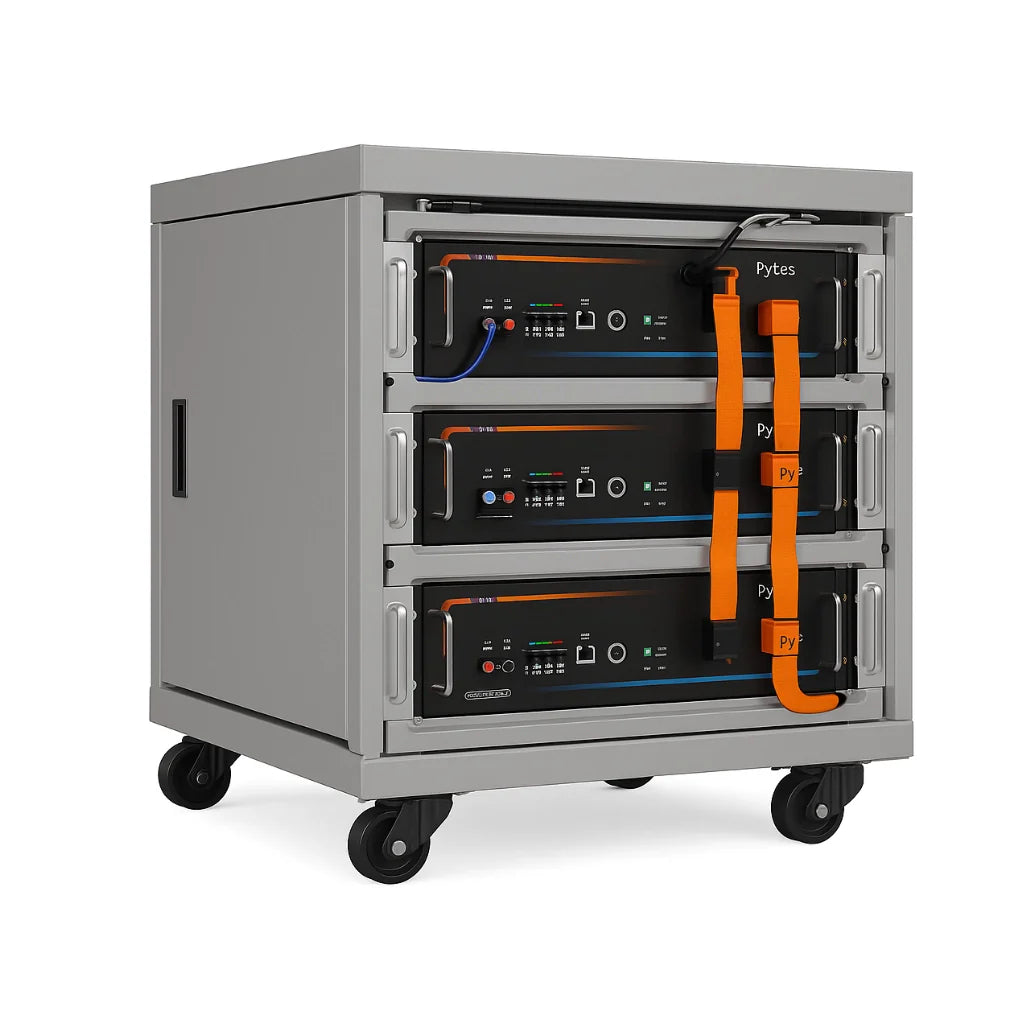
A typical AGM or gel battery delivers between 300 and 500 full cycles at 50% DoD before capacity degrades to the point of replacement. Lithium Iron Phosphate cells, by contrast, are rated for thousands of cycles at 80% DoD. The Skyenergi Core 460Ah battery is rated for up to 8,000 cycles at 80% DoD, a fundamentally different lifespan expectation.
For a campervan used regularly throughout the year, replacing lead acid every two to three seasons is a real cost that rarely appears in initial purchase comparisons. The total cost of ownership calculation looks very different once you account for replacement frequency.
Weight, Space and Payload: The Physical Cost of Lead Acid
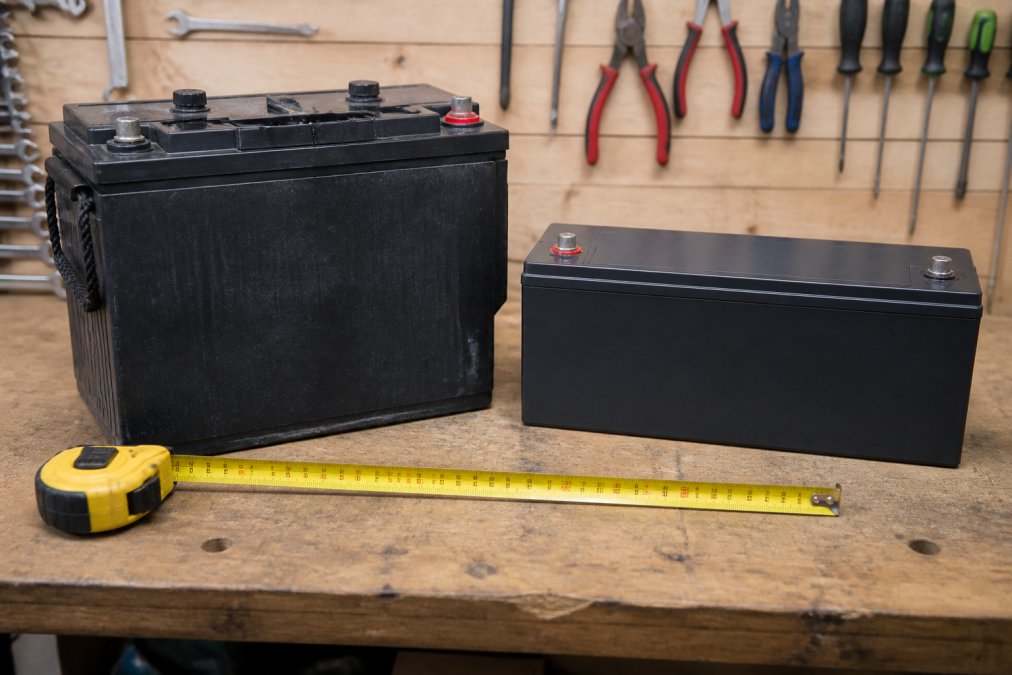
A standard 100Ah AGM leisure battery weighs around 26-30kg. A comparable 100Ah lithium battery typically weighs 10-13kg. For a van running a 200Ah battery bank, that difference is 30-40kg of additional payload, weight that could be used elsewhere or simply reduce fuel consumption and vehicle wear.
Weight-to-Power Ratio Analysis
Because usable capacity is capped at roughly 50% DoD, the effective energy density of lead acid is approximately half what its nameplate capacity suggests. Consider this comparison:
| Battery Type | Rated Capacity | Usable Capacity (at safe DoD) | Typical Weight | Weight per Usable Ah |
|---|---|---|---|---|
| Flooded Lead-Acid | 100Ah | ~50Ah | ~28kg | ~560g/Ah |
| AGM | 100Ah | ~50Ah | ~27kg | ~540g/Ah |
| Gel Battery | 100Ah | ~50Ah | ~26kg | ~520g/Ah |
| LiFePO4 Lithium | 100Ah | ~95Ah | ~11kg | ~116g/Ah |
The weight-to-power ratio for lithium is roughly four to five times better than lead acid on a usable capacity basis. Physical dimensions compound the issue: lead acid batteries are bulky relative to their usable output, consuming significantly more under-bed or seat box space.
Charging, Voltage Drop and Cold Weather Performance
Lead acid batteries do not accept charge at a constant rate. The absorption phase at high states of charge can be slow, particularly from solar input on overcast days. A solar charge controller feeding a lead acid battery bank will spend a disproportionate amount of time in absorption mode, reducing the effective energy harvested from available sunlight.
Cold Weather Performance Degradation
Cold weather performance is a genuine weakness of lead acid chemistry. As temperatures drop towards 0°C and below, available capacity can fall by 20-30% compared to rated capacity at 25°C. At temperatures approaching -10°C, capacity loss becomes severe enough to affect basic appliance operation. Charging a deeply discharged lead acid battery in sub-zero conditions also risks electrolyte freezing in flooded designs, which can crack the case and destroy the battery.
Lithium Iron Phosphate batteries experience less capacity reduction in cold conditions. Skyenergi's Core 460Ah battery addresses this directly with an integrated heat pad, which maintains cell temperature in cold weather and allows safe charging below 0°C, a meaningful practical advantage for year-round van life in the UK.

Voltage Drop and Appliance Reliability
As a lead acid battery discharges, its terminal voltage drops progressively. A 12V lead acid battery at 50% state of charge may measure 12.1V or lower under load. Many 12V appliances, particularly compressor fridges and inverters, have low-voltage cutoffs that trigger before the battery is fully discharged, causing fridges to cut out and inverters to shut down.
Lithium Iron Phosphate batteries maintain a much flatter voltage profile across their discharge cycle, staying close to 13.2-13.3V through most of the discharge range. Appliances run more consistently, and the battery management system handles the final cutoff cleanly.
Maintenance, Ventilation and Environmental Disposal
Flooded lead-acid batteries require regular maintenance: electrolyte levels need checking and topping up with distilled water, typically every one to three months. Terminals are prone to corrosion from acid vapour, and cleaning terminals and applying protective grease is a routine task.
Sealed AGM and gel batteries eliminate the electrolyte maintenance requirement, but they still off-gas hydrogen during charging. Any lead acid battery in an enclosed van installation requires ventilation to the outside to prevent hydrogen accumulation, requiring a dedicated vent path and restricting where the battery can be positioned.
Lead acid batteries are classified as hazardous waste under the UK Waste Batteries and Accumulators Regulations, and disposal must follow specific requirements. Replacing a lead acid battery bank every two to three seasons means dealing with this process repeatedly.
Lithium Iron Phosphate batteries require responsible end-of-life disposal, but their longer lifespan means the disposal cycle is far less frequent. LiFePO4 chemistry does not contain cobalt, making it one of the less environmentally problematic lithium chemistries.
SRNE Solar Charge Controller Compatibility with Lithium Systems
One practical barrier to switching from lead acid is whether existing solar and charging equipment will work with a lithium battery bank. SRNE solar charge controller compatibility is directly relevant here.
SRNE charging systems are designed with configurable charging profiles that support LiFePO4 lithium chemistry. The SRNE SAA 3-in-1 MPPT Charge Controller integrates MPPT solar charging, DC-to-DC alternator charging, and AC mains charging in a single unit, with built-in Bluetooth for monitoring via the SRNE mobile app. The charging profile can be set to match LiFePO4 voltage parameters, which differ from the bulk and absorption voltages used for lead acid.
Using a lead acid charging profile on a lithium battery will result in undercharging or overcharging. An SRNE controller with the correct LiFePO4 profile ensures the battery bank is charged to the correct voltage ceiling and avoids the prolonged absorption phase that lead acid requires, resulting in faster, more efficient charging from both solar and alternator sources.
The SRNE SAA 3-in-1 also reduces installation complexity considerably by replacing three separate charging devices with a single unit, simplifying wiring, reducing failure points, and providing unified monitoring. For a DIY van conversion, that reduction in complexity has real value.
Skyenergi Lithium Battery Benefits: Total Cost of Ownership
The upfront price of a lithium battery is higher than an equivalent lead acid unit. The question is what happens over three, five, or ten years of use.
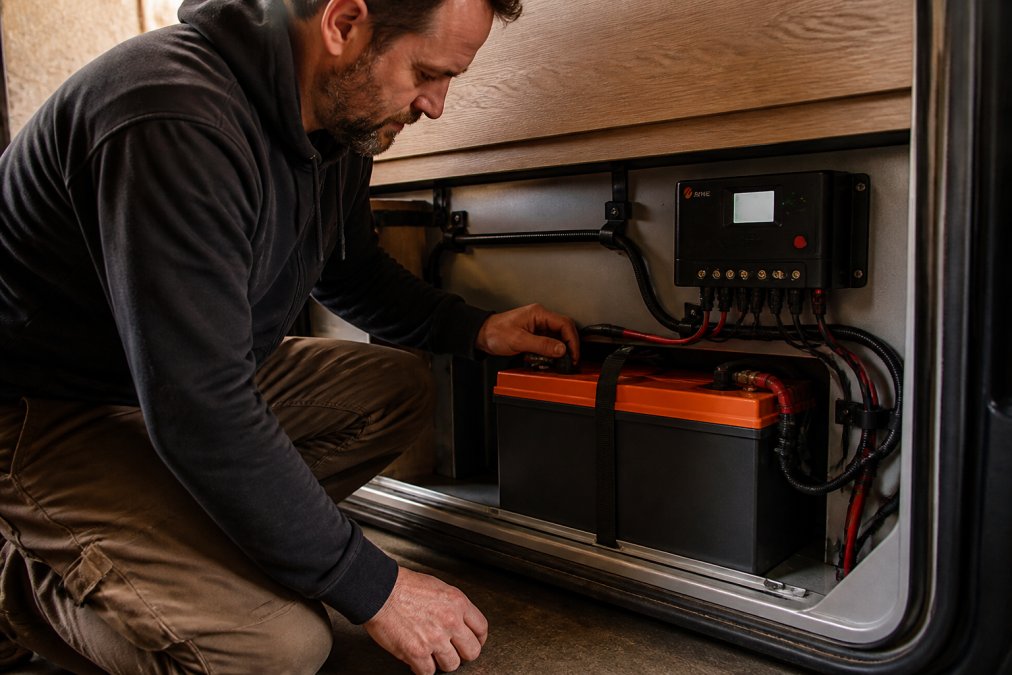
Skyenergi's Edge and Core ranges are built on LiFePO4 cells with advanced Battery Management Systems that protect against overcharge, over-discharge, short circuit, and thermal events. The BMS handles state of charge management automatically, removing the need for manual monitoring that flooded lead acid demands. A Skyenergi lithium battery used in a campervan has a realistic service life measured in years, not seasons.
The maintenance-free nature of sealed lithium batteries also removes the time cost of electrolyte checks, terminal cleaning, and ventilation management. For professional installers building systems for clients, that reduction in post-installation maintenance calls has direct commercial value.
Choosing the Right Skyenergi Battery for Your Van
Selecting the right battery depends on your energy audit: how much power you consume daily, how many days of autonomy you want without charging input, and the physical space available in your build.
| Battery | Capacity | Best For |
|---|---|---|
| Skyenergi Edge 100Ah Lithium Leisure Battery | 100Ah | Entry-level builds, smaller vans, supplementary banks |
| Skyenergi Edge 280Ah Lithium Leisure Battery | 280Ah | Full-time van life, medium consumption systems |
| Skyenergi Elite 304Ah Smart Lithium Leisure Battery - Victron Can-Bus | 304Ah | Advanced systems, Victron CAN-bus integration |
| Skyenergi Core 460Ah Lithium Leisure Battery - Bluetooth & Heat-Pad | 460Ah | High-capacity builds, extended off-grid use, cold climates |
For most single-battery builds replacing a 100Ah lead acid setup, the Edge 100Ah delivers more usable capacity, less weight, and a longer service life from day one. Vans running a fridge, lighting, and USB charging full-time will typically be better served by the Edge 280Ah or the Elite 304Ah, which includes Victron CAN-bus compatibility for integration with Victron inverter chargers and monitoring systems.

The Core 460Ah with integrated Bluetooth and heat pad is the correct choice for extended off-grid use, particularly for year-round use where cold weather performance matters. The heat pad prevents the BMS from blocking charging in sub-zero conditions, a practical issue for anyone leaving their van parked in cold conditions between trips.
Correctly sizing your leisure battery bank to your actual consumption is the single most important step in building a reliable off-grid electrical system. An undersized battery bank, regardless of chemistry, will always disappoint.
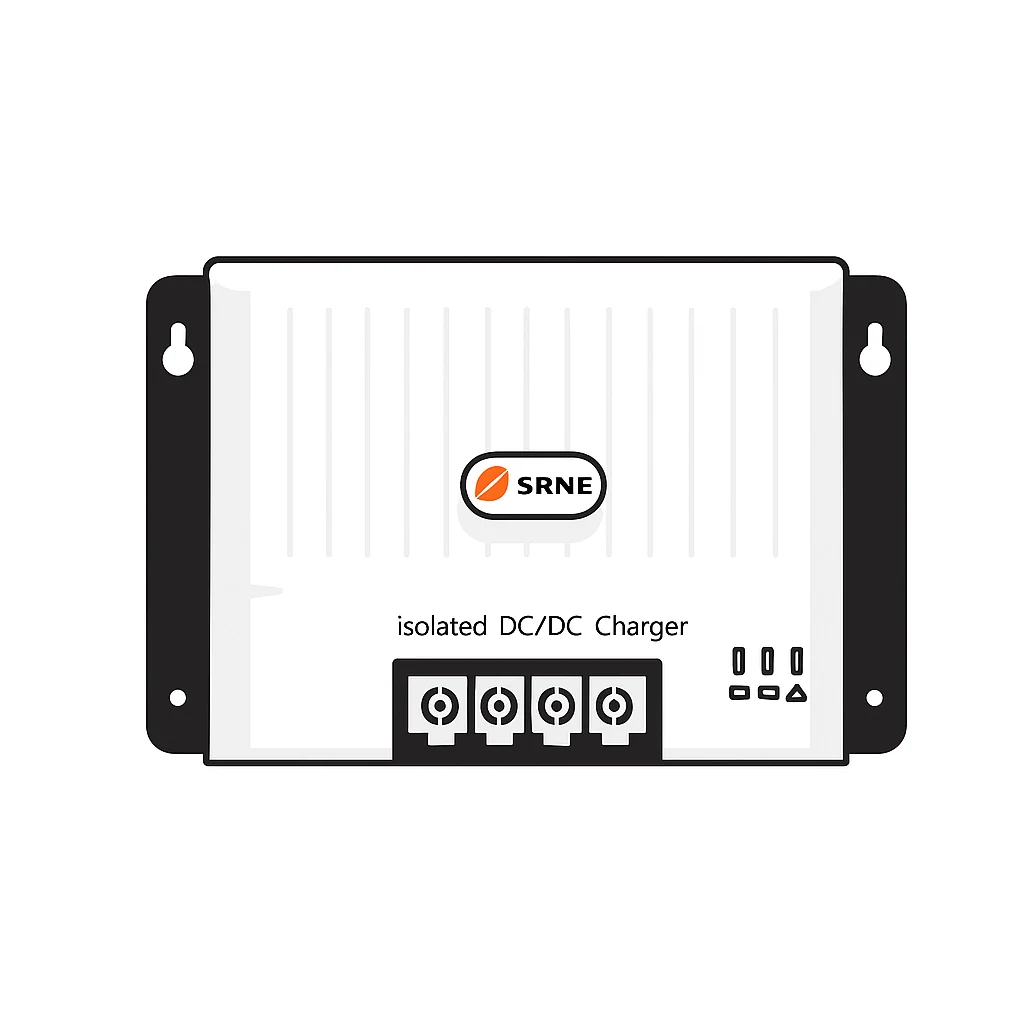
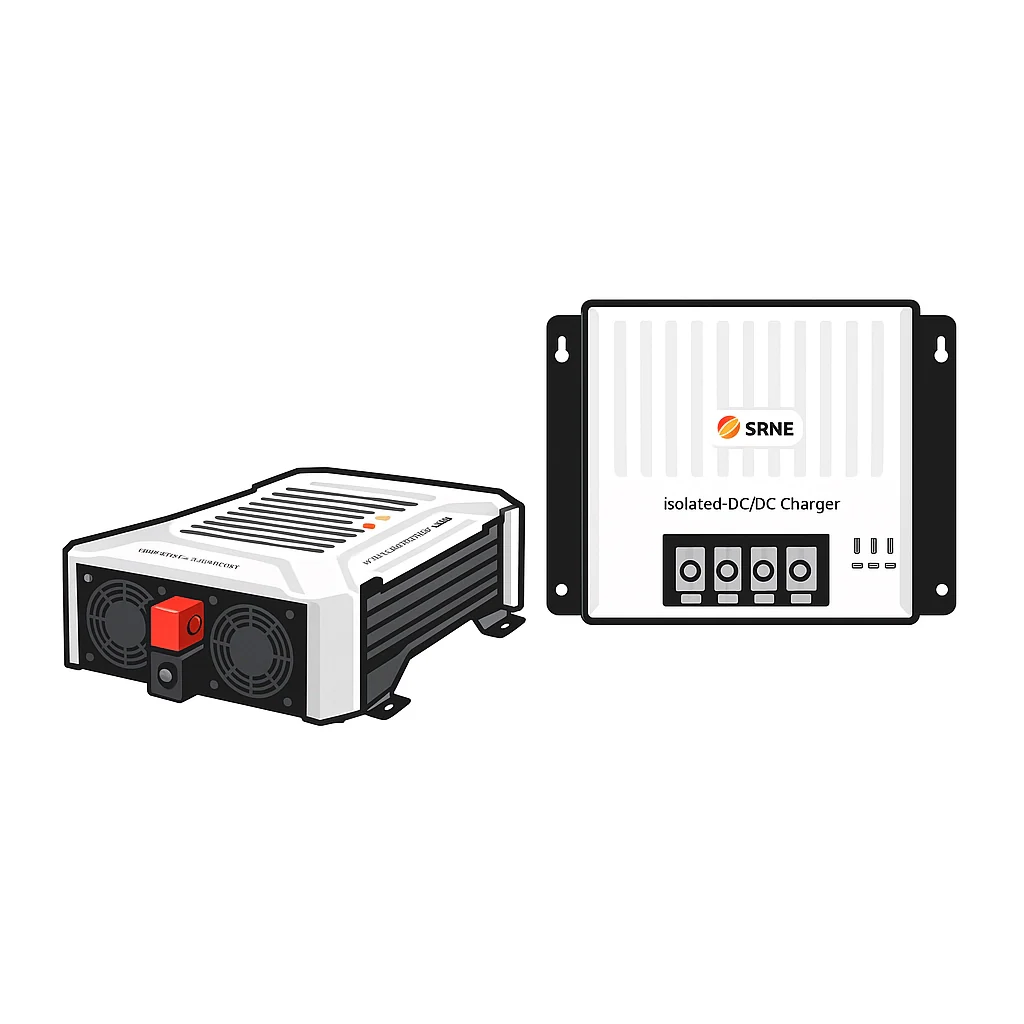
The core problem with a lead acid battery in a modern campervan is not that it fails to work, but that it works poorly relative to what lithium technology now offers. Skyenergi's Edge and Core lithium batteries, paired with SRNE solar charge controllers and DC-to-DC chargers, provide a complete electrical system that addresses every practical limitation covered in this guide. Build an off-grid power system that actually keeps up with how you use your van.
Frequently Asked Questions
What are the main disadvantages of using a lead acid battery in a campervan?
Lead acid batteries limit you to around 50% depth of discharge before damage occurs, meaning a 100Ah battery delivers only about 50Ah of usable capacity. They are significantly heavier than lithium alternatives, reducing your payload. They require ventilation to manage hydrogen off-gassing, need periodic maintenance on flooded types, and suffer accelerated capacity loss in cold weather. Cycle life is typically 300-500 cycles, making them considerably more expensive over time than their lower upfront price suggests.
How does depth of discharge affect a lead acid leisure battery's lifespan?
Regularly discharging a lead acid battery below 50% state of charge causes sulphation on the lead plates, permanently reducing capacity. Discharging to 80% depth of discharge can cut cycle life to fewer than 200 cycles. By contrast, LiFePO4 lithium batteries tolerate 80-100% depth of discharge without the same degradation, delivering far more usable amp-hours per cycle and extending overall lifespan to 2,000-8,000 cycles depending on the model.
Do lead acid batteries need special ventilation in a campervan?
Yes. Flooded lead acid batteries produce hydrogen gas during charging, which is flammable and requires dedicated ventilation to the outside of the vehicle. AGM and gel batteries off-gas far less but still need adequate airflow. This requirement takes up space and adds installation complexity. Lithium LiFePO4 batteries do not produce hydrogen during normal operation, removing the ventilation requirement and giving you more freedom over where you mount your battery bank.
What is the average lifespan of a lead acid leisure battery in a campervan?
A lead acid leisure battery used regularly in a campervan typically lasts two to four years, delivering 300-500 charge cycles under normal use. Frequent deep discharges or poor charging profiles shorten this considerably. A quality LiFePO4 lithium battery, such as those in the Skyenergi Edge and Elite ranges, is rated for 2,000 to 8,000 cycles, meaning the same battery can realistically last ten or more years in a well-managed electrical system.
This article was written using GrandRanker
Prev post

How Long Do Lithium Batteries Last: A Guide
Updated on 12 August 2026
Next post

SRNE RV Solar Systems: The Complete UK Guide
Updated on 10 August 2026


