





Why battery expandability matters for UK leisure vehicles
Discover why expandable lithium batteries offer UK leisure vehicle owners superior flexibility, cost savings, and energy independence for off-grid adventures compared to fixed battery setups.
Many leisure vehicle owners in the UK invest heavily in a single large battery, only to find their energy needs change within a year or two. Fixed battery setups lock you into a capacity that may prove too small for extended off-grid trips or unnecessarily large for weekend jaunts. Expandable lithium systems offer a smarter alternative, letting you start with modest capacity and add modules as your energy demands evolve. This approach matches your investment to real-world usage, avoiding the costly guesswork of predicting future power requirements for UK adventures.
Table of Contents
- Key takeaways
- Understanding battery expandability: scalability and savings
- How parallel connection works for lithium battery expandability
- Balancing the pros and cons: cost, performance, and practicalities
- Maximising your energy independence with expandable batteries
- Explore expandable energy solutions at Skyenergi
- Frequently asked questions
Key Takeaways
| Point | Details |
|---|---|
| Modular expansion | Expandable lithium systems let you start small and add identical modules in parallel as energy needs grow. |
| Parallel wiring safety | Connecting identical modules in parallel ensures balanced charging and safer operation. |
| Higher usable capacity | Lithium batteries offer substantially higher usable capacity and far longer cycle life than lead acid. |
| Upfront cost tradeoff | Initial prices are higher, but longer lifespan and flexible sizing can offset the expense over time. |
Understanding battery expandability: scalability and savings
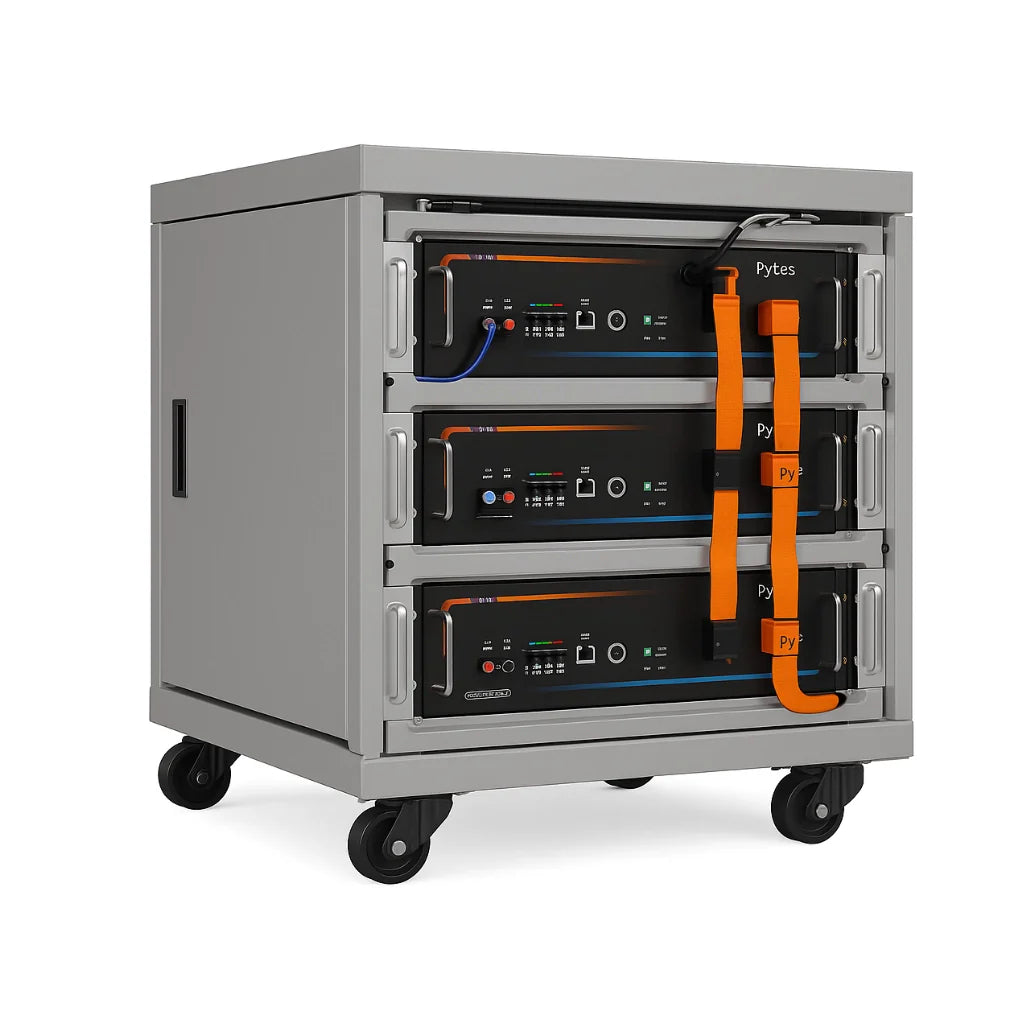
Battery expandability refers to the ability to increase your energy storage capacity incrementally by connecting additional modules in parallel. Rather than committing to a large fixed battery pack from the outset, you can begin with a modest 100Ah LiFePO4 unit and add identical modules as your solar array expands or your energy consumption patterns change. This modular approach delivers several practical advantages for UK leisure vehicle owners seeking off-grid independence.
Expandable systems avoid the large initial investment required for oversized battery banks. You match capacity precisely to your current needs, then scale up when you add appliances, extend trip durations, or install additional solar panels. This flexibility proves especially valuable for new campervan converters who are still discovering their energy usage patterns through real-world travel.
Lithium batteries provide inherent advantages that make expandability more practical than with lead-acid technology. Expandable systems provide 80-100% usable capacity versus 50% for lead-acid, 50-60% weight savings, and 2000-5000 cycles versus 200-500, enabling longer off-grid autonomy with less physical space and weight penalty. A 200Ah lithium bank weighs roughly 25kg compared to 60kg for equivalent lead-acid capacity, freeing up precious payload allowance in your leisure vehicle.
Consider a practical example: you start your campervan conversion with a single 100Ah LiFePO4 battery paired with 200W of solar panels. After six months of weekend trips, you decide to extend to week-long Scottish Highlands adventures and add a 12V fridge. You simply purchase another identical 100Ah module, connect it in parallel, and double your capacity to 200Ah without replacing your original battery. As your solar array grows to 400W, you can add a third module for 300Ah total storage.
Pro Tip: Always purchase identical battery modules from the same manufacturer to ensure safe parallel operation and maintain system reliability. Mixing different capacities, ages, or chemistries creates voltage imbalances that reduce performance and lifespan. For more guidance on expandable energy storage systems in the UK, explore detailed installation workflows. Understanding the benefits of lithium batteries for off-grid living helps you make informed capacity decisions.
How parallel connection works for lithium battery expandability
Connecting lithium batteries in parallel increases total capacity while maintaining system voltage. Parallel connection involves connecting positive-to-positive and negative-to-negative terminals of identical batteries, fully charging them first to less than 0.05V difference using bus bars and heavy cables. This method ensures even current distribution across all modules and prevents capacity loss from voltage imbalances.
Follow these steps for safe parallel wiring:
- Fully charge each battery individually to minimise voltage differences before connection.
- Measure voltage across all batteries with a multimeter, ensuring differences stay below 0.05V.
- Connect all positive terminals together using a copper bus bar or heavy gauge cable.
- Connect all negative terminals together using a separate bus bar or cable.
- Use cables rated 25-35mm² to handle high currents safely and reduce voltage drop.
- Secure all connections tightly to prevent resistance and heat buildup.
- Test the combined bank voltage before connecting to your inverter or charge controller.
Matching battery capacity, age, and chemistry before adding modules is essential. Mixing a new 100Ah battery with a two-year-old 100Ah unit creates voltage differences that force the newer battery to work harder, reducing its lifespan. Similarly, combining different capacities such as 100Ah and 200Ah units causes uneven charge and discharge rates that degrade both batteries prematurely.
Bus bars and thick cables handle the increased current safely as you scale capacity. A single 100Ah battery might draw 50A during heavy loads, but a four-module 400Ah bank can pull 200A or more. Undersized cables create voltage drop and heat, wasting energy and risking fire hazards. Quality copper bus bars distribute current evenly across all modules while minimising resistance.
| Configuration | Total capacity | Usable energy (80% DoD) | Typical applications |
|---|---|---|---|
| 2 x 100Ah | 200Ah | 160Ah (2048Wh at 12.8V) | Weekend trips, basic lighting and charging |
| 4 x 100Ah | 400Ah | 320Ah (4096Wh at 12.8V) | Extended off-grid, fridge, heating, laptops |
Pro Tip: Fully charge each battery to within 0.05V of existing modules before parallel wiring to prevent capacity loss and improve longevity. Even small voltage differences cause one battery to discharge into another, wasting energy and creating heat. For detailed guidance on energy storage installation workflow for UK campervans, consult professional installation resources. Understanding the complete energy storage system workflow for campervans ensures safe and efficient expansion.
Balancing the pros and cons: cost, performance, and practicalities
Choosing expandable lithium battery systems involves weighing upfront investment against long-term flexibility and performance. The following table compares key factors between expandable lithium and fixed lead-acid batteries for UK leisure vehicles.
| Factor | Expandable lithium | Fixed lead-acid |
|---|---|---|
| Upfront cost | £800-1200 per 100Ah | £300-400 per 100Ah |
| Cycle life | 2000-5000 cycles | 200-500 cycles |
| Weight (200Ah) | 25kg | 60kg |
| Usable capacity | 80-100% | 50% |
| Charger requirements | Lithium-compatible | Standard |
| Expandability | Add identical modules | Replace entire bank |
High upfront cost of 2-3 times lead-acid and charger upgrades are needed, worth it for frequent off-grid use but overkill for EHU sites where fixed packs offer simpler installation. The initial investment barrier deters some leisure vehicle owners, yet the 10-year-plus lifespan and superior performance offset expenses for those who regularly venture off-grid. Frequent wild campers and full-time vanlifers recoup costs within three to five years through extended battery life and reduced replacement frequency.
Practical considerations extend beyond purchase price:
- Lithium-compatible chargers and solar controllers prevent damage from incorrect charging profiles.
- Battery management systems with active balancing ensure safe operation and longevity.
- Victron, Renogy, and CTEK offer suitable lithium chargers for UK leisure vehicles.
- Upgrading existing lead-acid chargers adds £200-500 to initial conversion costs.
- BMS monitors cell voltages, temperatures, and charge states to protect batteries.
Weather impact matters for UK conditions. Cold weather reduces LiFePO4 capacity by 20% at -10°C and requires lithium-compatible chargers and solar controllers to avoid damage. Lead-acid suffers worse performance drops of 50% at similar temperatures, making lithium the better choice for Scottish winter trips or Alpine ski adventures. Modern LiFePO4 batteries include low-temperature charge protection that prevents damage when temperatures fall below freezing.
Expandable lithium systems suit specific use cases best. Frequent off-grid travellers who regularly spend weeks away from mains hookup benefit most from the capacity flexibility and performance advantages. Those planning to add solar panels, inverters, or high-draw appliances over time appreciate the ability to scale battery capacity without replacing their entire system. Conversely, occasional weekend campers who primarily use electric hookup sites may find fixed lead-acid batteries adequate and more economical.
For guidance on making the right choice, explore why you should choose lithium over lead-acid for your specific travel patterns and energy requirements.
Maximising your energy independence with expandable batteries
Selecting and maintaining expandable lithium batteries requires attention to compatibility, planning, and ongoing monitoring. Use this checklist when choosing expandable lithium batteries for your UK leisure vehicle:
- Same model and manufacturer across all modules to ensure voltage matching.
- Compatible BMS with active balancing to prevent cell degradation.
- IP65 waterproofing rating for UK weather conditions and condensation protection.
- Verified parallel capability supporting up to 16 units for future expansion.
- Bluetooth monitoring for real-time voltage, current, and temperature tracking.
- CE and UKCA certification confirming safety standards compliance.
Plan your expansion strategy by calculating current and anticipated energy consumption. List all appliances with their power ratings and daily usage hours, then multiply by 1.3 to account for inverter losses and inefficiency. Match your solar panel output to battery capacity, aiming for enough generation to fully recharge your bank during typical UK daylight hours. Size your inverter to handle peak loads from simultaneous appliance use, adding 20% headroom for startup surges.
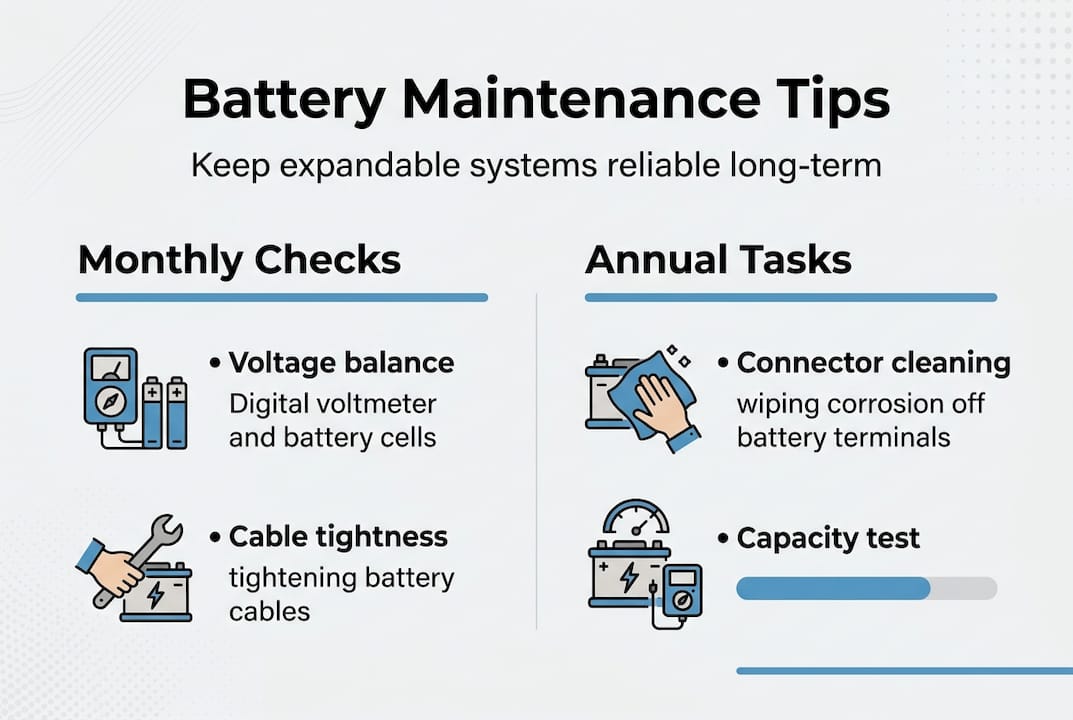
Maintenance tips ensure long-term reliability and performance. Monitor battery voltage differences between modules monthly using your BMS app or multimeter, investigating any variance exceeding 0.1V. Avoid charging below 0°C without low-temperature protection, as lithium plating damages cells permanently. Use suitable lithium chargers with correct voltage profiles, typically 14.4V bulk and 13.6V float for LiFePO4 chemistry. Keep firmware updated on your BMS to benefit from improved balancing algorithms and safety features.
Pro Tip: Consider modular turnkey kits that simplify installation and future capacity increases, saving time and avoiding compatibility issues between components. Pre-matched systems eliminate guesswork around cable sizing, fuse ratings, and component compatibility. For practical guidance, review how battery capacity matches energy needs for different travel styles. Comprehensive information on energy storage for campervans helps you plan effective system upgrades.
Monitor your energy usage trends through your BMS or battery monitor over several trips to identify patterns. If you consistently drain your battery bank below 30% remaining capacity, plan to add another module before your next extended adventure. Conversely, if you rarely drop below 60% capacity, you may have adequate storage for current needs and can delay expansion until usage patterns change.
Explore expandable energy solutions at Skyenergi
Now that you understand why and how battery expandability enhances off-grid independence, Skyenergi offers practical solutions tailored for UK leisure vehicles. Our modular expandable lithium battery systems pair seamlessly with Victron inverter/charger units and solar panels designed for parallel expansion. The Solar Power Electrics System with 3kVA inverter charger provides a complete turnkey solution including battery-to-battery charging and monitoring.
For larger residential or marine installations, the Victron EasySolar II 48/5000 combines inverter, charger, and MPPT solar controller in one integrated unit. Match your battery expansion with our Victron 610W solar panel kit featuring smart MPPT charge controllers and mounting hardware. Expert support guides you through system sizing and installation, ensuring your expandable setup delivers reliable performance for years of UK adventures.
Frequently asked questions
What causes lithium battery capacity loss in parallel setups?
Voltage differences above 0.2V between modules or mixing different battery ages and capacities cause up to 15% capacity loss and create safety risks. Mismatched batteries force stronger units to discharge into weaker ones, generating heat and accelerating degradation. Always use identical modules charged to within 0.05V before connecting in parallel to maintain full capacity and longevity.
How do I safely add additional lithium battery modules?
Fully charge new modules to within 0.05V of existing modules before connecting them. Connect all positive terminals together using quality copper bus bars, then connect all negative terminals separately. Use heavy gauge cables rated 25-35mm² to handle increased current safely and ensure even distribution across all modules.
Is an expandable lithium battery system worth the cost?
Higher upfront cost compared to lead-acid is offset by 10-plus years lifespan and improved energy independence for frequent off-grid users. The flexibility to add capacity as needs evolve avoids costly full system replacements. Occasional users relying primarily on electric hookup sites may find the investment less beneficial due to limited usage justifying the premium price.
What maintenance do expandable lithium batteries require?
Regularly monitor voltage differences between modules using your BMS app, investigating any variance exceeding 0.1V that suggests imbalance. Avoid charging below 0°C without battery protection to prevent lithium plating damage. Use lithium-compatible chargers with correct voltage profiles and keep BMS firmware updated for optimal balancing and safety features.
Recommended
Prev post

Off-grid solar installation guide for UK leisure vehicles
Updated on 23 March 2026
Next post

Best 6 Solar Battery Systems for Campervans 2026
Updated on 21 March 2026


