







Why monitoring battery health ensures reliable off-grid power
Discover why monitor battery health is crucial for reliable off-grid power. Learn to prevent breakdowns and extend battery life for your adventures.
TL;DR:
- Battery health involves capacity retention, internal resistance, and cycle stability, not just voltage.
- Monitoring tools detect parasitic drains, charging faults, and capacity loss early, preventing failures.
- Using shunt-based monitors and BMS systems with proper setup extends battery life and ensures reliable off-grid power.
A single hidden drain can leave your campervan, motorhome, or boat without power at the worst possible moment. Many owners assume that keeping a battery charged is sufficient, but charge level alone tells only part of the story. Without active monitoring, faults like parasitic loads, failing solar input, or irregular discharge patterns go undetected until a breakdown forces the issue. This guide covers what battery health genuinely means for off-grid setups, the threats most likely to cause damage, the monitoring tools available, and practical steps to extend battery life and keep your energy supply dependable on every trip.
Table of Contents
- What battery health really means in off-grid vehicles
- Common threats to battery health and performance
- How battery monitoring works and the options available
- Practical steps: Monitoring battery health to maximise longevity
- Why most off-grid owners underestimate battery risks
- Boost your off-grid power with smart battery monitoring
- Frequently asked questions
Key Takeaways
| Point | Details |
|---|---|
| Early fault detection | Battery monitoring catches hidden drains and faults before they cause power loss or breakdowns. |
| Right monitor for the job | Shunt-based monitors suit most setups, but lithium batteries require a dedicated BMS for true protection. |
| Prevent expensive failures | Regular monitoring and timely action preserve battery lifespan and avoid costly surprises off-grid. |
| Confident energy planning | Live monitoring data enables accurate, worry-free off-grid trips rather than relying on guesswork. |
What battery health really means in off-grid vehicles
Battery health is not simply a measure of whether a battery holds a charge. For off-grid use, it encompasses capacity retention, charge and discharge stability, internal resistance, and the consistency of behaviour across repeated cycles. A battery that reads 12.6V on a multimeter may still be operating at 60% of its original capacity, silently failing to support the loads your vehicle demands.
Off-grid environments place unique stress on leisure batteries. Deep cycling, which refers to regularly discharging a battery to a low state before recharging, is standard in campervans and on boats. Charging sources vary constantly: solar input fluctuates with cloud cover, an alternator charges only while the engine runs, and shore power is often unavailable. These inconsistencies create a demanding charge profile that accelerates wear if not tracked carefully.
Key factors that define true battery health include:
- Capacity: The actual usable energy storage versus the original rated figure
- State of charge (SoC): Where the battery currently sits within its usable range
- Internal resistance: Higher resistance indicates cell degradation
- Charge and discharge rate: Whether the battery accepts and delivers current within safe parameters
- Cycle count: How many full charge and discharge cycles the battery has completed
A single unseen parasitic drain can reduce usable overnight power by 50%, leaving essential systems such as lighting, refrigeration, and heating without supply by morning.
The most dangerous scenario is one where the battery appears healthy but is not. Monitors detect parasitic drains, faulty solar or alternator charging, and enable early corrective action before damage becomes irreversible. Understanding why battery monitoring matters is the starting point for genuinely reliable off-grid power.
Pro Tip: A simple voltage check shows you a snapshot, not a trend. Ongoing monitoring provides the historical data needed to identify whether your battery is gradually weakening over weeks or reacting to a specific fault.
Common threats to battery health and performance
Understanding battery health is only half the story; knowing what harms it is just as vital. Off-grid battery systems face a specific and predictable set of threats. The critical difference between owners who experience repeated failures and those who do not is usually early detection through monitoring rather than any particular battery brand or specification.
The most common threats to leisure battery health, in order of frequency, are:
- Parasitic drains: Small, continuous loads from devices left on standby, faulty isolators, or incorrectly wired accessories draw current overnight or while the vehicle is parked. A single 0.5A parasitic drain will remove around 12Ah from a 100Ah battery every 24 hours, enough to cause under-voltage damage within days.
- Faulty or undersized charging: A solar controller that is not properly matched to the battery type, or an alternator charge cable with excessive resistance, will chronically undercharge the battery. Chronic undercharging causes sulphation in lead-acid batteries and capacity degradation in lithium cells.
- Over-discharge: Taking a lithium battery below its minimum voltage, or a lead-acid battery below 50% state of charge repeatedly, causes permanent capacity loss. Without monitoring, many owners simply notice the battery “doesn’t last as long” without identifying the root cause.
- Temperature extremes: High ambient temperatures in summer or freezing conditions in winter both affect charge acceptance and accelerate degradation. A battery installed in an unventilated locker in a motorhome roof can reach temperatures that dramatically shorten its service life.
- Incorrect battery type settings on chargers: Using a charger set to the wrong profile, for instance an AGM profile on a lithium battery, delivers voltage levels that either undercharge or stress the cells.
Early fault detection through continuous monitoring can extend battery service life by two to three times compared with unmonitored setups in off-grid applications.
Consider a common real-world scenario: a motorhome owner installs a 200W solar panel and a new 100Ah battery, then parks the vehicle for two weeks. An older USB socket draws 0.3A continuously. By the time the owner returns, the battery has been discharged to below its minimum voltage threshold repeatedly and has permanently lost 30% of its capacity. A basic monitor would have flagged the drain within hours.
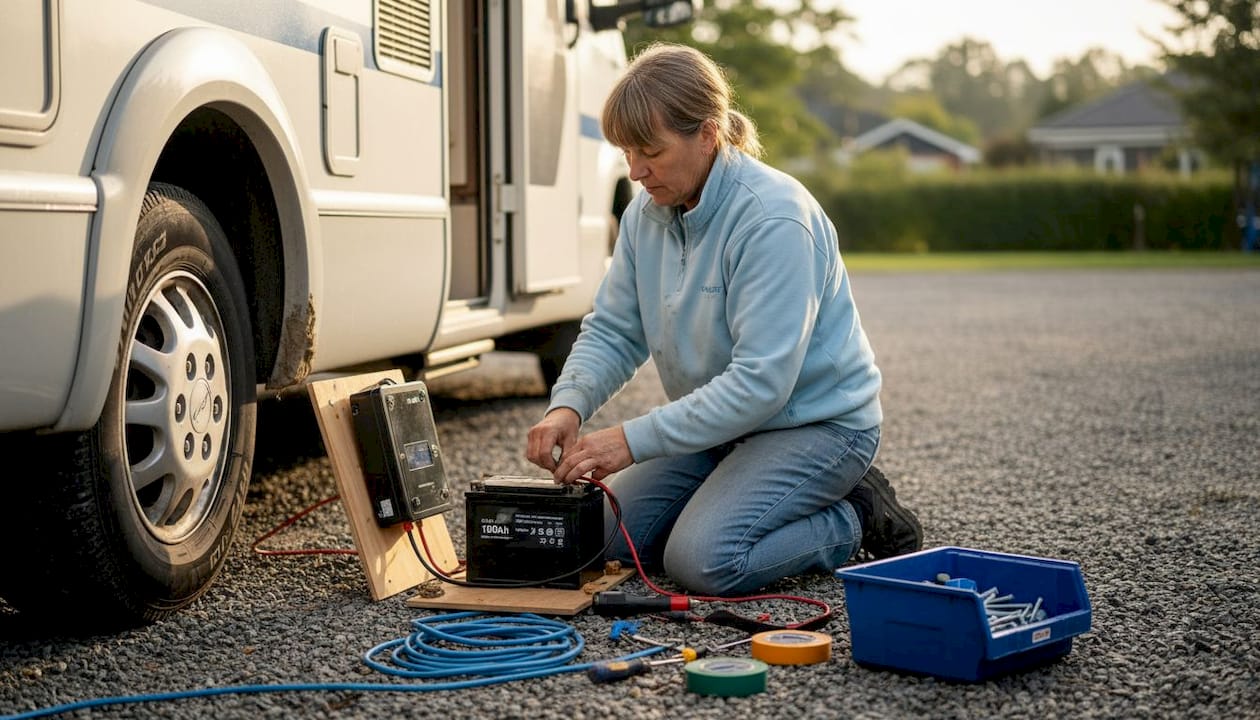
Reviewing off-grid battery troubleshooting guidance and understanding lithium battery features helps owners identify the specific vulnerabilities in their setups before they cause costly damage.
How battery monitoring works and the options available
Now that we know what can go wrong, let’s explore the tools to stop it happening. Battery monitors range from basic voltage displays to sophisticated systems capable of logging charge cycles, flagging faults in real time, and syncing data to a smartphone over Bluetooth. The right choice depends on battery chemistry, system complexity, and how much data you need to manage effectively.
Shunt-based monitors are the most accurate option for leisure vehicle setups. A shunt is a precision resistor installed in the negative battery cable. As current flows through it, the monitor measures the tiny voltage drop across the shunt and calculates exact current in amperes, cumulative amp-hours consumed, and state of charge over time. Shunt-based monitors, such as those in the Victron range, give a precise and continuously updated picture of energy flow that simple voltage checks cannot provide.
Battery Management Systems (BMS) are built into or closely integrated with lithium battery packs. A BMS monitors individual cell voltages, temperature, and current, providing protection against over-charge, over-discharge, and short circuits. Using a Battery Management System is not optional for lithium chemistry; it is a fundamental safety and performance requirement.
Voltage-only monitors provide a basic real-time display of terminal voltage. They are inexpensive and straightforward to install, but their usefulness is limited. Voltage sags under load and recovers when load is removed, making it difficult to assess true state of charge from voltage alone.
| Monitor type | Suitable battery | Key strength | Key weakness |
|---|---|---|---|
| Shunt-based | Lead-acid, lithium | Accurate current and SoC tracking | Requires correct installation and calibration |
| BMS (integrated) | Lithium | Cell-level protection and monitoring | Limited external data display without add-ons |
| Voltage monitor | Lead-acid, AGM | Simple, low cost | Inaccurate SoC, no current data |
Battery monitoring explained in detail shows that the method matters significantly for leisure applications, with shunt-based systems delivering the most actionable data.
Key benefits of advanced monitoring at a glance:
- Real-time and historical state of charge data
- Fault alerts for abnormal drain or charging events
- Cycle count tracking to anticipate battery replacement
- Bluetooth connectivity for remote checking via smartphone
Pro Tip: Pairing a quality shunt monitor with a lithium battery’s built-in BMS gives you both system-level energy accounting and cell-level protection. This combination is particularly effective in campervans and on boats where reliability is non-negotiable.
Practical steps: Monitoring battery health to maximise longevity
Understanding technology is helpful, but application is where the benefits truly appear. Installing a monitor is only the beginning. Using the data it provides to make informed decisions about charging, load management, and maintenance routines is where you recover real value.
Follow these steps to set up and use battery monitoring effectively:
- Select the appropriate monitor type for your battery chemistry. Lithium systems need a BMS; lead-acid or AGM setups benefit most from a shunt-based monitor. Verify that any monitor is rated for your battery’s maximum current output.
- Install the shunt in the correct position. The shunt must sit in the main negative cable, between the battery negative terminal and all other loads and charging sources. Any cable bypassing the shunt will not be measured and will introduce inaccuracies.
- Set battery parameters correctly. Input the battery’s rated capacity in amp-hours and the correct chemistry type. Incorrect settings produce inaccurate state of charge calculations from the outset.
- Allow a calibration cycle. Discharge the battery to a known low point, then charge it fully. This gives the monitor a reference point for accurate state of charge reporting going forward.
- Review data regularly. Check minimum overnight voltage, daily discharge depth, and charging completion figures. Any deviation from your established baseline warrants investigation.
The table below provides a reference for interpreting common monitor readings in lithium leisure battery setups:
| Reading | What it indicates | Recommended action |
|---|---|---|
| SoC drops below 20% regularly | Insufficient charging or oversized loads | Review solar/charging capacity |
| Overnight SoC drop greater than 10% without loads | Likely parasitic drain | Identify and isolate the source |
| Charge cycle does not reach 100% SoC | Charging source fault or undersized | Check MPPT output and cable sizing |
| Internal resistance rising over time | Cell degradation | Plan battery replacement |
| Repeated over-discharge events | Load management needed | Add low-voltage disconnect relay |
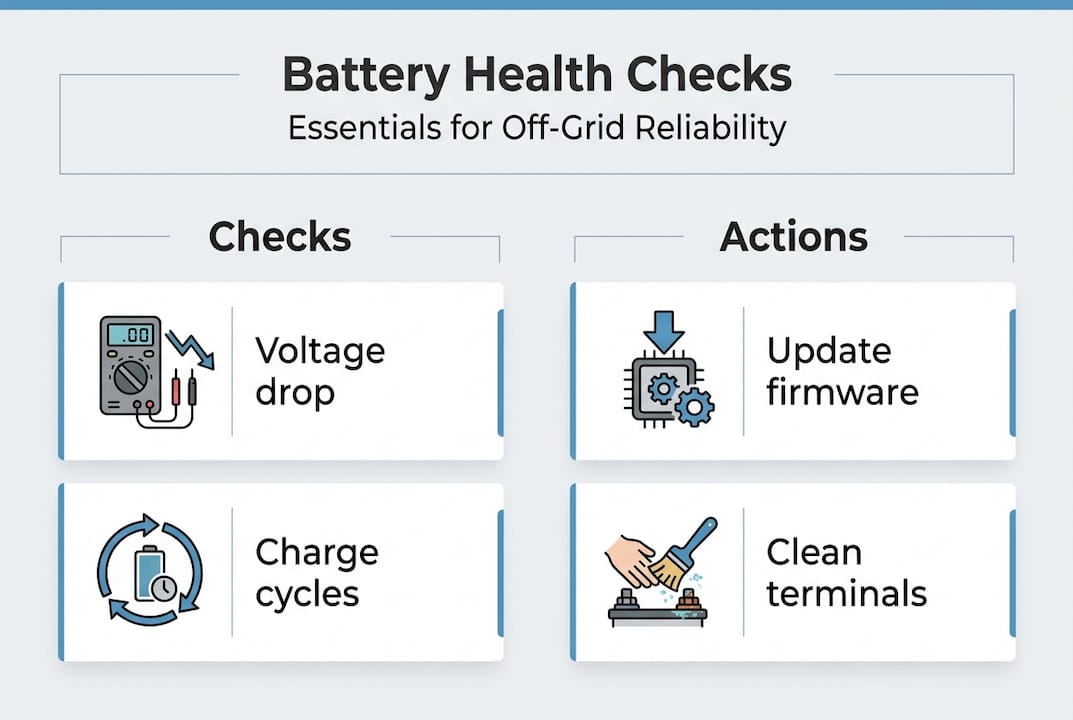
Routine habits that support long battery life include checking firmware updates for your monitoring hardware every few months, particularly for Bluetooth-enabled units from brands such as Victron. Manufacturers often improve state of charge algorithms and add new diagnostic features through updates.
Lithium battery maintenance guidance and information on battery management for longevity provide further detail on building a routine that keeps your system performing reliably across many years of off-grid use.
Monitors detect parasitic drains and faulty charging inputs early, which is the single most important function for off-grid vehicle owners who want to avoid unplanned failures.
Pro Tip: Regularly update your monitoring system’s firmware and app software. Manufacturers frequently improve the accuracy of state of charge algorithms and extend compatibility with new battery chemistries through these updates. Skipping updates can mean operating with outdated fault detection logic.
Why most off-grid owners underestimate battery risks
You’ve seen the steps involved, but let’s reflect on what truly separates resilient off-grid owners from the rest. The most common mistake is not a failure to buy quality batteries or a competent solar installation. It is operating with false confidence in an unmonitored system.
Many owners carry out a voltage check before a trip, see 12.7V, and assume everything is fine. What they do not see is that the battery accepted a full charge two days ago and has already lost 15Ah to an undetected standby load, or that their solar controller has been operating in bulk mode only and has never completed an absorption cycle. Shunt monitors reveal whether solar charging actually matches real usage, and this is data that no voltage reading can provide.
The uncomfortable truth is that manual inspection and basic routines create the appearance of control without the substance of it. Real control comes from continuous data. Owners who use proper monitoring do not just react to battery failures; they prevent them by spotting trends weeks before a failure point is reached. Monitoring is not an accessory for enthusiasts with complex setups. It is the foundation of reliable off-grid power for any system, regardless of size or complexity.
Boost your off-grid power with smart battery monitoring
If you’re ready to put these insights to work, here’s where to start.

Skyenergi supplies a range of battery monitors, Victron-compatible shunt systems, and lithium leisure batteries with integrated BMS and Bluetooth connectivity, all sourced directly from manufacturers to keep prices competitive. Whether you are building a new campervan system from scratch, upgrading a motorhome battery bank, or improving monitoring on a marine setup, the right tools are available without unnecessary complexity. Monitoring is low-cost insurance for your battery investment. A quality shunt monitor paired with a well-specified lithium battery protects hundreds of pounds of equipment and keeps your off-grid trips running without interruption. Browse the Skyenergi range to find monitoring solutions and leisure batteries suited to your setup. SHOP NOW
Frequently asked questions
How often should I check my battery’s health in a campervan?
With a monitoring system installed, your setup will alert you to issues automatically, but reviewing logged data weekly and before every long trip gives you a clear picture of trends and emerging faults.
Do I need a special monitor for lithium batteries?
Yes. A BMS is essential for lithium batteries, providing integrated cell-level protection and monitoring that standard voltage monitors are not designed to deliver.
Can battery monitoring really prevent breakdowns?
Active monitoring identifies parasitic drains and charging faults early, and these are the two leading causes of unexpected battery failures in off-grid campervans, motorhomes, and boats.
Is shunt-based monitoring better than simple voltage checks?
Shunt-based monitoring measures actual current flow in real time, giving accurate state of charge and fault data that basic voltage checks cannot provide, making it significantly more reliable for off-grid energy management.
Recommended
Prev post

Streamline your off-grid renewable energy storage workflow
Updated on 29 April 2026
Next post

Top 5 skyenergi.dearportal.com alternatives 2026
Updated on 27 April 2026


