







Battery Monitoring Technology: Powering UK Adventures
Battery monitoring technology for UK leisure vehicles: explore system types, real-time Bluetooth features, safety benefits, and common pitfalls to avoid.
Finding reliable power far from the mains can quickly turn into a guessing game for even the most seasoned campervan or motorhome owner. Whether you are planning an extended wild camping trip across the British countryside or exploring hidden corners of Scotland, understanding your leisure battery’s health makes all the difference. Advanced battery monitoring technology gives you the tools to maximise energy efficiency, spot potential issues early, and travel with confidence, knowing your off-grid adventures remain uninterrupted.
Table of Contents
- Defining Battery Monitoring Technology Today
- Types Of Monitoring Systems For Leisure Use
- How Bluetooth Battery Monitoring Works
- Key Benefits For Off-Grid Travellers
- Risks, Limitations, And Common Pitfalls
Key Takeaways
| Point | Details |
|---|---|
| Battery Monitoring Technology | Advanced systems enable real-time tracking of battery health and performance, crucial for off-grid applications and energy management. |
| UK Innovation Leadership | The United Kingdom is spearheading research in battery monitoring systems to support net zero emissions goals by 2050. |
| Diverse System Types | Various monitoring solutions, from basic voltage monitors to cloud-connected networks, cater to different user needs and enhance power management. |
| Risk Awareness | Users must understand potential risks like sensor inaccuracies and communication issues to maintain effective and safe battery management. |
Defining Battery Monitoring Technology Today
Battery monitoring technology represents a sophisticated approach to understanding, tracking, and optimising the performance of energy storage systems in leisure vehicles and off-grid applications. At its core, this technology enables real-time tracking of battery health, charge status, and operational efficiency through advanced digital interfaces and intelligent sensors.
The United Kingdom is positioning itself at the forefront of battery innovation, with government research supporting advanced monitoring systems that are critical for achieving net zero emissions by 2050. Modern battery monitoring technologies provide comprehensive insights through several key features:
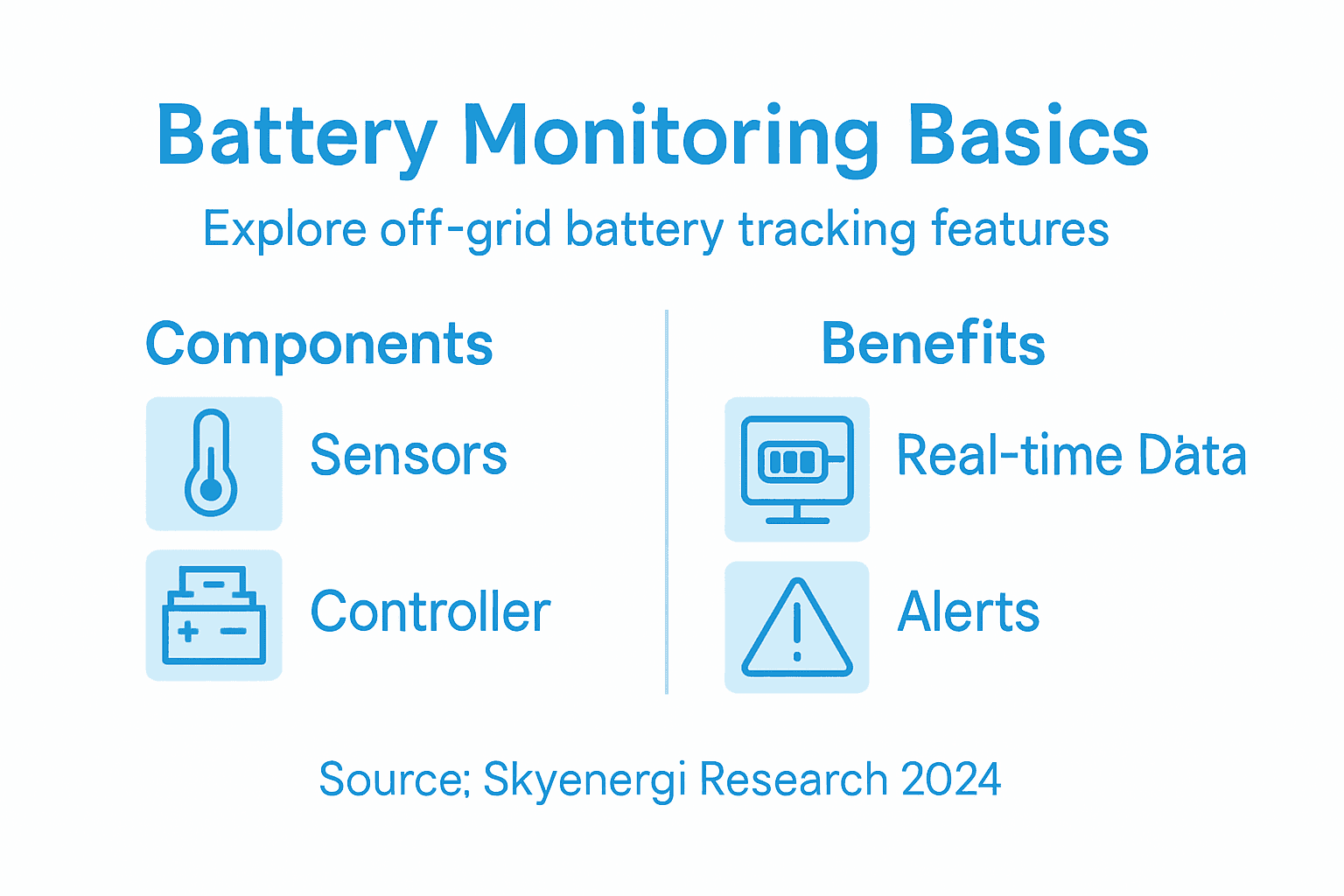
- Real-time voltage and temperature tracking
- State of charge (SoC) measurement
- Precise capacity estimation
- Performance degradation prediction
- Early fault detection mechanisms
Advanced battery monitoring systems go beyond simple measurement, offering intelligent diagnostics that help users make informed decisions about power management. Cutting-edge research from the Faraday Institution highlights the importance of smart battery systems capable of real-time data acquisition and health diagnostics.
The technology integrates multiple sensors and sophisticated algorithms to provide a holistic view of battery performance. These systems can detect potential issues before they become critical, reducing the risk of unexpected power failures during off-grid adventures.
Pro tip: Invest in a battery monitoring system with Bluetooth connectivity to enable seamless, wireless performance tracking directly from your smartphone.
Types Of Monitoring Systems For Leisure Use
Leisure vehicle battery monitoring systems have evolved dramatically, offering multiple sophisticated approaches to tracking power performance and health. These technologies range from basic voltage indicators to advanced intelligent monitoring platforms that provide comprehensive insights into battery behaviour and potential issues.
Modern leisure vehicle battery monitoring can be categorised into several distinct types, each offering unique capabilities for off-grid power management. Bluetooth battery monitoring systems represent a particularly innovative category, enabling real-time wireless tracking through smartphone applications:
- Standalone voltage monitors
- Integrated battery management systems (BMS)
- Bluetooth-enabled smart monitoring platforms
- Advanced diagnostic systems with predictive maintenance features
- Cloud-connected battery tracking networks
The digital monitoring ecosystem typically encompasses hardware and software components designed to provide granular insights into battery performance. These systems track critical parameters such as state of charge, temperature fluctuations, charging efficiency, and potential degradation patterns.
Each monitoring system type offers unique advantages for leisure vehicle owners. Standalone voltage monitors provide basic charge level information, while integrated battery management systems deliver comprehensive performance analytics. More advanced platforms combine multiple sensor technologies to create a holistic view of battery health and potential operational risks.
Here’s a concise comparison of leisure vehicle battery monitoring system types and their application focus:
| Monitoring System Type | Data Capabilities | Best For |
|---|---|---|
| Standalone Voltage Monitor | Basic charge monitoring | Simple use cases |
| Integrated Battery Management | Performance analytics | Comprehensive setups |
| Bluetooth Smart Platform | Real-time remote data | Modern connectivity |
| Advanced Diagnostics | Predictive maintenance | Preventative care |
| Cloud-Connected Network | Historical insights | Remote supervision |
Pro tip: Select a battery monitoring system that offers both real-time tracking and historical performance data to make informed maintenance decisions.
How Bluetooth Battery Monitoring Works
Bluetooh battery monitoring represents a sophisticated wireless technology that transforms how leisure vehicle owners track and manage their power systems. Wireless battery management systems enable real-time data transmission and comprehensive performance tracking through intelligent sensor networks.
The core functionality of Bluetooth battery monitoring involves several key technological components:
- Embedded microcontrollers for data processing
- Multiple precision sensors measuring:
- Battery voltage
- Current flow
- Internal temperature
- State of charge
- Wireless communication modules
- Smartphone application interfaces
- Cloud-based data storage and analysis
These intelligent monitoring platforms continuously collect and analyse battery performance data, transmitting critical insights directly to users’ mobile devices. The technology allows for instantaneous tracking of battery health, providing early warning systems for potential performance issues or maintenance requirements.

Advanced Bluetooth monitoring systems go beyond simple data collection. They integrate predictive algorithms that can forecast battery degradation, estimate remaining operational capacity, and provide recommendations for optimising power management in leisure vehicles. By translating complex technical data into user-friendly insights, these systems empower vehicle owners to make informed decisions about their battery usage and maintenance.
Pro tip: Always ensure your Bluetooth battery monitoring app is updated to the latest version to access the most advanced diagnostic and predictive features.
Key Benefits For Off-Grid Travellers
Off-grid travellers demand robust battery monitoring solutions that provide unprecedented insights into their power management capabilities. Battery monitoring systems support critical energy planning by delivering real-time performance data that transforms how adventurers approach power consumption and reliability.
The key advantages for off-grid travellers include:
- Precise energy consumption tracking
- Early warning for potential battery failures
- Optimised charging strategies
- Extended battery lifespan management
- Prevention of unexpected power interruptions
- Comprehensive system health diagnostics
- Remote monitoring capabilities
These intelligent monitoring technologies enable leisure vehicle owners to make data-driven decisions about their power systems. By providing granular insights into battery performance, travellers can anticipate maintenance requirements, plan recharging strategies, and avoid potentially dangerous situations caused by unexpected power depletion.
Advanced battery monitoring goes beyond simple measurement, offering predictive analytics that can significantly enhance the off-grid travel experience. The technology translates complex electrical data into user-friendly interfaces, allowing even technically inexperienced users to understand their power ecosystem with remarkable clarity and confidence.
Pro tip: Always maintain a backup power source and familiarise yourself with your battery monitoring system’s alert mechanisms before embarking on extended off-grid journeys.
Risks, Limitations, And Common Pitfalls
Battery monitoring technologies, while transformative, are not without inherent challenges and potential risks. Battery safety risks often emerge from complex management scenarios, requiring users to understand the nuanced limitations of monitoring systems.
Key risks and limitations include:
- Sensor reliability and potential calibration errors
- Complex data integration challenges
- Thermal management vulnerabilities
- Potential inaccuracies in state estimation
- Risk of cascading system failures
- Bandwidth and communication limitations
- Intermittent connectivity issues
The technological complexity of battery monitoring systems means that users must remain vigilant about potential failure modes. Battery safety risks frequently stem from improper management techniques, including scenarios involving overcharging, overheating, and undetected physical damage.
Moreover, battery monitoring technologies are not infallible. Advanced systems may still encounter challenges such as sensor drift, communication protocol inconsistencies, and difficulties in accurately predicting long-term battery degradation. Understanding these limitations is crucial for maintaining realistic expectations about system performance and reliability.
To help travellers assess system reliability, here’s a summary of main risk categories and practical mitigation strategies:
| Risk Category | Potential Impact | User Action |
|---|---|---|
| Sensor calibration | Inaccurate readings | Regular sensor testing |
| Data integration | Overlooked anomalies | Validate with manual checks |
| Communication faults | Lost performance data | Monitor app connectivity status |
| Overheating | Safety hazards | Keep systems well-ventilated |
| Protocol drift | Unclear diagnostics | Update software and firmware |
Pro tip: Regularly cross-validate your battery monitoring system’s readings with manual checks and maintain a comprehensive maintenance log to identify potential discrepancies early.
Take Control of Your Off-Grid Power with Skyenergi’s Intelligent Battery Solutions
Managing complex battery systems while adventuring across the United Kingdom demands cutting-edge technology that offers real-time insights, predictive diagnostics, and reliable performance tracking. As highlighted in the article, challenges such as state of charge estimation, early fault detection, and Bluetooth-enabled monitoring are critical for enjoying uninterrupted off-grid power and optimising battery lifespan. Skyenergi specialises in delivering high-performance lithium battery systems and intelligent battery management products designed to meet these exact needs.

Discover how Skyenergi’s range of Bluetooth-compatible lithium leisure batteries and turnkey energy solutions from SRNE can transform your leisure vehicle experience. By integrating smart battery monitoring platforms with your campervan or motorhome setup you gain precise control over energy consumption and early warnings on system health. Take the next step towards reliable power independence by exploring our comprehensive off-grid power solutions and learn why thousands trust Skyenergi for dependable energy storage. Visit Skyenergi today and start powering your UK adventures with confidence.
Frequently Asked Questions
What is battery monitoring technology?
Battery monitoring technology involves sophisticated systems that track and optimise the performance of energy storage, providing real-time insights into battery health, charge status, and operational efficiency through advanced sensors and digital interfaces.
How does Bluetooth battery monitoring work?
Bluetooth battery monitoring systems use wireless technology to transmit data about battery performance, including voltage, current, and temperature, directly to mobile apps, allowing users to track battery health and receive alerts about potential issues in real-time.
What are the key benefits of using advanced battery monitoring systems for off-grid travellers?
Advanced battery monitoring systems provide benefits such as precise energy consumption tracking, early failure warnings, optimised charging strategies, extended battery lifespan management, and comprehensive health diagnostics, enhancing the reliability of power systems in off-grid situations.
What risks and limitations are associated with battery monitoring systems?
Risks include sensor reliability issues, potential calibration errors, communication faults, thermal management vulnerabilities, and the chances of overlooking anomalies. Users should regularly validate readings and maintain systems to mitigate these risks.
Recommended
- Bluetooth Battery Monitoring: Smarter Power On The Road – Skyenergi
- Bluetooth Battery Monitoring – Empowering Off-Grid Travel – Skyenergi
- Bluetooth Battery Monitoring – Real-Time Power Insights – Skyenergi
- Troubleshooting Battery Systems for Off-Grid Performance – Skyenergi
- 5 Modern Backpacker Essentials
- Master Electrolyte Use for Endurance in Sports – Interval
Prev post

Off-Grid Power Systems: Enhancing Energy Freedom
Updated on 09 February 2026
Next post

6 Types of Campervan Batteries and Their Key Advantages
Updated on 07 February 2026


