









How battery monitoring works: accurate power management
Learn how battery monitoring systems work, why voltage-only readings fail with LiFePO4 batteries, and how shunt-based monitors deliver ±1% accuracy for leisure vehicles and boats.
TL;DR:
- Voltage readings are unreliable for modern lithium batteries due to flat discharge profiles.
- Shunt-based monitors provide accurate real-time data by measuring actual current flow.
- Proper system setup and periodic calibration are essential for effective battery monitoring.
Relying on a basic voltage reading to gauge your battery level is like judging a fuel tank by tapping the side. It gives you a rough idea, but modern lithium batteries make it almost useless. LiFePO4 cells hold a remarkably flat voltage profile across the bulk of their discharge cycle, meaning a voltmeter can show 13.2V whether you have 90% or 20% capacity remaining. For anyone running an off-grid leisure vehicle or boat, that kind of ambiguity is a real problem. This guide explains how battery monitoring systems actually work, why voltage alone fails, and how to get genuinely reliable data from your system.
Table of Contents
- Why accurate battery monitoring matters
- Core principles: how battery monitoring systems measure and calculate
- Why voltage-only monitoring fails with modern batteries
- Integrating monitoring with Battery Management Systems (BMS) for safety and performance
- The real-world truth: what most guides miss about battery monitoring
- Ready to upgrade your battery system for peace of mind?
- Frequently asked questions
Key Takeaways
| Point | Details |
|---|---|
| Shunt-based accuracy | Shunt-based battery monitoring offers superior, real-time tracking of battery status compared to voltage-only methods. |
| Essential for lithium batteries | Modern lithium batteries require monitoring systems that measure current flow, not just voltage, due to their unique discharge profile. |
| BMS integration boosts safety | Combining battery monitors with Battery Management Systems ensures both accurate data and reliable cell protection. |
| Upgrades are straightforward | Most vehicle or boat owners can retrofit advanced battery monitoring for better off-grid reliability with little technical hassle. |
Why accurate battery monitoring matters
For motorhome owners, campervan users, and boaters, power is not a luxury. It runs your fridge, lighting, heating controls, water pump, and communications equipment. Running out unexpectedly is not just inconvenient; in some conditions it is a safety issue. Understanding battery monitoring importance is the first step towards avoiding those situations.
The most common mistake is trusting a basic voltmeter. Voltage readings are affected by several variables:
- Load conditions: A battery under heavy load shows a temporarily depressed voltage, making it appear more depleted than it is.
- Temperature: Cold weather, common across the UK, causes voltage to drop even when the battery is healthy and well-charged.
- Battery chemistry: LiFePO4 batteries behave very differently from lead-acid, and a voltage reading calibrated for one chemistry is misleading for the other.
- Resting vs. active state: Voltage only stabilises accurately after a battery has rested for several hours with no load or charge input.
These factors combine to make voltage-only monitoring genuinely unreliable in real-world leisure use. Shunt-based systems offer ±1% accuracy and surpass voltage-only monitoring by measuring actual current flow rather than inferring charge state from voltage.
“A battery monitor that tracks current in and out of your bank gives you a true picture of state of charge, regardless of load, temperature, or chemistry.”
The benefits of accurate, real-time data go well beyond convenience. Correct state of charge (SoC) data helps you avoid both over-discharge and overcharge, both of which degrade lithium cells over time. Longer battery life, fewer unexpected failures, and genuine peace of mind are the practical outcomes. Understanding battery monitoring technology available today shows just how far the field has advanced beyond simple voltmeters.
Pro Tip: If your current setup only has a voltmeter, treat every reading with scepticism when the battery is under load. Always check voltage after a rest period of at least 30 minutes for a more accurate snapshot.
Core principles: how battery monitoring systems measure and calculate
Modern battery monitors are built around a shunt, a precision low-resistance resistor installed in the negative cable of your battery system. As current flows through it, a tiny voltage drop occurs across the shunt. The monitor measures this drop and uses Ohm’s law to calculate exact current flow, both in and out. Shunt-based battery monitors use a precision resistor and are accurate to ±1%, which is far beyond what any voltmeter can achieve.
Understanding what a battery shunt does makes the whole system easier to configure and trust. Here is how the measurement process works in sequence:
- Current measurement: The shunt measures millivolts across its terminals every fraction of a second, converting this to amps in or out.
- Voltage measurement: A separate input reads battery terminal voltage continuously.
- Power calculation: Watts are calculated by multiplying current by voltage in real time.
- SoC estimation: The monitor integrates current over time (amp-hours in vs. amp-hours out) against a programmed battery capacity to calculate SoC as a percentage.
- Time-to-go: Based on current consumption rate and remaining SoC, the monitor projects how long the battery will last at the present load.
The key metrics displayed on a quality battery monitor include:
| Metric | Unit | What it tells you |
|---|---|---|
| Voltage | V | Terminal voltage at that moment |
| Current | A | Charge or discharge rate |
| Power | W | Instantaneous power draw or input |
| State of charge | % | True remaining capacity |
| Time-to-go | h:min | Estimated runtime at current load |
| Amp-hours consumed | Ah | Total energy drawn since last full charge |
| Temperature | °C | Cell or ambient temperature (with sensor) |
| Cycle count | Number | Total charge cycles logged |
Some advanced monitors also support auxiliary inputs for a second battery bank or midpoint voltage monitoring, which is particularly useful in larger marine or motorhome installations. For off-grid troubleshooting, having historical data logged is invaluable.
Pro Tip: Always install the shunt on the negative terminal of the battery, and ensure every load and charging source connects to the system on the load side of the shunt. Any wire bypassing the shunt will produce inaccurate SoC readings.
Why voltage-only monitoring fails with modern batteries
Lead-acid batteries have a discharge curve that slopes gradually from around 12.7V fully charged down to 11.8V near empty. That slope gives a voltmeter some usefulness as a rough gauge. LiFePO4 batteries are fundamentally different. As noted, voltage-only monitoring cannot accurately track SoC in LiFePO4 batteries due to their flat voltage curve.
Consider this comparison:
| Battery type | Voltage at 100% SoC | Voltage at 20% SoC | Voltage difference |
|---|---|---|---|
| Lead-acid (12V) | 12.7V | 11.8V | 0.9V |
| LiFePO4 (12V) | 13.4V | 13.1V | 0.3V |
That 0.3V difference across 80% of usable capacity is simply too small to interpret reliably. A LiFePO4 cell typically holds between 13.1V and 13.3V from 100% down to around 20% SoC. Any load on the system causes voltage to sag temporarily, making the reading even less meaningful.
The practical consequences are significant:
- False confidence: A user sees 13.2V and assumes plenty of capacity remains, but the battery may be at 25%.
- Unexpected shutdown: The BMS cuts off the battery at its low-voltage threshold with no warning, because the voltmeter gave no useful advance signal.
- Overcharge risk: Without accurate SoC, charge sources may be incorrectly configured, risking overcharge on a battery that appeared partially discharged.
Understanding why battery management systems are essential for lithium setups makes this clearer. The role of BMS in energy storage is to protect cells at the chemistry level, but it cannot substitute for accurate system-level monitoring.
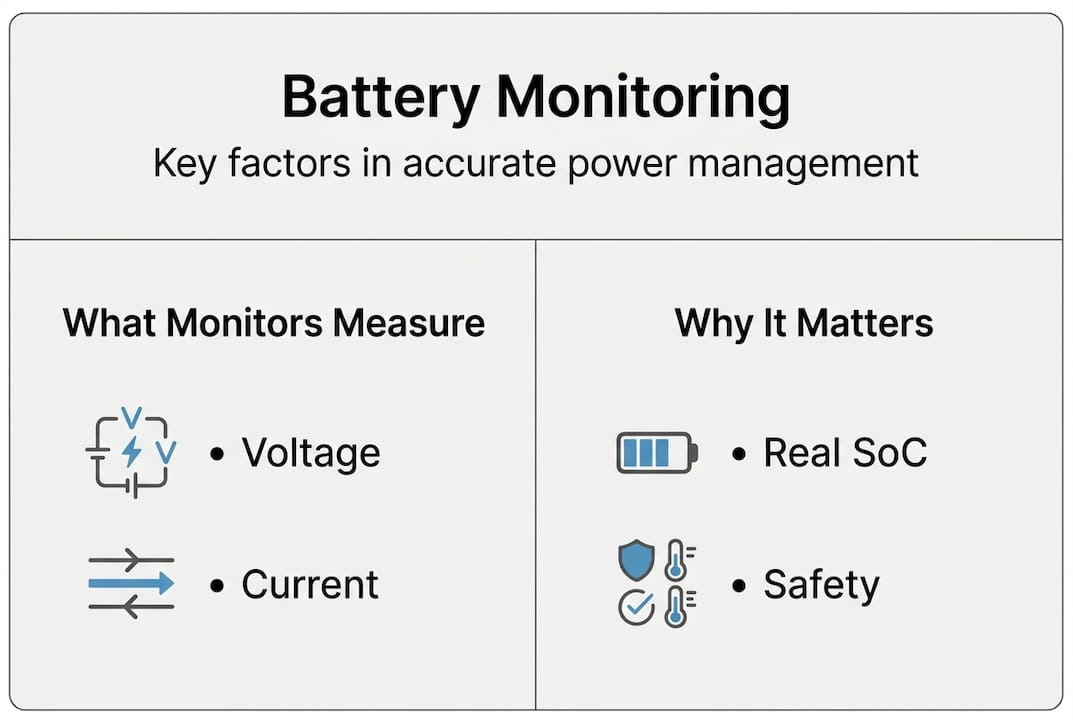
For any leisure vehicle or boat running LiFePO4 batteries, a shunt-based monitor is not optional. It is the only way to know where you actually stand.
Integrating monitoring with Battery Management Systems (BMS) for safety and performance
A battery monitor and a Battery Management System (BMS) are not the same thing, and understanding what a BMS does helps clarify why you need both. The shunt-based monitor tracks system-level data: total current, voltage, SoC, and historical usage. The BMS operates at the cell level, managing individual cell voltages, balancing charge across cells, and triggering protection cutoffs if any cell goes out of range.
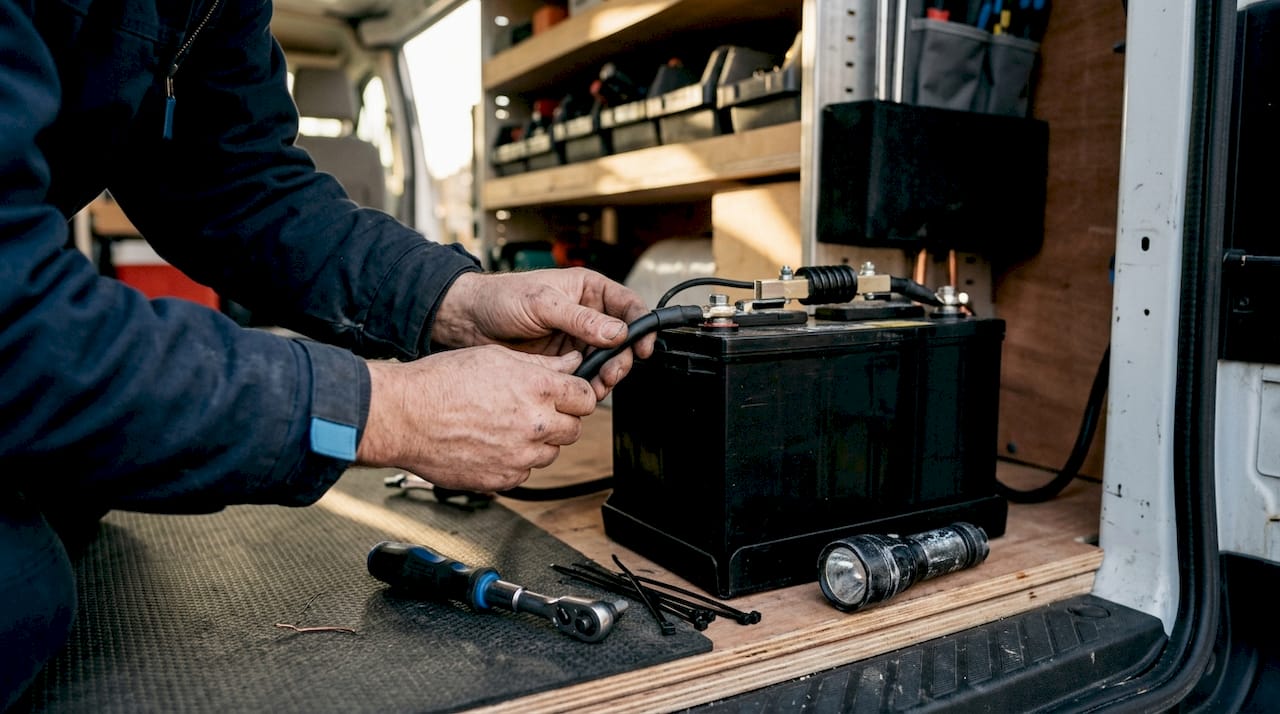
BMS complements shunt monitors by ensuring cell balancing and protecting lithium batteries from conditions that the system-level monitor cannot detect on its own. Together, they form a complete picture.
Here is a typical integration process for a motorhome or boat:
- Install the shunt on the battery negative terminal, with all system loads and charge sources connected on the load side.
- Connect the BMS to the lithium battery pack according to the manufacturer’s wiring diagram.
- Link the battery monitor display to the shunt via its data cable or Bluetooth connection.
- Programme the monitor with the correct battery capacity (Ah), chemistry, and Peukert exponent for accurate SoC calculation.
- Test under load by running a known appliance and verifying that current, voltage, and SoC all respond correctly in real time.
Many modern systems support Bluetooth battery monitoring, allowing you to check all metrics from a smartphone app without opening a panel. This is particularly practical on boats and larger motorhomes where the battery bank may be in an awkward location.
Historical data logging is another underused feature. Tracking cycle count, deepest discharge events, and maximum charge current over time gives you early warning of degradation and helps diagnose BMS battery safety issues before they become failures.
Pro Tip: Match the BMS rating to your battery chemistry and maximum charge or discharge current. A BMS rated too low will trigger unnecessary protection cutoffs; one rated too high may not protect cells adequately during fault conditions.
The real-world truth: what most guides miss about battery monitoring
Most articles focus on which monitor to buy. The harder lesson is that the monitor is only as good as its installation and configuration. We see this repeatedly: a quality shunt monitor fitted with a wire bypassing the shunt, or programmed with the wrong battery capacity, giving readings that are no more reliable than the voltmeter it replaced.
The number one failure mode is trusting the screen without verifying the setup. Firmware updates matter too. Monitor manufacturers release updates that improve SoC algorithms and fix calculation drift. Ignoring these leaves users with avoidable inaccuracies.
Shunt rating is also frequently overlooked. A 500A shunt on a system that regularly draws 600A will saturate and produce errors. Sizing the shunt correctly for your actual peak loads is just as important as choosing the right display unit.
For real-life troubleshooting advice, the consistent finding is that off-grid users who succeed long-term focus on whole-system integration: correct shunt sizing, proper BMS pairing, verified wiring, and regular calibration checks. The gadget is secondary to the fundamentals.
Ready to upgrade your battery system for peace of mind?
If this guide has clarified what accurate battery monitoring requires, the next step is choosing the right hardware for your setup. Skyenergi supplies a range of solutions built specifically for leisure vehicles and boats, from complete turnkey systems to individual Victron-compatible components.

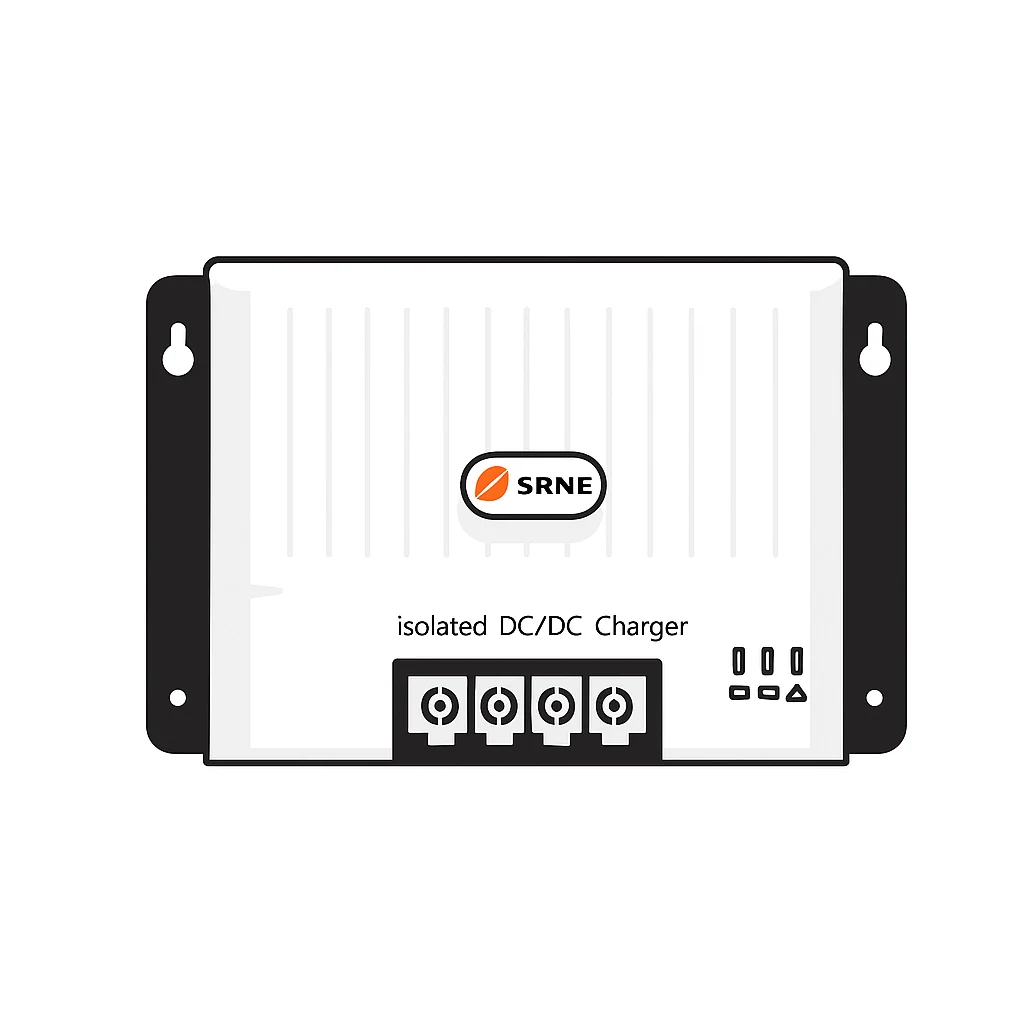
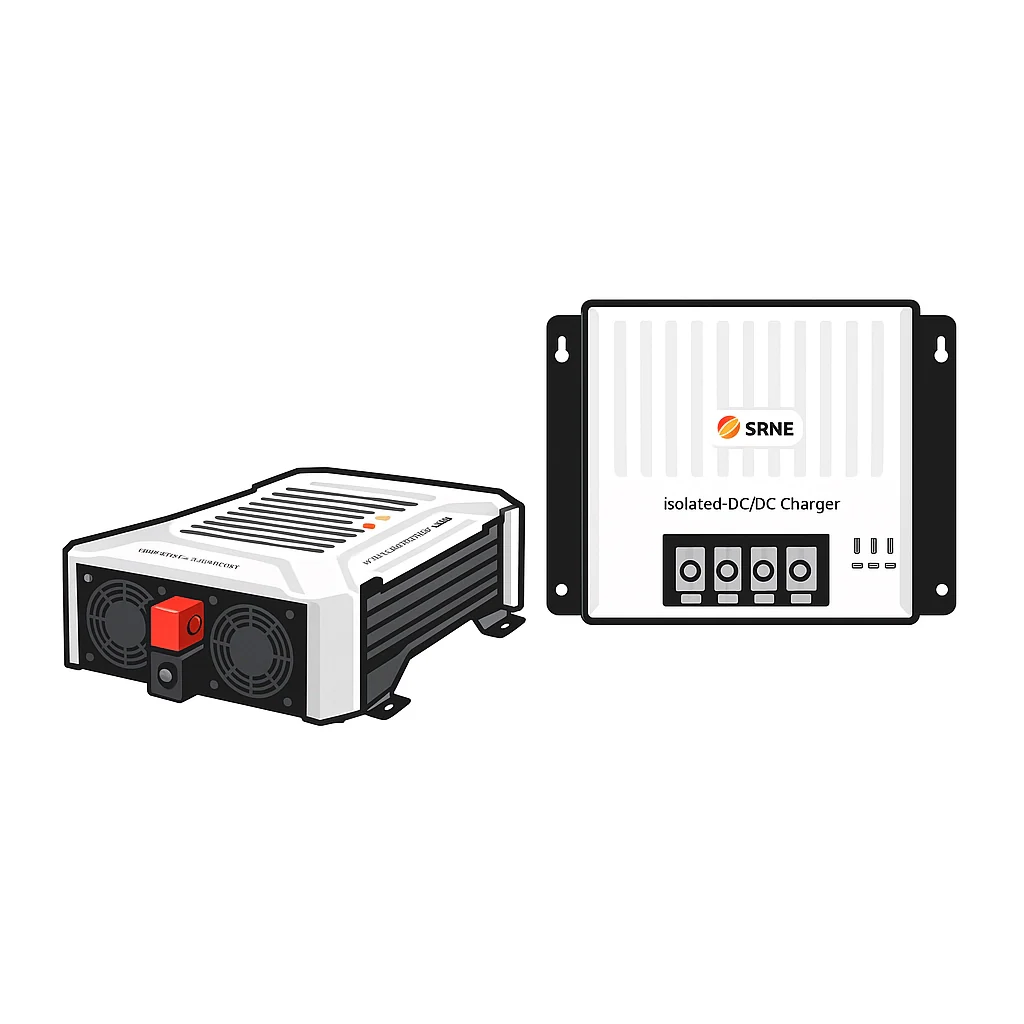
The SRNE solar power electrics system integrates inverter-charger, battery-to-battery charging, and monitoring in a single package, ideal for motorhomes and campervans. For those wanting best-in-class standalone monitoring, the Victron BMV-712 Smart offers Bluetooth connectivity, dual battery monitoring, and a proven SoC algorithm. Browse the full range at Skyenergi to find the right fit for your system.
Frequently asked questions
Can I retrofit my existing battery setup with a modern monitoring system?
Yes, most shunt-based monitoring systems can be added to existing battery setups with minimal wiring changes. Shunt-based monitors install in series with the battery negative terminal, requiring no major system redesign.
Do these monitors work with both lead-acid and lithium batteries?
Yes, modern shunt-based monitors support all common chemistries. They are particularly valuable with lithium systems, where voltage-only monitoring is insufficient for accurate SoC tracking.
What features should I look for in a battery monitor for a motorhome or boat?
Prioritise real-time current, true SoC percentage, time-to-go, and temperature input. Metrics including current, power, and time-to-go are available on advanced systems, along with dual battery bank support for larger installations.
How often should I check or calibrate my system?
Battery monitoring systems are largely automatic but benefit from seasonal checks and occasional recalibration. Routine checks and recalibration can improve long-term reliability, particularly after firmware updates or significant changes to your system load profile.
Recommended
Prev post

Top tips for campervan energy independence in the UK
Updated on 10 April 2026
Next post

Expandable motorhome energy: modular power for off-grid UK travel
Updated on 08 April 2026


