









Why reliable battery monitoring matters for leisure vehicles
Discover why accurate battery monitoring is essential for UK leisure vehicle owners. Compare solutions, learn installation steps, and avoid costly power failures off-grid.
Most leisure vehicle owners assume a quick glance at a voltage reading tells them everything they need to know about their battery. It does not. Estimating battery levels by guesswork is one of the most common mistakes made by campervan and motorhome owners in the UK, and it can cut a trip short, damage expensive equipment, or leave you without power in a remote location. This article covers what battery monitoring actually involves, why it matters for off-grid independence, how different solutions compare, and the practical steps to get it right on your vehicle.
Table of Contents
- Understanding battery monitoring: What it is and why it matters
- Key benefits of battery monitoring for off-grid adventures
- Different types of battery monitoring solutions
- Integrating monitoring into your leisure vehicle: Practical steps
- Our view: Why accuracy in battery monitoring is worth the investment
- Power your adventures with proven battery monitoring solutions
- Frequently asked questions
Key Takeaways
| Point | Details |
|---|---|
| Accurate monitoring prevents outages | Trustworthy monitors protect your energy supply and prevent inconvenient breakdowns during off-grid travel. |
| Smart systems prolong battery life | Monitoring helps you avoid deep discharge or overcharging, both of which damage batteries quickly. |
| Choose the right solution | Advanced shunt monitors are worth the cost for greater reliability and peace of mind, especially in the UK’s temperamental conditions. |
| Installation mistakes can be costly | Following best practices for integration ensures accurate readings and long-term benefits. |
Understanding battery monitoring: What it is and why it matters
Battery monitoring, in the context of leisure vehicles, means tracking the real-time state of your battery system using dedicated instruments rather than guesswork or simple voltage checks. A proper monitoring system measures voltage, current flow in and out of the battery, and calculates the true state of charge (SOC). SOC is the percentage of usable energy remaining in your battery at any given moment.
Many owners rely on a basic panel voltmeter and assume a reading of 12.5V means the battery is fine. The problem is that voltage alone is a poor indicator of remaining capacity, especially under load or immediately after charging. Battery monitoring is essential for optimising performance in energy systems, and without it, you are essentially driving blind.
Here is what a reliable monitoring system actually tracks:
- State of charge (SOC): The true percentage of energy remaining
- Voltage: Instantaneous battery voltage under load and at rest
- Current: Amps flowing in from solar or a charger, and amps being consumed
- Amp-hours (Ah): Cumulative energy used and replenished
- Temperature: Critical for lithium batteries to prevent thermal issues
A common misunderstanding is that a fully charged reading means the battery is healthy. Capacity degrades over time, and without monitoring history, you cannot know how much usable energy your battery actually holds versus what it held when new. Understanding leisure battery basics helps set realistic expectations for what monitoring can and cannot tell you.
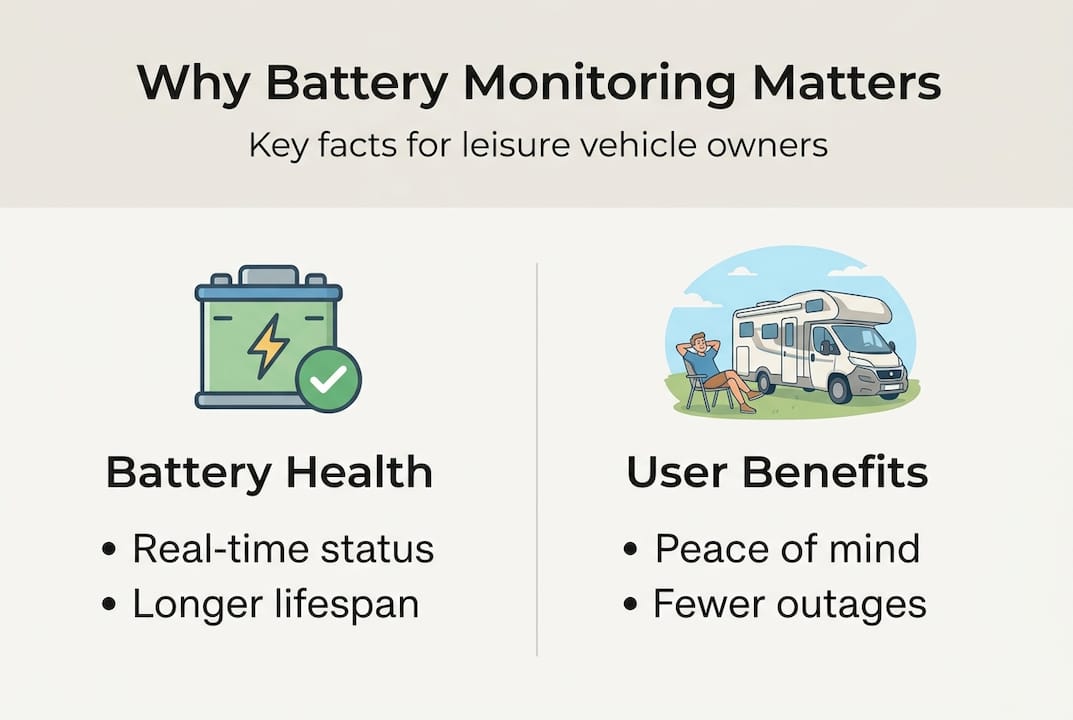
Pro Tip: Always check your SOC reading after a full charge cycle, not mid-charge. This gives you the most accurate baseline for your battery’s current health.
Accurate monitoring also prevents costly errors. Over-discharging a lead-acid battery below 50% SOC repeatedly will significantly shorten its lifespan. For lithium batteries, the consequences of poor monitoring can include triggering the battery management system (BMS) cutoff at an inconvenient moment.
Key benefits of battery monitoring for off-grid adventures
With a clear understanding of battery monitoring, we can now explore the main benefits it offers for your off-grid experiences.
Real-time data changes how you plan and use power. Instead of rationing electricity based on a rough estimate, you can see exactly how much capacity remains and adjust consumption accordingly. Running a 12V compressor fridge, lighting, and a laptop simultaneously is manageable when you know your actual SOC.
“Advanced battery monitoring technology is essential for reliability and performance in off-grid energy setups, particularly for UK leisure vehicle owners who face variable weather and charging conditions.”
The key benefits include:
- Preventing over-discharge: Alerts before your battery hits a critical low, protecting both lead-acid and lithium chemistries
- Avoiding unexpected outages: No more waking up to a dead battery because you misjudged overnight consumption
- Extending battery lifespan: Keeping discharge within safe limits adds years to battery life
- Optimising solar input: Knowing your charge rate helps you position panels and plan stops effectively
- Reducing maintenance costs: Early warnings flag issues before they become expensive failures
The role of BMS in modern lithium batteries already provides some protection, but a standalone monitor gives you visibility that the BMS alone does not offer. The BMS protects the battery; the monitor informs you.
For UK travellers exploring remote areas of Scotland, Wales, or the Lake District, the stakes are higher. A power failure in a remote spot is not just inconvenient. It can affect heating, navigation, and communication equipment. Reliable monitoring is a practical safety measure, not just a convenience.

Different types of battery monitoring solutions
Understanding the benefits is one thing, but which battery monitor is right for you? Let us compare the contemporary options.
There are three main categories of battery monitor available for leisure vehicles:
- Basic voltmeters: Simple panel-mounted displays showing voltage only. Low cost, easy to install, but limited accuracy.
- Integrated panel monitors: Display voltage, current, and sometimes SOC. Mid-range cost and accuracy.
- Smart shunt monitors with Bluetooth: Shunt-based systems that measure all current flowing through the battery. Highest accuracy, app connectivity, and data logging.
| Monitor type | Accuracy | Features | Approx. cost | Best for |
|---|---|---|---|---|
| Basic voltmeter | Low | Voltage only | £10 to £30 | Casual, occasional use |
| Panel monitor | Medium | Voltage, current, SOC | £40 to £100 | Regular weekend trips |
| Smart shunt (Bluetooth) | High | Full data, app, logging | £80 to £200 | Full-time or extended travel |
Basic voltmeters are cheap but inaccurate, while advanced shunt-based systems such as those from Victron are reliable but carry a higher upfront cost. The investment is justified for anyone spending significant time off-grid.
For Bluetooth monitoring insights, smart shunt systems allow you to check battery status from your phone without opening a panel. This is particularly useful in motorhomes where the battery compartment is not easily accessible.
Key factors when choosing:
- Battery chemistry: Lithium batteries benefit most from precise SOC tracking; lithium BMS benefits are maximised when paired with an accurate external monitor
- System complexity: Multi-battery or solar setups need more capable monitors
- Budget: Do not let upfront cost drive you toward a solution that will frustrate you in the field
Pro Tip: If you are running a lithium battery, pair it with a shunt-based monitor from day one. The SOC accuracy difference compared to a voltmeter is significant and will pay for itself in battery longevity.
Integrating monitoring into your leisure vehicle: Practical steps
Once you have selected your monitoring solution, it is time to put your knowledge into action in your vehicle.
Follow these steps to install and configure your battery monitor correctly:
- Identify your battery type and chemistry. Lead-acid, AGM, gel, and lithium all have different charge profiles and SOC curves. Your monitor must be configured for the correct chemistry.
- Locate the correct shunt position. The shunt must be installed on the negative terminal of the battery, between the battery and all loads. Any current bypassing the shunt will produce inaccurate readings.
- Connect the monitor display or app. For Bluetooth systems, download the manufacturer’s app and pair the device before finalising installation.
- Set battery capacity correctly. Enter the exact amp-hour (Ah) rating of your battery. Incorrect capacity settings will skew every SOC reading.
- Add a temperature sensor if available. This is especially important for lithium batteries operating in cold UK conditions.
| Usage pattern | Must-have features |
|---|---|
| Weekend trips | Voltage, SOC, low battery alert |
| Extended touring | Full shunt monitoring, Bluetooth app |
| Solar-integrated setup | Charge current tracking, historical data |
| Full-time living | Temperature sensor, multi-bank support |
Accurate monitoring systems prevent costly errors and support long-term system health. Reviewing battery troubleshooting tips before installation helps you avoid the most common wiring mistakes.
Common installation errors include placing the shunt incorrectly, failing to account for all loads on the negative bus, and not resetting the SOC after a full charge. Each of these will produce misleading readings and undermine the value of the entire system.
Pro Tip: After installation, run a full charge and discharge cycle before trusting your SOC readings. This allows the monitor to calibrate accurately to your specific battery.
Our view: Why accuracy in battery monitoring is worth the investment
After years of advising leisure vehicle owners across the UK, the pattern is consistent. Owners who save money on a basic voltmeter often return frustrated, having experienced either unexpected power loss or premature battery failure. The monitor was not the direct cause, but the lack of accurate data meant problems went undetected until it was too late.
The contrast is clear. Basic voltmeters cheap but inaccurate; advanced shunt-based systems from brands such as Victron carry a higher price but deliver the precision needed for genuine reliability. One unexpected battery replacement costs more than the price difference between a voltmeter and a quality shunt monitor.
Off-grid travel in the UK is not always forgiving. A single night of underestimated consumption can leave you without heating or a working fridge. The discomfort is real, and so is the potential cost to your equipment. Reviewing UK battery monitoring advice before purchasing any system is a practical first step. Skimping on monitoring is a false economy, and the data consistently supports investing in accuracy from the start.
Power your adventures with proven battery monitoring solutions
If you are ready to make every trip less stressful and more energy-efficient, here is where to start.
Skyenergi supplies a range of monitoring and energy management solutions built for UK leisure vehicles. Whether you need a complete solar electrics and monitoring package or a standalone system, we stock products designed for real-world off-grid use.

For larger setups, the Victron EasySolar system integrates inverter, MPPT controller, and monitoring in a single unit. If solar is your primary charging source, our Victron solar solutions include smart MPPT charge controllers with built-in monitoring capability. Browse the full range at Skyenergi and take control of your energy on the road.
Frequently asked questions
What does a battery monitor actually measure in a leisure vehicle?
A battery monitor measures voltage, current, and the calculated state of charge, giving you precise, real-time feedback on your battery’s true capacity. Unlike a voltmeter, it tracks cumulative energy flow to maintain an accurate SOC reading, as battery monitoring is essential for accurate charge feedback.
Can I use a voltmeter instead of a smart battery monitor?
A basic voltmeter is inexpensive but unreliable for off-grid use, as voltage alone does not accurately reflect remaining capacity under load. Smart monitors with shunt technology provide the precise, real-time data needed for dependable off-grid performance, since basic voltmeters are inaccurate compared to advanced shunt systems.
How does battery monitoring extend the life of my batteries?
Monitoring systems track discharge depth and flag when your battery approaches unsafe levels, preventing the over-discharge that is a leading cause of premature battery failure. Keeping within safe SOC limits consistently adds measurable cycles to your battery’s usable life, as proper monitoring prevents over-discharge and battery damage.
Do I need professional help to install a battery monitor?
Many modern monitors are straightforward to install for those comfortable with basic 12V wiring, but solar-integrated or multi-bank systems benefit from professional installation to ensure accuracy. Professional advice ensures optimal installation and correct system configuration from the outset.
Recommended
Prev post

Install lithium campervan batteries: UK step-by-step guide
Updated on 02 April 2026
Next post

Top 5 Off-Grid Battery Solutions for Campervans 2026
Updated on 31 March 2026


