






Why battery bank capacity matters for off-grid power
Discover why battery bank capacity matters for off-grid power. Learn how to optimize storage for reliable energy and avoid costly mistakes.
Battery bank capacity is the total amount of electrical charge a battery bank can store and deliver, directly determining how long your off-grid system can power your devices before requiring a recharge. Getting this figure right is the single most consequential decision in any off-grid energy build. Size it too small and your system fails under load. Size it too large without matching your solar array and you create a different set of problems. Understanding why battery bank capacity matters means understanding usable energy, Depth of Discharge (DoD), conversion losses, and how these factors interact in real systems.
Why battery bank capacity matters for system reliability
Battery bank capacity, known in the industry as nominal capacity, is measured in ampere-hours (Ah) or watt-hours (Wh). Nominal capacity describes the total theoretical charge a battery holds. Usable capacity is always lower. The gap between the two determines whether your system performs as expected or falls short.
Depth of Discharge is the key variable here. DoD defines what percentage of a battery’s nominal capacity you can safely draw before recharging. For lithium iron phosphate (LiFePO4) batteries, DoD is typically 80–90%. For lead-acid batteries, it sits closer to 50%. Usable capacity from nominal must be calculated using DoD to avoid premature battery failure. Ignoring this in your sizing calculation is one of the most common and costly mistakes in off-grid system design.

Here is why this matters practically. A 200Ah lithium battery at 80% DoD delivers 160Ah of usable energy. A 200Ah lead-acid battery at 50% DoD delivers only 100Ah. The nominal rating is identical. The real-world output is not. Choosing the right battery size requires working from usable capacity, not the headline figure on the label.
How depth of discharge affects battery lifespan
Every discharge cycle stresses a battery’s chemistry. Deeper cycles cause faster degradation. Oversizing capacity slightly extends lifespan by keeping each cycle shallower, which reduces the chemical stress on cells over time. A battery bank sized at 120% of your calculated need will consistently cycle at lower DoD levels, extending its operational life well beyond its nominal cycle rating.
Battery capacity also degrades by roughly 20% after 500 cycles under typical conditions. Building a degradation buffer into your initial sizing means the system continues to meet your energy needs years after installation, without requiring an early replacement. Professional and commercial users in particular benefit from this approach, where downtime and replacement costs carry real financial weight.
- Nominal capacity is the headline figure. It does not reflect what you can safely use.
- Usable capacity accounts for DoD. This is the figure to base your sizing on.
- Cycle depth directly affects how quickly a battery degrades. Shallower cycles mean longer life.
- Degradation buffer of 20–25% above calculated need protects performance over a multi-year horizon.
- BMS integration is critical. A battery management system enforces DoD limits automatically, protecting cells from over-discharge.
Pro Tip: When calculating your battery bank size, always work from usable capacity, not nominal. Multiply your daily energy load by your autonomy days, then divide by your DoD percentage. Add a 20% buffer on top for usage spikes and degradation over time.
What are the real energy losses in a battery bank?
Advertised capacity figures are optimistic by design. A 20,000mAh power bank typically delivers between 12,000mAh and 17,400mAh of usable output. That is 60–87% of the stated figure. The shortfall comes from voltage conversion losses, heat dissipation, and internal resistance.
The core issue is voltage mismatch. Lithium cells operate at 3.6–3.7V. Most USB devices require 5V output. The conversion circuit steps up the voltage, and energy is lost in the process. Typical conversion losses run at 15–30% depending on component quality. This means the mAh rating on the label and the mAh your device actually receives are two different numbers.
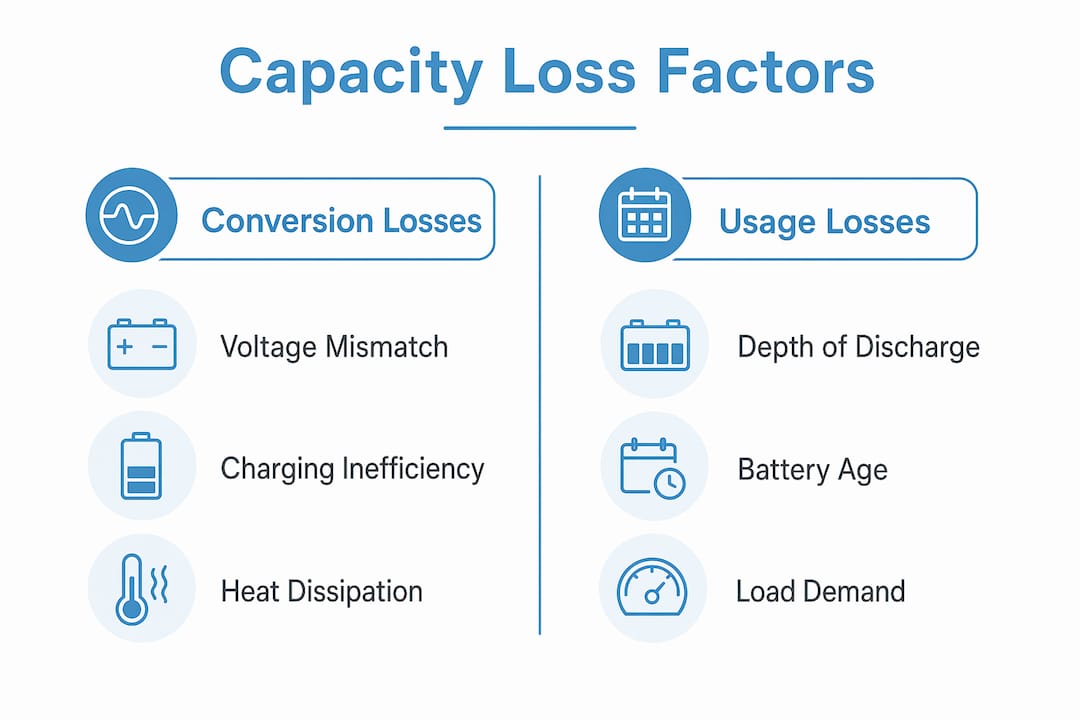
Watt-hours (Wh) provide a more accurate comparison than mAh alone. Wh accounts for both capacity and voltage, giving you a true measure of energy stored. A battery rated at 74Wh and another rated at 20,000mAh at 3.7V both hold roughly the same energy, but the Wh figure communicates this directly without requiring a conversion calculation.
| Metric | What It Measures | Limitation |
|---|---|---|
| mAh | Charge at cell voltage | Misleading across different voltages |
| Wh | Total energy stored | More accurate for cross-device comparison |
| Usable Wh | Energy after DoD and losses | Most accurate for real-world planning |
Quality matters significantly here. Reputable brands achieve conversion efficiency of 85–90%, while cheaper models often fall below 70%. A budget 20,000mAh unit may deliver less usable energy than a quality 15,000mAh unit from a recognised manufacturer. Checking the Wh rating and the brand’s stated efficiency figure gives you a far clearer picture than the mAh headline alone.
Pro Tip: When comparing battery banks or off-grid storage systems, always request or calculate the Wh figure. Divide the mAh rating by 1,000 and multiply by the nominal cell voltage to get Wh. This single step removes most of the confusion around capacity claims.
How does battery bank sizing affect off-grid system design?
Battery bank sizing methodology follows a clear sequence. Start with your daily energy load in Wh. Multiply by the number of autonomy days you need (typically 2–3 days for off-grid solar). Divide by your DoD percentage. Add a 20% safety margin to account for usage spikes and future load growth. The result is your minimum recommended bank size.
- Calculate daily load. List every device, its wattage, and daily hours of use. Sum the total in Wh.
- Set autonomy days. Two to three days is standard for solar-dependent systems without generator backup.
- Apply DoD. Divide total energy need by your battery’s DoD rating (e.g., 0.8 for LiFePO4).
- Add a 20% buffer. Multiply the result by 1.2 to cover spikes and degradation.
- Match to your solar array. Confirm your panels can fully recharge the bank within a reasonable daily window.
The fifth step is where many systems fail. A battery bank too large for its charging source remains in a chronic partial state of charge. This chemical imbalance reduces efficiency and shortens battery life. Spending more on capacity than your solar array can support wastes capital and damages the cells you paid to protect.
Capacity sizing also has direct operational consequences. A 600Ah bank allows multiple days of operation without running a generator, compared to a 200Ah bank under the same daily load. For marine users, motorhome owners, and remote residential setups, this translates to less fuel consumption, less noise, and greater comfort. You can explore battery bank use cases for motorhomes to see how these sizing principles apply in mobile off-grid contexts.
For home energy storage, the trade-offs shift slightly. Load shifting, peak demand management, and grid independence all benefit from correctly sized capacity. Undersized banks force more frequent grid draw during peak tariff periods. Oversized banks tied to small solar arrays sit underutilised and degrade through partial charging. The correct size sits at the intersection of your load, your solar input, and your autonomy target.
Does capacity alone determine battery bank performance?
Capacity is one specification. It is not the only one that determines whether a battery bank performs well in your system. Output wattage, input charging rate, and battery chemistry all interact with capacity to define real-world performance.
A 25,600mAh power bank can recharge devices nearly three times faster and deliver higher output wattage than a 30,000mAh unit with lower wattage ratings. The larger capacity bank loses the performance comparison despite its headline advantage. This pattern repeats across off-grid storage systems. A mid-capacity lithium battery with a high continuous discharge rate may outperform a larger lead-acid bank for high-draw applications like inverters or power tools.
| Specification | What It Affects | Why It Matters |
|---|---|---|
| Capacity (Ah/Wh) | Runtime between charges | Determines autonomy days |
| Continuous discharge rate (C-rate) | Peak power delivery | Critical for high-draw devices |
| Input charge rate | Recharge speed | Affects solar and generator integration |
| Round-trip efficiency | Energy retained per cycle | Affects long-term running costs |
Users often conflate capacity with power delivery. A battery with high capacity but a low C-rate cannot supply the instantaneous current that some loads demand. Checking the continuous discharge specification alongside capacity prevents mismatches between your battery bank and your load profile. For off-grid systems with inverters, this is particularly relevant. The lithium battery features guide from Skyenergi covers these specifications in detail for users building or upgrading off-grid systems.
Assessing a battery bank correctly means reviewing at least four figures: usable capacity in Wh, continuous discharge rate, input charge rate, and round-trip efficiency. Capacity alone tells you how much energy is stored. The other three tell you how quickly you can use it, how quickly you can replace it, and how much you lose in the process.
Key takeaways
Correctly sizing battery bank capacity is the foundation of a reliable, long-lasting off-grid energy system, requiring usable capacity, DoD, conversion losses, and output specifications to all be assessed together.
| Point | Details |
|---|---|
| Usable capacity, not nominal | Always size your bank using DoD-adjusted usable capacity, not the headline Ah figure. |
| Oversizing extends lifespan | A 20–25% capacity buffer reduces cycle depth and delays degradation significantly. |
| Match capacity to solar input | A bank too large for its charging array causes partial state of charge and cell damage. |
| Wh beats mAh for comparisons | Watt-hours account for voltage and give a true measure of stored energy across systems. |
| Capacity is one of four specs | Discharge rate, charge rate, and efficiency must be assessed alongside capacity. |
The sizing mistake i see most often
Most people who contact Skyenergi about underperforming systems have made the same error. They sized their battery bank on nominal capacity and ignored DoD. A 200Ah bank sounds substantial until you realise a lead-acid version at 50% DoD gives you 100Ah of real energy. That is a 50% shortfall built into the design from day one.
The second most common mistake is oversizing without checking the solar array. I have seen systems where a customer invested in a 400Ah lithium bank paired with a 100W panel. The panel cannot fully recharge that bank in a single day under good conditions. The battery spends most of its life in a partial state of charge, which is one of the most damaging conditions for lithium chemistry over time.
My honest recommendation is to oversize slightly, but do it intelligently. A 20% buffer above your calculated need is sound practice. It accounts for degradation, usage spikes, and future load additions. Going beyond that requires a proportional increase in your charging source. The energy storage upgrade guide covers this balance well for users planning incremental system growth.
The broader point is this: battery bank capacity is not a single number to maximise. It is a variable to calibrate against your load, your charging source, your chemistry, and your autonomy requirements. Get all four right and the system runs efficiently for years. Get one wrong and the others cannot compensate.
— John
Victron energy systems built for correct capacity management
Skyenergi stocks a range of Victron Energy products designed to work together as a complete, well-matched off-grid system. The Victron Solar Home System 200 MPPT combines solar input, MPPT charge control, and battery management in a single kit, making it straightforward to match charging capacity to battery bank size from the outset.

For users building larger or more complex systems, Skyenergi also supplies Victron MPPT controllers, inverter/chargers, and monitoring components that integrate directly with lithium battery banks. Every product is sourced directly from manufacturers to keep pricing competitive without compromising on specification. If you are sizing a new system or upgrading an existing one, the Victron range gives you the tools to get the balance right.
FAQ
What is battery bank capacity?
Battery bank capacity is the total electrical charge a battery bank can store, measured in ampere-hours (Ah) or watt-hours (Wh). Usable capacity is always lower than the nominal figure due to Depth of Discharge limits and conversion losses.
How do i calculate the right battery bank size?
Multiply your daily energy load in Wh by your required autonomy days, divide by your DoD percentage, then add a 20% buffer. Two to three autonomy days is the standard starting point for off-grid solar systems.
Why does depth of discharge matter for battery life?
Deeper discharge cycles accelerate chemical degradation inside battery cells. Keeping cycles shallower by sizing your bank generously extends operational life and delays the point at which capacity drops below acceptable levels.
Is a higher mAh rating always better?
Not necessarily. A higher mAh rating from a low-quality manufacturer may deliver less usable energy than a lower-rated unit from a reputable brand, due to conversion efficiency differences of 85–90% versus below 70%.
Can a battery bank be too large for an off-grid system?
Yes. A bank too large for its solar array remains in a chronic partial state of charge, causing chemical imbalance and reducing both efficiency and lifespan. Capacity must be matched to your charging source, not just your load.
Recommended
Prev post

Residential battery buying guide for UK homes
Updated on 17 June 2026
Next post

Step by step campervan electrics: 2026 UK guide
Updated on 15 June 2026


