





Grid connection application for battery storage: UK guide
Navigate the grid connection application for battery storage in the UK. Learn how to avoid common pitfalls and ensure compliance for your system.
A grid connection application for battery storage is the formal process by which you notify or seek approval from your Distribution Network Operator (DNO) before connecting an energy storage system to the public electricity network. In the UK, this process is governed by ENA Engineering Recommendations G98, G99, and G100, each applying to different system sizes and configurations. Getting the right application route wrong is one of the most common and costly mistakes UK installers and homeowners make. This guide sets out exactly which route applies to your system, how to submit a compliant application, and what pitfalls to avoid in 2026.
What are the regulatory standards that govern UK battery storage grid connections?
The UK’s grid interconnection requirements for battery storage centre on three ENA Engineering Recommendations: G98, G99, and G100. Each applies to a different system type, and choosing the wrong one can result in disconnection or retrospective compliance costs.
Most UK DNOs treat AC-coupled battery systems as generating stations, not simple electrical loads. That classification means your battery storage system must follow either a notification or a formal application route before it exports electricity to the grid.

G98: the notification route
G98 applies to installations with an export capacity of 16A per phase or less, which equates to up to 3.68 kW on a single-phase supply. Under G98, you do not need prior DNO approval. You commission the system and notify your DNO within 28 days. That notification window is firm, and missing it puts you in breach of the standard.
G99: the formal application route
G99 applies to any system above 16A per phase, or to three-phase systems above 11.04 kW. Unlike G98, G99 requires written DNO acceptance before you commission the system. The DNO has a 45-working-day window to respond. G99 is a legal requirement, and the DNO holds discretion to approve, reject, or limit your export capacity based on the application you submit.
G100: DC-coupled systems and export limitation
G100 applies to DC-coupled battery storage systems connected behind solar inverters. It requires export limitation controls to cap net export and prevent the combined output from exceeding inverter capacity. G100 compliance must be included alongside your G98 or G99 application. Non-compliance with G100 is a frequent cause of DNO rejection.
| Standard | Applies to | Process | Timing |
|---|---|---|---|
| G98 | Up to 16A per phase (≤3.68 kW single-phase) | Notify DNO after commissioning | Within 28 days of commissioning |
| G99 | Above 16A per phase or >11.04 kW three-phase | Formal application, written DNO approval required | DNO responds within 45 working days |
| G100 | DC-coupled battery behind solar inverter | Export limitation compliance alongside G98/G99 | Submitted with main application |
Pro Tip: If you are adding a battery to an existing solar installation, calculate the combined export capacity of both assets before selecting your route. The aggregate figure, not the battery alone, determines whether G98 or G99 applies.
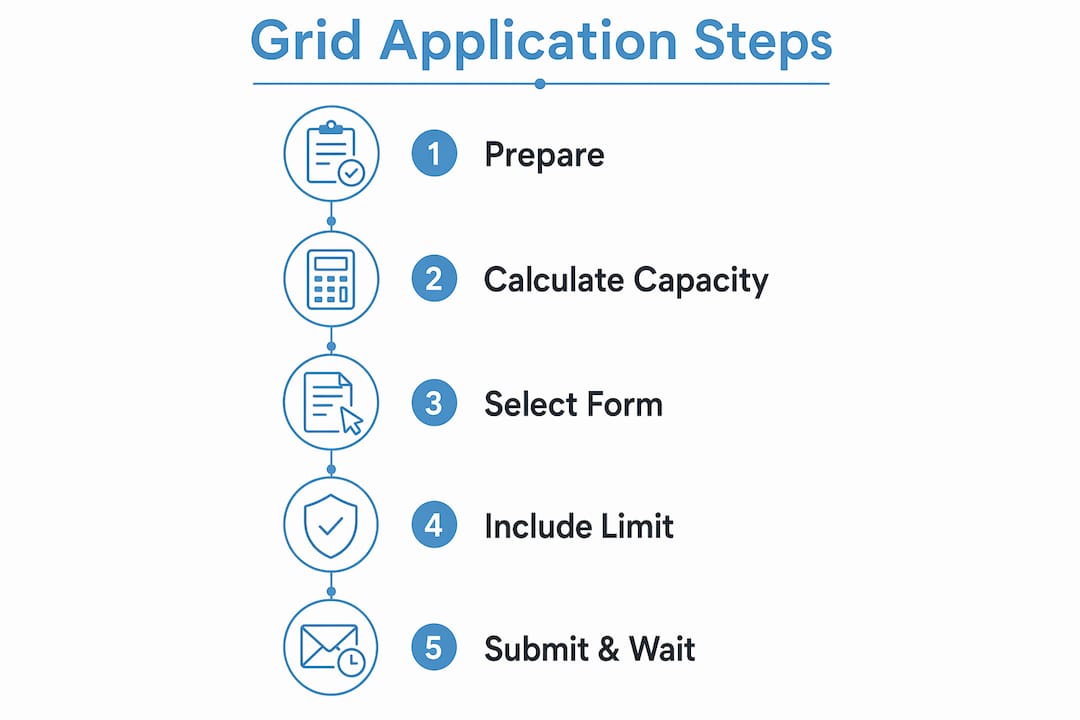
How to prepare and submit a grid connection application for battery storage
Preparation is the stage where most applications succeed or fail. A complete, accurate submission reduces DNO queries and avoids delays.
Step 1: Gather your technical documentation
Collect the following before you begin:
- Inverter specifications, including rated output in kW and amps per phase
- A single-line diagram showing the full system layout
- Protection relay settings and anti-islanding configuration details
- Battery Management System (BMS) data, including charge and discharge rates
- Details of all existing generation assets at the same connection point
Step 2: Calculate aggregate export capacity
All generating assets at the connection point must be included in your capacity calculation. A 3 kW solar array combined with a 2 kW battery inverter gives an aggregate export figure of 5 kW. That total determines your application route, not each asset in isolation.
Step 3: Select the correct form and DNO
Each DNO publishes its own G98 notification form and G99 application form. You submit to the DNO responsible for your network area. In England, Scotland, and Wales, DNOs include National Grid Electricity Distribution, SP Energy Networks, and Electricity North West, among others. Check your electricity bill or the Energy Networks Association website to confirm your DNO.
Step 4: Include export limitation if required
If your system is DC-coupled, include G100 export limitation documentation with your submission. If you plan to limit export to zero, state this clearly and provide the technical controls that enforce it. DNOs assess this information as part of their network impact review.
Step 5: Submit and await response
For G99 applications, the DNO has 45 working days to respond. Do not commission the system before receiving written approval. For G98, commission first, then notify within 28 days. Keep copies of all correspondence and confirmation receipts.
| Application step | G98 | G99 |
|---|---|---|
| Prior DNO approval needed | No | Yes |
| Notification or submission timing | Within 28 days of commissioning | Before commissioning |
| DNO response window | Not applicable | 45 working days |
| Export limitation (G100) required | If DC-coupled | If DC-coupled |
Pro Tip: Request a pre-application feasibility discussion with your DNO before submitting a G99 application. Many DNOs offer this service at no cost, and it can identify network constraints early, saving weeks of delay.
What are the common pitfalls in battery storage grid connection applications?
Several recurring mistakes cause applications to be delayed, rejected, or result in costly retrospective compliance work.
- Misjudging aggregate capacity. Adding a battery to an existing solar system can push combined export above 16A per phase, triggering a G99 requirement even when the battery alone would qualify for G98. Many applicants miss this and submit the wrong form.
- Omitting existing generation assets. Failing to declare co-located solar, wind, or other generation in your application gives the DNO an incomplete picture. This leads to rejection or, worse, retrospective compliance testing after commissioning.
- Ignoring G100 for DC-coupled systems. DC-coupled battery storage behind solar inverters requires G100 export limitation compliance. Omitting this is one of the most frequent causes of DNO rejection.
- Energising before G99 approval. Installing or energising a battery storage system before receiving formal DNO approval under G99 breaches distribution licence conditions and can result in forced disconnection.
- No export MPAN on record. Exporting electricity without an export MPAN and without a compliance record on file requires the generating station to shut down until full compliance testing is completed. That testing carries significant cost.
“The UK grid’s connection queue for battery storage projects far exceeds projected capacity needs for 2030 and 2035. Over 14.8 GW of surplus capacity above 2030 targets has already been identified, and 221 GW of non-viable projects have been filtered out. Speculative or poorly prepared applications face increasing scrutiny and are unlikely to progress.”
Ofgem’s 2026 guidance prioritises viable projects and proposes levies on high-impact speculative applications. Projects must now demonstrate a credible business case to secure a connection offer. For residential and small commercial applicants, this means accurate documentation and realistic export figures matter more than ever.
What tools and best practices support a smooth UK battery storage grid connection?
Getting your renewable energy storage connection approved first time requires more than filling in the correct form. System design, documentation, and ongoing compliance all play a part.
- Use certified installers. Installations must comply with BS 7671 (the IET Wiring Regulations) and, for solar-plus-storage systems, MCS 012. A certified installer carries professional indemnity and understands DNO submission requirements. This is not optional for G99 applications.
- Conduct a pre-application feasibility study. A battery storage feasibility study assesses network capacity, export potential, and compliance requirements before you commit to hardware. It identifies whether your connection point can support your planned system without costly reinforcement.
- Verify your export MPAN. Confirm with your DNO that an export MPAN exists for your property before commissioning. If one does not exist, apply for it as part of your grid tie system application.
- Document everything. Keep inverter datasheets, BMS specifications, single-line diagrams, protection settings, and all DNO correspondence in a single project file. DNOs can request this information at any point, including after commissioning.
- Use export limitation software where applicable. For DC-coupled systems, export limitation controls must be verifiable and tamper-resistant. Software-based controls are acceptable if they meet G100 requirements and are documented in your submission.
- Monitor regional network constraints. Some DNO regions have limited headroom for new connections. Check your DNO’s published network capacity maps before selecting a connection point or system size.
| Best practice | Why it matters |
|---|---|
| Certified installer (BS 7671, MCS 012) | Required for G99 compliance and professional indemnity |
| Pre-application feasibility study | Identifies network constraints before hardware purchase |
| Export MPAN verification | Prevents retrospective compliance testing costs |
| Complete project documentation | Supports DNO review and post-commissioning audits |
| G100 export limitation controls | Required for all DC-coupled battery systems |
Pro Tip: Check the UK battery safety standards that apply to your system before finalising your application. Compliance with current safety regulations strengthens your G99 submission and reduces the risk of DNO queries.
Key takeaways
A successful grid connection application for battery storage in the UK depends on selecting the correct regulatory route, submitting complete technical documentation, and commissioning only after the appropriate approval or notification is in place.
| Point | Details |
|---|---|
| G98 vs G99 threshold | Systems above 16A per phase require G99 formal approval before commissioning. |
| Aggregate capacity rule | All co-located generation assets count toward the export capacity total, not just the battery. |
| G100 for DC-coupled systems | DC-coupled batteries behind solar inverters must include G100 export limitation compliance. |
| Commission timing | G99 systems must not be energised before written DNO acceptance is received. |
| 2026 regulatory scrutiny | Ofgem and DNOs now prioritise viable projects; speculative or incomplete applications face rejection. |
The part of this process most applicants underestimate
The paperwork looks straightforward until you are three weeks into a G99 review and the DNO comes back asking for protection relay settings you did not include. I have seen this delay projects by two months. The 45-working-day clock only starts when the DNO considers your application complete, and they decide what “complete” means.
The aggregate capacity rule catches people out constantly. A homeowner adds a 3.5 kW battery to a 3.5 kW solar system and assumes G98 applies because neither asset alone exceeds the threshold. The combined 7 kW export capacity puts them firmly in G99 territory. That is not a technicality. That is a missed application route, a potential disconnection notice, and a compliance bill they did not budget for.
The 2026 regulatory environment is also less forgiving than it was two years ago. The connection queue is genuinely oversubscribed. Legal protections for advanced projects have contributed to overcapacity in the queue, and eligibility for connection may increasingly require secured revenue support. For residential applicants, this is less of a concern. For commercial projects, demonstrating a credible business case is now a practical necessity, not a formality.
My recommendation: engage your DNO early, even before you finalise your system design. A pre-application conversation costs nothing and can save you from designing a system that cannot get a connection offer. Keep your documentation complete from day one. And if you are adding storage to an existing solar installation, recalculate your aggregate export capacity before you assume anything about your application route.
The home energy storage basics are well-established. The regulatory process around them is where projects stall. Get that part right first.
— John
Skyenergi battery storage: built for compliant grid integration
Skyenergi supplies high-performance lithium battery systems designed for residential and off-grid applications across the UK. Whether you are planning a grid-connected home storage setup or a standalone system, the right battery hardware supports a cleaner, more straightforward application process.
The Skyenergi Elite 560Ah features Victron Can-Bus integration for advanced system management, making it well-suited to installations where BMS data is required for DNO submissions. The Core2 680Ah lithium battery includes Bluetooth monitoring and a built-in heat pad for year-round reliability. For smaller setups, the Elite 304Ah variant delivers the same smart integration in a compact form. Browse the full range at Skyenergi to find the right battery for your project.
FAQ
What is the difference between G98 and G99 for battery storage?
G98 applies to systems exporting 16A per phase or less and requires only a DNO notification within 28 days of commissioning. G99 applies to larger systems and requires formal DNO approval before the system is energised.
Does adding a battery to solar trigger a new grid connection application?
Yes, if the combined export capacity of the solar and battery system exceeds 16A per phase, a G99 application is required even if each asset individually falls below the threshold.
What is G100 and when does it apply to battery storage?
G100 applies to DC-coupled battery systems connected behind solar inverters. It requires export limitation controls to cap net export and must be submitted alongside the G98 or G99 application.
How long does a G99 battery storage application take?
The DNO has 45 working days to respond once it considers the application complete. Incomplete submissions reset this clock, so submitting full documentation at the outset is critical.
What happens if I commission a battery storage system without DNO approval?
Commissioning a G99 system without written DNO acceptance breaches distribution licence conditions and can result in forced disconnection and retrospective compliance testing costs.
Recommended
Prev post

Energy resilience for leisure vehicles: 2026 UK guide
Updated on 10 July 2026
Next post

Role of inverters in marine power: a practical guide
Updated on 08 July 2026


