





What is balanced charging for batteries?
Learn what balanced charging is and how it maximizes battery lifespan. Discover essential techniques for optimal performance in your systems.
Balanced charging is defined as the process of equalising the voltage or state of charge (SoC) across every individual cell within a battery pack. Without it, cells drift apart over time, reducing the pack’s usable capacity and accelerating degradation. For anyone running an off-grid solar system, a campervan, or a marine setup, understanding the balanced charging process is the difference between a battery that lasts a decade and one that fails in three years.
What is balanced charging and why does it matter?
Balanced charging is the technique of keeping all cells at equal voltage so the battery pack performs as a single, unified unit. A battery management system (BMS) monitors each cell individually and activates balancing circuits whenever it detects a voltage gap. The goal is simple: no single cell should be significantly weaker or stronger than its neighbours.
The consequences of ignoring cell balance are measurable and serious. A 0.1V voltage difference between cells can cause 5–10% capacity loss in that cell alone, and up to 20% total pack capacity reduction. That means a 200Ah lithium battery could effectively deliver only 160Ah, despite appearing fully charged.
Why cell imbalance gets worse over time
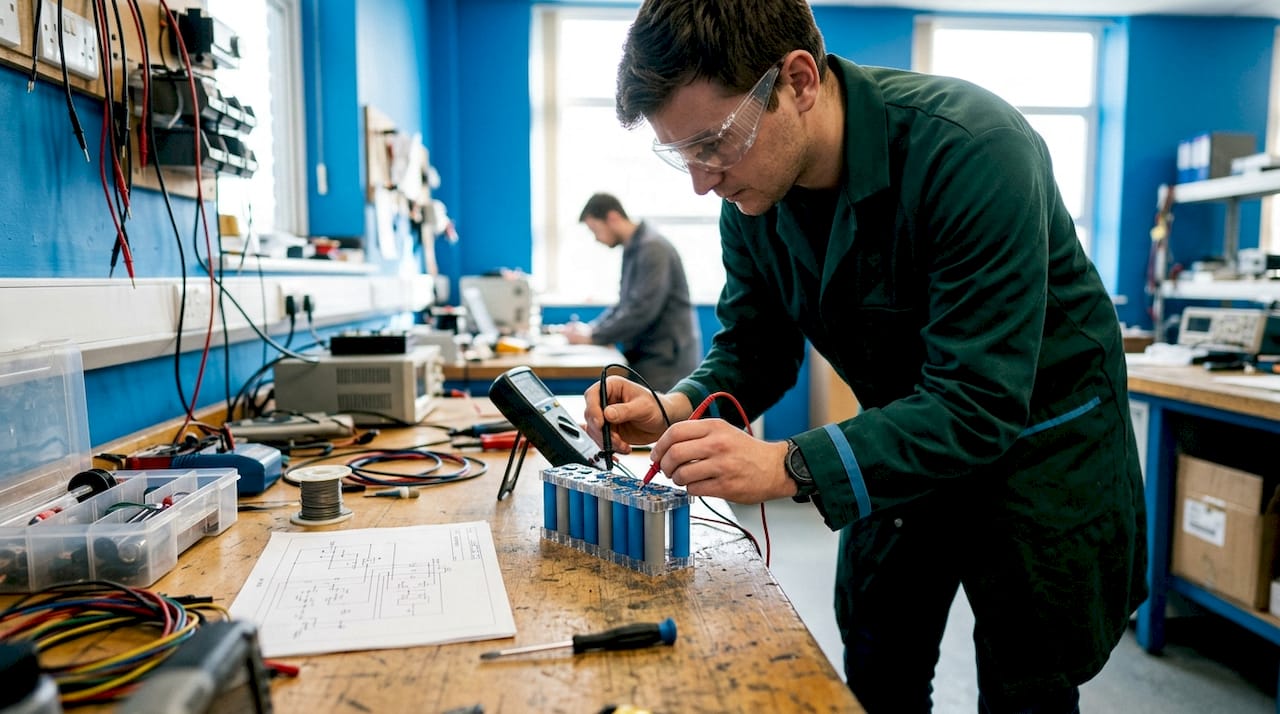
All lithium cells experience internal drift. Manufacturing tolerances, temperature variation, and differing discharge rates cause cells to age at slightly different rates. This drift is not a fault. It is an inevitable physical process. The problem is that an unbalanced pack forces the BMS to cut charging early, at the voltage limit of the weakest cell, leaving stronger cells undercharged.
Unbalanced cells degrade 2–3 times faster than balanced ones and can trigger thermal runaway if the imbalance goes uncorrected. Thermal runaway is a chain reaction of heat and gas release inside a cell. In a vehicle or off-grid system, that risk is unacceptable.
The benefits of balanced charging extend beyond safety. Proactive balancing can extend lithium battery life by 40–60%. For a battery bank costing several hundred pounds, that extension represents significant financial value.
How does the balanced charging process work?
The balanced charging process relies on the BMS as its central controller. The BMS continuously monitors each cell’s voltage in real time, comparing readings across the pack. When a voltage gap exceeds a set threshold, the BMS activates balancing circuits to correct the imbalance.
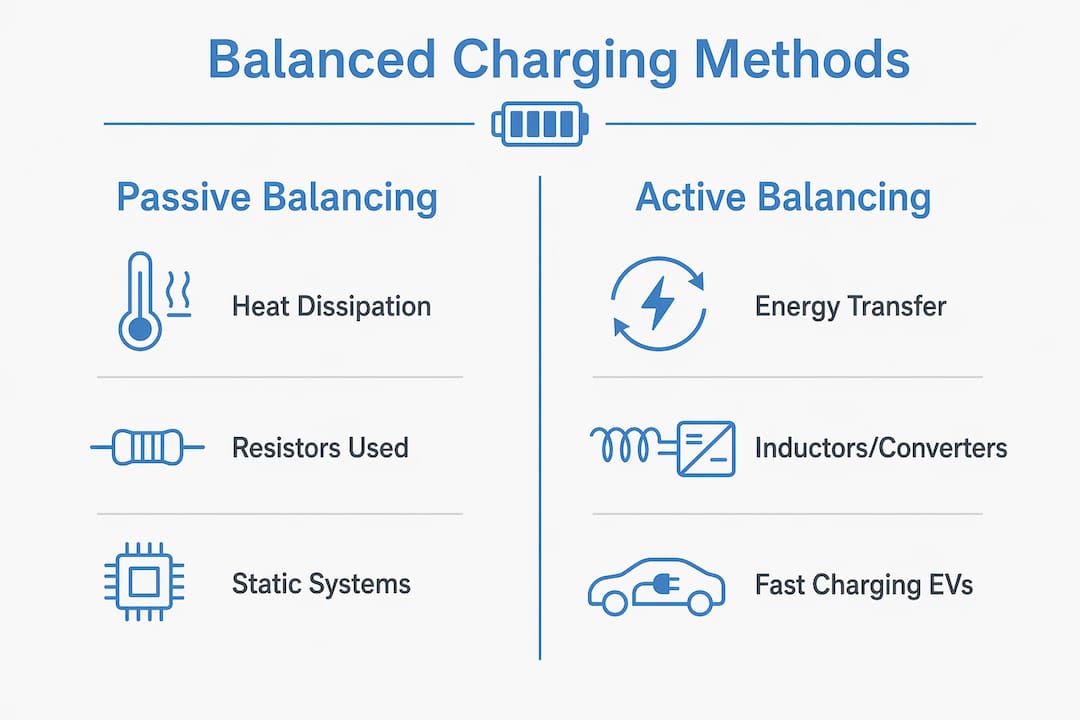
Two distinct methods exist: passive balancing and active balancing. Each works differently and suits different applications.
Passive balancing
Passive balancing dissipates excess energy from higher-voltage cells as heat, using resistors to bleed off the surplus charge. The stronger cells are brought down to match the weaker ones. This method is straightforward and reliable, but it wastes the bled energy rather than redistributing it.
Passive balancing is well suited to predictable, static systems such as a fixed solar installation at home. The charge cycles are regular, the loads are consistent, and the small energy loss from heat dissipation is acceptable.
Active balancing
Active balancing transfers energy from higher-voltage cells to lower-voltage cells using inductors, capacitors, or DC/DC converters. No energy is wasted as heat. Instead, the pack equalises by sharing charge between cells. This approach is more efficient but also more complex and costly to implement.
| Feature | Passive balancing | Active balancing |
|---|---|---|
| Energy handling | Dissipated as heat | Transferred between cells |
| Efficiency | Lower | Higher |
| Cost | Lower | Higher |
| Best application | Static off-grid solar | EVs, marine, high-demand systems |
| Complexity | Simple | More complex |
Converter-based active balancing is now emerging as the preferred approach for fast-charging electric vehicles, offering better speed and control flexibility. This trend reflects the growing demand for high-performance battery management in dynamic applications.
Pro Tip: If your system uses a Victron MPPT charge controller, check that the absorption voltage is set correctly for your battery chemistry. Balancing circuits only engage at or near peak voltage, so an incorrect absorption setting can prevent balancing from ever activating.
What are the types of balanced charging techniques?
The choice of balancing technique depends on the application. Passive and active methods each have a natural home, and using the wrong one adds cost without benefit.
Passive balancing suits these scenarios:
- Fixed residential solar storage: Charge cycles are predictable, loads are steady, and the simplicity of passive balancing reduces the risk of component failure.
- Leisure vehicle systems at rest: A campervan or motorhome parked for extended periods benefits from passive balancing during overnight solar charging.
- Budget-conscious off-grid setups: Passive balancing hardware costs less, making it the practical choice when efficiency losses are acceptable.
Active balancing suits these scenarios:
- Electric vehicles and high-discharge marine systems: Rapid, variable loads demand faster balancing to keep cells matched during both charge and discharge cycles.
- Large battery banks with high cell counts: The efficiency gains from active balancing become more significant as pack size increases.
- Systems requiring maximum usable capacity: Active balancing recovers energy that passive balancing would waste, which matters in high-demand applications.
The absorption phase: when balancing actually happens
Balancing in off-grid systems is often seasonal and tied directly to the absorption charge phase. During absorption, the charger holds voltage at its peak level while current tapers off. This is the window in which balancing circuits engage, because cells are at their highest and most differentiated voltages.
Off-grid users who rely on partial solar days in winter often never reach absorption voltage. Their batteries never fully balance. This is one of the most common and least recognised causes of premature capacity loss in residential and leisure battery systems.
Pro Tip: Schedule a full charge cycle from a mains charger or generator at least once per month during low-sun seasons. This guarantees the absorption phase is reached and balancing can complete properly.
How can you optimise balanced charging in your system?
Getting the most from balanced charging requires active management, not passive reliance on the BMS alone. Follow these steps to keep your battery bank in good condition.
-
Allow full absorption charges regularly. The BMS balancing circuits only activate during the absorption phase. Partial charges prevent balancing from engaging. Aim for at least one full charge cycle per week in active systems, and monthly in low-use setups.
-
Monitor individual cell voltages. Many BMS units with Bluetooth connectivity display per-cell voltage data. Check this data periodically. A cell consistently reading 0.05V or more above or below its neighbours signals a developing imbalance that needs attention. Skyenergi’s lithium leisure batteries include Bluetooth monitoring for exactly this purpose.
-
Perform manual top-balancing when needed. Manual top-balancing restores cell harmony when automatic balancing cannot correct a persistent imbalance. This involves individually charging each cell to the same voltage before reconnecting the pack. It is recommended as a maintenance procedure for off-grid battery banks showing signs of drift.
-
Use a BMS that supports both balancing methods. A BMS limited to passive balancing may be insufficient for a growing system. Choose hardware that can be configured or upgraded as your energy demands change. Skyenergi’s range of Victron-compatible BMS components supports both passive and active balancing configurations.
-
Follow a structured maintenance schedule. A battery maintenance checklist for leisure and off-grid systems covers balancing checks alongside terminal inspection, SoC calibration, and firmware updates. Treating balancing as part of routine maintenance, rather than an emergency fix, prevents the gradual drift that shortens battery life.
Key takeaways
Balanced charging is the single most effective maintenance practice for extending lithium battery life and preventing safety failures in off-grid and vehicle systems.
| Point | Details |
|---|---|
| Definition of balanced charging | Equalising voltage or SoC across all cells prevents capacity loss and degradation. |
| Capacity impact of imbalance | A 0.1V cell difference can reduce total pack capacity by up to 20%. |
| Passive vs active balancing | Passive suits static solar systems; active suits high-demand EVs and marine applications. |
| Absorption phase is critical | Balancing only activates at peak voltage, so full charge cycles must be completed regularly. |
| Lifespan benefit | Proactive balancing extends lithium battery life by 40–60%. |
Why balanced charging is often misunderstood
Most people treat balanced charging as something the BMS handles automatically and permanently. That assumption is wrong, and it costs battery owners years of usable life.
The BMS is a reactive system. It corrects imbalance when it detects it, but only if the conditions for balancing are met. If your system never reaches absorption voltage, the BMS never gets the chance to act. I have seen off-grid setups where the owner believed their batteries were being balanced every day, when in reality the system had not completed a full absorption cycle in months. The cells had drifted significantly, and the usable capacity had quietly dropped.
The other misconception is that balancing is only needed when something goes wrong. Balancing is proactive maintenance, not a recovery tool. Cells drift even in healthy, well-managed systems. The question is whether you catch the drift early or discover it when the battery fails to power your system through the night.
Active balancing technology is advancing quickly. Converter-based systems are becoming more affordable and are starting to appear in mid-range off-grid hardware, not just high-end EV applications. Within a few years, active balancing will likely be standard in most quality leisure battery systems. For now, the practical priority is ensuring your existing BMS has the conditions it needs to do its job.
— John
Skyenergi battery systems with built-in balancing support
Skyenergi supplies battery management hardware and solar charging systems designed to support effective cell balancing from installation onwards.

The Victron Energy Solar Home System 200 MPPT integrates solar charging with battery management in a single unit, making it straightforward to configure absorption voltage correctly and maintain regular full charge cycles. For off-grid and leisure vehicle users, this removes the most common barrier to effective balancing. The Victron Energy Battery Balancer is a dedicated hardware solution for 24V battery banks, actively equalising cell voltages across series-connected batteries. Both products are available directly from Skyenergi with full technical specifications on the product pages.
FAQ
What is balanced charging in simple terms?
Balanced charging is the process of equalising the voltage or state of charge across every cell in a battery pack. It prevents stronger cells from overcharging while weaker cells remain undercharged.
Why is balanced charging important for lithium batteries?
Without balancing, a single weak cell forces the BMS to cut charging early, reducing total pack capacity by up to 20%. Unbalanced cells also degrade 2–3 times faster and carry a higher risk of thermal runaway.
How does a BMS carry out the balancing process?
The BMS monitors each cell’s voltage continuously and activates balancing circuits when a voltage gap is detected. Passive circuits bleed excess charge as heat; active circuits transfer charge between cells.
Does balanced charging happen automatically?
The BMS handles balancing automatically, but only when the battery reaches the absorption phase of a full charge cycle. Systems that never complete a full charge may never balance effectively.
What is the difference between passive and active balancing?
Passive balancing dissipates excess cell energy as heat and suits static off-grid solar systems. Active balancing transfers energy between cells with no waste and is better suited to electric vehicles and high-demand marine applications.
Recommended
Prev post

Why passive cooling in battery systems matters in 2026
Updated on 14 July 2026
Next post

Residential off-grid power tips for UK homeowners
Updated on 12 July 2026


