





Understanding battery C-rate: a practical guide
Unlock the secrets of understanding battery C-rate. This guide teaches you how it impacts capacity, lifespan, and setup for optimal performance.
Battery C-rate is defined as the charge or discharge current of a battery relative to its total capacity, expressed as a ratio. Understanding battery C-rate is the foundation of selecting, operating, and protecting any lithium energy storage system, whether in a campervan, a solar home setup, or a commercial energy storage installation. The term appears in every battery datasheet and warranty document, yet it is frequently misread or ignored until something goes wrong. This guide covers the calculation method, the real effects on capacity and lifespan, the electrochemical mechanisms behind degradation, and how to apply C-rate knowledge in practice.
How is battery C-rate calculated?
C-rate normalises charge and discharge current relative to battery capacity, with 1C meaning a full charge or discharge in one hour. The formula is straightforward: C-rate equals current in amps divided by battery capacity in amp-hours. For energy-based systems, the equivalent is power in kilowatts divided by energy in kilowatt-hours.
A 100Ah battery discharged at 100A is operating at 1C. The same battery discharged at 50A is operating at 0.5C, meaning it takes two hours to fully discharge. At 2C, the current is 200A and the battery empties in 30 minutes. The table below summarises common C-rate values and their corresponding charge or discharge durations.

| C-rate | Current for 100Ah battery | Time to full charge or discharge |
|---|---|---|
| 0.1C | 10A | 10 hours |
| 0.2C | 20A | 5 hours |
| 0.5C | 50A | 2 hours |
| 1C | 100A | 1 hour |
| 2C | 200A | 30 minutes |
Pro Tip: Always use the capacity figure from the manufacturer’s datasheet test conditions, not the nominal label. Capacity varies with temperature and discharge rate, so datasheet test conditions give you the most accurate C-rate calculation for your specific operating scenario.
The “1C equals one hour” rule is a useful starting point, but it is a simplification. Real-world capacity depends on rate-dependent factors and charge protocols, so treat the formula as a baseline rather than an absolute.
What are the effects of C-rate on battery performance and lifespan?
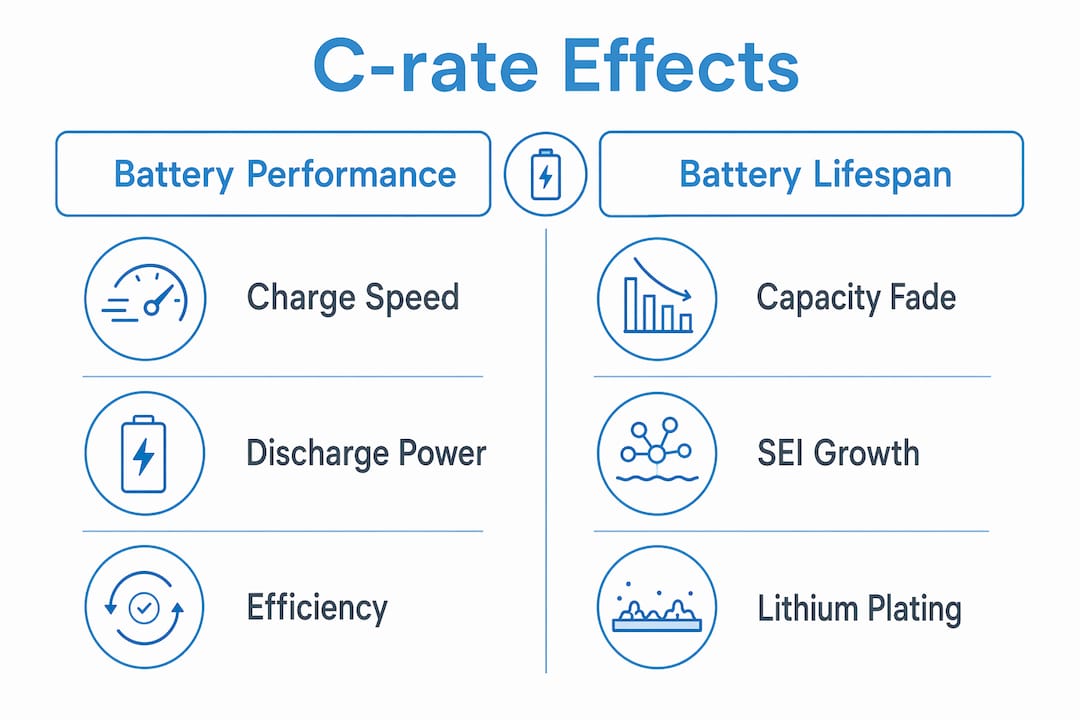
Higher C-rate operation in lithium batteries causes reduced deliverable capacity due to voltage sag and accelerates degradation through mechanical stress, solid electrolyte interphase (SEI) growth, and lithium plating. These are not theoretical risks. They are the primary reasons manufacturers specify maximum continuous and peak C-rates in their documentation.
The key effects of operating outside recommended C-rate limits include:
- Voltage sag. High discharge rates cause the terminal voltage to drop below the usable threshold before the battery is actually empty. The result is apparent capacity loss, even though the energy is still physically present in the cell.
- SEI growth. The SEI layer on the anode thickens faster under high current, consuming lithium ions permanently and reducing long-term capacity.
- Lithium plating. At high charge C-rates, lithium ions cannot intercalate into the anode fast enough and instead deposit as metallic lithium. This is irreversible and creates safety risks including internal short circuits.
- Mechanical stress. Rapid charge and discharge cycles cause the electrode materials to expand and contract quickly, leading to cracking and delamination over time.
- Temperature interaction. Heat generated at high C-rates accelerates all of the above. Cold temperatures compound the problem during charging specifically.
Low-temperature charging at elevated C-rates, such as 0.85C at 0°C, promotes lithium plating and can reduce the self-heating onset temperature by up to 50°C. That figure represents a direct reduction in the safety margin of the cell. For anyone operating lithium batteries in a vehicle during winter, this is a critical consideration.
Pro Tip: Battery warranties specify maximum continuous and peak C-rates, and exceeding these limits can void your coverage. Peak C-rates typically apply for very short durations, often 30 seconds to 5 minutes. Check your warranty document before configuring your battery management system (BMS) charge and discharge limits.
What internal mechanisms drive C-rate degradation?
Beyond the headline effects, two electrochemical phenomena explain why C-rate damage is often uneven and difficult to predict from basic specifications alone.
The first is electrolyte motion induced salt inhomogeneity, known as EMSI. Salt gradients develop with cycling and increase with higher C-rates, causing lithium plating stripes at the edges of the jelly-roll structure inside cylindrical and prismatic cells. These gradients stabilise after 50–100 cycles, but at higher C-rates they are more severe and accelerate capacity loss from the outset. This explains why two cells with identical nominal specifications can behave differently under the same C-rate if their cycling histories differ.
“Salt gradient and edge plating degradation patterns help explain why seemingly identical cells behave differently under the same nominal C-rate but different cycling profiles.” — IOPscience, 2026
The second mechanism is state-of-charge dependent polarisation. High C-rate accelerates internal battery gradients affecting performance, and the impact depends on the state-of-charge profile and charge control modes rather than C-rate alone. A battery cycled between 20% and 80% state of charge at 1C will age differently from one cycled between 0% and 100% at the same C-rate. The interaction between C-rate and state-of-charge window is a key variable in system design.
| Mechanism | Trigger | Primary consequence |
|---|---|---|
| EMSI salt gradients | High C-rate cycling | Edge lithium plating, capacity loss |
| SEI growth | High current, high temperature | Permanent lithium loss |
| Lithium plating | High charge C-rate, low temperature | Safety risk, irreversible capacity loss |
| Electrode cracking | Rapid volume change | Structural degradation |
Voltage-driven adaptive fast charging strategies can reduce lithium plating by regulating current based on voltage feedback. These approaches outperform conventional constant-current constant-voltage (CC-CV) charging with substantially lower plating degradation. For EV and solar storage applications, this means the charging algorithm matters as much as the C-rate figure itself.
How to apply C-rate knowledge in real energy storage systems
Translating C-rate theory into practical decisions requires matching your operating conditions to the manufacturer’s specifications and your BMS configuration. Here is a structured approach for vehicles and renewable energy systems.
-
Read the datasheet first. Identify the rated continuous discharge C-rate, the peak C-rate, and the maximum charge C-rate. These are the hard limits for your system. Operational setpoints should always align to manufacturer-rated test conditions and BMS limits, as C-rate alone is insufficient to ensure warranty compliance and longevity.
-
Match C-rate to your application profile. Long-duration solar storage systems typically operate at 0.05C to 0.2C. Energy arbitrage applications run at around 0.5C. Typical application windows span from 0.05C for long-duration storage to approximately 0.5C for energy arbitrage. EV fast charging can reach 1C or above, which is why thermal management is non-negotiable in those systems.
-
Configure your BMS charge limits for temperature. If your system operates in cold environments, reduce the maximum charge C-rate at low temperatures. Victron Energy MPPT controllers and compatible BMS units support temperature-compensated charging profiles. This is the single most effective way to prevent lithium plating in leisure vehicle and marine applications. For further guidance on off-grid battery selection, Skyenergi covers this in detail.
-
Monitor in real time. A battery monitor such as the SRNE BS 48500 tracks current, voltage, and state of charge continuously. Knowing your actual operating C-rate at any moment allows you to catch problems before they become permanent. Skyenergi’s guide to battery monitoring for power management explains how to interpret this data effectively.
-
Avoid sustained high C-rate discharge. Short peak loads are generally within warranty limits. Sustained high-current draws, such as running a high-power inverter continuously, push the battery into the degradation zone. Size your battery bank so that typical loads fall below 0.5C continuous. Skyenergi’s battery bank setup guide covers bank sizing in practical terms.
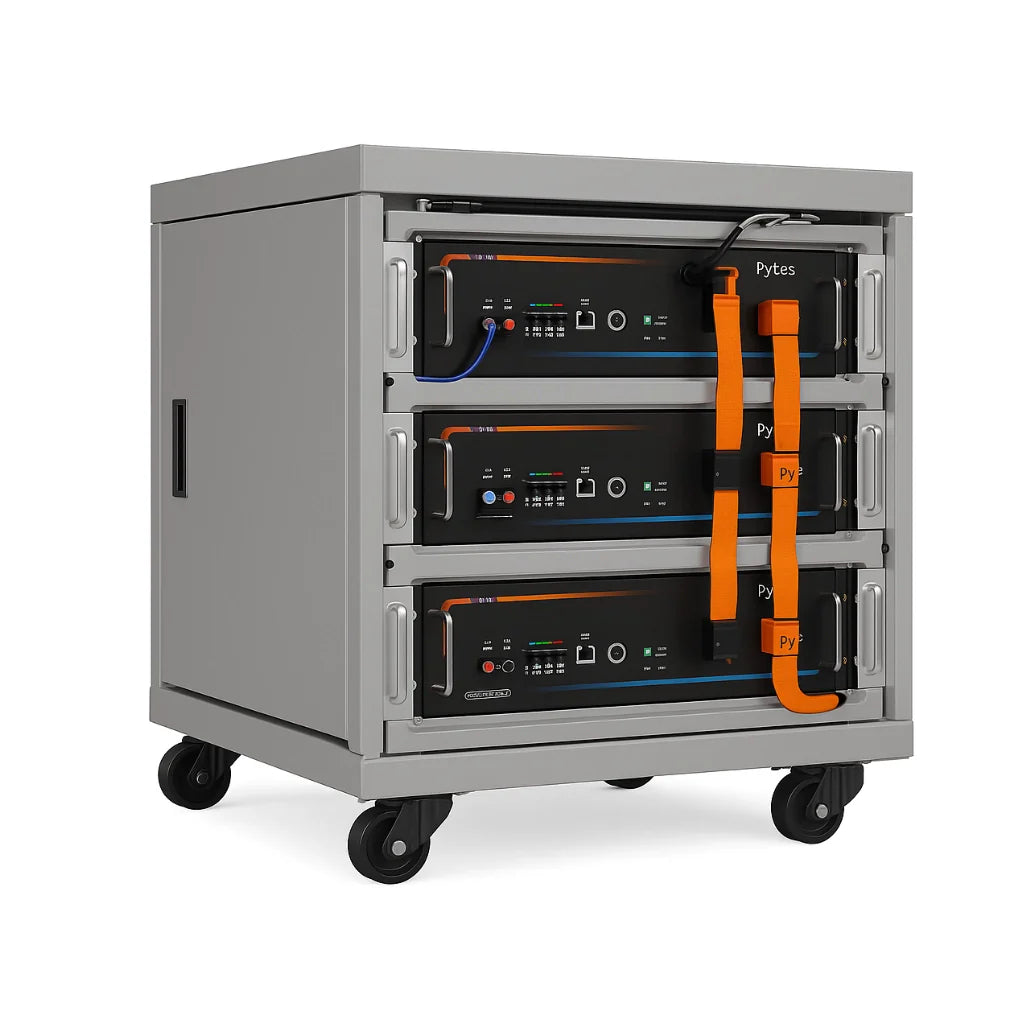
For residential solar storage, systems like those from Pytes are designed for daily cycling at moderate C-rates, typically 0.2C to 0.5C. For campervans and motorhomes, the SRNE turnkey solutions distributed by Skyenergi are rated for the C-rate demands of leisure vehicle use, with integrated BMS protection to prevent exceedance.
Key takeaways
Battery C-rate is the single most important performance metric for matching a lithium battery to its application, and operating within manufacturer-specified limits is the most direct way to protect capacity, safety, and warranty coverage.
| Point | Details |
|---|---|
| C-rate definition | C-rate equals current in amps divided by capacity in amp-hours; 1C means full charge or discharge in one hour. |
| High C-rate consequences | Elevated rates cause voltage sag, SEI growth, lithium plating, and accelerated capacity loss. |
| Temperature interaction | Charging at high C-rates in cold conditions promotes lithium plating and reduces safety margins significantly. |
| EMSI and internal gradients | Salt gradients and state-of-charge windows affect degradation as much as the C-rate figure itself. |
| Practical application | Match operating C-rate to datasheet limits, configure BMS temperature controls, and monitor current in real time. |
Why C-rate is the metric most buyers overlook
Most people buying a lithium battery for a campervan or solar system focus on capacity in amp-hours and voltage. C-rate rarely appears in the purchasing conversation, yet it determines whether that battery will last three years or ten. I have seen systems where the inverter was sized to draw 2C continuously from a battery rated for 0.5C continuous. The battery degraded within 18 months and the warranty was void because the BMS logs showed sustained overcurrent. The capacity was right. The C-rate was wrong.
The other misconception I encounter regularly is treating peak C-rate as the operating limit. Peak ratings, often 2C or 3C, apply for 30 seconds to five minutes. They exist for motor start loads and brief surges, not for running a 2,000W inverter through an afternoon. If your typical load exceeds the continuous C-rate rating, you need a larger battery bank, not a higher-rated inverter.
The 2026 research on EMSI and lithium plating reinforces something that experienced system designers have known for years: the cycling profile matters as much as the peak figure. Two batteries with identical specifications will age at different rates depending on how they are charged and discharged. Voltage-driven adaptive charging, as demonstrated in recent IOPscience studies, is the direction the industry is moving. For now, the practical takeaway is to keep your charge C-rate conservative, especially in cold weather, and let your BMS do the work it was designed for. For a deeper look at lithium battery lifespan factors, Skyenergi’s resources cover the full picture.
— John
Manage C-rate with the right equipment from Skyenergi
Knowing your C-rate limits is only useful if your system can enforce them. Skyenergi supplies the hardware to do exactly that.

The Victron Energy Solar Home System 200 MPPT integrates solar input, MPPT charge control, and battery management in a single unit, with charging profiles configurable to match your battery’s rated charge C-rate. For real-time performance tracking, the SRNE BS 48500 battery monitor displays current, voltage, and state of charge continuously, giving you the data to confirm your system is operating within safe C-rate limits. Both products are available directly from Skyenergi, sourced from manufacturers to keep pricing competitive.
FAQ
What is the C-rate definition for a battery?
C-rate is the charge or discharge current of a battery expressed as a multiple of its capacity in amp-hours. A 1C rate means the battery charges or discharges fully in one hour.
How does a high C-rate affect battery life?
High C-rate operation accelerates SEI growth, lithium plating, and mechanical stress in the electrodes, all of which reduce long-term capacity and can shorten cycle life significantly.
What C-rate is safe for charging lithium batteries in cold weather?
Charging at high C-rates in cold conditions, particularly above 0.5C at temperatures near 0°C, promotes lithium plating. Reducing the charge C-rate and using a temperature-compensated BMS profile is the recommended approach.
How do I measure the C-rate my system is actually using?
Divide the current your charger or load is drawing in amps by your battery’s rated capacity in amp-hours. A battery monitor such as the SRNE BS 48500 displays live current, making this calculation straightforward in real time.
Does C-rate affect battery warranty?
Battery warranties specify maximum continuous and peak C-rates. Exceeding these limits, even briefly in sustained operation, can void warranty coverage, as BMS logs record current draw over time.
Recommended
Prev post

Best practices for off-grid systems: 2026 guide
Updated on 21 June 2026
Next post

Battery maintenance checklist 2026: leisure and off-grid guide
Updated on 19 June 2026


