







Lithium battery terminology explained: a clear guide
Master lithium battery terminology explained! Confidently choose and maintain energy storage systems with our clear, informative guide.
TL;DR:
- Understanding lithium battery terminology, including chemistry, capacity, and management parameters, is essential for safe and effective energy system design. Proper knowledge of key terms like SOC, SOH, voltage limits, and discharge rates helps prevent operational errors and prolongs battery lifespan. Reading datasheets carefully and cross-referencing specifications ensures accurate system sizing and safe handling practices.
If you have ever stared at a battery datasheet and felt lost somewhere between “nominal voltage” and “state of health,” you are not alone. Getting lithium battery terminology explained properly makes a real difference when selecting, installing, or maintaining energy storage for a campervan, off-grid setup, or home system. The wrong interpretation of a single specification can lead to undersized systems, premature cell degradation, or genuine safety risks. This guide works through the core terms, from basic chemistry to battery management parameters, so you can read datasheets and make purchasing decisions with confidence.
Table of Contents
- Key takeaways
- Lithium battery terminology explained: structure and chemistry
- Performance specifications: capacity, voltage, and rates
- Battery management terms: SOC, SOH, SOP, and SOF
- Safety, labelling, and recycling terminology
- Applying terminology to real-world decisions
- My perspective on the terminology problem
- Explore lithium battery solutions at Skyenergi
- FAQ
Key takeaways
| Point | Details |
|---|---|
| Chemistry defines performance | LiFePO4 and NMC have different voltages, energy densities, and safety profiles that affect suitability for your application. |
| Capacity is not always usable capacity | Rated Ah figures can differ from actual usable energy once BMS cutoffs and voltage drop are accounted for. |
| SOC and SOH are distinct metrics | State of charge measures remaining energy; state of health measures long-term battery condition and ageing. |
| C-rate governs charge and discharge speed | A higher C-rate means faster power delivery or charging, but sustained high C-rates reduce battery lifespan. |
| Safe disposal requires specialist handling | Lithium batteries must go to designated recycling points, not household waste, to prevent fire risk. |
Lithium battery terminology explained: structure and chemistry
Understanding what a lithium battery actually is makes every other term easier to grasp. At its core, a lithium-ion battery stores and releases energy by cycling lithium ions between two electrodes through an electrolyte and separator, while electrons travel through an external circuit to do useful work.
The key structural components are:
- Anode. The negative electrode, typically made of graphite. Lithium ions are stored here during charging.
- Cathode. The positive electrode. The chemistry of the cathode material largely defines the battery type.
- Separator. A thin, permeable membrane that keeps the anode and cathode physically apart while allowing ion movement.
- Electrolyte. The medium through which lithium ions travel between electrodes. Usually a liquid organic solution.
- Current collectors. Thin metal foils (copper at the anode, aluminium at the cathode) that channel electrons in and out of each electrode.
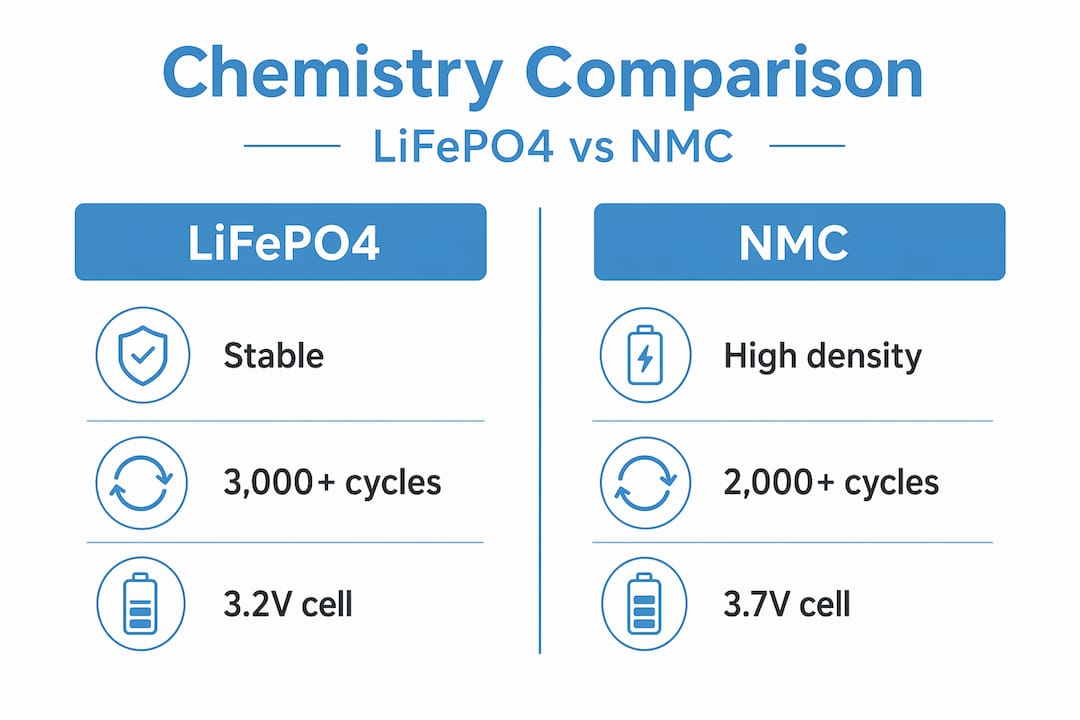
The cathode chemistry is where you will encounter the most variation. Common materials include lithium, cobalt, nickel, manganese, and graphite, each lending different performance characteristics. The two chemistries most relevant to energy storage applications are:
LiFePO4 (lithium iron phosphate). Thermally stable, long cycle life (often 3,000 to 6,000 cycles), and the preferred choice for leisure and off-grid use. Nominal cell voltage is approximately 3.2 V.
NMC (nickel manganese cobalt). Higher energy density than LiFePO4, nominal cell voltage around 3.7 V with a maximum charge voltage of approximately 4.2 V per cell. Common in electric vehicles and portable electronics.
Pro Tip: When comparing lithium batteries, always check the chemistry first. A 100 Ah LiFePO4 and a 100 Ah NMC battery will have different voltages, different safe operating temperatures, and different total cycle life expectations.
Performance specifications: capacity, voltage, and rates
This is where most confusion in lithium battery basics occurs, and where precise definitions matter most for comparing products.
Capacity: Ah and mAh
Capacity tells you how much charge a battery can store. It is measured in ampere-hours (Ah) for larger batteries and milliampere-hours (mAh) for smaller cells. A 100 Ah battery can theoretically deliver 10 A for 10 hours, or 100 A for one hour, before reaching its discharge cutoff.
However, usable battery capacity is not always identical to the rated figure. The BMS enforces voltage cutoffs that restrict access to the full nominal capacity, particularly under high load or at low temperatures. The headline Ah figure is a useful benchmark, but check the datasheet for usable energy figures where available.
Voltage terms
| Term | Definition | Typical LiFePO4 value |
|---|---|---|
| Nominal voltage | Average operating voltage under load | 3.2 V per cell / 12.8 V (4S pack) |
| Maximum charge voltage | Upper voltage limit; must not be exceeded | 3.65 V per cell / 14.6 V (4S pack) |
| Discharge cutoff voltage | Lower voltage limit enforced by BMS | 2.5 V per cell / 10 V (4S pack) |
| Open-circuit voltage (OCV) | Resting voltage with no load or charge | Varies with SOC |
Energy density vs power density
These two terms are frequently conflated, and the confusion is understandable. Energy density (measured in Wh/kg) describes how much total energy a battery stores per unit of weight. Power density (W/kg) describes how quickly it can deliver that energy.
Think of it this way: a large water tank has high capacity, but a narrow outlet pipe limits flow rate. A battery with high energy density but low power density can store plenty of energy yet struggles to release it fast under heavy loads.
Pro Tip: For off-grid solar storage and leisure use, energy density matters more than power density. For applications involving engine starting or high-current inverter loads, you need both. Always check the continuous and peak discharge current ratings alongside Ah capacity.
C-rate
C-rate expresses charge or discharge current relative to capacity. A 1C rate for a 100 Ah battery means 100 A. A 0.5C rate means 50 A. Most LiFePO4 batteries used in leisure applications are rated for continuous discharge at 1C, meaning a 100 Ah battery can deliver up to 100 A continuously. Some support higher burst rates for short durations.

Battery management terms: SOC, SOH, SOP, and SOF
The battery management system (BMS) is the intelligence layer inside every modern lithium battery pack. It monitors cell conditions and protects against faults. Understanding battery state parameters is central to using any battery monitoring tool effectively.
-
State of Charge (SOC). Expressed as a percentage (0 to 100%), SOC tells you how much energy remains in the battery at a given moment. A BMS estimates SOC using open-circuit voltage readings, coulomb counting (tracking current in and out), or a combination of both. Accurate SOC estimation also accounts for temperature and ageing effects, which shift the relationship between voltage and actual charge remaining.
-
State of Health (SOH). SOH is a measure of a battery’s condition relative to its original new specification, again expressed as a percentage. A battery at 80% SOH has lost 20% of its original capacity. When SOH drops below around 80%, the battery is typically considered end-of-life for most applications. Factors like deep cycling, high temperatures, and consistently high charge voltages accelerate SOH decline. Skyenergi’s guide to battery lifespan factors covers these in practical detail.
-
State of Power (SOP). SOP indicates the maximum power the battery can safely deliver or accept at a given moment. It changes dynamically with temperature, SOC level, and cell condition. A cold battery at low SOC will have a much lower SOP than a warm battery at 80% SOC.
-
State of Function (SOF). SOF is an aggregate parameter combining SOC, SOH, and SOP to give an overall picture of battery capability. Not all BMS units report this explicitly, but it underpins the overall functional readiness assessments in advanced battery monitoring systems. For a detailed look at how these metrics are used in practice, see how battery monitoring works.
Together, these four parameters are the foundation of intelligent battery management. Knowing them helps you interpret monitoring data from Bluetooth-enabled BMS units and react appropriately to system alerts.
Safety, labelling, and recycling terminology
Lithium battery safety terminology is not purely academic. Getting it wrong has real consequences.
-
Chemistry labelling. Battery markings typically include the chemistry abbreviation (Li-ion, LiFePO4, LiPo) and sometimes a recycling symbol. These labels matter for transport compliance, charging equipment selection, and disposal procedures.
-
Thermal runaway. A self-reinforcing failure condition where increasing heat causes accelerating chemical reactions, potentially leading to fire or rupture. LiFePO4 chemistry is significantly more resistant to thermal runaway than NMC or LiCoO2, which is a primary reason it dominates leisure and off-grid storage applications.
-
IEC 62619. This is the industrial safety standard for secondary lithium cells and batteries used in industrial applications. It mandates electrical, thermal, and mechanical protection, including BMS-enforced overcharge and over-discharge prevention, short circuit protection, and thermal runaway mitigation. Batteries compliant with IEC 62619 have undergone defined abuse testing.
-
Disposal and recycling. Lithium batteries must not go into household waste or standard recycling streams. Damaged or discharged cells can still cause fires if crushed. They should be taken to designated hazardous waste or battery recycling collection points.
Correct chemistry labelling is not just a regulatory requirement. It is the information that determines how a battery is charged, transported, stored, and recycled. A battery without clear labelling is a genuine liability.
Applying terminology to real-world decisions
Reading a datasheet well is a skill. Here is how the terms connect to practical decisions:
- Selecting capacity. Calculate your daily energy consumption in Wh, divide by nominal system voltage to get Ah required, then apply a usable capacity factor (typically 80 to 100% for LiFePO4) to find your target battery size.
- Matching charge sources. Confirm that your charger’s maximum charge voltage setting matches the battery chemistry. A charger set for a 14.4 V gel battery will undercharge a 14.6 V LiFePO4 pack.
- Interpreting BMS data. SOC readings from a Bluetooth BMS are only as reliable as the calibration. A freshly installed battery may read inaccurately until it has completed a full charge and discharge cycle.
- Avoiding capacity misconceptions. A higher Ah figure does not automatically mean longer runtime if the discharge C-rate is insufficient for your load. Always check continuous discharge current alongside capacity.
Pro Tip: If a battery datasheet does not state maximum continuous discharge current separately from peak current, ask the supplier. The difference between the two can be significant for high-draw applications like inverters and electric motors.
For further reading on selecting a battery suited to off-grid setups, Skyenergi’s article on off-grid battery features covers specification priorities in practical context.
My perspective on the terminology problem
I have noticed that the terms people get wrong most often are not the obscure ones. They are the ones that sound self-explanatory. “Capacity” is a good example. Most people assume rated capacity is what they will get. They buy a 100 Ah battery and expect 100 Ah of usable energy in every condition. The reality is that usable energy depends on discharge voltage, load, temperature, and BMS configuration. That gap between expectation and reality is where undersized systems come from.
The SOC versus SOH distinction is another persistent confusion. I have spoken with customers who thought their battery was “at 70%” meaning it was ageing and nearly at end of life, when the monitor was actually showing SOC, meaning it simply had 30% charge consumed. The terminology is similar enough to cause real operational mistakes.
My honest view is this: you do not need to understand electrochemistry to use lithium batteries well. But you do need to know the difference between nominal and maximum voltage, between energy density and power density, and between SOC and SOH. Those six terms alone will prevent most of the common purchasing and operational errors I see repeatedly.
The practical takeaway: read datasheets methodically, cross-reference terms against a reliable source, and do not assume a higher number is always better. Context determines everything in battery specifications.
— John
Explore lithium battery solutions at Skyenergi

Skyenergi supplies high-performance lithium battery systems for campervans, motorhomes, marine setups, and off-grid residential installations across the UK. The range includes LiFePO4 leisure batteries with integrated BMS and Bluetooth monitoring, home energy storage from Pytes, and complete turnkey solutions from SRNE. All products are sourced directly from manufacturers to keep quality high and pricing competitive.
If you are working through a system build and want to go deeper on related topics, the Skyenergi blog covers lithium leisure battery basics, solar battery terms, and practical maintenance guidance. Whether you are specifying your first off-grid system or upgrading an existing setup, the product range and supporting content are designed to give you what you need without the guesswork.
FAQ
What is the difference between energy density and power density?
Energy density (Wh/kg) measures total stored energy per unit of weight. Power density (W/kg) measures how fast that energy can be delivered. A battery can have high energy density but limited power delivery, which matters for high-draw applications.
What does SOC mean on a lithium battery monitor?
SOC stands for state of charge and indicates the percentage of energy remaining in the battery at that moment. It is not a measure of battery age or condition; that is state of health (SOH).
What is the nominal voltage of a LiFePO4 battery?
A single LiFePO4 cell has a nominal voltage of approximately 3.2 V. A standard 12 V LiFePO4 pack uses four cells in series, giving a nominal pack voltage of around 12.8 V and a maximum charge voltage of 14.6 V.
Why does usable battery capacity differ from rated capacity?
Rated capacity is measured under controlled conditions. In real use, the BMS enforces voltage cutoffs and temperature limits that restrict access to the full cell capacity. High discharge rates and low temperatures reduce accessible energy further.
Can lithium batteries go in normal household recycling?
No. Lithium batteries must be taken to designated collection points or hazardous waste facilities. Placing them in standard recycling streams risks fire if cells are crushed or punctured during processing.
Recommended
Prev post

How to size a battery bank for off-grid power
Updated on 24 May 2026
Next post

Expandable battery system examples for DIY builds
Updated on 22 May 2026


