





Lithium battery charging explained: a practical guide
Discover how lithium battery charging explained can enhance battery life and safety. Learn the right techniques and best practices today!
TL;DR:
- Lithium battery charging requires precise, staged processes controlled by an effective BMS to ensure safety and longevity. The standard CC-CV method delivers 60-80% capacity in CC phase, then safely tops off in CV; proper management of this sequence is critical. Advanced adaptive charging techniques offer further improvements, dynamically optimizing battery health in demanding applications.
Lithium battery charging is not as straightforward as it might appear. Unlike lead-acid or NiMH batteries, lithium cells require a precise, staged charging process to operate safely and maintain long-term capacity. Get it wrong and you risk reduced performance, accelerated degradation, or in serious cases, thermal runaway. This guide covers the lithium battery charging process from electrochemical fundamentals through to advanced adaptive methods, with practical guidance on best practices for lithium charging, BMS operation, and safe charging habits relevant to campervans, off-grid setups, and residential energy storage systems.
Table of Contents
- Key takeaways
- The chemistry behind lithium battery charging
- The CC-CV charging process in detail
- The role of the BMS in charging control
- Best practices for charging lithium batteries safely
- Advanced charging methods beyond CC-CV
- What I have learned after years working with lithium systems
- Skyenergi’s lithium charging solutions
- FAQ
Key takeaways
| Point | Details |
|---|---|
| CC-CV is the standard | The two-stage constant current, constant voltage method delivers 60–80% capacity in the CC phase, then tops off safely in the CV phase. |
| BMS is not optional | The Battery Management System controls voltage, current, and temperature limits, and bypassing it risks fire and permanent cell damage. |
| Temperature range matters | Charging outside 0°C to 45°C causes irreversible damage and creates safety hazards including thermal runaway. |
| Chemistry affects charge limits | NMC batteries benefit from daily charging to 80%, while LFP chemistries can routinely charge to 100% without degradation. |
| Advanced methods are emerging | Step, pulse, and adaptive charging offer longevity and speed advantages over static CC-CV profiles in demanding applications. |
The chemistry behind lithium battery charging
To understand why lithium battery charging requires such control, you need a basic picture of what happens inside the cell. During charging, lithium ions move from the cathode (typically a lithium metal oxide compound) through the electrolyte and intercalate into the anode (usually graphite). During discharge, the process reverses. The charger drives this ion movement by applying voltage and current in a controlled sequence.
The problem with uncontrolled charging is significant:
- Lithium plating: If current is applied too quickly or at too low a temperature, lithium ions cannot intercalate properly and deposit as metallic lithium on the anode surface. This causes permanent capacity loss and creates dendrites that can pierce the separator, causing a short circuit.
- Electrolyte decomposition: Overvoltage accelerates breakdown of the liquid electrolyte, generating gas, heat, and internal pressure.
- Capacity fade: Repeated stress from uncontrolled charge cycles degrades both anode and cathode materials, reducing the cell’s ability to hold charge over time.
Compared to lead-acid batteries, which tolerate relatively loose charging control, lithium cells have a narrow operating window. Each cell chemistry has specific voltage limits, NMC cells typically capping at 4.2V per cell and LFP cells at 3.65V per cell. Exceeding these even briefly causes measurable damage. This is precisely why the CC-CV protocol was developed and why it remains the industry-standard method for lithium ion battery charging today.
The CC-CV charging process in detail
The standard lithium ion battery charging guide used across the industry follows two sequential stages: Constant Current (CC) and Constant Voltage (CV). Understanding both stages is the foundation of knowing how to charge lithium batteries correctly.
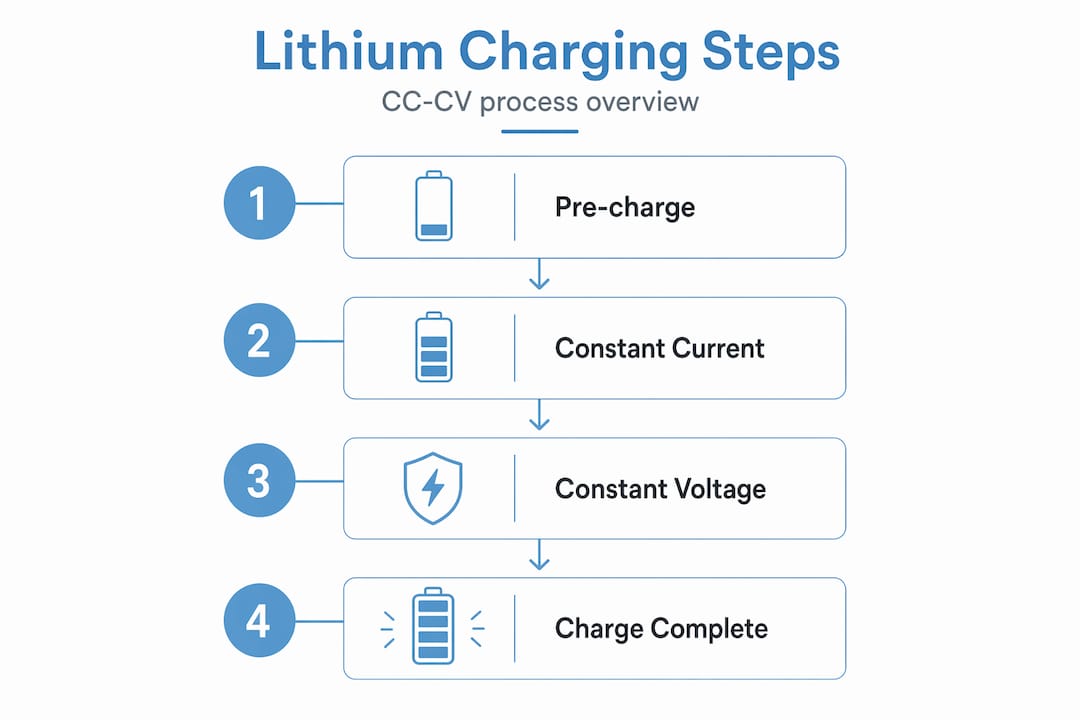
The charging sequence:
- Pre-charge (trickle): If a cell voltage is critically low (typically below 3.0V per cell), a reduced current is applied first to bring the cell back to a safe voltage range. Charging a deeply discharged lithium cell at full current risks plating and thermal stress.
- CC phase: The charger applies a fixed current (commonly 0.5C to 1C, where C equals the battery’s capacity in amp-hours) while voltage rises naturally. This phase is the fastest part of charging and delivers 60–80% of capacity before the voltage ceiling is reached.
- CV phase: Once the cell voltage reaches its upper limit (4.2V for NMC, 3.65V for LFP), the charger holds that voltage constant. Current then tapers off as the battery approaches full charge. The CV phase ends when current drops to approximately 0.02C to 0.07C, signalling the cell is fully charged.
- Termination: The charger cuts off. Most quality chargers include a timed safety cutoff if current does not taper correctly.
| Charging stage | Current behaviour | Voltage behaviour | Capacity delivered |
|---|---|---|---|
| Pre-charge | Very low, fixed | Rising slowly | Minimal |
| Constant current (CC) | Fixed, high | Rising to limit | 60–80% |
| Constant voltage (CV) | Tapering to near zero | Fixed at limit | Remaining 20–40% |
| Termination | Cut off | Held at charge level | 100% |
Pro Tip: Charging at 0.5C rather than 1C during the CC phase adds modest charge time but noticeably reduces cell stress over hundreds of cycles, which matters in fixed energy storage installations where battery replacement is costly.
The transition from CC to CV is the point most often mismanaged when using incompatible or generic chargers. A charger that holds current too long into the CV stage causes overvoltage, while one that terminates too early leaves the battery undercharged and gradually unbalances multi-cell packs.

The role of the BMS in charging control
The Battery Management System is not a passive safety add-on. As noted in research on BMS safeguards in certified packs, it is the core intelligence managing lithium battery health, charging precision, and operational safety.
A BMS monitors and controls:
- Cell voltage: Monitors each cell individually to prevent overvoltage or undervoltage during charging and discharge.
- Current: Measures charge and discharge current to enforce safe limits and prevent overcurrent events.
- Temperature: Tracks cell and pack temperature in real time, suspending charging if thresholds are exceeded.
- State of charge (SoC): Estimates remaining capacity to guide charging decisions and avoid deep discharge.
- Cell balancing: In multi-cell packs, active cell balancing redistributes charge between cells to prevent voltage divergence that would otherwise degrade the weakest cell fastest.
The BMS integrates fault detection with redundant sensors and fail-safe architecture to maintain safety in both consumer and industrial-grade packs. If any parameter exceeds safe limits, the BMS disconnects the charging circuit. You can read more about how BMS technology supports off-grid energy systems and why it matters for system reliability.
Pro Tip: Many Skyenergi lithium batteries include Bluetooth-enabled BMS units. Connecting via a mobile app during a charging session lets you verify that cell voltages are balancing correctly, which is particularly useful after deep discharge events or in systems that have been idle for extended periods.
Bypassing or disabling a BMS, whether to use a non-compatible charger or to force a charge into a deeply discharged cell, removes all protection. The result is uncontrolled charging, potential lithium plating, gas generation, and in worst cases, fire.
Best practices for charging lithium batteries safely
Following the right charging habits has a direct and measurable effect on longevity. Optimised charging protocols can reduce capacity loss by up to 50% and maintain above 90% state of health over five years. These are not minor margins in a residential or commercial energy storage context.
Key best practices:
- Stay within the temperature window. Charging outside 0°C to 45°C risks permanent damage. Below 0°C, lithium plating accelerates dramatically. Above 45°C, electrolyte degradation and thermal runaway risk increase significantly.
- Use approved chargers. Chargers not designed for lithium cells lack the correct CC-CV profile and voltage termination logic. Generic or uncertified chargers are a leading cause of battery fires.
- Match charge limits to your chemistry. NMC batteries benefit from daily charging to approximately 80% to reduce cathode stress. LFP batteries are more tolerant of full charges and a regular 100% charge is often recommended to help the BMS re-calibrate its SoC calculations.
- Never charge damaged or swollen batteries. A swollen cell indicates internal gas build-up and possible separator failure. Charging it applies pressure to an already compromised structure.
- Avoid soft surfaces during charging. Charging on beds, sofas, or carpeted surfaces restricts airflow and traps heat, which is one of the most common causes of lithium battery fires in residential settings.
- Monitor regularly. In off-grid or mobile installations, periodic checks using a BMS app or battery monitor confirm that all cells are performing within spec.
You can find additional guidance on maintaining battery health in off-grid setups in the lithium battery maintenance workflow from Skyenergi.
Advanced charging methods beyond CC-CV
The CC-CV profile is reliable and well understood, but it applies the same charging parameters regardless of how the battery is actually responding. As noted in research on charge profile optimisation, static CC-CV lacks dynamic adaptation to battery state, which limits performance in demanding or longevity-focused applications.
Three methods have gained traction as alternatives or supplements:
| Method | How it works | Primary benefit | Best suited for |
|---|---|---|---|
| Step charging | Current reduced in predefined stages as battery fills | Reduces lithium plating and heat stress | High-cycle industrial packs |
| Pulse charging | Alternates current bursts with rest intervals | Improves ion distribution, reduces polarisation | Research, specialist EV applications |
| Adaptive charging | Adjusts current dynamically using real-time feedback | Balances speed, longevity, and safety simultaneously | Advanced BMS-integrated systems |
Step charging addresses one of the main stress points in CC-CV by reducing the current flux as cells approach full charge, moderating both heat generation and ion intercalation stress. Pulse charging takes a different approach, using rest intervals between current bursts to allow lithium ions to diffuse more uniformly through the electrode, which reduces localised stress.
Adaptive charging goes furthest. It monitors real-time parameters such as internal resistance, temperature, and electrode response, then adjusts the charging current accordingly. The result is a profile that treats every charge cycle differently based on actual battery condition rather than a fixed algorithm. For renewable energy storage where battery replacement costs are high and cycle life is critical, adaptive charging strategies are likely to become standard within the next few years.
What I have learned after years working with lithium systems
In my experience, the BMS is consistently the most underestimated component in a lithium battery system. Most users focus on cell capacity or charger brand, but the BMS is what actually determines whether the battery survives long term. I have seen well-specified battery packs degrade rapidly because the BMS lacked proper cell balancing, and I have seen modest-capacity packs run reliably for years because the BMS was well integrated and correctly configured. Skyenergi’s own batteries with Bluetooth BMS monitoring are a good example of getting this right.
The other thing I find is that charge speed is routinely over-prioritised. A 1C charge rate is fine for occasional use, but in a system cycling daily, dropping to 0.5C or even lower during the CC phase costs you perhaps 30 minutes per cycle while meaningfully extending the useful life of the pack. For off-grid residential systems, that trade-off is worth making every time.
The most common mistake I observe is using a charger that is “close enough” rather than specifically rated for the battery chemistry in question. LFP and NMC have different voltage limits and termination thresholds. A charger calibrated for NMC will regularly overcharge an LFP cell if left unattended, which degrades the electrolyte and triggers BMS over-voltage faults repeatedly until the pack fails early. Correct charger selection is not complicated, but it is non-negotiable.
— John
Skyenergi’s lithium charging solutions

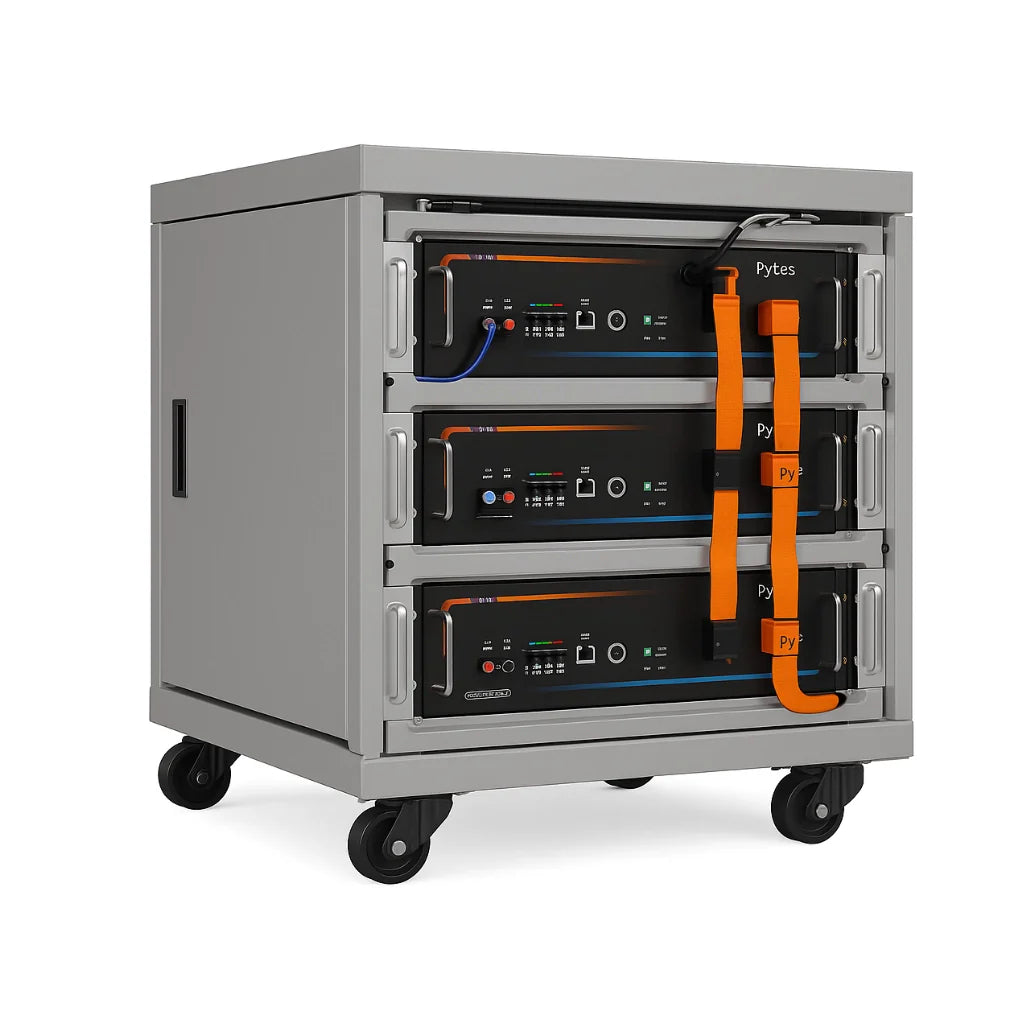
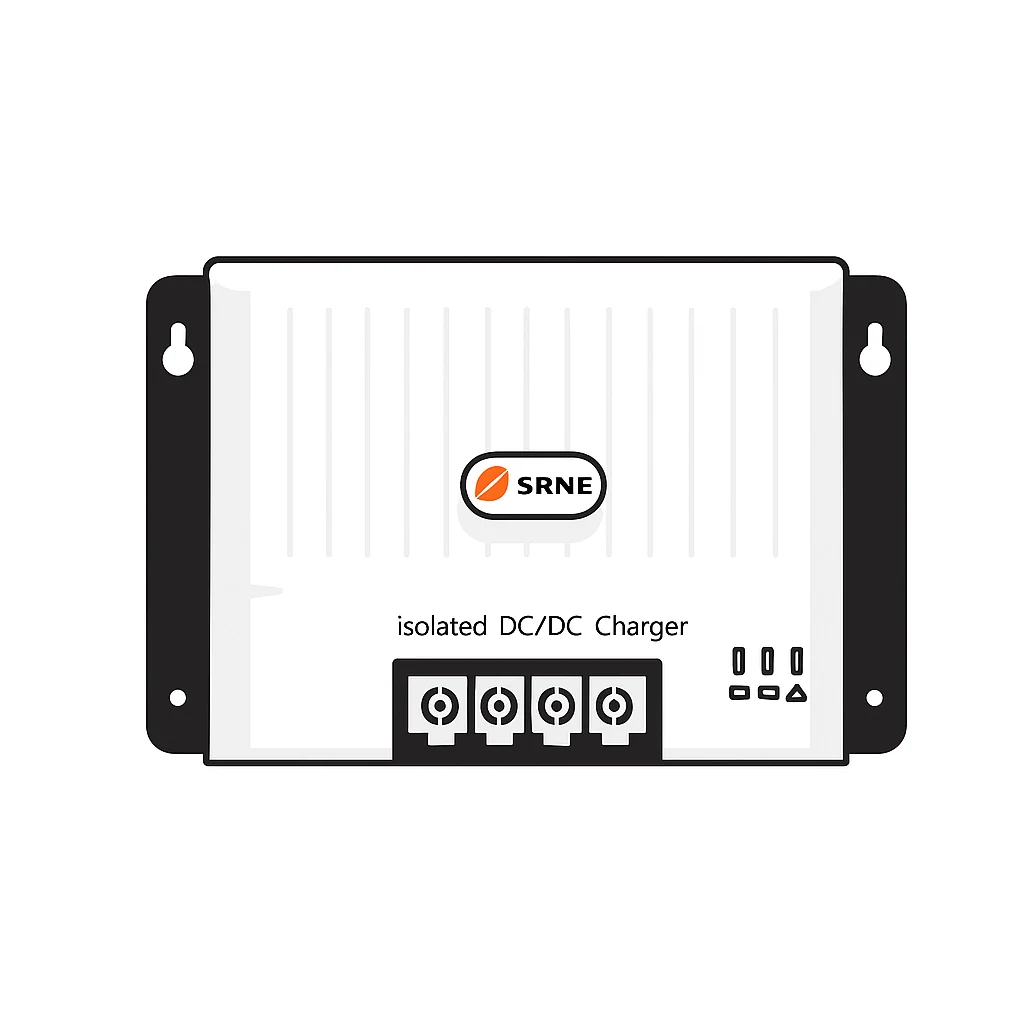
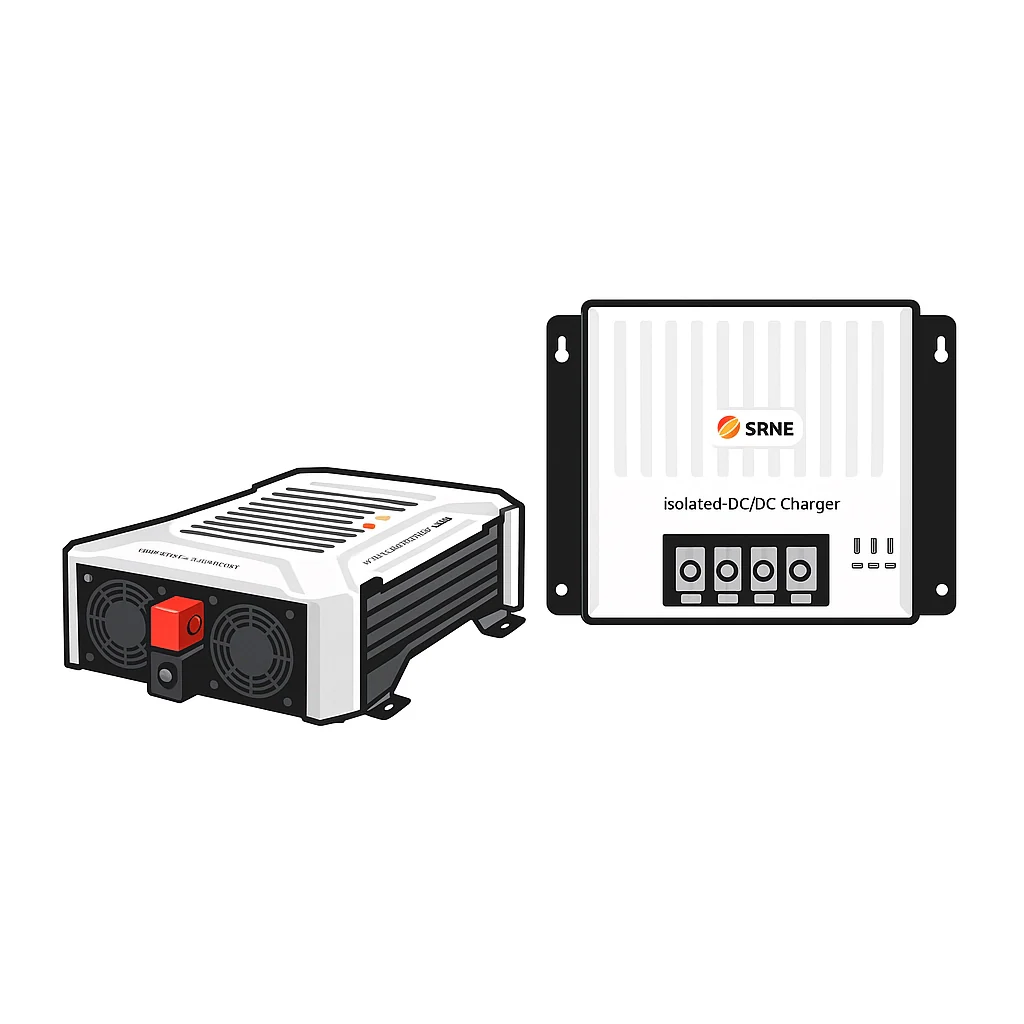
Skyenergi supplies lithium battery systems and charging solutions built around the CC-CV principles and BMS integration covered in this guide. The Victron Smart MPPT solar charge controller is a strong choice for solar-charged lithium installations, delivering a precise charge profile compatible with both LFP and NMC chemistries, with real-time monitoring via the VictronConnect app. For more complex setups, the 3kVA inverter and charger system integrates solar input, battery-to-battery charging, and monitoring in a single solution designed for campervans, motorhomes, and off-grid residential use. All Skyenergi lithium batteries include integrated BMS with Bluetooth monitoring for full visibility over cell health and charging status. Explore the full range at Skyenergi or contact us directly for guidance on selecting the right charging configuration for your system.
FAQ
What is the CC-CV lithium battery charging process?
CC-CV stands for Constant Current, Constant Voltage. The CC phase supplies a steady current while voltage rises, delivering 60–80% of capacity, then the CV phase holds voltage constant while current tapers to safe termination levels.
What temperature range is safe for charging lithium batteries?
Lithium batteries should only be charged between 0°C and 45°C. Charging below 0°C accelerates lithium plating, and charging above 45°C increases the risk of thermal runaway and electrolyte degradation.
Do I need to charge my lithium battery to 100% every time?
It depends on the chemistry. LFP batteries can regularly charge to 100% without significant harm and it helps BMS calibration. NMC batteries benefit from staying at around 80% daily to reduce long-term cathode stress.
What happens if you bypass the BMS when charging?
Bypassing the BMS removes all voltage, current, and temperature protections. This can cause overcharging, lithium plating, gas build-up, and in severe cases, fire or permanent cell damage.
What is adaptive charging and why does it matter?
Adaptive charging adjusts current in real time based on battery resistance, temperature, and electrode response rather than using a fixed profile. It offers better longevity, safety, and charging efficiency than static CC-CV methods, particularly in high-cycle energy storage systems.
Recommended
Prev post

Top 4 vanjunkies.co.uk Alternatives in 2026
Updated on 21 May 2026
Next post

Lithium battery lifespan factors: what you need to know
Updated on 19 May 2026


