





Solar Charge Control: Boost Campervan Battery Life 30%
Discover how solar charge controllers protect campervan batteries and boost energy harvest by 30%. Learn MPPT vs PWM, sizing, dual battery management, and smart features for UK off-grid power independence.
Many campervan owners believe any solar charge controller delivers the same results, but this misconception can cost you thousands in premature battery replacements and reduced energy independence. The right solar charge controller can improve battery longevity and energy harvest by up to 30%, transforming your off-grid experience across the UK. This guide explains what solar charge controllers are, how to choose the optimal type for your campervan, and practical tips to maximize their battery-protecting benefits.
Table of Contents
- What Is A Solar Charge Controller And How It Works
- Types Of Solar Charge Controllers: Pwm Vs Mppt
- How Solar Charge Controllers Protect And Optimize Battery Performance
- Sizing And Selecting The Right Solar Charge Controller For Your Campervan
- Managing Dual Battery Systems With Solar Charge Controllers
- Common Misconceptions About Solar Charge Control
- Practical Tips And Features To Look For In Solar Charge Controllers
- Conclusion: Enhancing Your Campervan Energy Independence With Solar Charge Control
- Explore Skyenergi’s Solar Solutions For Campervans
Key Takeaways
| Point | Details |
|---|---|
| Battery Protection | Solar charge controllers prevent overcharging and deep discharge damage by regulating voltage and current. |
| MPPT Efficiency Advantage | MPPT controllers harvest up to 30% more solar energy than PWM types in variable UK weather conditions. |
| Proper Sizing Critical | Select controllers rated at least 10% above your solar panel wattage for safe, reliable performance. |
| Dual Battery Solutions | Dual output MPPT controllers charge starter and leisure batteries independently for balanced system health. |
| Smart Monitoring Benefits | Bluetooth-enabled controllers provide real-time system data for proactive maintenance and troubleshooting. |
What Is a Solar Charge Controller and How It Works
A solar charge controller is the essential device managing power flow from your solar panels to your campervan batteries. Without this regulator, solar panels would push uncontrolled voltage and current into your batteries, causing overcharging, heat buildup, and permanent damage that shortens battery life by years.
Solar charge controllers regulate voltage and current from solar panels to protect campervan batteries from overcharging, improving battery longevity. They continuously monitor battery voltage and adjust power delivery to match the battery’s capacity and charge state. This precision prevents the catastrophic failures that occur when batteries receive too much or too little charge.
For UK campervan owners seeking energy independence, the controller acts as your system’s brain. It ensures every watt harvested from limited British sunlight reaches your batteries safely and efficiently. Understanding solar battery connection steps for campervans helps you appreciate where controllers fit in your electrical system.
Key functions include:
- Regulating charging voltage to safe levels based on battery chemistry
- Preventing reverse current drain from batteries to panels at night
- Adjusting power delivery during different charging stages for optimal battery health
- Protecting against short circuits and overload conditions
- Monitoring system performance for user visibility and troubleshooting
Think of your charge controller as a vigilant guardian that never sleeps. While you explore the Scottish Highlands or park along the Cornish coast, it constantly adapts charging to weather changes, battery conditions, and power demands. This automation protects your investment and maximizes usable energy without requiring constant manual adjustments.
Types of Solar Charge Controllers: PWM vs MPPT
Two primary technologies dominate the solar charge controller market: Pulse Width Modulation (PWM) and Maximum Power Point Tracking (MPPT). Understanding their differences determines whether you harvest adequate power or leave significant energy on the table.
PWM controllers represent the simpler, budget-friendly option. They connect solar panels directly to batteries after the panel voltage matches battery voltage, essentially acting as an on/off switch. This approach works adequately for small systems or tight budgets but wastes potential energy, especially when panel and battery voltages differ significantly.
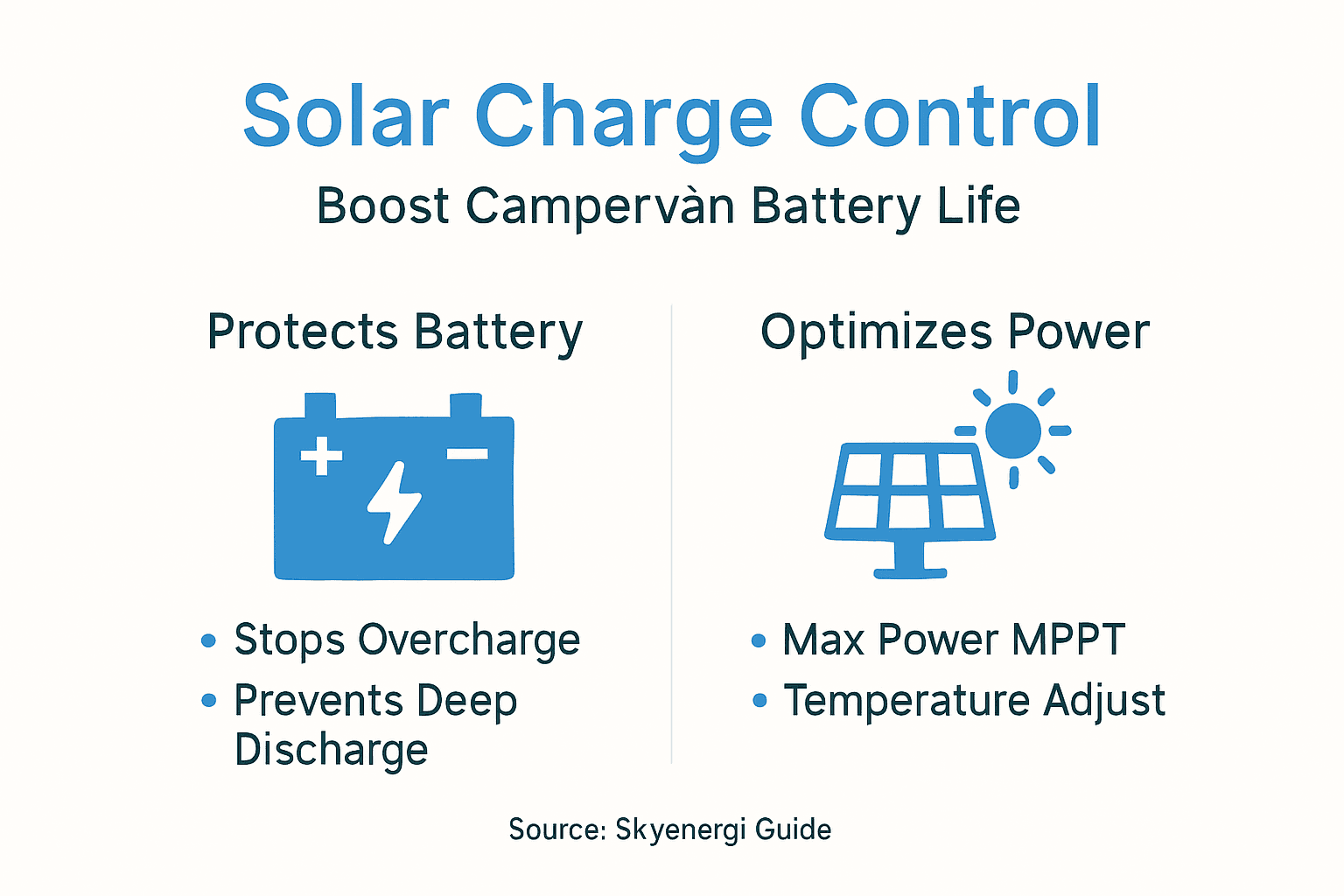
MPPT controllers employ sophisticated electronics to extract maximum power from solar panels regardless of voltage mismatch. MPPT solar charge controllers increase solar energy harvest efficiency by up to 30% compared to PWM controllers, especially in variable lighting conditions. This advantage proves crucial in the UK’s frequently cloudy, unpredictable weather where every photon counts.
| Feature | PWM | MPPT |
|---|---|---|
| Cost | Lower upfront investment | Higher initial cost, better long-term value |
| Efficiency | 70-80% in ideal conditions | 92-97% across varying conditions |
| Cold Weather | Standard performance | Excellent performance, harvests more in cold |
| System Complexity | Simple installation | Advanced features, more setup options |
| Best Use Case | Small budgets, tiny systems | Serious off-grid use, battery longevity priority |
For UK campervan owners wanting reliable off-grid power, MPPT technology delivers measurable benefits. Morning fog, afternoon clouds, and low winter sun angles all reduce panel output, but MPPT controllers adapt continuously to extract maximum available power. Discover why MPPT is essential for campervans to understand the practical performance differences.
Pro Tip: Calculate your daily energy needs and solar input realistically. If you frequently camp in shaded sites or winter months, MPPT’s efficiency advantage pays for itself through extended battery life and reduced generator dependence.
How Solar Charge Controllers Protect and Optimize Battery Performance
Beyond simple voltage regulation, modern solar charge controllers execute sophisticated battery management strategies that dramatically extend battery lifespan and reliability. These protection mechanisms work silently but deliver tangible financial benefits by preventing premature battery replacement.

Solar charge controllers prevent battery overcharging and deep discharge; adjust voltage and current based on battery chemistry; extend battery lifespan through controlled charging. Overcharging causes electrolyte loss in lead-acid batteries and thermal runaway risks in lithium batteries. Deep discharge below safe thresholds permanently reduces capacity in both chemistries.
Controllers implement multi-stage charging profiles tailored to your battery type:
- Bulk Stage: Delivers maximum current until batteries reach about 80% capacity, rapidly recovering from overnight discharge
- Absorption Stage: Holds constant voltage while current gradually decreases, safely completing the charge to 100%
- Float Stage: Maintains full charge with minimal current, preventing self-discharge without overcharging
- Equalization Stage: Periodically applies controlled overcharge to lead-acid batteries, balancing cell voltages and preventing sulfation
Quality controllers adjust these parameters based on battery chemistry, ambient temperature, and real-time voltage readings. Lithium batteries require precise voltage limits to avoid damage, while lead-acid batteries benefit from temperature-compensated charging that accounts for seasonal variations.
Implementing proper solar battery protection steps ensures your controller can execute these strategies effectively. Incorrect wiring or incompatible settings bypass protective features, negating the controller’s benefits.
Pro Tip: Monitor your controller’s display or app regularly during the first month after installation. Unusual charging patterns, voltage spikes, or unexpected stage transitions often indicate wiring issues, incorrect battery settings, or developing problems you can address before permanent damage occurs.
Sizing and Selecting the Right Solar Charge Controller for Your Campervan
Choosing an appropriately sized solar charge controller requires calculating your system parameters and adding safety margins for reliable, long-term operation. Undersized controllers fail catastrophically, while oversized units waste money without performance benefits.
Start by totaling your solar panel wattage. If you have 300W of panels feeding a 12V battery system, your panels theoretically produce 25 amps (300W ÷ 12V = 25A). However, choosing a charge controller rated at least 10% higher than the solar array wattage is essential for safe, reliable performance. This margin accounts for voltage spikes, temperature variations, and prevents operating at maximum capacity continuously.
For the 300W example, select a controller rated for at least 28-30 amps. This headroom prevents overheating, extends controller lifespan, and provides expansion capacity if you add panels later. System voltage compatibility matters equally because 12V and 24V systems require different controller configurations.
Critical selection factors for UK campervan applications:
- Current Rating: Minimum 10% above calculated panel output, preferably 20% for future expansion
- System Voltage: Match your battery bank (typically 12V for campervans, occasionally 24V for larger motorhomes)
- Battery Chemistry Settings: Confirm the controller supports your specific battery type with correct voltage parameters
- Environmental Protection: IP65 or higher rating for moisture and dust resistance in vehicle environments
- Monitoring Capabilities: Bluetooth or display for real-time performance tracking and troubleshooting
Explore examples of solar charging setups to see how different campervan configurations match controllers to panel arrays and battery banks.
Pro Tip: Document your system specifications, controller settings, and installation date. This reference proves invaluable when troubleshooting issues, upgrading components, or explaining your setup to technicians during warranty claims or modifications.
Managing Dual Battery Systems with Solar Charge Controllers
Most campervans utilize dual battery systems with separate starter and leisure batteries, creating charging complexity that standard single-output controllers cannot address properly. Managing both batteries from one solar source requires specialized equipment or creative solutions.
The fundamental challenge involves conflicting charging requirements. Your starter battery needs occasional trickle charging to maintain readiness, while your leisure battery demands bulk charging after heavy daily use. Connecting both batteries in parallel to a single controller output creates voltage imbalances and prevents optimized charging for either battery.
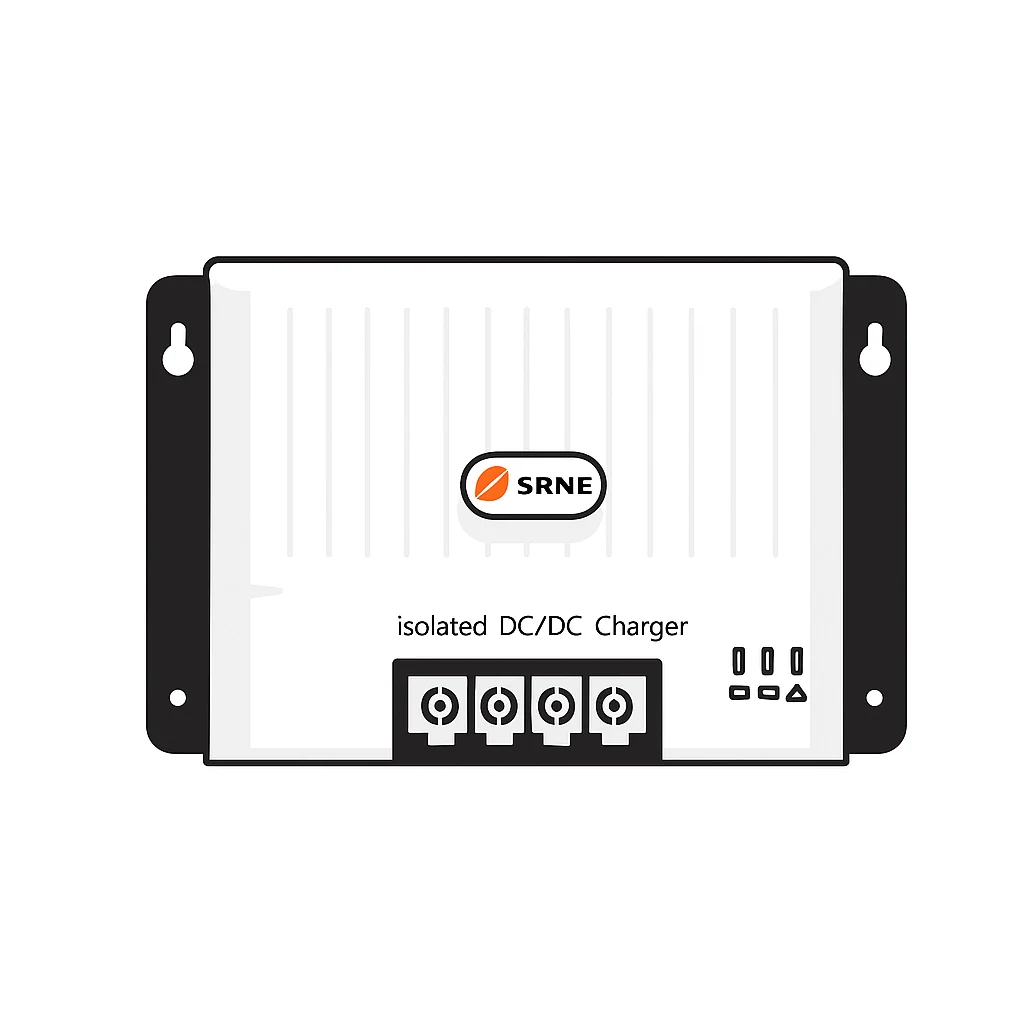
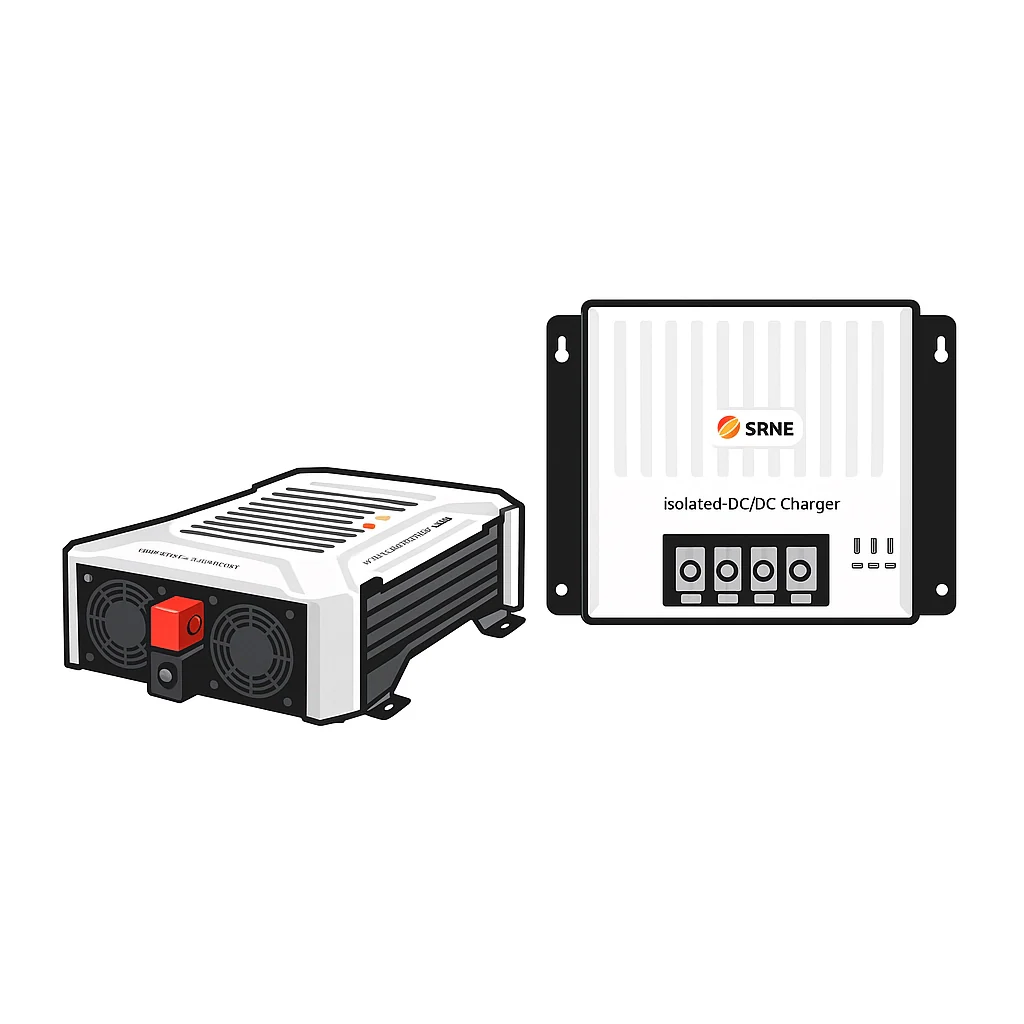
Dual output MPPT solar charge controllers safely charge both starter and leisure batteries independently, improving energy efficiency and battery balance. These specialized controllers feature two separate outputs, each with independent regulation and charging profiles. Your leisure battery receives priority charging with full solar capacity, while the starter battery gets maintained separately.
Alternative approaches include:
- Battery Maintainer Devices: Small auxiliary units that trickle charge the starter battery from the leisure battery or solar array
- Smart Battery Isolators: Automatic switches that connect batteries during charging but isolate them during discharge
- Dual Controller Systems: Separate controllers for each battery, though this increases cost and complexity
For practical implementation guidance, review strategies for managing dual battery systems in campervans. Proper integration ensures both batteries receive appropriate charging without conflicts or safety compromises.
Dual battery management becomes especially critical during winter storage or extended parking periods. Your starter battery gradually self-discharges, and returning to a dead starter battery ruins travel plans. Maintaining both batteries through solar keeps your campervan ready for spontaneous adventures year-round.
Common Misconceptions About Solar Charge Control
Several persistent myths about solar charge controllers lead UK campervan owners toward suboptimal choices, wasted money, or system failures. Correcting these misconceptions helps you make informed decisions based on facts rather than outdated advice or marketing hype.
-
Misconception: PWM controllers suffice for all campervan solar systems. Reality demonstrates MPPT controllers harvest up to 30% more energy, especially valuable in Britain’s limited sunlight conditions. The upfront cost difference disappears quickly through fuel savings and extended battery life.
-
Misconception: Any single controller efficiently charges both starter and leisure batteries simultaneously. Standard controllers cannot optimize charging for two separate batteries with different capacities and discharge states. Dual output controllers or dedicated maintainers prevent voltage conflicts and ensure proper charging for each battery.
-
Misconception: Matching controller amperage exactly to panel wattage provides adequate safety margin. Controllers operating at maximum rated capacity overheat, fail prematurely, and lack expansion headroom. Always size controllers at least 10% above calculated requirements, preferably 20% for longevity and flexibility.
-
Misconception: Expensive controllers with numerous features always outperform simpler models. Feature-rich controllers benefit tech-savvy users who actively monitor and optimize their systems. If you never check Bluetooth apps or adjust settings, a reliable mid-range MPPT controller delivers equivalent charging performance at lower cost.
-
Misconception: Solar charge controllers eliminate the need for proper battery maintenance and monitoring. Controllers protect against charging damage but cannot prevent issues from loose connections, corroded terminals, or incompatible loads. Regular physical inspections remain essential for system reliability.
Understanding realistic solar charge controller capabilities helps set appropriate expectations and guides maintenance priorities. Controllers provide critical protection and optimization, but they work within a properly designed, installed, and maintained system.
Practical Tips and Features to Look for in Solar Charge Controllers
Selecting a solar charge controller involves balancing essential features, desirable conveniences, and budget constraints. Focusing on capabilities that deliver tangible benefits in UK campervan environments ensures you invest wisely without paying for unused functionality.
Prioritize Bluetooth-enabled solar charge controllers for remote real-time monitoring and setup via smartphone apps. This connectivity transforms system management by revealing charge current, battery voltage, daily energy harvest, and error codes without accessing the controller physically. You can troubleshoot issues, adjust settings, and track performance trends from your smartphone.
Environmental protection ratings matter significantly in vehicle applications. Controllers mounted in engine bays, under seats, or exterior compartments face moisture, dust, vibration, and temperature extremes. IP65 or IP67 rated enclosures resist water ingress and dust penetration, preventing corrosion and electronic failures that strand you far from help.
Additional valuable features:
- Multi-Stage Charging Profiles: Programmable bulk, absorption, float, and equalization stages optimized for your specific battery chemistry
- Temperature Compensation: Automatic voltage adjustment based on ambient temperature for optimal charging across seasons
- Load Output Terminals: Built-in connections for small DC loads with low voltage disconnect protection
- Expandable Capacity: Support for adding battery banks or increasing solar array size without replacing the controller
- Comprehensive Display: Clear voltage, current, and status information visible without apps or external devices
Consider practical installation and access requirements. Controllers need adequate ventilation, secure mounting, and reasonable wire routing to battery and panels. Locate controllers where you can easily view displays, press buttons, and inspect connections during routine checks.
Explore practical solar charge controller tips for installation best practices and ongoing maintenance strategies that maximize controller performance and longevity.
Pro Tip: Test your controller’s Bluetooth connectivity and app functionality immediately after installation while you still have easy access for repositioning if signal strength proves inadequate. Metal vehicle bodies and component placement significantly affect wireless range.
Conclusion: Enhancing Your Campervan Energy Independence with Solar Charge Control
Solar charge controllers represent the critical link between your panels and batteries, protecting your investment while maximizing energy harvest for reliable off-grid power. Choosing MPPT technology sized 10-20% above your panel wattage delivers up to 30% more usable energy compared to undersized or PWM alternatives.
Dual battery systems require specialized dual output controllers or supplementary maintainers to charge starter and leisure batteries properly without conflicts. Modern features like Bluetooth monitoring, IP-rated enclosures, and temperature compensation provide practical benefits that simplify system management and extend component lifespan in demanding UK campervan environments.
Applying these insights when selecting and installing your solar charge controller establishes a foundation for genuine energy independence. You gain confidence exploring remote locations, reduce generator dependence, and enjoy the quiet satisfaction of harvesting free, clean solar energy wherever your travels lead across Britain and beyond.
Explore Skyenergi’s Solar Solutions for Campervans

Skyenergi provides comprehensive guidance and quality components to build reliable campervan solar systems matched to UK conditions. Our examples of solar charging setups for UK campervans demonstrate real-world configurations from compact weekend vans to full-time mobile homes.
Discover why MPPT controllers prove essential for maximizing off-grid power efficiency in variable British weather. Pair your optimized charge control with our guidance to install lithium batteries safely in your campervan, creating a complete energy system engineered for performance, safety, and longevity. Visit Skyenergi for expert advice and trusted products supporting your energy independence goals.
Frequently Asked Questions
What size solar charge controller do I need for my campervan?
Calculate total solar panel wattage, divide by system voltage to find amperage, then select a controller rated at least 10% higher for safety margin. A 300W panel array on a 12V system produces about 25 amps, requiring a 28-30 amp controller minimum.
Can I use one solar charge controller for both starter and leisure batteries?
Standard single-output controllers cannot properly charge two separate batteries with different capacities and states simultaneously. Dual output MPPT controllers provide independent regulation for each battery, or you can add a battery maintainer device for the starter battery.
Is Bluetooth monitoring worth it in solar charge controllers?
Bluetooth connectivity provides real-time system data, error notifications, and settings adjustment from your smartphone without physically accessing the controller. This convenience significantly simplifies troubleshooting, performance tracking, and system optimization, especially for controllers mounted in difficult-to-reach locations.
How does MPPT improve solar energy harvest compared to PWM?
MPPT controllers continuously adjust voltage and current to extract maximum power from panels regardless of battery voltage or lighting conditions, achieving 92-97% efficiency. PWM simply matches panel voltage to battery voltage, wasting potential energy and typically achieving only 70-80% efficiency, especially problematic in cloudy UK weather.
What IP rating should a controller have for UK campervan use?
Minimum IP65 rating provides adequate protection against dust and water jets for most campervan installations. IP67 offers superior protection if mounting in particularly exposed locations subject to heavy moisture or submersion risk, ensuring long-term reliability despite harsh vehicle environments.
Recommended
Prev post

7 Off-Grid Power Solutions for UK Campervans with 50% Weight Savings
Updated on 04 March 2026
Next post

Step by Step Energy Storage Setup: Cut Faults by 40% in UK Vans
Updated on 02 March 2026


