





What is lithium iron phosphate? A practical guide
Discover what lithium iron phosphate is and its advantages. Learn how this battery technology outperforms others and ensures safety.
TL;DR:
- Lithium iron phosphate (LiFePO4) batteries are safer, longer-lasting, and more thermally stable than many other lithium-ion chemistries. Despite lower energy density, their benefits make them ideal for EVs, residential storage, and off-grid applications, especially when paired with proper BMS management. Market adoption continues to grow due to their safety, affordability, and environmental advantages.
Lithium iron phosphate is one of the most misunderstood battery technologies available today. Most people assume all lithium batteries perform the same way, but that assumption leads to poor purchasing decisions and real safety risks. What is lithium iron phosphate, exactly? It is a specific lithium-ion chemistry, formally known as LiFePO4 (lithium iron phosphate), that uses an iron-based cathode rather than the nickel or cobalt compounds found in other variants. This guide covers the chemistry, the genuine advantages, how it compares to alternatives, and where it is actually being deployed at scale.
Table of Contents
- Key takeaways
- What is lithium iron phosphate and how does it work?
- Benefits of lithium iron phosphate batteries
- LFP vs other lithium-ion chemistries
- Where LFP batteries are used
- LFP production and sustainability
- My take on LFP and what people get wrong
- Skyenergi LFP solutions for energy independence
- FAQ
Key takeaways
| Point | Details |
|---|---|
| Distinct chemistry | LFP uses LiFePO4 as its cathode, setting it apart from nickel-rich lithium-ion variants. |
| Exceptional safety profile | The phosphate structure remains thermally stable up to 500 °C, greatly reducing thermal runaway risk. |
| Long cycle life | LFP cells typically deliver over 3,000 cycles, far exceeding most competing chemistries. |
| Growing market adoption | LFP held 31% of the EV battery market share as of 2022, with continued expansion in stationary storage. |
| BMS is non-negotiable | A capable battery management system is required to realise the full lifespan and safety benefits of LFP. |
What is lithium iron phosphate and how does it work?
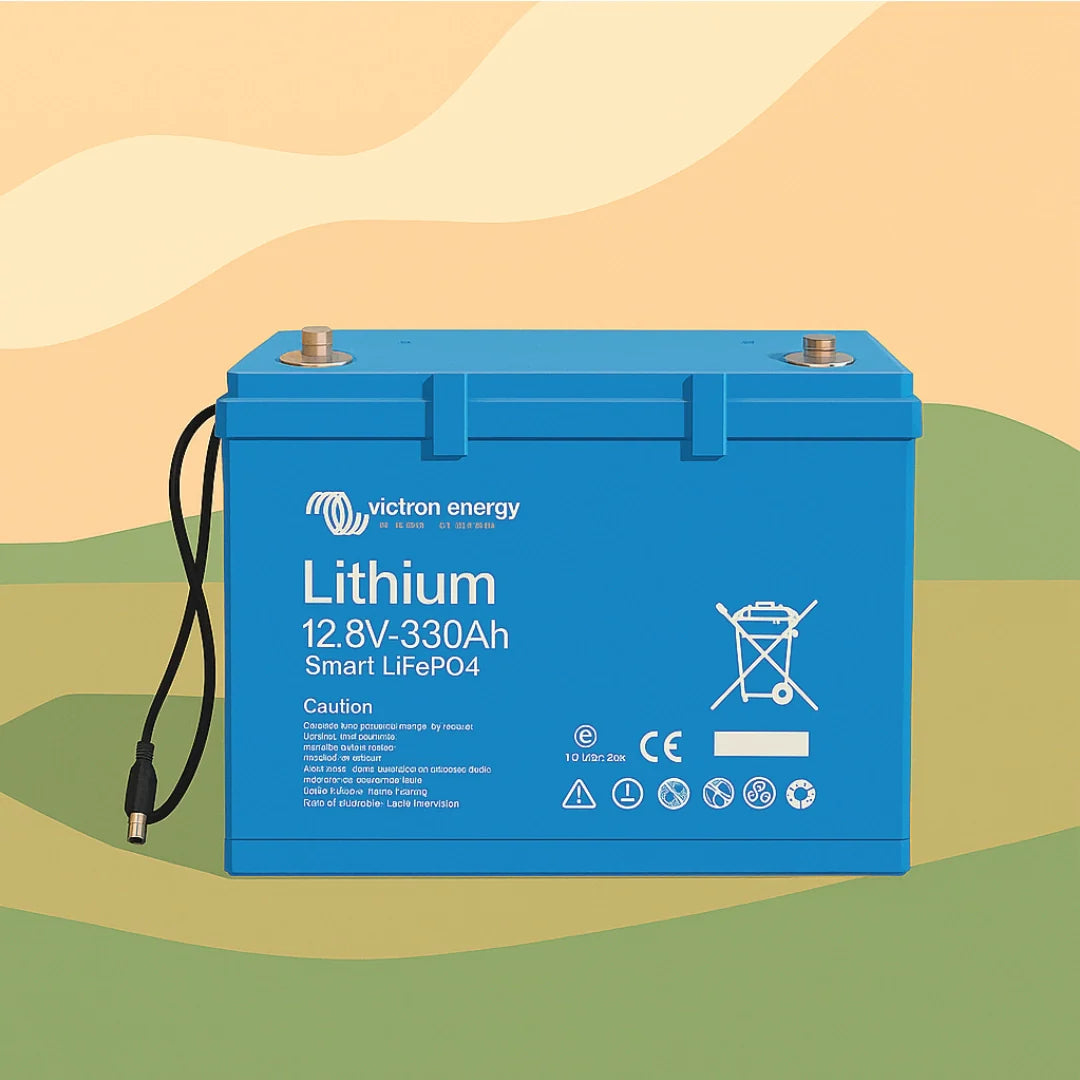
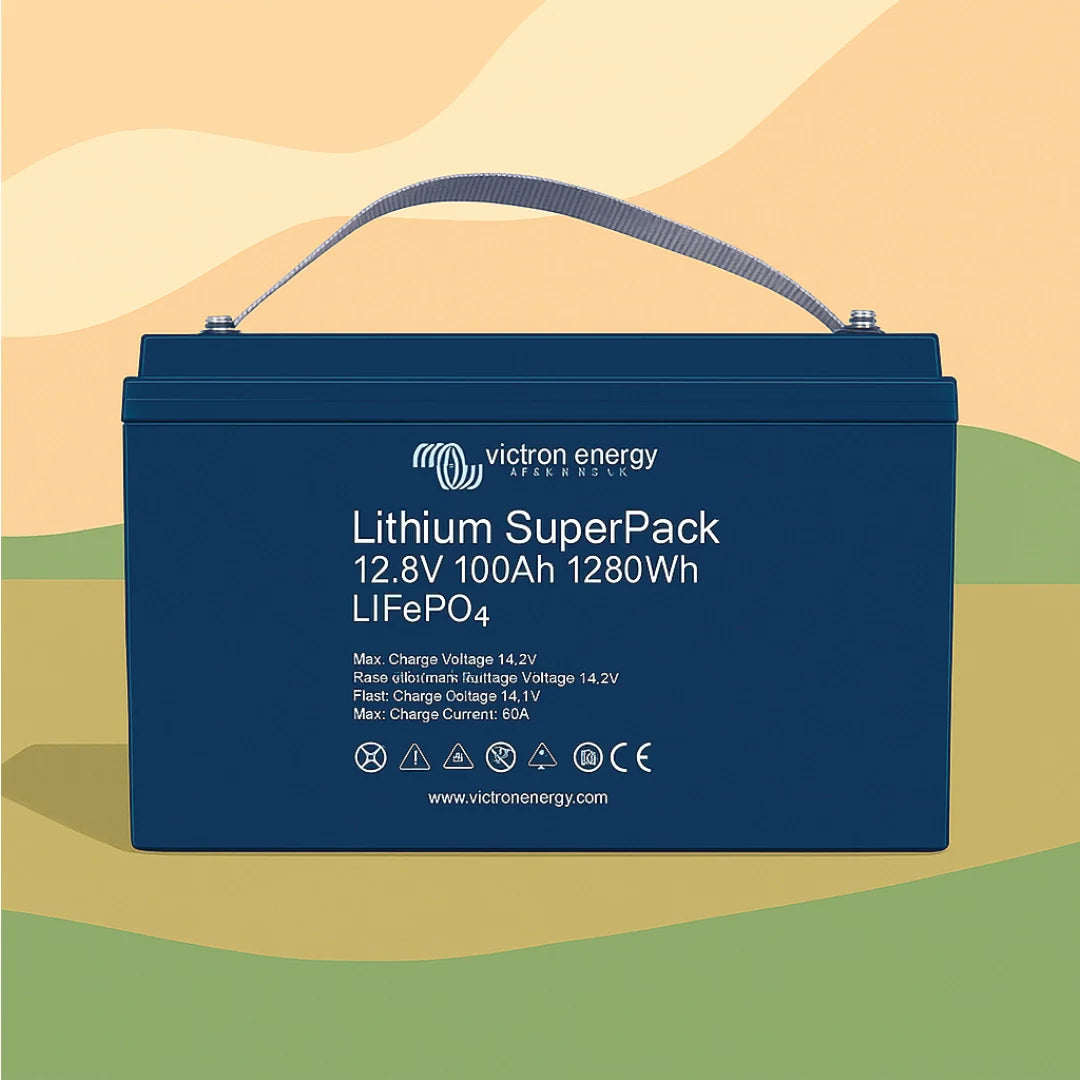
LFP is a lithium-ion chemistry that uses lithium iron phosphate (LiFePO4) as its cathode material and graphite as the anode. Those two materials are the defining elements of lithium iron phosphate chemistry. The phosphate group (PO4) creates a stable, three-dimensional olivine crystal structure that holds lithium ions securely during charge and discharge cycles.
Here is what happens inside a cell during operation:
- Charging: Lithium ions are extracted from the LiFePO4 cathode and migrate through the electrolyte to be stored in the graphite anode.
- Discharging: Ions reverse direction, returning from the graphite anode through the electrolyte back into the cathode, releasing electrical energy in the process.
- Voltage output: Each LFP cell delivers a nominal voltage of approximately 3.3 V, compared to 3.6 to 3.7 V for nickel manganese cobalt (NMC) cells.
- Pack construction: Multiple cells are connected in series to reach the required system voltage, such as 12 V, 24 V, or 48 V for off-grid and marine applications.
The lower nominal voltage of 3.3 V per cell is worth understanding early. It means an LFP pack requires more cells in series to match the voltage output of an NMC pack. This affects component selection and overall pack cost, but it does not diminish the chemistry’s practical value in most energy storage contexts.
What makes lithium iron phosphate chemistry particularly interesting is the covalent bonding within the phosphate unit. The oxygen atoms are held tightly to the phosphorus atoms, which makes it very difficult to release oxygen even under severe thermal stress. This is the structural reason LFP outperforms other chemistries in safety testing, and it is not just a marginal difference.
Benefits of lithium iron phosphate batteries
LFP’s advantages are well documented and consistently verified across independent testing. The key benefits are not just marketing claims.
- Thermal stability: LFP cathodes remain stable up to 500 °C when fully charged, a performance level nickel-rich cathodes cannot match.
- Long cycle life: LFP typically supports over 3,000 cycles and can reach 10,000 cycles under optimal conditions, making it the preferred choice for daily cycling applications.
- Lower toxicity: Iron and phosphate are both abundant, relatively benign materials. Removing cobalt from the equation reduces both the environmental impact of mining and the ethical concerns tied to cobalt supply chains.
- Cost advantages: Iron is far cheaper and more accessible than nickel or cobalt, which makes LFP cathode production less exposed to commodity price volatility.
- Flat discharge curve: LFP cells hold a remarkably stable voltage throughout most of the discharge cycle, which simplifies inverter design and provides consistent power delivery.
The phosphate framework’s stable thermal behaviour during abuse conditions sets LFP apart from nickel cobalt chemistries, where thermal runaway can escalate rapidly. This is not merely a laboratory distinction. It translates directly into real-world safety in campervans, motorhomes, and residential storage systems where batteries operate in uncontrolled environments.
Pro Tip: When selecting an LFP battery for off-grid use, check the cycle life rating at the depth of discharge you actually intend to use. A battery rated for 3,000 cycles at 80% depth of discharge will outlast one rated at 100% depth of discharge, even if the headline cycle numbers match.

The superior cycle life and low toxicity of LFP make it the go-to chemistry for applications demanding daily cycling and long-term reliability. Over a ten-year installation, the cost per usable kilowatt-hour is typically lower with LFP than with higher energy-density alternatives, once replacement cycles are factored in.
LFP vs other lithium-ion chemistries
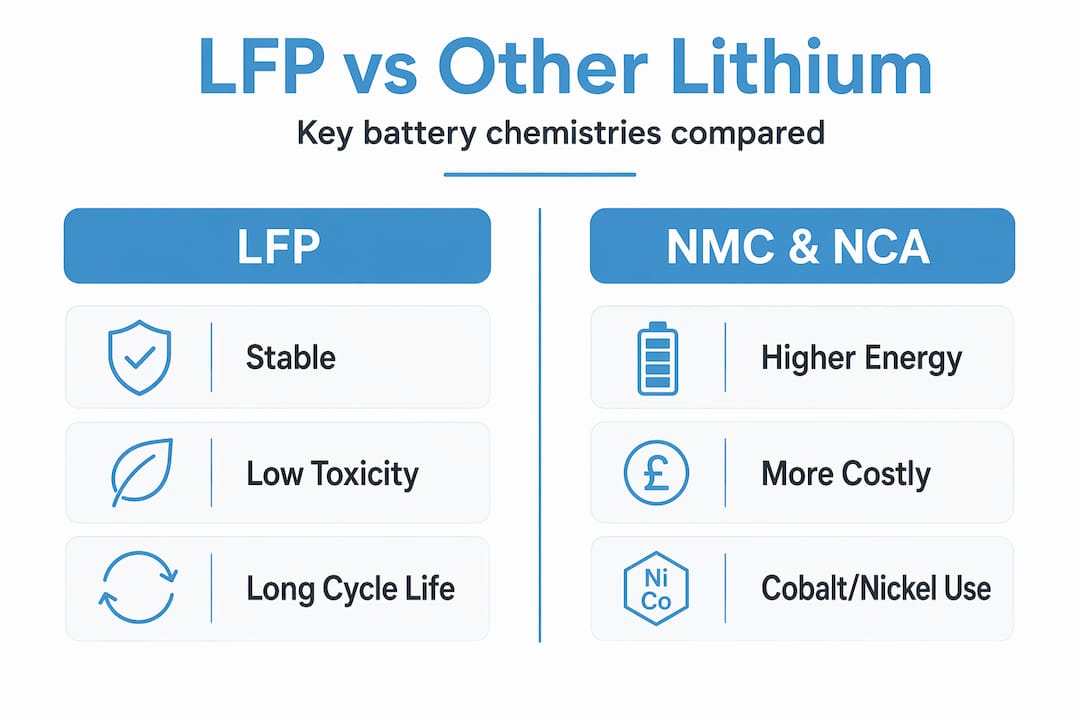
The comparison between LFP and competing chemistries, particularly NMC and NCA (nickel cobalt aluminium), comes down to trade-offs rather than a single winner.
| Characteristic | LFP | NMC | NCA |
|---|---|---|---|
| Nominal cell voltage | 3.3 V | 3.6 V | 3.65 V |
| Gravimetric energy density | 90–120 Wh/kg | 150–220 Wh/kg | 200–260 Wh/kg |
| Typical cycle life | 2,000–10,000 | 1,000–2,000 | 500–1,500 |
| Thermal runaway threshold | ~500 °C | ~200 °C | ~150 °C |
| Cobalt content | None | Moderate | Moderate |
| Typical applications | Off-grid, EVs, stationary storage | EVs, portable electronics | High-performance EVs |
The most common objection to LFP is its lower gravimetric energy density. At 90 to 120 Wh/kg at the cell level, it stores less energy per kilogram than NMC or NCA. In weight-critical applications like aerospace, that matters enormously. For a campervan, motorhome, or residential wall unit, it matters very little.
Pack-level energy density comparisons tell a more complete story than cell-level chemistry figures. When you account for the additional safety hardware, cooling systems, and cell management electronics that NMC packs require, the gap in practical energy density narrows considerably.
Thermal runaway risk also behaves differently depending on the battery’s state of charge. Higher SOC increases explosion risk during thermal events even in LFP batteries. This is a meaningful nuance: LFP is safer, but it is not unconditionally safe at all charge levels. Proper charge control remains necessary.
Pro Tip: Do not compare battery chemistries using cell-level energy density figures alone. Always request pack-level specifications from suppliers, accounting for the BMS, casing, and thermal management components included in the quoted weight and volume.
Where LFP batteries are used
Lithium iron phosphate applications span a wide range of sectors, and adoption is accelerating across all of them.
- Electric vehicles: As of 2022, LFP held 31% of EV battery market share, with major manufacturers adopting LFP for standard-range models due to cost and longevity advantages.
- Residential energy storage: LFP is the dominant chemistry in home battery systems, including popular wall-mount units used alongside solar PV installations. Its cycle life directly translates to a longer system lifespan.
- Off-grid power: For campervans, motorhomes, and marine vessels, LFP is the practical standard. The benefits for off-grid living are well established: deep discharge capability, low self-discharge rates, and tolerance for partial states of charge.
- Backup power and UPS systems: LFP’s flat discharge curve and long calendar life make it well suited for critical backup applications where the battery may sit at partial charge for extended periods.
- Utility-scale storage: Grid operators are deploying LFP at multi-megawatt scale for frequency regulation and renewable energy smoothing, particularly where safety certification and longevity are prioritised over volumetric density.
Battery management systems are a consistent thread across all these applications. Effective BMS operation controls charge voltage, discharge limits, and temperature thresholds to keep cells within the operating window where LFP’s inherent stability actually delivers results. Without a properly configured BMS, even the best LFP cells will underperform. The role of battery cells in renewable storage depends heavily on this system-level management, not just chemistry alone.
Recycling is an emerging advantage too. Because LFP contains no cobalt or nickel, the recovered materials have lower intrinsic value, which has historically slowed recycling investment. However, the abundance of iron and phosphate means the environmental liability at end-of-life is significantly lower than for cobalt-containing chemistries.
LFP production and sustainability
Producing a battery-grade LFP cathode powder is technically demanding. Raw iron and phosphate sources contain impurities that degrade electrochemical performance if not removed. Purification processes must achieve impurity removal efficiencies of 99.9 to 100% to meet the specifications required for reliable battery production.
| Production stage | Key requirement |
|---|---|
| Raw material sourcing | Iron ore and phosphate rock with consistent purity profiles |
| Synthesis | Controlled temperature and atmosphere to form olivine LiFePO4 structure |
| Purification | Impurity removal to 99.9–100% efficiency |
| Particle size control | Nano-scale or micron-scale particles depending on target power density |
| Quality verification | Electrochemical testing of sample batches before dispatch |
Sustainable LFP cathode production is directly linked to the broader energy transition. Scaling up LFP manufacturing without addressing ore processing efficiency and chemical waste management would undermine the environmental case for the technology. Responsible manufacturers are investing in closed-loop water systems and cleaner synthesis routes, though the industry standard varies considerably between suppliers.
My take on LFP and what people get wrong
I have spent years working with lithium battery systems across off-grid, marine, and residential applications. My honest assessment: LFP is the right chemistry for the majority of energy storage use cases, and the objections I hear most often are based on misunderstandings rather than genuine limitations.
The energy density argument comes up constantly. What I have found is that most off-grid users have far more space than they realise, and the weight difference between an LFP pack and an NMC pack of equivalent usable capacity is rarely the deciding factor. Where it genuinely matters, such as a small sailboat with strict weight budgets, the trade-off deserves careful analysis. For a motorhome or a home wall unit, it rarely does.
What people consistently overlook is the BMS. I have seen well-specified LFP batteries underperform significantly because the BMS was poorly configured or incompatible with the charging source. System-level battery safety and longevity depend on the BMS controlling the operating window correctly. This is where the real risk lies, not in the chemistry itself.
The market trajectory is clear. LFP is gaining share in EVs, dominating residential storage, and expanding into utility-scale deployments. The combination of safe chemistry, long service life, and declining production costs makes LFP the practical default for most applications. Those chasing maximum energy density at the cost of safety and longevity are solving the wrong problem for most real-world use cases.
— John
Skyenergi LFP solutions for energy independence
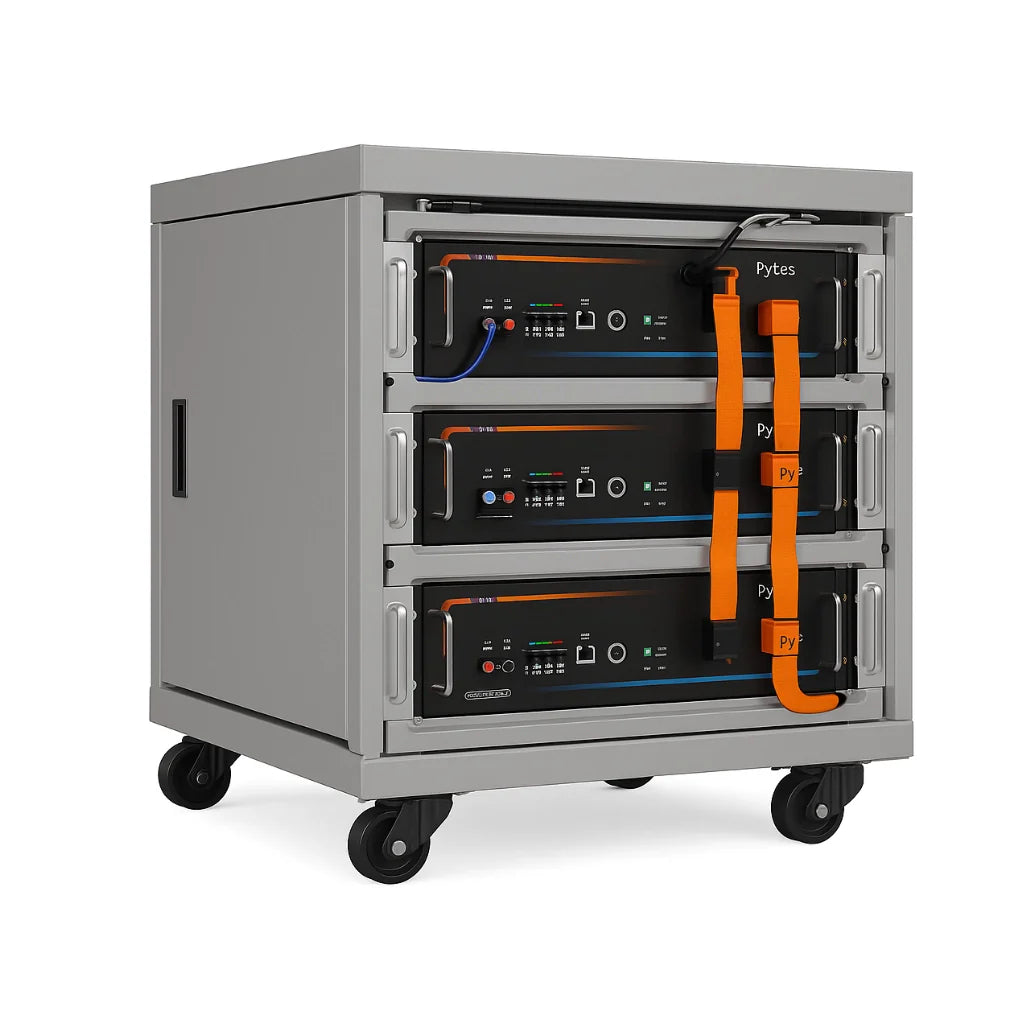
Skyenergi supplies a focused range of LFP-based energy storage systems for campervans, motorhomes, marine vessels, and home installations. The product range includes Skyenergi’s own lithium leisure batteries with integrated BMS and Bluetooth monitoring, home energy storage from Pytes, and the complete SRNE turnkey solution for leisure vehicles. All products are sourced directly from manufacturers, keeping quality high and costs competitive.
If you are building or upgrading an off-grid system, explore the Skyenergi battery range for LFP options that include Victron-compatible components and intelligent monitoring. For further reading, the guide on reliable off-grid battery features covers what to prioritise when specifying a system. Skyenergi also tracks the latest UK lithium battery trends for those planning longer-term energy independence strategies.
FAQ
What does LFP stand for in batteries?
LFP stands for lithium iron phosphate, referring to the cathode material LiFePO4 used in this class of lithium-ion battery.
How long do lithium iron phosphate batteries last?
LFP batteries typically support over 3,000 charge cycles, with well-managed systems reaching up to 10,000 cycles under optimal conditions.
Is lithium iron phosphate safer than other lithium batteries?
Yes. LFP cathodes remain thermally stable up to approximately 500 °C, significantly reducing the risk of thermal runaway compared to nickel-rich chemistries. State of charge still affects safety during extreme abuse conditions.
What are the main lithium iron phosphate applications?
LFP is widely used in electric vehicles, residential solar storage, off-grid campervan and marine systems, backup power, and utility-scale grid storage.
Does LFP have lower energy density than other lithium batteries?
At the cell level, yes. LFP delivers 90 to 120 Wh/kg compared to 150 to 220 Wh/kg for NMC. At the pack level, the gap narrows when safety and thermal management hardware are included in the comparison.
Recommended
Prev post

Residential off-grid system types: a homeowner's guide
Updated on 31 May 2026
Next post

Top 6 sghomeleisure.co.uk Alternatives 2026
Updated on 29 May 2026


