






Explain parallel battery banks: a DIY guide
Learn how to explain parallel battery banks in our DIY guide. Boost your off-grid power setup effectively by connecting batteries for maximum capacity.
A parallel battery bank is a configuration where multiple batteries are connected positive-to-positive and negative-to-negative, keeping voltage constant while multiplying amp-hour capacity. This is the standard industry term for what DIY builders often call “stacking batteries for more power.” Understanding how parallel battery systems work is the foundation of any reliable off-grid build, whether you are fitting out a campervan, a narrowboat, or a residential solar setup. Victron Energy components and lithium leisure batteries from suppliers like Skyenergi are routinely used in these configurations, making this one of the most practical topics in off-grid power design.
How do parallel battery banks work electrically?
A parallel battery bank connects all positive terminals together and all negative terminals together. The result is a single combined bank that operates at the original battery voltage. Two 12V 100Ah batteries in parallel produce a 12V 200Ah bank, not a 24V bank. That distinction matters enormously for system design.
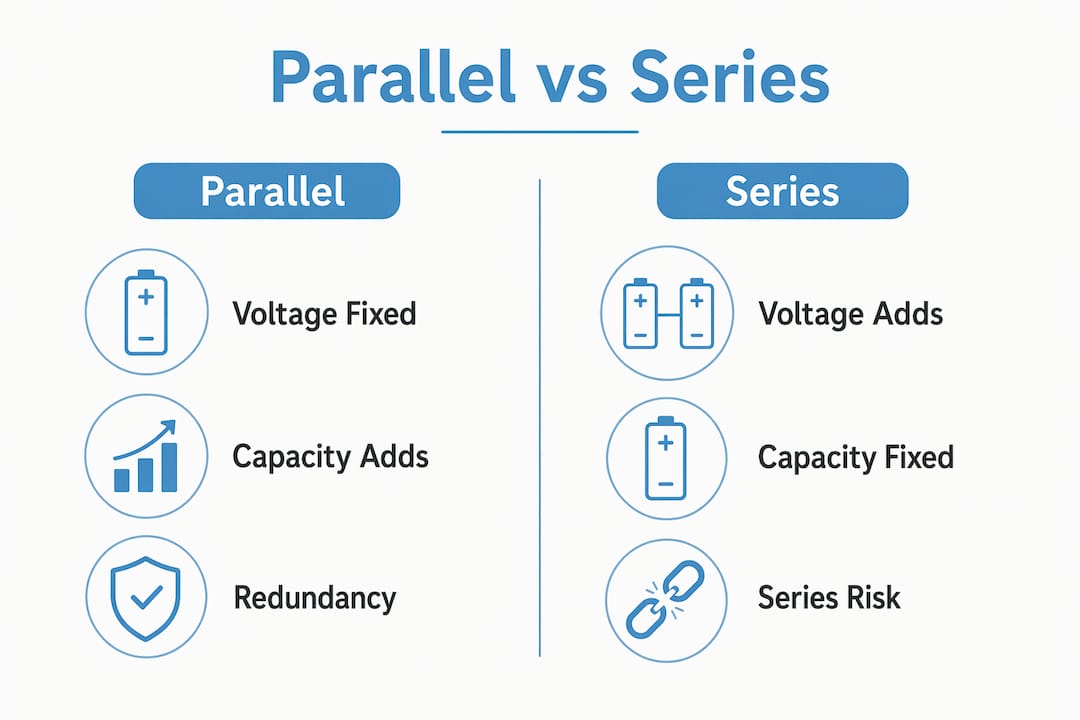
Voltage stays fixed because every battery in the circuit sees the same potential difference. Capacity adds up because each battery contributes its amp-hours to the shared pool. Current from the load draws proportionally from each battery, provided the wiring is balanced.
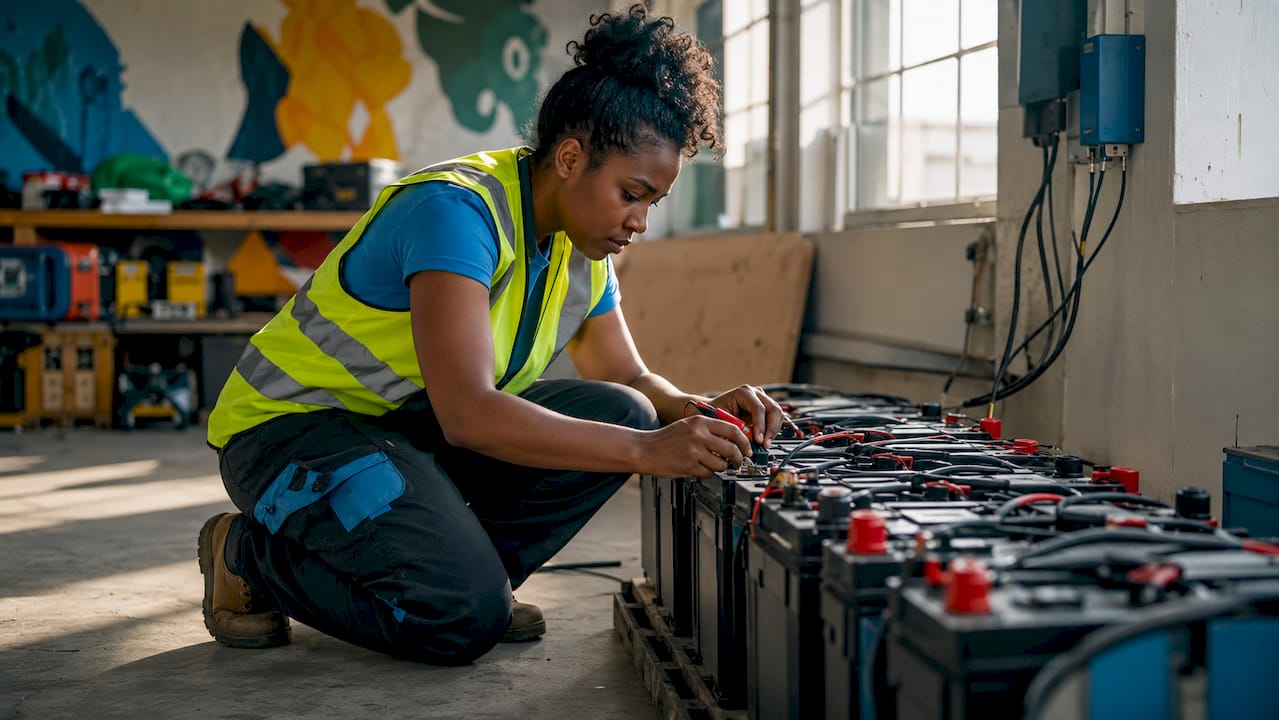
The contrast with series wiring is direct. Series connections add voltage but keep capacity the same. Parallel connections add capacity but keep voltage the same. The table below shows the key differences.
| Property | Parallel connection | Series connection |
|---|---|---|
| Voltage | Stays the same | Adds up |
| Amp-hour capacity | Adds up | Stays the same |
| Total energy (Wh) | Increases | Increases |
| System complexity | Moderate | Lower |
| BMS compatibility | Simpler for lithium | More complex |
Current sharing between batteries depends on internal resistance and state of charge (SOC). Batteries with lower internal resistance draw more current. This is why matched batteries are not optional; they are a requirement.
Pro Tip: Always use cables of identical gauge and length between batteries. Mixed cable lengths create unequal resistance, which forces one battery to work harder than the others and accelerates degradation.
What are the main benefits of parallel battery banks?
Parallel battery systems offer practical advantages that make them the preferred choice for most 12V and 48V off-grid builds.
- Increased storage capacity. Adding a battery to a parallel bank increases total amp-hours without changing system voltage. A 12V system stays at 12V whether you have one battery or four.
- Expandability. You can expand a parallel bank over time by adding matched batteries, rather than redesigning the entire system.
- Redundancy. Failure of one battery does not disable the entire bank. The remaining batteries continue supplying power, which is critical in marine and off-grid residential applications.
- Voltage compatibility. Most leisure vehicle inverters and solar charge controllers operate at 12V or 48V. Parallel banks maintain those voltages natively, avoiding the need for additional conversion hardware.
- Simpler BMS integration. Parallel systems are preferred for residential solar because battery management system (BMS) compatibility is more straightforward than with series arrangements.
The redundancy point deserves emphasis. In a series bank, one failed cell can break the entire circuit. In a parallel bank, the system degrades gracefully. For a campervan owner two hundred miles from the nearest workshop, that difference is significant.
Lithium batteries, including LiFePO4 chemistry, suit parallel configurations particularly well. Their flat discharge curve means individual batteries stay closely matched in voltage throughout the cycle, reducing the circulating currents that cause problems in parallel lead-acid setups.
How to connect battery banks in parallel: wiring and safety
Correct installation of a parallel battery bank follows a clear sequence. Skipping any step creates risk.
- Use identical batteries. Battery age, chemistry, and capacity must match exactly. Mixing old and new batteries causes the weaker unit to limit the entire bank’s performance and shortens the lifespan of every battery in the group.
- Equalise state of charge before connecting. Circulating current can reach 75A or more if SOC differs by 50% between batteries. Charge all batteries to within 10% of each other before making any connections.
- Cut cables to identical lengths. Use the same cable gauge throughout. This keeps resistance equal across all parallel paths and prevents one battery from carrying a disproportionate share of the load.
- Wire diagonally. Connect the positive load cable to the positive terminal of the first battery and the negative load cable to the negative terminal of the last battery. Diagonal wiring balances current flow across the entire bank and prevents the batteries nearest the load from discharging faster.
- Fuse each battery individually. Individual fuses at each positive terminal isolate a faulty battery before other cells can dump high current into it. This prevents thermal runaway and cable fires.
- Check polarity before finalising connections. A reversed connection in a parallel bank causes an immediate short circuit. Use a multimeter to confirm polarity at every terminal before tightening.
- Label all cables. Mark positive and negative runs clearly. This makes future maintenance and fault-finding straightforward.
Pro Tip: Refer to a DIY battery bank guide before purchasing cables. Getting cable sizing right before cutting saves time and prevents the most common wiring errors in parallel builds.
A well-built parallel bank with matched lithium batteries, diagonal wiring, and individual fusing will operate reliably for years with minimal intervention.
What are the common challenges with parallel battery banks?
Parallel battery configurations introduce specific failure modes that series banks do not. Knowing them in advance prevents most problems.
Imbalanced ageing is the most common long-term issue. Batteries age at slightly different rates even when matched at installation. Over time, one battery develops higher internal resistance. It then accepts and delivers less current than its neighbours, reducing the effective capacity of the whole bank.
Unequal SOC at connection causes immediate problems. Connecting a fully charged battery to a discharged one creates a large voltage difference. Current flows between the batteries rather than to the load, generating heat and stressing the cells. Always equalise before connecting.
Warning signs to watch for include:
- Cables running noticeably warm during normal operation
- One battery consistently showing a lower voltage than the others after charging
- Reduced total runtime despite batteries appearing fully charged
- A BMS triggering protection faults on one battery but not others
Preventive actions include:
- Checking individual battery voltages monthly with a multimeter
- Using a battery management system that monitors each cell group independently
- Replacing all batteries simultaneously rather than substituting individual units
Limiting parallel strings to four batteries is a professional best practice. Beyond four batteries, managing current imbalance becomes exponentially more complex. If you need more capacity than four batteries provide, the correct solution is to raise system voltage rather than add more parallel strings. A 48V system with four batteries in series-parallel stores significantly more energy than a 12V system with eight batteries in parallel, and it does so with better efficiency.
For persistent faults, a troubleshooting guide for off-grid battery systems covers diagnostic steps in detail.
Key takeaways
Parallel battery banks increase capacity without changing voltage, making them the most practical configuration for 12V and 48V off-grid systems.
| Point | Details |
|---|---|
| Voltage stays constant | Parallel connection keeps system voltage fixed while amp-hours multiply with each added battery. |
| Match batteries precisely | Age, chemistry, and capacity must be identical to prevent one battery limiting the whole bank. |
| Equalise SOC before connecting | Connecting batteries with mismatched charge levels causes circulating currents that damage cells. |
| Wire diagonally with equal cables | Diagonal wiring and identical cable lengths distribute current evenly across all batteries. |
| Limit to four parallel strings | Beyond four batteries, current imbalance becomes difficult to manage; raise voltage instead. |
Why the wiring details matter more than the battery brand
The most common mistake I see in DIY parallel builds is treating the batteries as the only variable that matters. Builders spend hours researching LiFePO4 chemistry and BMS specifications, then connect everything with whatever cable is left over in the garage. That approach defeats the purpose of buying quality batteries.
Diagonal wiring is the single change that makes the biggest practical difference in a parallel bank. Most builders wire straight across, positive to positive and negative to negative, then connect the load at one end. The batteries nearest the load discharge first. The ones furthest away contribute less. The bank appears to work, but capacity is uneven from day one.
I have also seen parallel banks built with batteries from two different purchase dates, even the same model. The older battery had measurably higher internal resistance. Within six months, the newer battery was doing the majority of the work. Both batteries failed earlier than they should have.
The redundancy benefit of parallel banks is real and worth having. But it only holds if the bank is wired and maintained correctly. A poorly wired parallel bank with mismatched batteries gives you the worst of both worlds: reduced capacity and accelerated failure. Get the wiring right, match your batteries, and a parallel bank is one of the most reliable configurations available for off-grid power.
— John
Skyenergi’s parallel-ready solar and battery solutions
Skyenergi supplies Victron Energy components designed to work directly with parallel battery bank configurations. The Victron Energy Solar Home System 200 MPPT is a complete off-grid package that includes an MPPT charge controller, wiring, and mounting hardware suited to 12V parallel battery setups.

For builders who need individual components, Skyenergi stocks Victron Smart MPPT charge controllers, fusing accessories, and cabling compatible with parallel battery bank design. All products are sourced directly from manufacturers, keeping prices competitive without compromising on specification. Browse the full range at Skyenergi’s off-grid solutions to find components matched to your system voltage and capacity requirements.
FAQ
What does a parallel battery bank do?
A parallel battery bank connects multiple batteries positive-to-positive and negative-to-negative to increase total amp-hour capacity while keeping system voltage constant. Two 12V 100Ah batteries in parallel produce a 12V 200Ah bank.
Is parallel or series wiring better for off-grid solar?
Parallel wiring suits 12V and 48V systems where voltage must stay fixed. Series wiring raises voltage, which improves efficiency over long cable runs but requires more complex BMS integration.
How many batteries can I connect in parallel?
Professionals recommend a maximum of four batteries in a parallel string. Beyond four, current imbalance becomes difficult to control and system voltage should be raised instead.
Do I need a BMS for a parallel battery bank?
A BMS is strongly recommended for lithium parallel banks. It monitors individual cell groups, prevents overcharge and deep discharge, and protects against the circulating currents caused by SOC imbalance.
Can I mix old and new batteries in a parallel bank?
Mixing batteries of different ages causes the weaker battery to limit the entire bank’s performance and shortens the lifespan of every battery in the group. Always replace all batteries simultaneously.
Recommended
Prev post

Solar storage system loss analysis: 2026 guide
Updated on 27 June 2026
Next post

Role of firmware in energy storage: 2026 guide
Updated on 25 June 2026


