








Role of firmware in energy storage: 2026 guide
Discover the crucial role of firmware in energy storage. Learn how it ensures efficiency, safety, and management in modern systems.
Firmware is the embedded control software that orchestrates the operation, safety, and energy management of every modern energy storage system. Without it, hardware components such as the Battery Management System (BMS), Power Conversion System (PCS), and Energy Management System (EMS) cannot coordinate. The role of firmware in energy storage extends from cell-level safety decisions to grid-scale power dispatch. Firmware resolves logic errors and nuisance trips that would otherwise reduce system uptime and cause financial losses across megawatts of capacity. Understanding what firmware actually does separates competent system operators from those who treat storage as a black box.
What is the role of firmware in energy storage systems?
Firmware sits between hardware and high-level software. It runs on microcontrollers embedded inside the BMS, PCS, and EMS, executing instructions in real time without waiting for a host operating system. This makes it faster and more reliable than application software for time-critical tasks such as overcurrent protection and cell balancing.
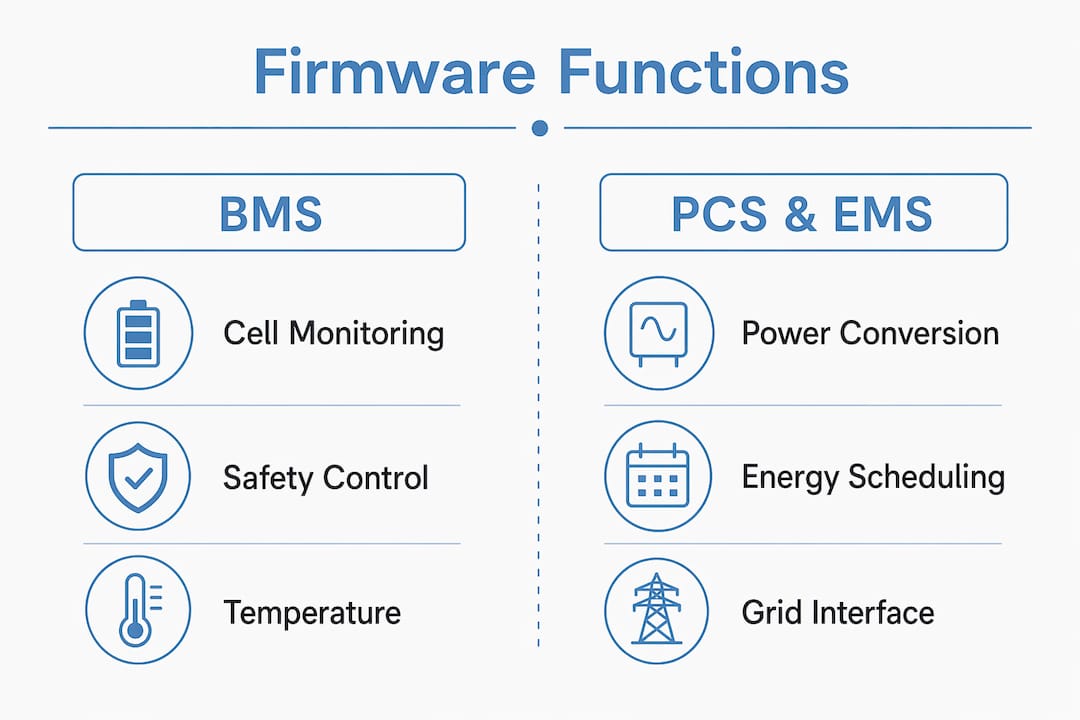
The BMS firmware monitors individual cell voltages, temperatures, and state of charge. It makes autonomous safety decisions: disconnecting the pack if a cell exceeds its voltage limit, throttling charge current during high temperatures, and logging fault codes for diagnostics. The PCS firmware controls the inverter’s switching behaviour, regulating AC output frequency and voltage to match grid or load requirements. The EMS firmware sits above both, coordinating energy flows based on tariff data, solar forecasts, and demand profiles.

Firmware quality often dictates real-world performance and resilience more than hardware specifications alone. Asset managers in commercial battery energy storage systems (BESS) treat firmware as a strategic asset, weighing the benefits of each update against the risk of introducing new faults. That framing applies equally to a 5 kWh residential system and a 10 MW grid installation.
How does firmware integrate with hardware and communication protocols?
Energy storage systems rely on multiple communication protocols to pass data between components. Firmware must speak each protocol fluently, or the system fails to function. The most common protocols in professional installations are:
- CAN bus: used between BMS modules and the PCS for high-speed, fault-tolerant data exchange
- Modbus RTU/TCP: widely used between EMS platforms and inverters or meters
- IEC 61850: the standard for substation automation and grid-connected BESS requiring utility-grade communication
- IEEE 1547-2018: the US interconnection standard that firmware must implement for grid compliance, though its influence extends to UK and European grid codes
Firmware compatibility requires matched communication protocols and identical data dictionaries between hardware components. A data dictionary defines which register address holds which value. If a BMS firmware update changes register 0x0032 from “state of charge” to “cycle count,” and the EMS firmware still reads that address as state of charge, the system will make incorrect dispatch decisions. This is not a theoretical risk. Minor firmware mismatches readily cause communication lockouts in field installations.
| Scenario | Result |
|---|---|
| Matched firmware versions, identical data dictionaries | Full communication, correct charging and discharging |
| Mismatched register mappings after update | EMS reads incorrect values, poor dispatch decisions |
| Incompatible protocol versions | Communication errors, battery refuses to charge or discharge |
| Missing grid compliance firmware | Fails grid interconnection tests, cannot export power |
The role of BMS firmware in maintaining these communication standards is why replacing a BMS with a different manufacturer’s unit often requires a full firmware audit, not just a hardware swap. Skyenergi recommends checking firmware compatibility matrices before any component substitution in an existing system.
What are the core firmware functions in a BESS?
BMS firmware performs cell health monitoring continuously. It measures voltage, temperature, and current across every cell group, then applies algorithms to estimate state of charge and state of health. When a cell drifts outside safe parameters, the firmware triggers a protection relay before the hardware can be damaged. This is not a passive process. The firmware actively balances cells during charging, redistributing energy from high-voltage cells to low-voltage ones to extend pack life.
PCS firmware controls the power electronics that convert DC battery power to AC grid power. It manages switching frequencies, power factor correction, and reactive power output. Two systems with identical hardware can perform very differently because of firmware-driven algorithms for power and thermal management. A PCS with well-tuned firmware will respond to a sudden load spike in milliseconds. One with poorly written firmware may hesitate, causing voltage sag or a protection trip.
EMS firmware handles the economic layer. It schedules charge and discharge cycles based on time-of-use tariffs, grid frequency response signals, and renewable generation forecasts. Advanced EMS platforms integrate model predictive controls, running short-horizon simulations to choose the dispatch strategy that minimises cost or maximises revenue.
Pro Tip: If your system is tripping on overtemperature faults during moderate loads, check the PCS firmware version before replacing any hardware. Thermal management algorithms are frequently updated to correct over-conservative trip thresholds.
Key firmware functions across the three main components:
- BMS: cell voltage and temperature monitoring, state of charge estimation, cell balancing, fault logging, protection relay control
- PCS: inverter switching control, AC voltage and frequency regulation, power factor correction, anti-islanding protection
- EMS: tariff-based scheduling, renewable integration, demand response, grid ancillary services, system diagnostics
The power electronics in storage systems that firmware controls are the physical reason why firmware quality matters so much. Better algorithms applied to the same transistors produce measurably better efficiency and longer component life.
How should you manage energy storage firmware updates?
Firmware updates carry genuine risk. Firmware corruption is a leading cause of complex storage failures, and early professional intervention improves recovery success significantly. The instinct to apply every available update immediately is wrong for mission-critical systems.
A structured update process follows these steps:
- Review the manufacturer’s release notes before downloading anything. Identify whether the update addresses a fault relevant to your system configuration.
- Check the compatibility matrix for your specific hardware revision. Firmware versions are often tied to hardware generations, and applying the wrong version bricks the controller.
- Test on a non-production subset first. Professional BESS deployments begin updates on one or two units before rolling out fleet-wide, specifically to catch communication protocol mismatches before they cause widespread failures.
- Verify cryptographic signatures. Legitimate firmware images from manufacturers such as Victron Energy are cryptographically signed. Reject any image that fails signature verification.
- Confirm rollback capability. Know whether your system supports reverting to the previous firmware version before you begin.
Firmware update errors can cause system inoperability and require rigorous compatibility matrices that prioritise existing protocols over new versions. For systems requiring 24/7 uptime, firmware over-the-air (FOTA) orchestration with secure bootloaders is the correct approach. Secure bootloaders with cryptographic verification prevent unsafe grid conditions and allow autonomous recovery if an update fails mid-process.
Pro Tip: Never update BMS and PCS firmware simultaneously. Update one component, verify communication is restored, then proceed to the next. Simultaneous updates double the failure surface and make fault diagnosis far harder.
Security is a growing concern. Grid-connected BESS are increasingly targeted by cyberattacks that exploit unpatched firmware vulnerabilities. Cryptographically signed firmware images and secure boot chains are the minimum acceptable standard for any system connected to a public grid.
What is firmware’s role in future energy storage capabilities?
Firmware must bridge hierarchical hardware tiers from individual battery cells to the electrical grid, translating proprietary protocols to standard grid communication in real time. This middleware role is a complex engineering challenge with no off-the-shelf solution, making firmware a key differentiator in system reliability. It is the reason why two BESS products with similar cell chemistry and inverter hardware can have dramatically different grid performance records.
Modern BESS firmware architecture is hierarchical. At the cell level, BMS firmware handles microsecond-scale protection decisions. At the rack level, a master BMS firmware aggregates data from multiple slave BMS units. At the system level, EMS firmware coordinates multiple racks and the PCS. At the grid level, firmware translates internal data into IEC 61850 or DNP3 messages that utilities can read. Each layer must pass data upward without loss or latency.
The integration of artificial intelligence within EMS firmware is accelerating. Model predictive control algorithms now run on embedded processors within the EMS, adjusting dispatch strategies every few minutes based on updated weather and price data. This is not a future concept. Commercial EMS platforms from vendors such as SRNE already incorporate adaptive algorithms that learn from historical system behaviour.
Vendor approaches divide broadly into two camps:
- Vertically integrated platforms: the manufacturer controls firmware across BMS, PCS, and EMS, guaranteeing compatibility but limiting hardware choice
- Hardware-agnostic EMS platforms: open firmware interfaces allow mixing components from different manufacturers, offering flexibility but requiring careful compatibility management
Custom firmware development is a rigorous, engineering-intensive process with significant safety and compliance implications. It goes well beyond adjusting parameters. Operators who need bespoke firmware for unusual grid configurations or proprietary hardware should engage qualified embedded software engineers, not attempt in-house modification.
Key takeaways
Firmware is the single most important determinant of energy storage system performance, safety, and long-term reliability, regardless of hardware quality.
| Point | Details |
|---|---|
| Firmware controls all core functions | BMS, PCS, and EMS firmware manage safety, power conversion, and energy scheduling respectively. |
| Protocol compatibility is non-negotiable | Mismatched data dictionaries between firmware versions cause communication lockouts and charging failures. |
| Updates require a structured process | Test on a subset first, verify cryptographic signatures, and never update BMS and PCS simultaneously. |
| Firmware outweighs hardware specs | Two systems with identical hardware perform differently due to firmware-driven thermal and power algorithms. |
| Future firmware integrates AI | EMS firmware now incorporates model predictive controls that adapt dispatch strategies in real time. |
Firmware as a strategic asset: John’s perspective
The energy storage industry spent years treating firmware as an afterthought. Operators would spec the cells, choose the inverter, and assume the software would sort itself out. That assumption has caused more system failures than any single hardware defect I have encountered.
What changed my thinking was watching a well-funded commercial installation lose weeks of revenue because a BMS firmware update changed a single register address. The hardware was fine. The cells were fine. The inverter was fine. The system simply refused to communicate because nobody had checked the data dictionary before pushing the update. That is not a technical failure. It is a process failure.
The shift I would encourage is treating firmware lifecycle management the same way you treat physical maintenance. Schedule reviews. Track versions across every component. Read release notes before applying updates, not after something breaks. For off-grid systems in campervans or marine installations, the stakes are lower than a grid-scale BESS, but the principle is identical. A Victron MPPT controller running outdated firmware may charge your lithium battery less efficiently than the current version allows. That difference compounds over months.
The next frontier is AI-driven EMS firmware that genuinely learns from your usage patterns. The technology exists now in commercial platforms. The challenge is validation: how do you verify that an adaptive algorithm is making correct decisions when its behaviour changes over time? That question will define firmware engineering for the next decade.
— John
Victron Energy systems with advanced firmware management
Skyenergi supplies Victron Energy products specifically because their firmware architecture is one of the most mature in the off-grid and solar storage market. Victron’s VE.Direct and VE.Can protocols are well-documented, firmware updates are cryptographically signed, and the VictronConnect app gives you direct visibility into firmware versions across your system.

The Victron Energy Solar Home System 200 MPPT is a complete off-grid solution with firmware-managed MPPT charge control built in. For larger solar installations, the Victron 305W panel and Smart MPPT bundle pairs proven panel output with a Smart MPPT controller whose firmware handles adaptive charge algorithms automatically. Both options are available directly from Skyenergi with full UK support.
FAQ
What does firmware do in a battery management system?
BMS firmware monitors cell voltages, temperatures, and state of charge in real time, then makes autonomous protection decisions such as disconnecting the pack or throttling charge current. It also manages cell balancing to extend battery life.
Why does firmware compatibility matter between BMS and inverter?
Incompatible firmware causes communication errors because data dictionaries and register mappings differ between versions. This can prevent the battery from charging or discharging, even when all hardware is physically intact.
How often should energy storage firmware be updated?
Updates should be applied only when release notes confirm they address a fault or improvement relevant to your specific hardware revision. Indiscriminate updates increase the risk of firmware corruption and communication failures.
What is FOTA in energy storage firmware management?
FOTA stands for firmware over-the-air, a method for delivering firmware updates remotely to mission-critical BESS without requiring physical access. Secure FOTA systems use cryptographic verification and secure bootloaders to prevent unsafe states during the update process.
Can firmware affect battery lifespan?
Firmware directly affects lifespan through cell balancing algorithms and thermal management. Systems running firmware with well-tuned balancing and conservative thermal thresholds consistently show lower cell degradation rates than identical hardware running older or poorly calibrated firmware.
Recommended
Prev post

Explain parallel battery banks: a DIY guide
Updated on 26 June 2026
Next post

Smart meter integration with battery storage: 2026 guide
Updated on 24 June 2026


