





The role of power electronics in storage systems
Discover the vital role of power electronics in storage systems, enhancing efficiency and performance in battery energy storage. Learn more!
Power electronics are defined as the technology governing energy conversion, control, and flow within battery energy storage systems (BESS). Their function determines whether a storage system can charge efficiently, discharge on demand, and deliver grid services at the required speed and quality. The role of power electronics in storage extends far beyond simple voltage conversion. Power conversion systems (PCS), SiC semiconductors, and energy management system (EMS) software together define what a storage asset can actually do. Power electronics constitute 15–25% of total BESS hardware cost and directly shape operational capability and grid compliance. That figure alone signals how central converter technology is to system design.
What is the role of power electronics in storage?
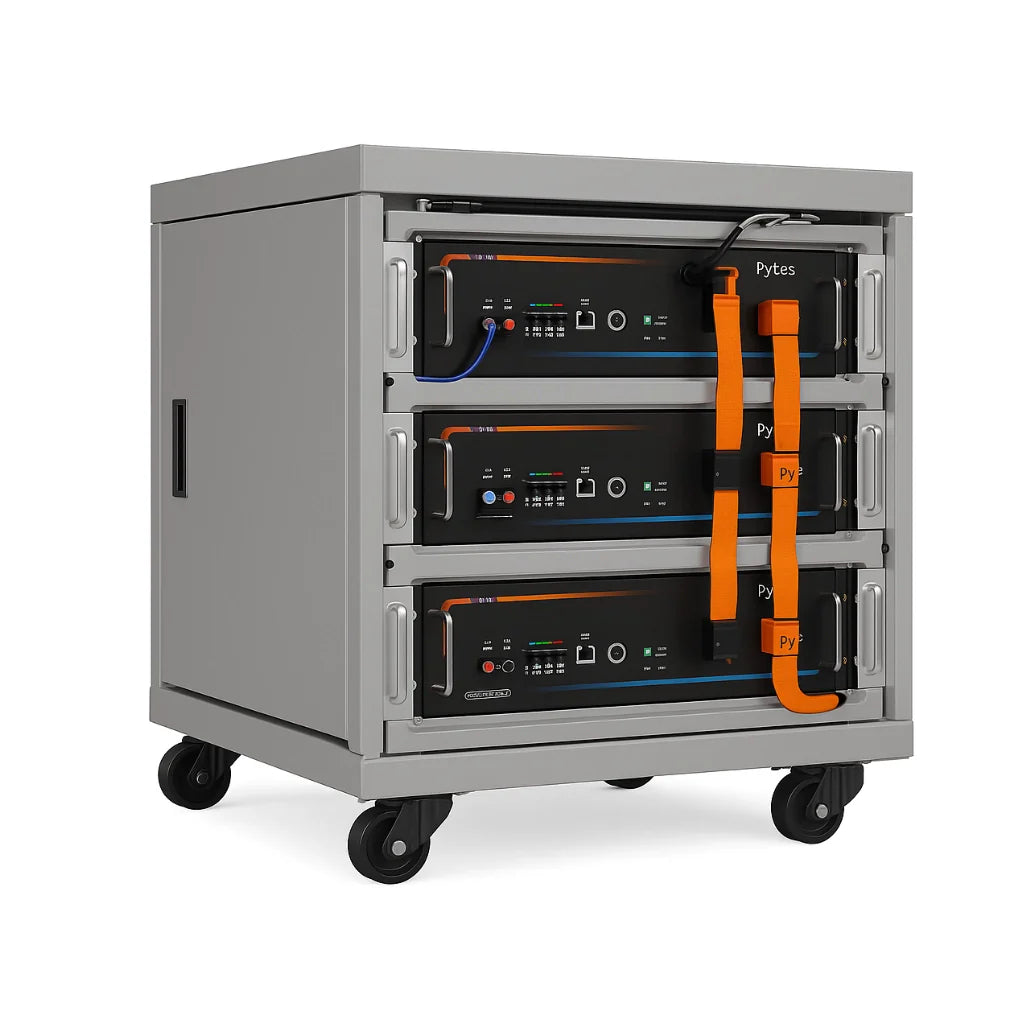
Power electronics manage every watt that enters or leaves a battery. The core component is the power conversion system, which combines bidirectional inverters and DC/DC converters to handle both charge and discharge cycles within a single unit. Without bidirectional conversion, a storage system cannot respond to grid signals or renewable generation profiles in real time.
Round-trip efficiency is the primary performance metric for any storage asset. Even a 1% loss in conversion efficiency causes significant wasted energy at gigawatt-hour scale, which translates directly into lost revenue and reduced carbon benefit. This is why the industry targets peak round-trip efficiencies above 98%, a figure now achievable with modern converter designs.

Wide-bandgap semiconductors are the technology making those targets realistic. SiC devices contribute to peak efficiencies above 98%, reduce cooling requirements, and allow higher power density within the same physical footprint. Gallium nitride (GaN) devices follow a similar trajectory, particularly for lower-voltage applications in residential and leisure vehicle storage.
Key functions delivered by the PCS in a storage system include:
- Bidirectional AC/DC conversion: Charges the battery from the grid or a solar array and discharges back to the load or grid.
- DC/DC conversion: Manages voltage matching between battery strings and the inverter bus, critical for lithium chemistries with varying state-of-charge profiles.
- Power quality control: Filters harmonics, manages reactive power, and maintains voltage stability at the point of connection.
- Fault protection: Detects overcurrent, ground faults, and islanding conditions faster than any mechanical protection device.
Pro Tip: When specifying a PCS for a lithium storage system, confirm the converter’s switching frequency range. Higher switching frequencies, enabled by SiC, reduce output filter size and improve dynamic response, which matters for frequency regulation services.
Grid-forming vs grid-following: which inverter mode matters more?
The distinction between grid-following (GFL) and grid-forming (GFM) inverters is now one of the most consequential design decisions in storage project development. Understanding both modes is not optional for engineers working on grid-connected assets.
A grid-following inverter synchronises to an existing grid voltage and frequency reference using a phase-locked loop (PLL). It injects current at the commanded power factor but cannot independently establish voltage or frequency. GFL inverters dominate the installed base today and perform well on strong, inertia-rich grids.
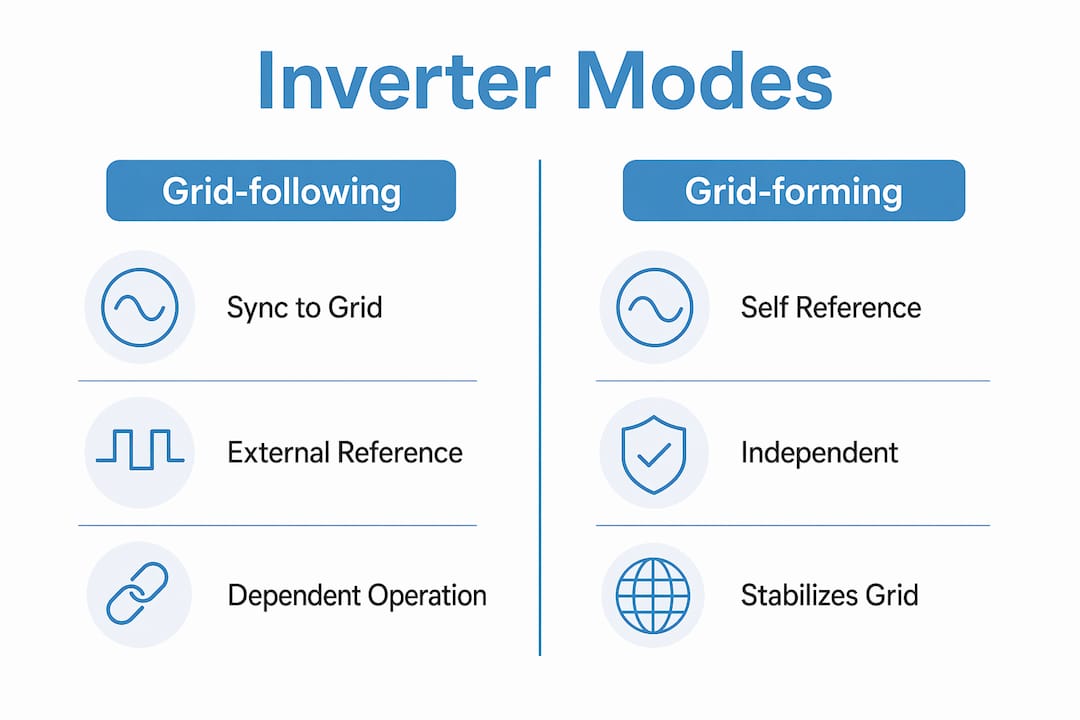
A grid-forming inverter behaves differently. It establishes its own voltage and frequency reference, effectively acting like a synchronous generator from the grid’s perspective. GFM inverters can establish voltage and frequency autonomously, which is the defining capability needed for weak or inverter-dominated grids. This includes inertia emulation, droop control, and black start capability.
| Feature | Grid-following (GFL) | Grid-forming (GFM) |
|---|---|---|
| Voltage reference | External grid | Self-generated |
| Frequency response | Passive tracking | Active inertia emulation |
| Black start capability | No | Yes |
| Weak grid performance | Degraded | Stable |
| Regulatory trend | Legacy standard | Increasingly mandated |
Grid-forming inverter capability is rapidly becoming a standard requirement worldwide as rotating inertia declines with coal and gas plant retirements. The UK National Grid ESO and equivalent bodies in Australia and the US are already specifying GFM requirements in new storage contracts.
Grid-connected storage now provides active grid services including frequency regulation, voltage support, fast reserve, and black start, primarily through power electronics and control software rather than the batteries themselves. The battery provides the energy; the converter defines the service.
Pro Tip: For projects in areas with high renewable penetration, specify GFM capability from the outset even if it is not yet mandated. Retrofitting GFM control to GFL hardware is rarely straightforward and often requires full converter replacement.
How do BMS and EMS integration affect storage performance?
Power electronics do not operate in isolation. Their performance depends on tight integration with the battery management system (BMS) and the energy management system (EMS). This three-layer control architecture is what separates a high-performing storage asset from one that degrades prematurely or underperforms commercially.
The integration between these layers follows a clear hierarchy:
- BMS layer: Monitors individual cell voltages, temperatures, and state of charge. Communicates limits to the PCS via CAN bus or Modbus protocols. Prevents the converter from operating outside safe battery parameters.
- PCS layer: Executes real-time power commands within the limits set by the BMS. Manages switching, filtering, and protection at millisecond timescales. Feeds telemetry upward to the EMS.
- EMS layer: Optimises dispatch across minutes to hours based on market signals, grid requirements, and battery health constraints. Coordinates multiple PCS units in larger systems.
Well-tuned EMS software can increase revenues by 30–40% annually compared to poorly dispatched systems with identical hardware. That gap is attributable entirely to software and control logic, not battery chemistry. The role of BMS in energy storage is therefore inseparable from the converter controls that act on its outputs.
BESS-STATCOM integration illustrates this synergy at grid scale. BESS-STATCOM integration allows real-time dynamic energy support and network reliability improvement by combining reactive power compensation with active energy dispatch. The power electronics handle both functions simultaneously, with the EMS coordinating which service takes priority at any given moment.
What innovations are shaping power electronics for storage?
The power electronics sector is advancing on several fronts simultaneously, each addressing a specific limitation of earlier converter generations.
Wide-bandgap semiconductors remain the most impactful near-term development. SiC MOSFETs now appear in utility-scale PCS units from suppliers including ABB, SMA, and Sungrow. GaN transistors are entering residential inverters and DC/DC converters where their low gate charge enables very high switching frequencies with minimal switching loss.
Modular converter architectures are replacing large centralised PCS designs. Deploying MW-class standardised modules is preferred over bespoke central converters because modular systems improve redundancy, simplify maintenance, and allow capacity expansion without full system redesign. A single string failure in a distributed architecture does not take the entire asset offline.
Distributed power conversion systems placing conversion stages near battery modules improve fault tolerance and maintain system availability despite string failures. This architecture also reduces DC cable losses by shortening the distance between battery terminals and the conversion stage.
Advanced filtering and control algorithms are delivering measurable gains in hybrid storage systems. Hamming window-weighted optimised Savitzky-Golay filtering reduces filter window by 24.39% in hybrid storage configurations, which reduces the computational burden on the control system and extends battery service life by smoothing power allocation between storage elements.
The table below summarises the performance trajectory for key power electronics technologies:
| Technology | Current status | Primary benefit |
|---|---|---|
| SiC MOSFETs | Production-grade in utility PCS | Peak efficiency above 98%, reduced cooling |
| GaN transistors | Entering residential and EV applications | High switching frequency, compact design |
| Modular PCS | Preferred architecture for new BESS projects | Redundancy, scalability, fault tolerance |
| GFM control firmware | Mandated in new grid contracts | Inertia emulation, black start, weak grid stability |
| Co-design optimisation | Research and early commercial stage | Reduced system cost through concurrent hardware/software design |
Cybersecurity is an emerging constraint that power electronics engineers cannot ignore. Power electronics have evolved from commodity converters to technological backbones for safely integrating renewable variability, and that connectivity creates attack surfaces. Modern PCS units include encrypted communications, firmware signing, and network segmentation as standard requirements for critical infrastructure projects.
For off-grid and leisure vehicle applications, the same principles apply at smaller scale. Victron Energy’s MultiPlus and Quattro inverter/charger range, for example, implements bidirectional conversion with programmable transfer switching, BMS communication via VE.Bus, and MPPT charge controller integration through the Cerbo GX. The off-grid renewable storage workflow mirrors utility-scale logic: convert efficiently, protect the battery, and dispatch intelligently.
Key takeaways
Power electronics define the operational capability, efficiency, and grid service potential of any energy storage system, making converter selection as critical as battery chemistry choice.
| Point | Details |
|---|---|
| Converter efficiency is decisive | A 1% conversion loss causes significant wasted energy at scale; SiC devices now achieve above 98% round-trip efficiency. |
| GFM capability is becoming mandatory | Grid-forming inverters provide inertia emulation and black start, increasingly required by grid operators worldwide. |
| BMS and EMS integration multiplies value | Well-tuned EMS dispatch increases annual revenues by 30–40% compared to identical hardware with poor control logic. |
| Modular architectures improve resilience | Distributed PCS designs maintain availability during string failures and simplify future capacity expansion. |
| Power electronics cost reflects their centrality | At 15–25% of total BESS hardware cost, converters are the single largest differentiator in system performance and compliance. |
Why converter controls matter more than most engineers expect
Having worked across storage projects ranging from 5 kWh leisure vehicle systems to multi-megawatt grid assets, the pattern I keep observing is the same: teams spend months selecting battery chemistry and relatively little time on converter controls. That imbalance is the most common source of underperformance I encounter.
Grid-forming control in converters defines a project’s ability to stabilise weak grids more than raw battery capacity does. I have seen projects with premium lithium iron phosphate cells deliver poor frequency response because the PCS firmware was not configured for droop control. The battery was fine. The converter settings were not.
The software and hardware integration trend is accelerating faster than most procurement specifications acknowledge. Co-design frameworks that optimise battery modules and power electronic switches concurrently are moving from research papers into early commercial deployments. Engineers who treat the PCS as a commodity item and the BMS as a separate procurement will find their systems outperformed by competitors who specify them as a unified control architecture.
My practical recommendation: treat the PCS control firmware as a first-class deliverable, not a commissioning afterthought. Require factory acceptance testing that validates GFM response, BMS communication handshaking, and EMS dispatch logic before the system leaves the manufacturer’s facility. The cost of fixing control issues on site is an order of magnitude higher than resolving them in the factory.
— John
Skyenergi’s power electronics solutions for efficient storage
Skyenergi supplies power electronics and storage components built for reliable performance in off-grid, leisure vehicle, and residential applications.

The Victron 610W solar panel with Smart MPPT charge controller combines high-efficiency solar input with Victron’s adaptive charging algorithm, delivering precise DC/DC conversion optimised for lithium battery chemistries. For full system integration, the 3 kVA inverter/charger system provides bidirectional AC/DC conversion, battery-to-battery charging, and real-time monitoring in a single package. Both products reflect the same principles that define utility-scale power electronics: efficient conversion, precise control, and reliable protection.
FAQ
What does a power conversion system do in a BESS?
A power conversion system (PCS) handles bidirectional AC/DC and DC/DC conversion, enabling a battery to charge from the grid or solar array and discharge on demand. It also manages power quality, fault protection, and communication with the BMS and EMS.
Why are SiC semiconductors used in modern storage inverters?
Silicon carbide (SiC) devices operate at higher switching frequencies and voltages than standard silicon, achieving peak efficiencies above 98% while reducing heat dissipation and cooling system size. This makes them the preferred semiconductor for utility-scale and high-performance residential PCS units.
What is the difference between grid-forming and grid-following inverters?
Grid-following inverters synchronise to an existing grid reference and cannot operate independently, while grid-forming inverters establish their own voltage and frequency, enabling black start and stable operation on weak or islanded grids. Grid-forming capability is increasingly mandated in new storage contracts.
How does EMS software affect storage system revenue?
Well-tuned EMS dispatch logic can increase annual revenues by 30–40% compared to identical hardware with poor dispatch algorithms, by optimising when the system charges, discharges, and provides ancillary services based on market and grid signals.
How do power electronics affect battery lifespan?
Power electronics directly influence battery degradation through charge and discharge current profiles, temperature management, and state-of-charge control. Advanced filtering algorithms and precise BMS integration reduce stress on battery cells, extending service life and protecting warranty compliance.
Recommended
Prev post

Campervan energy independence workflow: UK guide
Updated on 08 June 2026
Next post

The role of inverter chargers in off-grid systems
Updated on 06 June 2026


