






Bluetooth Battery Monitoring – Empowering Off-Grid Travel
Bluetooth battery monitoring delivers UK campervan owners real-time system health, enhanced safety, and proactive maintenance. Learn applications and pitfalls.
Life off-grid in a campervan across the United Kingdom demands more than just strong batteries—it requires smart, reliable insights into every kilowatt used. Traditional wired systems add clutter and can be a headache to diagnose when issues arise, but now, Bluetooth battery monitoring systems deliver real-time data on voltage, current, temperature, and State of Charge without excessive wiring. Understanding how these wireless systems fit your campervan helps you protect your power supply and enjoy more freedom wherever your travels take you.
Table of Contents
- Defining Bluetooth Battery Monitoring Systems
- How Bluetooth Enables Battery Insights
- Key Features For Off-Grid Campervans
- Real-World Applications And Use Cases
- Common Pitfalls And Mitigating Risks
Key Takeaways
| Point | Details |
|---|---|
| Bluetooth Technology | Bluetooth battery monitoring offers real-time data transmission, improving energy management in campervans. |
| Reduced Cabling | The system minimises physical wiring, saving space and enhancing reliability in off-grid setups. |
| Improved Decision Making | Real-time insights allow users to manage power consumption more effectively, extending off-grid independence. |
| Preventative Maintenance | Continuous diagnostics help detect potential issues early, preventing battery damage and optimising longevity. |
Defining Bluetooth Battery Monitoring Systems
Bluetooth battery monitoring systems represent a significant shift from traditional wired battery management approaches. Rather than relying on physical cables connecting battery cells to a central control unit, these systems use wireless communication technology to transmit real-time data about your battery’s health and performance. For campervan owners who value both reliability and practicality, understanding how this technology works forms the foundation for making informed decisions about your off-grid power setup.
At their core, Bluetooth battery monitoring systems function as a bridge between your battery pack and your mobile device or display unit. Wireless battery management systems monitor essential operational parameters including voltage, current, temperature, and state of charge, delivering this information wirelessly rather than through traditional hardwired connections. This wireless approach eliminates the need for multiple cables running through your campervan’s installation, reducing weight, simplifying maintenance, and improving overall system reliability by removing the physical wiring complexity that can sometimes cause connection issues or degradation over time.
The specific advantages of Bluetooth technology become apparent when you consider your campervan’s constraints. Space is precious in a motorhome, and every cable you can eliminate means more room for other essentials. Bluetooth Low Energy (BLE) communication protocols ensure minimal power drain from the monitoring system itself, so the act of tracking your battery’s performance doesn’t significantly impact the energy you’ve worked to store. Furthermore, battery management system design has evolved to enhance fault response capabilities and reliability, meaning you gain better insight into potential problems before they become serious issues on the road.
For UK campervan owners venturing into remote areas, this real-time monitoring capability transforms how you manage energy consumption. Rather than guessing whether you have enough power for the evening, you receive accurate data about remaining capacity, charging speed, and battery temperature. This transparency empowers you to make better decisions about which appliances to use and when, helping you extend your off-grid independence significantly. The system essentially turns your battery into a communicative partner in your energy management strategy rather than a mysterious black box you hope functions correctly.
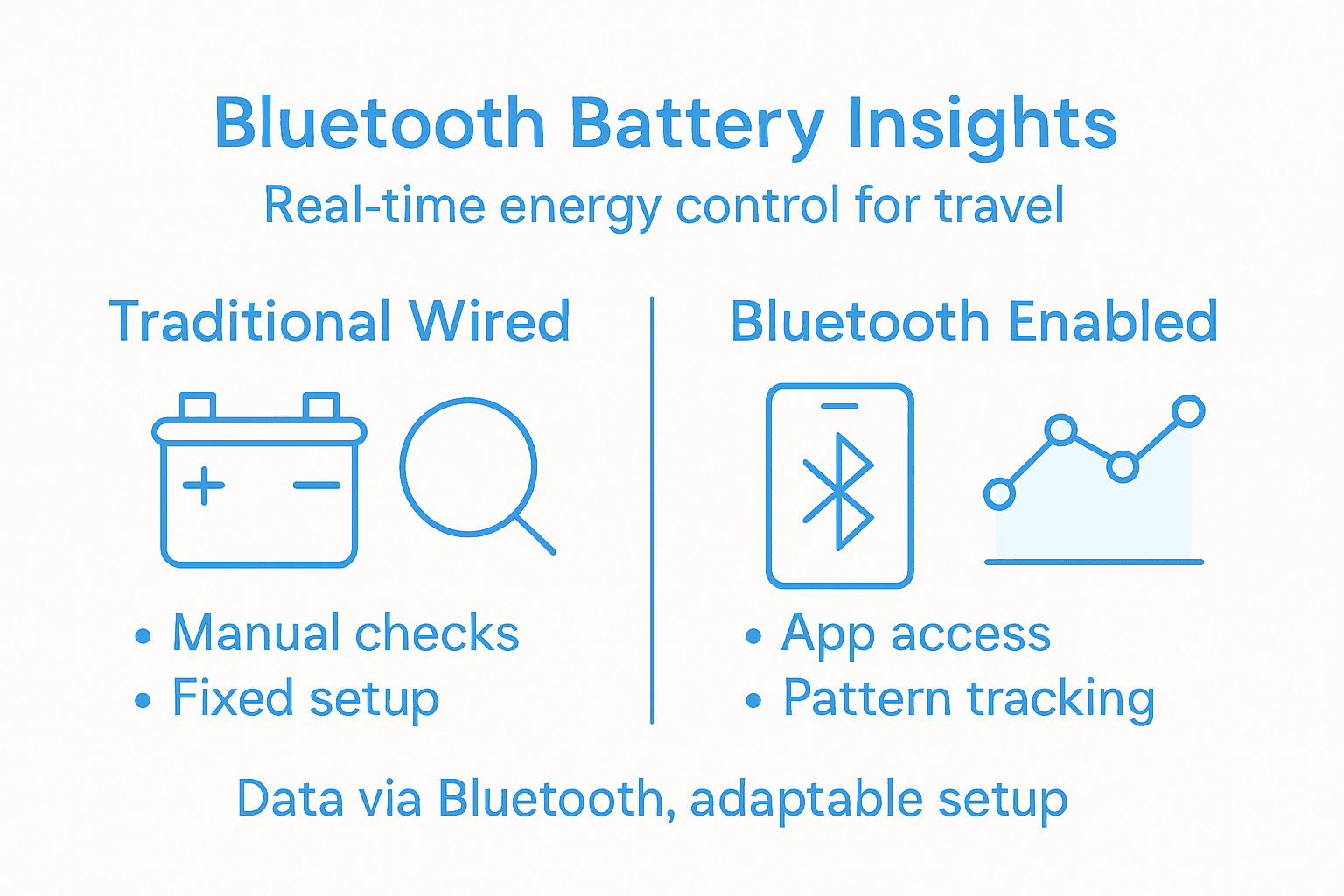
Here’s a summary highlighting practical differences between traditional wired and modern Bluetooth battery monitoring for campervans:
| Aspect | Wired Monitoring | Bluetooth Monitoring |
|---|---|---|
| Cabling Required | Extensive physical wiring needed | Minimal to no additional wiring |
| Data Access | Local display only | Remote access via mobile device |
| System Expansion | Complex rewiring for upgrades | Seamless scalability with sensors |
| Maintenance | Manual checks and repairs | Automated alerts and diagnostics |
| Impact on Campervan | Higher weight, reduced space | Lightweight, preserves cabin space |
Pro tip: When selecting a Bluetooth monitoring system, verify it’s compatible with both your specific battery chemistry and your existing charge controller or inverter, as seamless integration ensures you receive accurate data across your entire power system.
How Bluetooth Enables Battery Insights
Bluetooth technology transforms battery monitoring from a passive, interval-based observation into active, real-time communication. Rather than waiting for a scheduled data check or manually connecting cables to retrieve information, Bluetooth creates a constant conversation between your battery pack and your monitoring device. This wireless dialogue happens continuously, meaning you always have current information about what is happening inside your power system. For campervan owners managing energy in remote locations, this shift from passive to active monitoring represents a meaningful practical advantage that influences daily decisions about power consumption.
The technical foundation of this capability rests on Bluetooth Low Energy (BLE) protocols, which transmit multiple critical parameters simultaneously. Wireless transmission of battery data includes voltage readings, current flow, temperature measurements, and state of charge calculations. This multi-parameter transmission happens rapidly and efficiently, allowing your smartphone or display unit to receive updated information multiple times per second rather than periodic snapshots. The speed matters because it reveals dynamic information about your system. When you turn on a high-power appliance like an electric kettle, Bluetooth monitoring captures the instantaneous current surge, temperature response, and state of charge drop in real time. You observe these changes as they occur rather than discovering them after the fact.

What makes this capability particularly valuable for off-grid living is how it informs decision making. Traditional battery monitoring often leaves users guessing about remaining capacity or system health. Bluetooth changes this completely. The real-time data stream allows wireless communication within battery management systems to optimise battery performance and safety through continuous diagnostics. Your system detects abnormal temperature patterns, voltage irregularities, or charging anomalies instantly and alerts you before problems escalate. This early warning capability prevents situations where your battery experiences damage that goes unnoticed until serious issues develop. For UK campervan owners facing unpredictable weather and extended periods off-grid, this diagnostic advantage translates directly into extended battery lifespan and improved reliability when you need it most.
Beyond immediate performance tracking, Bluetooth enables pattern analysis that shapes your energy strategy over time. By recording historical data about how your battery responds to charging cycles, temperature variations, and load patterns, you develop detailed understanding of your specific system’s behaviour. You discover which activities drain power fastest, how ambient temperature affects charging efficiency, and what margin you genuinely have before reaching critical levels. This knowledge compounds over multiple journeys, allowing you to refine your energy management with increasing precision. The transparency that Bluetooth monitoring provides gradually transforms you from someone reacting to power limitations into someone confidently predicting and preventing them.
Pro tip: Check your Bluetooth monitoring app settings regularly to enable data logging or export features, which allow you to track seasonal patterns and identify trends that help you optimise your power system for different travel periods.
Key Features for Off-Grid Campervans
When you’re living off-grid in your campervan, the Bluetooth monitoring system you choose needs to address your specific challenges and constraints. Generic battery monitoring won’t cut it because campervan energy demands fluctuate wildly. You might be stationary for days running minimal loads, then drive for hours with solar charging, then encounter cloudy weather when power generation drops significantly. The features that matter most are those that give you visibility and control within this unpredictable environment.
The foundation of any effective Bluetooth battery monitoring system for off-grid use is comprehensive real-time data visibility. Real-time monitoring of voltage, current, temperature, and State of Charge ensures battery safety and longevity by keeping you informed about critical system parameters constantly. Rather than knowing only your battery percentage, you gain insight into how fast you’re drawing power, whether your battery is heating up during charging, and exactly how much usable capacity remains. This multi-parameter approach reveals patterns that single-metric monitoring misses completely. You notice that your battery voltage drops differently during cold nights than during warm afternoons, or that certain appliances cause temperature spikes that concern you. This transparency enables you to make informed decisions about when and how to use power, preventing situations where you discover too late that your battery can’t handle the load you’ve imposed on it.
Equally important is the scalability and adaptability of your monitoring architecture. Decentralised sensor arrays with Bluetooth connectivity provide flexible solutions optimised for the variable usage conditions in campervans and remote energy setups. This matters because off-grid systems evolve. You might start with a single battery pack, then add a second one later. Your initial solar setup might expand. Your charge controller could be upgraded. A monitoring system with decentralised sensors handles these expansions without requiring complete system replacement. The Bluetooth connectivity integrates seamlessly across multiple components, meaning your mobile app continues to provide unified visibility even as your power system grows more sophisticated. This flexibility transforms your battery monitoring from a static installation into a system that grows with your off-grid ambitions.
The usability aspect often gets overlooked but proves critical during actual off-grid use. Mobile app access to battery status information enhances maintenance management significantly. You don’t need to climb outside your campervan in darkness or bad weather to check a physical display. Instead, you glance at your phone whilst sitting inside, accessing your battery data instantly. Many quality systems also provide historical tracking and trend analysis, allowing you to spot degradation patterns or unusual behaviour before they become problems. Some systems generate alerts for abnormal conditions, warning you when temperature rises unexpectedly or when voltage behaviour suggests developing issues. These features transform monitoring from passive observation into active system management. You move from hoping everything is fine to knowing with certainty whether your battery and charging system are operating optimally.
Consider also how your monitoring system integrates with understanding campervan electrical systems more broadly. The best Bluetooth monitoring provides data that helps you understand not just your battery, but how it interacts with your solar panels, charge controller, and inverter. Some advanced systems detect when your charger isn’t working efficiently or when your solar setup underperforms due to angle or shading. This integrated perspective helps you optimise your entire energy ecosystem rather than managing the battery in isolation.
Pro tip: Ensure your chosen Bluetooth monitoring system supports data export functionality, which allows you to download historical records and identify seasonal patterns in your power consumption and battery performance across different travel regions.
The following table outlines core features to look for when choosing a Bluetooth battery monitor for off-grid campervans:
| Feature | Why It Matters | Impact on Off-Grid Use |
|---|---|---|
| Real-Time Multi-Parameter Data | Delivers instant insights | Enables precise power management |
| Scalability & Adaptability | Supports system expansion | Accommodates changing energy needs |
| App-Based Monitoring | Offers remote access and control | Simplifies maintenance and alerts |
| Data Export & Analysis | Facilitates tracking and forecasting | Optimises seasonal power strategy |
| Integrated System Visibility | Monitors battery & peripherals | Improves overall energy efficiency |
Real-World Applications and Use Cases
Bluetooth battery monitoring has moved beyond experimental technology into practical, everyday solutions for campervan owners across the United Kingdom and Europe. The applications span a surprisingly diverse range of off-grid scenarios, each with distinct demands and constraints. Understanding how this technology performs in real situations helps you evaluate whether it matches your specific travel style and energy requirements.
The most straightforward application is seasonal off-grid touring, where campervan owners spend weeks or months in one location with minimal movement. Imagine spending a month parked near the Welsh coast, with your solar panels angled toward the southern sky and your battery providing consistent power for heating, cooking, and daily appliances. Real-time battery performance analysis and proactive fault detection helps maintain battery health and extend battery life through continuous remote monitoring. In this scenario, Bluetooth monitoring tracks how your battery responds to predictable daily cycles. You observe that cloudy mornings require careful power management until afternoon sun arrives, then your solar system catches up during peak hours. Over weeks, you develop precise understanding of your system’s rhythm. You notice seasonal variations in charging efficiency and adjust your usage patterns accordingly. The historical data becomes invaluable because you can compare this month’s performance against previous visits to the same location, identifying whether your battery is degrading or whether changes reflect seasonal differences in weather.
A different but equally common use case involves frequent movement across changing terrain and climate. Consider touring from Scotland to Cornwall, encountering varying weather, different sun angles, and continuously changing environmental conditions. Your battery faces constant challenges as you travel. Bluetooth monitoring becomes your diagnostic partner in this scenario. Wireless battery management systems leveraging Bluetooth technology improve battery safety and optimise charging cycles through reduced wiring and enhanced system flexibility. When you park somewhere new each day, you quickly establish a baseline for how your specific battery and solar combination performs in those conditions. You notice that your battery charges faster at higher elevations where atmosphere is thinner and sunlight intensity increases. You observe temperature variations as you move between coastal areas and inland valleys. This knowledge allows you to make better decisions about where to park (choosing south-facing slopes when possible) and how to manage power consumption based on available sunlight. The monitoring system essentially becomes your energy advisor, showing you the consequences of your location choices and helping you optimise as you travel.
Another practical application emerges when you’re managing multiple battery banks or hybrid power systems. Many experienced off-grid users combine lithium batteries with traditional leisure batteries, or add battery capacity over time as their needs expand. Bluetooth monitoring handles this complexity elegantly. Rather than juggling multiple monitoring methods or struggling with incompatible systems, unified Bluetooth monitoring provides consolidated visibility across all your power sources. You see instantly which battery bank is contributing to current charging, which is supplying power to loads, and whether charge distribution is balanced across multiple cells. This integration proves particularly valuable during fault diagnosis. If you suspect charging inefficiency, the data reveals whether the problem lies in your solar array, charge controller, or battery itself.
Some users employ Bluetooth monitoring primarily for preventative maintenance and longevity optimisation. They’re not struggling with power shortages but rather seeking to maximise their battery investment by understanding degradation patterns and addressing issues early. These owners monitor battery temperature meticulously, ensuring their cells never experience the heat stress that accelerates ageing. They track voltage patterns to spot early signs of cell imbalance or internal resistance changes. They use historical data to calculate realistic remaining capacity and plan battery replacement timing before catastrophic failure occurs. For these users, Bluetooth monitoring transforms battery management from reactive problem-solving into proactive asset stewardship.
Pro tip: Document your baseline battery performance during your first few weeks of use, noting voltage readings, charging times, and temperature patterns under various weather conditions; this establishes a reference point that helps you identify genuine degradation from normal seasonal variation.
Common Pitfalls and Mitigating Risks
Whilst Bluetooth battery monitoring offers significant advantages for off-grid campervan living, the technology isn’t without challenges. Understanding these potential pitfalls before you install a system prevents frustrations and ensures your monitoring setup delivers reliable performance when you need it most. The good news is that most risks are manageable through thoughtful system design and user awareness.
One of the most common issues campervan owners encounter is connection instability and signal dropout. Your campervan contains metal panels, engine components, and various electronic systems that can interfere with Bluetooth signals. Parked beside a cliff face or dense forest, your phone might lose connection to your battery monitor even though they’re physically close. Weather changes matters too. Heavy rain or snow can degrade signal quality surprisingly quickly. Connection instability and limited communication range represent genuine challenges in automotive and off-grid environments. To mitigate this, quality Bluetooth systems incorporate robust error-checking algorithms and optimised antenna placement that maximises signal penetration throughout your campervan. The practical solution involves testing your system’s range and connectivity before you venture far from civilisation. Position your battery monitor in a location that offers clear line-of-sight to where you’ll typically use your phone. Consider whether metal storage lockers or engine compartments will shield the signal. Some users apply external antennas or relocate their monitoring hardware slightly to improve reception. These simple adjustments often eliminate most connectivity issues entirely.
Data security represents another consideration that deserves attention. Your Bluetooth monitoring system transmits sensitive information about your battery state, charging patterns, and energy usage. Whilst most recreational campervan users aren’t targets for sophisticated hacking, poor security practices do create vulnerabilities. Data security vulnerabilities and signal interference susceptibility require mitigation through encryption protocols and standardised communication frameworks. Quality monitoring systems implement encrypted communication between your battery and your app, preventing interception of data. This encryption means that even if someone nearby has Bluetooth scanning tools, they cannot read the information you’re transmitting. The user responsibility lies in keeping your app and firmware updated. Manufacturers regularly release security patches addressing newly discovered vulnerabilities. Ignoring these updates leaves your system exposed to risks that were already identified and fixed. Treat firmware updates for your battery monitor with the same seriousness you’d apply to security updates on your computer.
Another pitfall involves over reliance on Bluetooth monitoring whilst neglecting basic safety checks. Your monitoring system is sophisticated and useful, but it can malfunction or provide misleading data if sensors become dirty, disconnected, or miscalibrated. Some campervan owners become so accustomed to checking their app that they stop performing visual inspections of their battery terminals, connections, and overall physical condition. Corrosion can develop at connection points without affecting the electrical readings your app displays. A loose terminal might escape detection until it causes intermittent power loss. Combining wireless solutions with conventional safety checks ensures reliable operation. This means periodically disconnecting your app and visually inspecting your battery and connections. Check for corrosion, loose terminals, and physical damage. Verify that connections remain tight. Look for any signs of swelling, discolouration, or unusual heat. These visual checks catch problems that Bluetooth monitoring alone might miss.
Data loss during system transfers or upgrades also catches users off guard. If your monitoring system stores historical data on your phone and you switch to a new device, that data disappears unless you’ve exported it. Similarly, if your battery monitor fails and you replace it with a new unit, you lose all historical records stored in the old device. To prevent this frustration, regularly export your battery data to cloud storage or external backup. Most quality systems support data export functionality. Schedule monthly or quarterly exports and save them to a cloud drive that you can access anywhere. This ensures your historical performance data survives device changes and provides a permanent record of your battery’s behaviour over time.
Frequency selection and interference management deserve consideration if you’re operating in areas with multiple wireless systems. Other users’ Bluetooth devices, WiFi networks, or even microwave ovens operating nearby can create interference. Mitigating this involves selecting systems that support frequency hopping or dynamic channel selection. These capabilities allow your Bluetooth connection to automatically switch frequencies if interference is detected, maintaining connection stability even in crowded wireless environments. Ask potential system suppliers whether their equipment supports these advanced features.
Pro tip: Establish a baseline battery performance profile during your system’s first month by exporting weekly data and noting environmental conditions, then compare subsequent months against this baseline to distinguish genuine battery degradation from normal seasonal variation.
Take Control of Your Off-Grid Power with Bluetooth-Enabled Solutions
Managing real-time battery health and performance is crucial for any campervan owner aiming to boost energy independence and avoid unexpected power failures. If you have experienced the frustrations of unreliable wired monitoring or struggled to understand your battery’s true state of charge during remote adventures, then embracing Bluetooth battery monitoring technology is a game changer. Skyenergi offers expertly engineered lithium battery systems and Bluetooth-enabled battery management solutions designed specifically to meet the demanding conditions of off-grid travel in the UK and beyond.
Explore our range of high-quality lithium leisure batteries and intelligent monitoring products that provide multi-parameter real-time data, seamless app integration, and scalable system expansion. These features give you peace of mind and full visibility over your energy usage and battery condition wherever the road takes you. Don’t wait until your travels are interrupted by unforeseen energy shortages. Visit Skyenergi today to discover how our Bluetooth-enabled solutions can empower your off-grid lifestyle. Start monitoring smarter and travel further with confidence now.
Frequently Asked Questions
What are the advantages of Bluetooth battery monitoring systems for campervans?
Bluetooth battery monitoring systems eliminate the need for extensive wiring, offering wireless data access to real-time battery performance. This lightweight solution simplifies maintenance, enhances reliability, and conserves valuable space in your campervan.
How does Bluetooth technology improve battery management compared to traditional methods?
Bluetooth technology allows continuous, real-time communication of critical battery parameters such as voltage, current, temperature, and state of charge, providing immediate insights that enable better decision-making, especially in off-grid scenarios.
Can Bluetooth battery monitoring systems be expanded to include additional batteries or components?
Yes, Bluetooth battery monitoring systems are designed for scalability, allowing you to seamlessly integrate additional batteries or expand your solar setup without complex rewiring or replacing the entire system.
How do I ensure data security when using Bluetooth monitoring systems?
To enhance data security, ensure your monitoring system uses encrypted communication and practice regular updates for your app and firmware. This protects your sensitive battery information from potential interception and vulnerabilities.
Recommended
- Bluetooth Battery Monitoring – Real-Time Power Insights – Skyenergi
- 7 Key Benefits of Lithium Batteries for Off-Grid Living – Skyenergi
- Role of BMS in Energy Storage – Why It Matters – Skyenergi
- Role of Lithium Batteries in Campervans: Powering UK Adventures – Skyenergi
- 12 Best Electric Golf Trolleys 2025 (UK Top Picks & Guide) – More Sports
Prev post

Lithium Battery Maintenance Workflow for Off-Grid Systems
Updated on 24 January 2026
Next post

Top 8 SRNE Ric Inverter Options in 2026 for Energy Independence
Updated on 22 January 2026


