






Why passive cooling in battery systems matters in 2026
Discover why passive cooling in battery systems matters in 2026. Learn how it enhances efficiency, performance, and supports renewable energy storage.
Passive thermal management in battery systems is defined as the regulation of cell temperatures using natural heat transfer processes, specifically conduction, convection, and radiation, without any auxiliary power input. This approach is gaining ground fast, particularly as new battery chemistries like sodium-ion and solid-state lithium enter the market with wider acceptable operating ranges. Understanding why passive cooling in battery systems delivers real engineering value requires looking at three things: how it works physically, where it outperforms active systems, and where it needs support. For engineers and technicians working on renewable energy storage, this guide covers all three with 2026 research behind every claim.
Why passive cooling in battery systems is a thermal management priority
Passive cooling removes heat from battery cells using no fans, pumps, or compressors. That single fact has significant downstream consequences for system design, cost, and reliability.
The thermal management system (TMS) in a battery energy storage system (BESS) typically occupies 10–15% of enclosure volume and accounts for 5–8% of system cost. Passive designs reduce both figures by eliminating the bill of materials (BOM) items associated with liquid loops, pumps, and fans. That reduction is not marginal. It removes entire failure modes from the system.
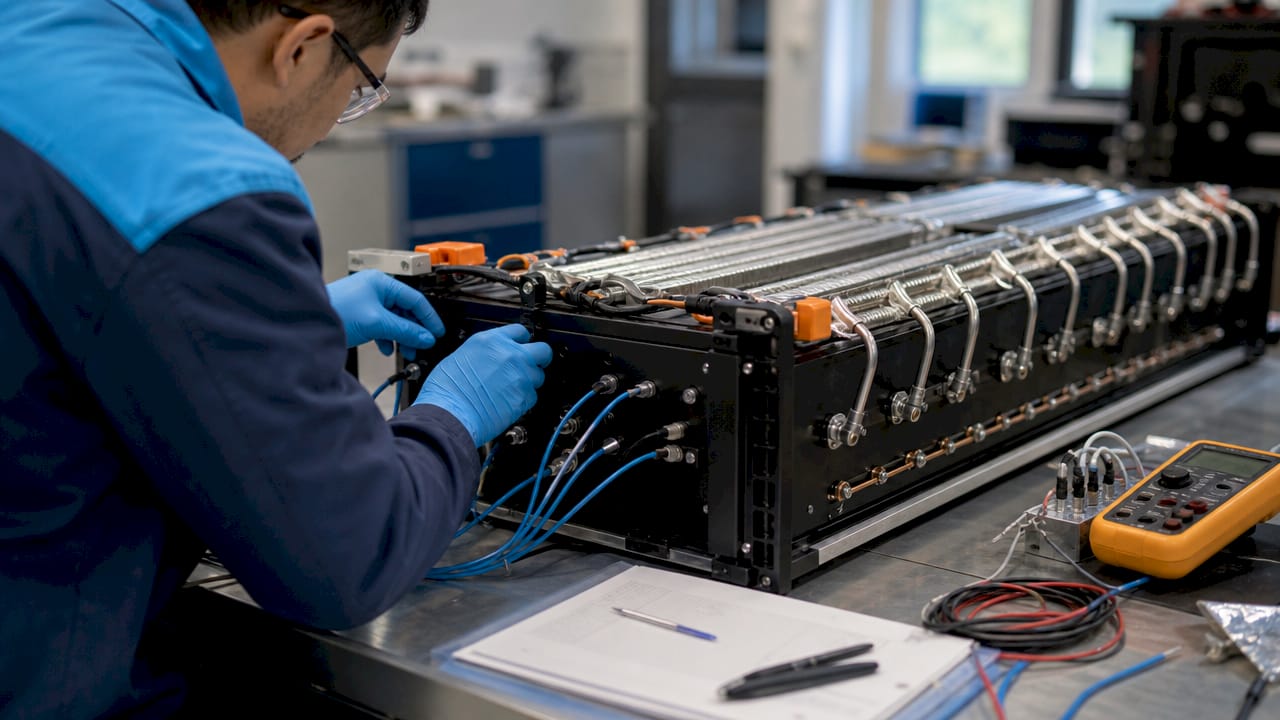
The importance of temperature control in lithium battery systems is well established. Cell degradation accelerates outside the 15°C to 35°C optimal window, and thermal runaway risk rises sharply above 60°C. Passive thermal management in batteries addresses this by keeping cells within safe limits continuously, without relying on powered components that can fail or require maintenance.
Passive cooling strategies eliminate auxiliary power consumption and reduce both system complexity and operational and maintenance costs. For off-grid or remote deployments, where servicing is expensive and power budgets are tight, this is a decisive advantage.
How does passive cooling operate within battery systems?
Passive cooling relies on three physical mechanisms working in combination: conduction, natural convection, and radiation.
Conduction moves heat through solid materials from the cell surface to a heatsink or thermally conductive enclosure wall. Natural convection allows heated air or fluid to rise and carry thermal energy away from the battery pack without a pump. Radiation dissipates heat as infrared energy from surfaces exposed to cooler surroundings. In practice, no passive system relies on just one of these. Effective designs stack them.
Phase change materials (PCMs)
Phase change materials provide passive temperature regulation by absorbing latent heat as they transition from solid to liquid at a defined temperature. This buffers peak temperature rise and improves uniformity across a cell stack during transient load events. The limitation is low intrinsic thermal conductivity, which means PCMs work best when combined with conductive pathways such as graphite sheets or metal fins rather than as a standalone solution.
Heat pipes
Heat pipe cooling is one of the most effective passive techniques available. Heat pipe systems integrated with heatsinks keep Li-ion batteries below 60°C at ambient temperatures up to 45°C in air and watertight portable energy storage units. This is significant for marine and campervan applications where sealed enclosures prevent forced airflow. The heat pipe transfers thermal energy via internal phase change of a working fluid, with no moving parts and no power draw.
Natural convection limitations
Natural convection has a ceiling. Heat entrainment in dense battery racks is a known problem. When cells are packed tightly, rising warm air recirculates rather than escaping, reducing cooling effectiveness. Computational fluid dynamics (CFD) modelling consistently shows that cell spacing and rack geometry have a larger effect on passive cooling performance than material selection alone.
Pro Tip: When designing a passive-cooled battery rack, model airflow paths before finalising cell spacing. A 5mm change in inter-cell gap can shift peak temperature by several degrees under sustained load.
What are the benefits and limitations of passive cooling?
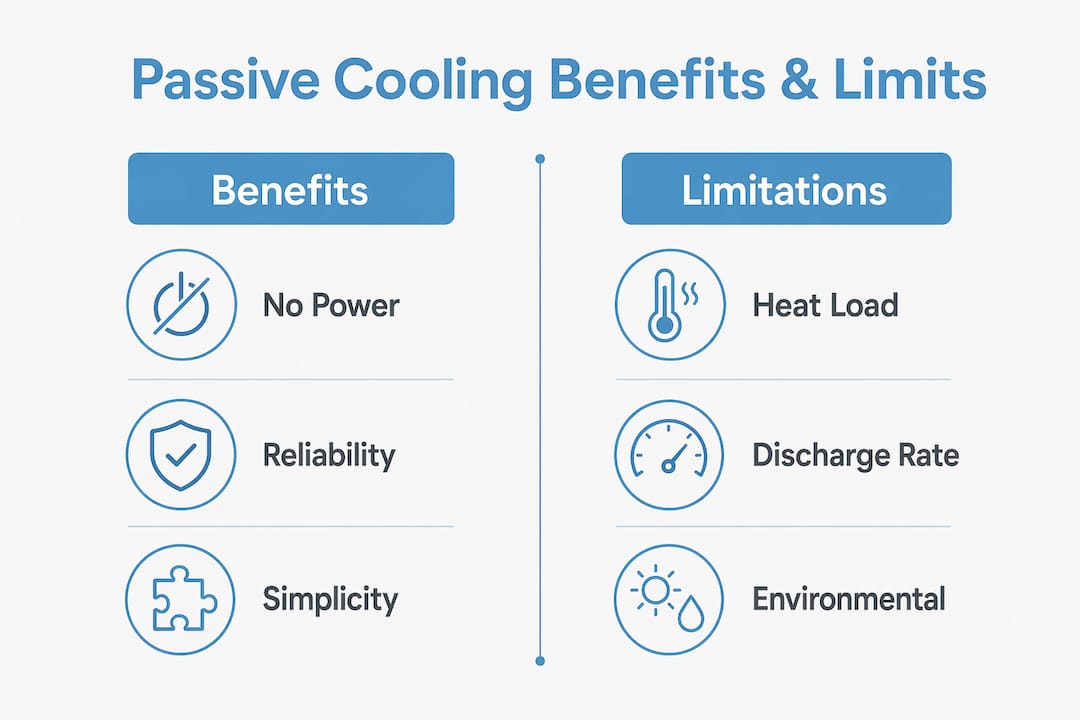
The passive cooling advantages over active systems are most visible in four areas: energy consumption, reliability, safety, and cost.
Energy efficiency and system simplification
Active cooling systems draw continuous auxiliary power to run fans, pumps, and control electronics. Passive systems draw none. For a BESS deployed in a remote location or integrated into an off-grid solar setup, that auxiliary load is a direct reduction in available energy. Passive thermal management in batteries also simplifies the BOM by removing liquid loops, pumps, and fans entirely, which reduces both procurement cost and the number of components that can fail.
Safety and reliability
Passive cooling eliminates liquid coolant loops, removing the risk of water ingress and single-point failures associated with active liquid systems. For sealed or submerged applications, this is not a minor benefit. It is a fundamental design requirement. Passive systems also have no active failure modes triggered by power loss, which matters in off-grid scenarios where the battery itself may be the only power source.
Where passive cooling falls short
Passive natural convection cannot meet heat extraction demands above 3C discharge rates. At high power outputs or in hot ambient environments, the thermal load exceeds what conduction and natural convection can remove quickly enough. This is the primary limitation of fully passive designs and the reason hybrid systems exist.
| Criterion | Passive cooling | Active cooling |
|---|---|---|
| Auxiliary power draw | None | Continuous |
| BOM complexity | Low | High |
| Maintenance requirement | Minimal | Regular servicing needed |
| Cooling capacity at high C-rates | Limited above 3C | High |
| Failure risk | Low (no moving parts) | Higher (pumps, fans, controls) |
| Suitability for sealed enclosures | Excellent | Restricted by ingress risk |
Pro Tip: For leisure vehicle and marine battery systems operating at moderate discharge rates, passive cooling is often sufficient. Reserve hybrid designs for applications with sustained high-current draws or extreme ambient temperatures.
How are emerging battery chemistries influencing passive cooling adoption?
The relationship between battery chemistry and thermal management is direct. Chemistry determines the acceptable operating temperature range, and that range determines how much active cooling infrastructure a system needs.
Lithium iron phosphate (LFP) cells, which dominate current leisure and residential storage applications, have a relatively narrow optimal temperature window. Sodium-ion and solid-state lithium chemistries tolerate operating temperatures from -30°C to 70–100°C, a range that is dramatically wider. That wider tolerance reduces the dependency on active cooling infrastructure and makes fully passive thermal management viable in more deployment scenarios.
The practical implications for system designers are significant:
- Simplified enclosure design. Wider temperature tolerance means less precise thermal control is needed, reducing the engineering overhead of the TMS.
- Reduced capital cost. Removing active cooling components lowers upfront system cost, which improves the economics of off-grid energy storage deployments.
- Improved cold-weather performance. Sodium-ion cells in particular perform well at low temperatures without heating elements, which removes another active component from the BOM.
- Longer asset life. Fewer powered components mean fewer failure points over a 10 to 20-year asset life.
The shift towards these chemistries is not hypothetical. It is already influencing how battery system architects approach thermal design at the specification stage, with passive-first strategies becoming the default for moderate-duty applications.
What practical design considerations apply to passive cooling systems?
Effective passive thermal management does not happen by default. It requires deliberate geometric and airflow design from the outset.
Layout and geometry
- Model airflow before committing to cell spacing. CFD analysis of inter-cell gaps, rack orientation, and enclosure venting is the single most effective tool for passive cooling design. Geometric layout optimisation is critical to prevent heat entrainment in dense arrays.
- Orient cells to favour natural convection. Cylindrical cells in vertical orientation allow warm air to rise along the cell axis. Horizontal orientations can trap heat between cells.
- Use thermally conductive interface materials. Graphite pads, thermal gap fillers, and phase change interface materials between cells and heatsinks improve conduction pathways without adding active components.
- Size heatsinks for worst-case ambient. Design for the highest expected ambient temperature, not average conditions. A passive system sized for 25°C ambient will fail thermally at 45°C.
Hybrid system integration
Hybrid cooling systems combining passive and active methods are the direction the industry is moving. The practical approach is to use passive cooling as the baseline and add active components only for peak load management. A PCM layer handles transient thermal spikes. A small fan or liquid loop activates only when cell temperature exceeds a defined threshold. This keeps auxiliary power consumption low while extending the operational envelope beyond what fully passive designs can achieve.
Pro Tip: When specifying a hybrid system, set the active cooling activation threshold at least 5°C below the cell’s upper safety limit. This gives the active component time to respond before temperatures reach a critical point.
High-voltage battery systems in particular benefit from this approach, where thermal loads are higher and the cost of a thermal event is greater.
Key takeaways
Passive thermal management is the most reliable and cost-effective baseline strategy for battery systems operating at moderate discharge rates, and emerging chemistries are expanding the range of applications where it is sufficient.
| Point | Details |
|---|---|
| Passive cooling definition | Uses conduction, convection, and radiation with no auxiliary power to regulate battery temperatures. |
| Cost and BOM reduction | TMS typically accounts for 5–8% of system cost; passive designs reduce this by removing pumps, fans, and liquid loops. |
| Heat pipe performance | Heat pipe systems keep Li-ion cells below 60°C at 45°C ambient in sealed enclosures with no moving parts. |
| Discharge rate limitation | Passive natural convection is insufficient above 3C discharge rates; hybrid systems are required for high-power applications. |
| Chemistry impact | Sodium-ion and solid-state lithium cells tolerate -30°C to 100°C, making fully passive thermal management viable in more scenarios. |
Passive cooling: a design philosophy, not just a technique
I have watched battery system design evolve from a hardware problem into a systems engineering problem, and the shift towards passive thermal management reflects that maturity. The engineers who get this right are not the ones who add the most cooling capacity. They are the ones who design systems that need the least.
The case for passive-first design is strongest in remote and off-grid deployments, which is exactly where Skyenergi’s customers operate. A campervan battery system that requires a fan to stay within temperature limits is a system that fails when the fan fails. A passively cooled system with a well-designed enclosure and quality cells simply works, regardless of whether there is power available to run auxiliary components.
What I find underappreciated is the interaction between passive cooling and battery monitoring. A system with real-time temperature visibility via Bluetooth BMS can flag thermal anomalies before they become failures, even in a fully passive design. That combination of passive thermal management and intelligent monitoring is where I see the most resilient systems being built right now.
The emerging chemistry story is also real. Sodium-ion cells are not a future technology. They are entering the market now, and their wider temperature tolerance will make passive-only designs viable for a broader range of applications within the next few product generations. Engineers who understand passive thermal management today will be better positioned to specify those systems when the cells arrive.
— John
Skyenergi battery monitoring and solar solutions
Passive cooling works best when paired with real-time system visibility. Knowing your battery temperatures, state of charge, and charge rates at all times lets you verify that your passive design is performing as intended and catch any anomalies early.

Skyenergi stocks the SRNE BS 48500 Battery Monitor for accurate, real-time battery management in off-grid and leisure vehicle systems. For complete solar and storage setups, the Victron Energy Solar Home System 200 MPPT integrates solar charging with battery management in a single, well-engineered package. Both products are available directly from Skyenergi, sourced from manufacturers to keep pricing competitive without compromising on quality.
FAQ
What is passive cooling in a battery system?
Passive cooling in a battery system is the management of cell temperatures using conduction, natural convection, and radiation without any powered components. No fans, pumps, or compressors are required.
What are the main benefits of passive cooling?
The primary benefits of passive cooling are zero auxiliary power consumption, reduced BOM complexity, lower maintenance requirements, and elimination of liquid coolant failure risks. These advantages are most significant in remote, sealed, or off-grid deployments.
When is passive cooling insufficient for a battery system?
Passive natural convection cannot meet thermal demands above 3C discharge rates. High-power or high-ambient-temperature applications require hybrid systems that add active cooling components for peak load management.
How do phase change materials improve passive cooling?
PCMs absorb latent heat during phase transition, buffering peak temperature rise and improving temperature uniformity across a cell stack. They work best when combined with conductive pathways such as metal fins or graphite sheets, not as standalone solutions.
Do new battery chemistries change the case for passive cooling?
Sodium-ion and solid-state lithium cells operate across a much wider temperature range than LFP cells, reducing the need for active cooling infrastructure. This makes fully passive thermal management viable for a broader range of applications as these chemistries reach commercial scale.
Recommended
Prev post

SRNE vs. Victron: Which Is Better For Your Off-Grid Build?
Updated on 14 July 2026
Next post

What is balanced charging for batteries?
Updated on 13 July 2026


