






Commissioning lithium battery systems checklist: 2026 guide
Ensure your battery system is safe and compliant with our comprehensive commissioning lithium battery systems checklist. Learn the essential steps now!
A commissioning lithium battery systems checklist is the structured validation process that confirms a battery installation is safe, code-compliant, and performing to its design specification before it enters live service. The industry term for this process is system commissioning, and it covers everything from pre-installation site surveys through to final handover documentation. Skipping or rushing any stage carries real consequences: approximately 59% of utility-scale battery energy storage system failures occur within the first two years, traced directly to commissioning and balance-of-system errors rather than cell defects. That figure applies equally to residential and leisure installations. Whether you are fitting a campervan setup or a home energy storage system, this guide covers every battery system commissioning step you need.
What are the prerequisites for commissioning lithium battery systems?
Preparation determines whether commissioning runs smoothly or stalls. A pre-commissioning site survey typically takes 1–2 hours, but permit processing can stretch from days to several weeks depending on your local authority. Build that lead time into your project plan from day one.
Before any tools come out, gather the following documentation:
- Factory Acceptance Test (FAT) reports confirming the battery modules passed manufacturer testing
- As-built drawings showing final cable routes, protection devices, and earthing arrangements
- Permits and grid connection approvals from your Distribution Network Operator (DNO) or relevant authority
- Safety data sheets for all lithium cells, covering thermal runaway response procedures
- Manufacturer installation manuals for every major component, including the Battery Management System (BMS) and inverter
The tools required split into two categories. Basic electrical tools include a calibrated multimeter, torque wrench, insulation resistance tester, and labelled cable markers. Specialised tools include a thermal imaging camera for hot-spot detection, a power quality analyser, and laptop software for BMS configuration and data logging.
Pre-energisation checks must verify code compliance covering electrical clearances, ventilation adequacy, and fire safety as specified under NFPA 855 and IEC 62619. These are not optional reviews. They are the legal baseline for any lithium battery installation in a UK residential or commercial setting.

Pro Tip: Schedule all preliminary checks, permit applications, and FAT document requests in parallel rather than sequentially. Waiting on paperwork after the hardware arrives is the single most common cause of commissioning delays.
What are the step-by-step battery system commissioning stages?
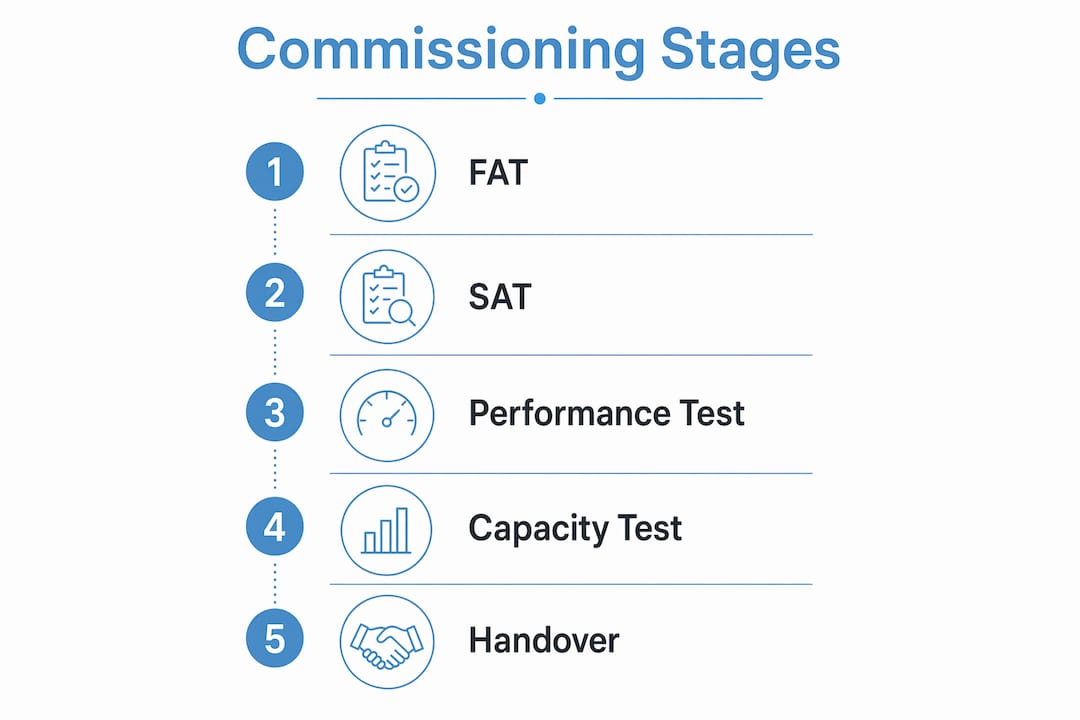
Comprehensive commissioning covers four defined stages: Factory Acceptance Testing (FAT), Site Acceptance Testing (SAT), Performance Testing, and Baseline Capacity Testing. Each stage has a specific objective and a defined set of pass criteria.
-
Factory Acceptance Test (FAT). The manufacturer tests each battery module before shipment. Your role is to receive the FAT report and verify that serial numbers on delivered units match the documented test results exactly. Mismatches void warranties before the system is even switched on.
-
Site Acceptance Test (SAT). Conducted after physical installation, the SAT confirms the system is correctly assembled on site. Check torque settings on all busbars and cable terminations against manufacturer specifications. Run insulation resistance tests on all DC and AC circuits. Carry out a thermal scan of all connections under partial load to identify any hot spots before full energisation.
-
Performance Test. This stage verifies the system delivers its rated output under controlled conditions. Test charge and discharge cycles at specified C-rates. Confirm the BMS communicates correctly with the inverter and any monitoring platform. For grid-tied systems, verify protection relay settings and controls mapping against the DNO’s technical requirements.
-
Baseline Capacity Test. Commissioning must document a 72-hour continuous load test as the baseline capacity record. This figure becomes the warranty reference point. Any future capacity degradation claim is measured against this documented baseline.
Common mistakes at each stage are predictable. At FAT, installers skip serial number verification. At SAT, torque checks are rushed or undocumented. At the Performance Test, relay settings are left at default rather than configured for the specific site. At the Baseline Capacity Test, the 72-hour run is shortened to a few hours to save time. All four shortcuts create liability.
Pro Tip: Treat each commissioning stage as a formal pass/fail gate. Sign off each stage in writing before moving to the next. This protects both the installer and the end user if a fault appears later.
How do you troubleshoot common commissioning errors?
Balance-of-system faults cause the majority of early failures in battery installations. These are problems with the wiring, protection devices, and communication links rather than the cells themselves. Knowing where to look saves significant diagnostic time.
The most frequent issues to check during commissioning include:
- Serial number and FAT report mismatches. Verify shipped units match documented acceptance tests before energisation. A mismatch means you cannot enforce the manufacturer warranty if a fault develops.
- BMS communication errors. Confirm the BMS is correctly configured for the specific battery chemistry and cell count. CAN bus or RS485 wiring faults are common and show up as intermittent state-of-charge errors.
- Relay and protection faults. Relay testing is a step many residential installers skip entirely. An incorrectly set protection relay can disconnect the system under normal load or, worse, fail to disconnect under a genuine fault condition.
- Thermal imbalance between cells. A thermal camera during the SAT stage catches this early. Uneven temperatures across a battery bank indicate a connection resistance problem or a cell with higher internal resistance.
- Grid integration errors. For grid-tied systems, confirm export limitation settings and anti-islanding protection are active and correctly configured before the system goes live.
Treating commissioning as a box-ticking exercise rather than a pass/fail process is the fastest route to a warranty dispute and an unsafe installation. Every relay, every communication link, and every protection setting needs a verified result, not just a visual check.
The step-by-step energy storage setup guide from Skyenergi covers balance-of-system fault prevention in detail for leisure vehicle installations, where the same principles apply in a more compact form factor.
What documentation and handover steps finalise commissioning?
Documentation closes out the commissioning process and protects everyone involved. Without it, warranty claims are unenforceable and maintenance teams have no baseline to work from.
| Milestone | Required document or action |
|---|---|
| FAT completion | FAT report with serial numbers, signed by manufacturer |
| SAT completion | Insulation test results, torque records, thermal scan images |
| Performance test | Charge/discharge cycle data, relay test certificates |
| Baseline capacity | 72-hour load test report, signed as warranty baseline |
| Regulatory approval | DNO approval letter, Certificate of Completion (COD) |
| Handover | As-built drawings, emergency procedures, user training record |
End-user training is not optional. The person operating the system needs to understand how to read the BMS monitoring interface, how to respond to alarms, and what the emergency shutdown procedure is. Maintenance teams need the as-built drawings and test reports to carry out future inspections without guesswork.
The first 90 days post-commissioning are critical for detecting faults that initial testing misses. Schedule software updates and State of Health (SOH) checks at 30, 60, and 90 days. Early thermal imbalances and BMS calibration drift show up in this window. Catching them early prevents premature cell degradation.
The battery maintenance checklist for leisure and off-grid systems from Skyenergi provides a practical framework for these early operational checks, covering SOH monitoring and connection inspection intervals.
Commissioning is a collaborative process where system behaviour must be configured for the specific load profile of the site. The owner, installer, and any grid operator all have sign-off responsibilities. A clear handover record confirms each party has fulfilled their obligation.
Key takeaways
Successful lithium battery commissioning requires completing four defined stages, verifying FAT documentation, and maintaining a signed 72-hour baseline capacity record as the warranty reference point.
| Point | Details |
|---|---|
| Four-stage process | FAT, SAT, Performance Test, and Baseline Capacity Test must all be completed and signed off. |
| Document everything | FAT reports, serial number verification, and the 72-hour load test form the legal warranty baseline. |
| Pass/fail gate approach | Treat each commissioning stage as a formal checkpoint, not a formality, to reduce operational risk. |
| First 90 days matter | Schedule SOH checks and software updates at 30, 60, and 90 days to catch early faults. |
| Balance-of-system faults dominate | Most early failures trace to wiring, relays, and communications, not the battery cells themselves. |
Why commissioning is more than a checklist
I have seen installations where every box on the commissioning form was ticked and the system still failed within six months. The reason is almost always the same: the checklist was treated as a paperwork exercise rather than a genuine verification process. Relay settings were left at default. The 72-hour load test was run for four hours. Serial numbers were not cross-checked against FAT reports.
The uncomfortable truth is that a commissioning checklist only works if the person completing it understands why each item exists. Torque checks matter because a loose busbar connection creates resistance, heat, and eventually a fire risk. FAT report verification matters because a battery module that was never properly tested at the factory is a warranty dispute waiting to happen.
What I have found genuinely useful is treating commissioning as a design validation exercise, not just an installation sign-off. You are confirming that the system as built matches the system as designed, and that it will behave correctly under the specific load conditions of that site. That requires collaboration between the owner and the installer, not just a signature at the end.
The lithium battery maintenance workflow for off-grid systems is worth reading alongside any commissioning checklist. The habits you build during commissioning, specifically the discipline of documenting baseline readings, directly determine how useful your maintenance records will be two years later.
— John
Skyenergi products for lithium battery system commissioning
Skyenergi supplies a range of Victron Energy components designed to support every stage of battery system commissioning and ongoing monitoring.

The Victron Energy CANvu GX provides real-time system monitoring and BMS communication, making it straightforward to verify performance data during SAT and baseline testing. For complete residential setups, the Victron Energy Solar Home System 200 MPPT integrates solar charging, battery management, and monitoring in a single pre-engineered package, reducing the number of commissioning variables on site. Skyenergi sources directly from manufacturers, keeping prices competitive without compromising on specification. Contact Skyenergi for product advice matched to your specific installation requirements.
FAQ
What is a commissioning checklist for lithium battery systems?
A commissioning checklist is a structured verification process confirming a lithium battery installation is safe, code-compliant, and performing to its design specification. It covers four stages: FAT, SAT, Performance Testing, and Baseline Capacity Testing.
Why do so many battery systems fail in the first two years?
Approximately 59% of battery energy storage system failures within the first two years are caused by commissioning and balance-of-system errors, not cell defects. Thorough commissioning directly reduces this risk.
What is a Baseline Capacity Test?
A Baseline Capacity Test is a 72-hour continuous load run conducted during commissioning to document the system’s actual capacity at installation. This record serves as the reference point for all future warranty claims.
How long does pre-commissioning preparation take?
A site survey typically takes 1–2 hours, but permit processing can take days to several weeks. Starting permit applications early is the most effective way to avoid delays.
What checks are critical in the first 90 days after commissioning?
Software updates and State of Health assessments at 30, 60, and 90 days are the priority checks. This window reveals early thermal imbalances and BMS calibration issues that initial testing does not always detect.
Recommended
Prev post

Top 5 SolarPanelsVenue.com Alternatives 2026
Updated on 29 June 2026
Next post

Solar storage system loss analysis: 2026 guide
Updated on 27 June 2026


