








Battery storage feasibility study steps: 2026 guide
Discover essential battery storage feasibility study steps for 2026. This guide ensures effective evaluation for your renewable energy projects.
A battery storage feasibility study is the systematic evaluation of technical, economic, and regulatory factors that determine whether a battery energy storage system suits your renewable energy objectives and site conditions. The industry term for this process is a Battery Energy Storage System (BESS) feasibility study, and the battery storage feasibility study steps covered here follow 2026 best practices drawn from BC Hydro guidance, Scottish Government planning standards, and NFPA 855 safety requirements. Skipping any step risks costly redesigns, permit failures, or a system that never delivers its projected savings. This guide gives you a clear, sequential process for conducting a thorough battery storage project evaluation, whether you are planning an off-grid residential setup or a commercial hybrid installation.
What data do you need before starting battery storage feasibility study steps?
The quality of a feasibility study depends entirely on the quality of its input data. Weak or incomplete data produces misleading results, which leads to undersized systems, missed savings, or failed permit applications.
The single most critical input is load data. Collect at least 12 months of 15-minute interval load and generation readings. Shorter datasets miss seasonal demand peaks and troughs, which directly distorts ROI modelling and system sizing.
Beyond load data, you need the following before any modelling begins:
- Electricity tariff details: time-of-use rates, peak demand charges, and standing charges from your actual utility supplier, not generic industry averages.
- Grid capacity information: available substation headroom, connection voltage, and any existing distributed generation on the same feeder.
- Site constraints: available floor area, ceiling height, access routes for equipment delivery, and proximity to occupied spaces.
- Fire safety parameters: local fire service requirements, building classification, and any existing suppression systems.
- Interconnection requirements: your Distribution Network Operator’s (DNO) application process and expected study timelines.
Pro Tip: Request your half-hourly or 15-minute interval data directly from your energy supplier or metering agent. Many organisations hold only monthly billing data, which is too coarse for accurate feasibility modelling.
Early stakeholder engagement is equally non-negotiable. Permitting must begin the same week land or site access is secured, not after design is complete. Fire services, planning officers, and DNOs all have long response cycles. Starting those conversations late compresses your project timeline and forces reactive design changes.
How do you conduct technical site evaluation for battery storage?
Technical site evaluation confirms whether your chosen location can physically and electrically support the system you intend to install. A site that looks suitable on paper often reveals constraints that reshape the entire project.
Work through these checks in order:
- Grid capacity screening. Request a formal capacity assessment from your DNO. Confirm available fault level, thermal limits on the local feeder, and whether a formal grid connection offer is required before design can proceed.
- Transformer headroom check. Transformer capacity headroom is the most commonly overlooked constraint in battery storage project planning. Industrial systems typically require several hundred kilowatts of additional transformer capacity to handle simultaneous battery charging and peak solar output. Insufficient headroom kills a project even when the economics look strong.
- Site dimension and layout review. Measure usable floor area against the footprint of your target system, including maintenance clearances and fire safety setbacks. Battery enclosures require specific separation distances from building boundaries and occupied spaces.
- NFPA 855 threshold check. Lithium-ion systems below 600 kWh can avoid the most demanding NFPA 855 hazard mitigation requirements. Exceeding that threshold triggers enhanced safety analysis, UL 9540A test data review, and longer permitting phases. Staying below it where possible simplifies approval significantly.
- Permit scope decision. Permit for the full ultimate buildout size at feasibility stage, not just the first phase. Re-opening a permit later exposes the project to new planning policies, updated fire codes, and additional fees that can delay commissioning by months.
Permitting is not a back-office task. It is a concurrent engineering workstream. Projects that treat permitting as a final step routinely face six-month delays caused by fire service objections or DNO design conflicts that could have been resolved in week one.
Understanding battery bank setups at the design stage helps you match physical configuration to site constraints before committing to a layout.
How does financial modelling work in a battery feasibility study?
Financial modelling translates your technical design into projected costs, savings, and payback periods. The accuracy of this step determines whether the project proceeds or stalls at board level.
The most common modelling error is using generic electricity rates. Model against actual utility tariff structures specific to your site and supplier. Small tariff nuances, such as a demand charge that applies only to the highest 15-minute interval each month, can shift a project from profitable to cost-prohibitive overnight.
The table below shows how different use cases affect financial outcomes and control system requirements:
| Use case | Primary saving | Control system complexity | Typical payback driver |
|---|---|---|---|
| Peak shaving | Demand charge reduction | Medium | Demand tariff structure |
| Load shifting | Time-of-use arbitrage | Low to medium | Peak/off-peak price spread |
| Backup power | Avoided downtime cost | Low | Business continuity value |
| Solar self-consumption | Export avoidance | Low | Feed-in vs. import rate gap |
Aligning the battery use case with the correct control system is critical. Misalignment produces suboptimal savings and often results in an oversized system footprint that inflates capital cost without improving returns.
Your financial model must also account for battery degradation. Lithium-ion cells lose capacity over time, typically modelled across a 10-year or 15-year lifecycle. A model that ignores degradation overstates year-eight and year-ten savings, which distorts net present value calculations.
Pro Tip: Factor in the home energy tariff implications of any planned EV charging infrastructure on the same site. EV load can significantly alter your peak demand profile and change which battery use case delivers the best return.
Grid interconnection studies add another scheduling variable. Interconnection studies take 3–6 months at distribution level, during which no construction can proceed. Build this window into your project schedule and financial model from day one, or your projected commissioning date will slip.
Step-by-step process for executing a battery storage project evaluation
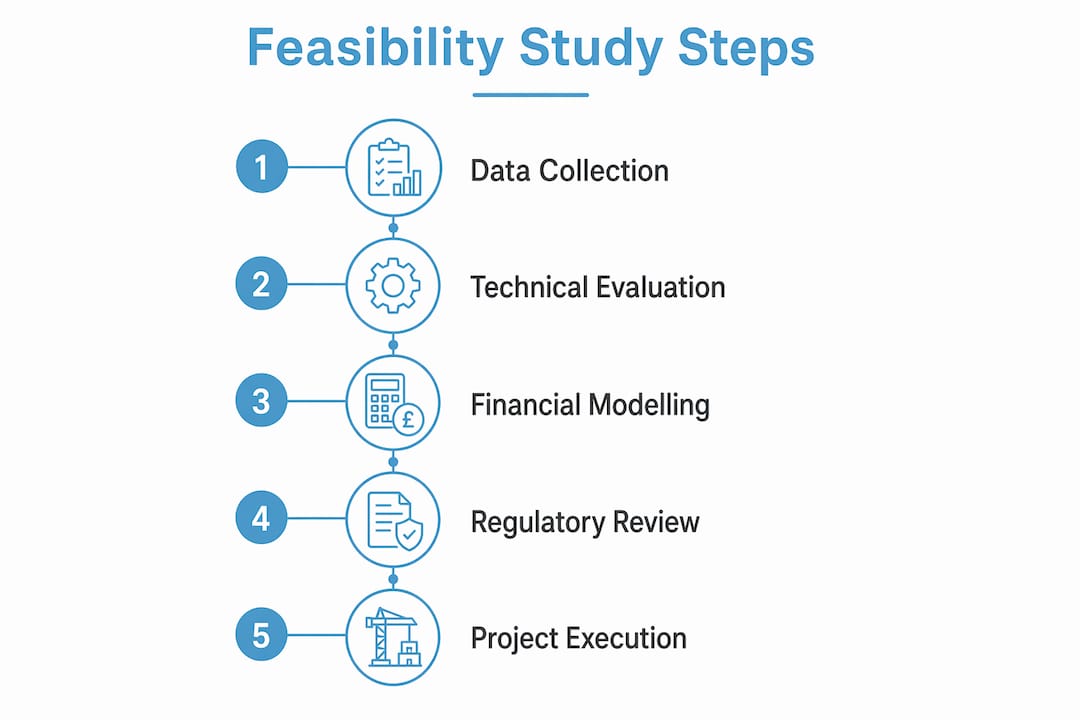
A structured workflow prevents gaps and keeps all workstreams aligned. The six steps below represent the standard sequence for conducting a battery feasibility study from first principles to final recommendation.
- Data collection and load profile analysis. Gather 12 months of 15-minute interval load data, tariff schedules, and any existing generation data. Build a baseline load profile that captures daily, weekly, and seasonal patterns.
- Grid interconnection and permit screening. Submit a preliminary enquiry to your DNO and open dialogue with your local planning authority and fire service. Identify whether a formal grid connection offer is required and what safety standards apply to your system size.
- System sizing aligned with use cases. Size the battery capacity and power rating against your chosen use cases. Confirm that the selected configuration fits within site constraints and stays within NFPA 855 thresholds where possible.
- Safety and site design parameters. Finalise setback distances, fire suppression system requirements, and blast wall specifications if applicable. Cross-reference UL 9540A test data for your chosen battery chemistry.
- Financial modelling including tariff optimisation. Build a full financial model using actual tariff data. Calculate payback period, net present value, and levelised cost of storage. Stress-test the model against degradation scenarios and tariff change assumptions.
- Report generation and recommendation. Compile findings into a structured report covering technical viability, financial projections, permitting status, and a clear go or no-go recommendation with conditions.
The table below summarises common challenges at each stage and how to address them:
| Stage | Common challenge | Resolution |
|---|---|---|
| Data collection | Only monthly billing data available | Request half-hourly data from metering agent |
| Grid screening | DNO response delays | Submit preliminary enquiry on day one of project |
| System sizing | Use case conflicts with site constraints | Revisit use case priority before finalising design |
| Safety design | NFPA 855 threshold exceeded | Reduce system size or engage specialist fire engineer |
| Financial modelling | Tariff data incomplete | Obtain full tariff schedule directly from supplier |
| Report | Stakeholder disagreement on assumptions | Present sensitivity analysis alongside base case |
Understanding battery cells in renewable energy storage helps you select the right chemistry for your use case before system sizing begins.
Key takeaways
A battery storage feasibility study succeeds when it combines granular load data, site-specific tariff modelling, and early permitting engagement into a single structured workflow.
| Point | Details |
|---|---|
| Use 12 months of load data | Shorter datasets miss seasonal peaks and produce inaccurate sizing and ROI projections. |
| Start permitting immediately | Open DNO and planning authority dialogue on day one to avoid schedule-critical delays. |
| Check transformer headroom | Insufficient transformer capacity is the most commonly missed constraint in battery project planning. |
| Model with actual tariffs | Generic rates produce misleading financial results; use your site-specific tariff schedule. |
| Permit for full buildout | Permitting only for the first phase risks costly re-permitting when the project expands. |
Why most feasibility studies fail before they begin
The feasibility studies I have seen fail most often do not collapse at the financial modelling stage. They collapse at the data stage, weeks earlier, because the project team assumed monthly billing data was sufficient. It never is. Monthly data hides the 15-minute demand spikes that drive demand charges, and those spikes are precisely what a battery system is designed to shave. If you model without them, you are solving a problem you have not actually measured.
The second pattern I see repeatedly is treating transformer headroom as an afterthought. Teams spend weeks on financial modelling only to discover the site transformer has no spare capacity for battery charging concurrent with solar output. That finding does not just delay the project. It often forces a complete redesign of the connection strategy, which adds cost and time that the original business case never accounted for.
My strongest advice is this: start the permitting conversation the same week you start data collection. Fire services and planning authorities are not obstacles to manage at the end of the process. They are stakeholders whose requirements shape the design. The projects that commission on time are the ones where the fire engineer reviewed the site layout in month one, not month nine.
— John
Skyenergi’s battery storage solutions for your project
Once your feasibility study confirms technical and financial viability, selecting the right hardware is the next step. Skyenergi stocks a full range of Victron Energy components suited to residential and small commercial battery storage projects, including MPPT charge controllers, inverter-chargers, and monitoring systems.

The Victron Solar Home System 200 is a complete, pre-engineered solution for off-grid and hybrid setups, combining solar input, battery management, and load control in a single unit. For projects requiring a modular approach, Skyenergi’s Victron 305W solar panel packages pair a high-output panel with a Smart MPPT charge controller, cabling, and mounting hardware. Contact Skyenergi directly to discuss system design support tailored to your feasibility study findings.
FAQ
What is a battery storage feasibility study?
A battery storage feasibility study is a structured assessment of the technical, financial, and regulatory factors that determine whether a battery energy storage system is viable for a specific site and use case. It covers load data analysis, grid capacity, safety requirements, and financial modelling.
How long does a battery storage feasibility study take?
Timelines vary by project complexity, but grid interconnection studies alone typically require 3–6 months. A full feasibility study including data collection, site evaluation, and financial modelling commonly takes 2–4 months before the interconnection study begins.
What data is needed to start a battery feasibility study?
At minimum, you need 12 months of 15-minute interval load data, your actual electricity tariff schedule including demand charges, site dimensions, transformer capacity details, and your DNO’s grid connection requirements.
Does system size affect permitting requirements?
Yes. Lithium-ion systems exceeding 600 kWh trigger enhanced NFPA 855 safety analysis requirements, including UL 9540A test data review, which extends the permitting timeline. Staying below this threshold simplifies the approval process where the project economics allow it.
What is the most common reason battery storage projects fail feasibility?
The most common causes are insufficient load data, transformer capacity constraints that are identified too late, and financial models built on generic tariff rates rather than site-specific utility schedules. All three are avoidable with thorough upfront data collection and early stakeholder engagement.
Recommended
Prev post

Why modular battery setups outperform traditional systems
Updated on 05 July 2026
Next post

Top 5 Mowgli Adventures Alternatives 2026
Updated on 03 July 2026


