





Why modular battery setups outperform traditional systems
Discover why modular battery setups outperform traditional systems. Learn how they provide flexibility and reliability for your energy needs.
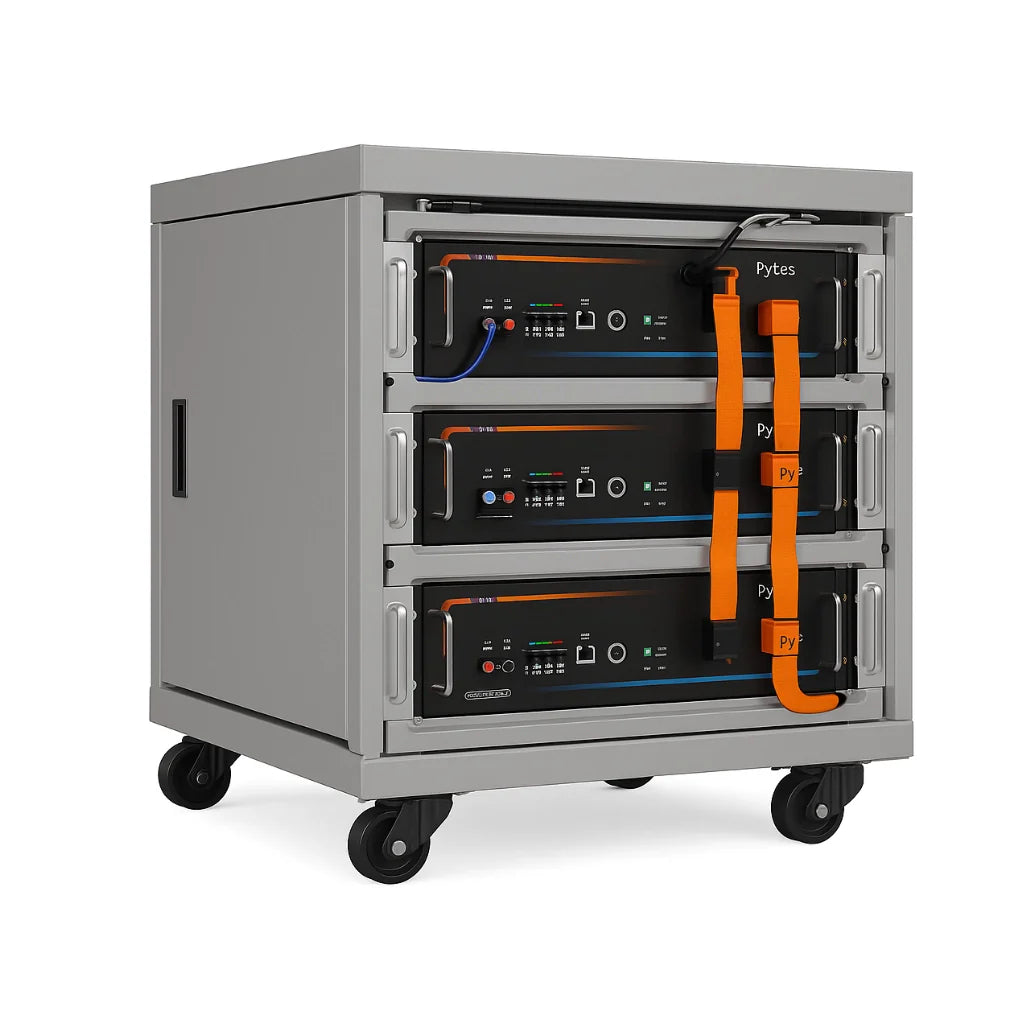
Modular battery setups are defined as energy storage systems built from multiple independent battery modules that connect together to form a single, unified power source. Unlike monolithic designs, where the entire unit fails if one component degrades, modular architecture isolates faults at the module level. This distinction matters enormously for anyone running off-grid power, renewable energy storage, or mobile applications. Skyenergi supplies lithium battery systems and Victron-compatible components built around this principle, giving customers the ability to start small and expand as their energy needs grow.
Why modular battery setups deliver flexibility other designs cannot
Modular battery systems use a building-block architecture, where each module operates independently but contributes to a shared capacity pool. This design lets you add capacity in measured steps rather than replacing an entire system when demand grows. A commercial site can scale from 100 kWh to multi-MWh using identical building blocks, deferring capital expenditure until load growth justifies it. That is a fundamentally different financial model from buying a fixed monolithic unit and hoping it matches future demand.
The pay-as-you-grow approach removes the pressure to over-provision at the outset. A residential solar customer might start with two modules covering overnight loads, then add a third module when they install an EV charger or a heat pump. A commercial operator can scale from 500 kWh to 2 MWh over several years without changing the system’s physical footprint. Neither scenario requires a full system replacement.

Modular energy setups also adapt to changing usage profiles in ways fixed systems cannot. A campervan owner who upgrades to a larger vehicle simply transfers and reconfigures existing modules rather than buying new capacity from scratch. For off-grid and mobile applications, this adaptability is the primary reason to choose modular battery packs over all-in-one alternatives.
Pro Tip: When planning a modular installation, size your inverter and cabling for your target capacity, not your starting capacity. Retrofitting oversized cabling later costs significantly more than installing it correctly at the outset.
- Start with your minimum viable capacity and document your expansion path before purchasing.
- Choose modules from a single product family to guarantee firmware and BMS compatibility.
- Verify that your charge controller, such as a Victron MPPT, supports the total combined capacity you plan to reach.
- Plan cable routing and busbar positions for the full expanded system, not just the initial build.
How modular designs improve reliability and simplify maintenance
Fault tolerance is the defining reliability advantage of modular battery systems. When one module degrades or fails, the remaining modules continue operating. The system does not go dark. This is the critical difference from a monolithic design, where a single cell group failure can take the entire unit offline.
Modular systems demonstrate 99.7% uptime compared to 98.2% for traditional monolithic designs. That gap translates to approximately 130 fewer hours of commercial downtime annually. For a data centre, a hospital, or a cold-storage facility, 130 hours of avoided downtime represents a substantial operational and financial difference.
Maintenance is also structurally simpler with modular setups. A technician replaces one module rather than decommissioning an entire battery bank. The battery management system monitors each module individually, flagging degradation before it becomes a failure. This predictive visibility is absent in most monolithic designs, where the BMS reports aggregate state rather than per-cell or per-module health.
Pro Tip: Schedule a state-of-health check across all modules every 12 months. Replacing a single underperforming module early prevents it from dragging down the capacity and cycle life of the healthy modules around it.
The table below compares key reliability characteristics between modular and monolithic battery architectures.
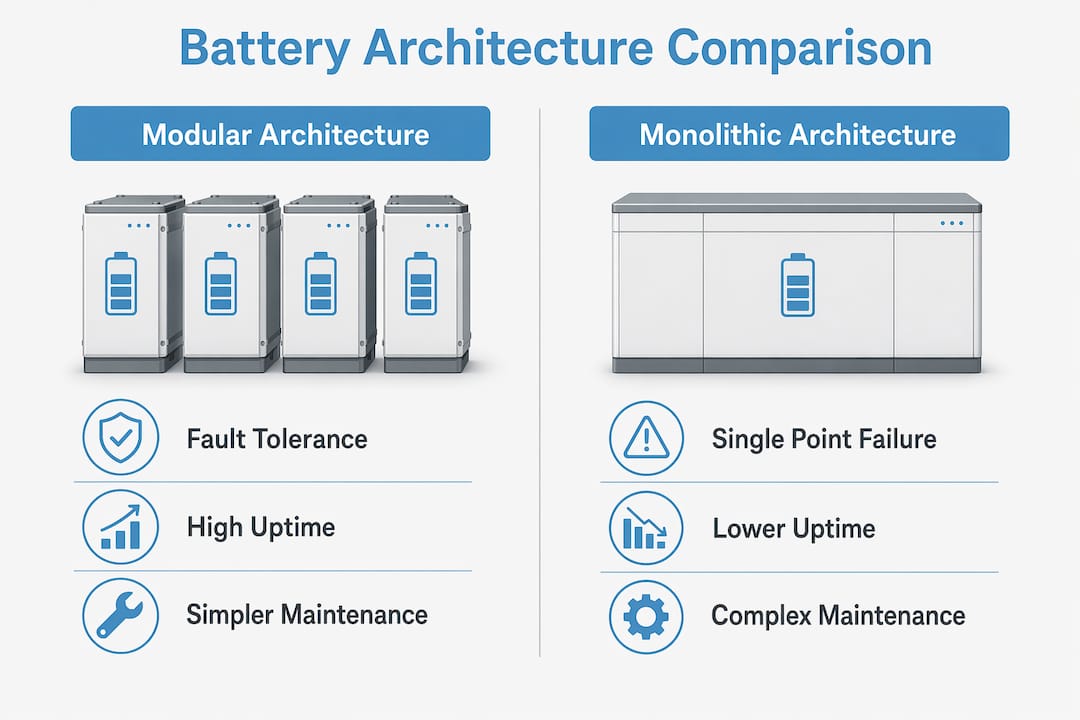
| Characteristic | Modular architecture | Monolithic architecture |
|---|---|---|
| Single-point failure risk | Low. Failed module isolated automatically | High. One fault can disable the full system |
| Maintenance approach | Replace individual module | Full system service or replacement |
| Uptime performance | 99.7% (2026 data) | 98.2% (2026 data) |
| Safety incident rate | 3x fewer incidents per installation | Higher incident rate per installation |
| BMS visibility | Per-module health monitoring | Aggregate system monitoring only |
What is the total cost of ownership for modular battery systems?
Modular battery setups typically deliver 15–25% lower total cost of ownership over a 15-year period compared to traditional battery designs. That figure accounts for targeted module replacement, deferred capital expenditure, and the ability to right-size capacity at each stage of growth. The upfront cost is 10–20% higher than an equivalent monolithic unit, but that premium pays back through avoided full-system replacements.
Efficiency at partial loads is another financial lever. A modular system activates only the modules needed to meet current demand, avoiding energy waste that occurs when a monolithic system runs at a fraction of its rated capacity. Reduced heat generation at partial loads also lowers cooling requirements, which cuts operating costs in enclosed installations.
The table below outlines the primary cost factors across a 15-year ownership period.
| Cost factor | Modular system | Monolithic system |
|---|---|---|
| Initial capital outlay | 10–20% higher | Lower upfront |
| Replacement cost | Single module only | Full system replacement |
| Partial-load efficiency | High. Only active modules draw power | Lower. Full system runs regardless of load |
| Cooling and thermal costs | Reduced at partial loads | Higher due to constant full-system operation |
| 15-year total cost of ownership | 15–25% lower | Higher over full lifecycle |
Fleet operators managing battery-powered vehicles face similar cost dynamics. A review of total cost of ownership in fleet management shows that component-level replacement strategies consistently outperform full-unit replacement cycles on long-term cost. The principle applies directly to modular battery banks.
Practical challenges when deploying modular battery setups
Modular systems require more careful commissioning than monolithic units. The most common deployment error is mixing modules with different firmware versions or different states of health. Adding a new module to aged batteries creates charge-balancing conflicts that reduce total system efficiency and accelerate degradation in the older modules. The BMS attempts to equalise charge across all modules, which forces the newer module to operate below its potential.
Physical installation demands attention in mobile and off-grid environments. Vibration-resistant mounting hardware and correctly rated cabling are not optional extras in vehicle or marine installations. Loose connections generate heat. Heat accelerates cell degradation. In a campervan or boat, the consequences range from capacity loss to connection failure at the worst possible moment.
Thermal management is a specific challenge in multi-module configurations. Heat does not distribute evenly across a battery bank, particularly when modules are stacked vertically. The bottom modules in a vertical stack typically run warmer than the top modules, which creates uneven ageing across the bank. Installers should follow manufacturer spacing guidelines and avoid blocking ventilation paths between modules.
- Match firmware versions across all modules before commissioning.
- Verify state-of-health parity when adding modules to an existing bank.
- Use vibration-resistant busbars and heat-resistant cable terminations in mobile installations.
- Maintain manufacturer-specified spacing between modules for thermal management.
- Commission the BMS before connecting loads to confirm per-module monitoring is active.
For detailed guidance on off-grid battery system features, including BMS configuration and monitoring, Skyenergi publishes technical resources covering common installation scenarios.
Where do modular battery systems perform best?
Modular battery systems perform best in applications where capacity needs change over time or where continuous power availability is non-negotiable. Residential solar storage is the clearest example. A household installs two modules to cover overnight loads, then adds capacity as solar generation increases or as additional appliances come online. The system grows with the household rather than requiring replacement.
Off-grid and mobile applications benefit from a different aspect of modularity. Separating power sources improves portability without sacrificing total capacity. A campervan operator can carry two lighter modules rather than one heavy monolithic unit, then combine them for multi-day backup when parked. Marine installations follow the same logic, with modular marine battery systems offering the flexibility to redistribute weight and capacity across a vessel’s layout.
Commercial and industrial sites with critical continuous power requirements gain the most from fault tolerance. Data centres, cold-storage facilities, and telecoms infrastructure cannot tolerate full system outages. A modular bank keeps the site running while a failed module is swapped out, often without interrupting the load at all.
Pro Tip: For renewable energy installations, pair modular battery banks with a Victron MPPT charge controller. MPPT controllers adjust charge parameters dynamically, which protects individual modules from overcharge during periods of high solar generation.
The case for modular: a perspective worth considering
The industry has spent years debating capacity numbers. Kilowatt-hours dominate the marketing conversation, and buyers naturally focus on the headline figure. What that framing misses is that fault tolerance and system redundancy are the advantages that actually determine whether a battery system earns its place in a critical application.
I have seen installations where a customer chose a large monolithic unit because the capacity figure looked impressive on paper. When one cell group degraded two years in, the entire bank needed decommissioning. The modular alternative would have required a single module swap. The total cost difference over five years was not marginal.
The technology has matured considerably. Firmware synchronisation tools, standardised BMS communication protocols, and better thermal management in modern modules have addressed the early-generation pain points. The practical gap between modular and monolithic has narrowed on the installation side, while the operational advantages of modularity have only grown clearer.
My advice is straightforward. If your energy needs are fixed and will not change, a monolithic system is simpler. If your needs will grow, if continuous uptime matters, or if you are operating in a mobile or off-grid environment, modular battery architecture is the more rational choice. The 15-year cost data supports that conclusion without ambiguity.
— John
Skyenergi’s modular-ready energy storage solutions
Skyenergi stocks a range of Victron Energy components built for modular and expandable energy systems, from MPPT charge controllers to monitoring interfaces that give you per-module visibility across your entire installation.

The Victron Solar Home System 200 MPPT is a practical starting point for residential and off-grid customers who want a modular-ready setup from day one. For larger builds, the Victron 610 Watt solar panel bundle includes a Smart MPPT charge controller, cabling, and mounting hardware, giving you the core components to build a system that scales. Skyenergi sources directly from manufacturers, keeping prices competitive without compromising on specification.
Key takeaways
Modular battery setups deliver lower long-term costs, higher uptime, and greater flexibility than monolithic designs, making them the practical choice for renewable energy, off-grid, and commercial applications.
| Point | Details |
|---|---|
| Fault tolerance is the core advantage | A single module failure does not cause a full system outage, supporting 99.7% uptime. |
| Total cost of ownership is lower | Modular systems cost 15–25% less over 15 years through targeted module replacement. |
| Scalability defers capital expenditure | Capacity expands incrementally, from 100 kWh to multi-MWh, without full system replacement. |
| Firmware matching is non-negotiable | Mismatched firmware or state-of-health across modules causes charge imbalance and efficiency loss. |
| Mobile installations need specific hardware | Vibration-resistant busbars and heat-resistant cabling are required in vehicle and marine setups. |
FAQ
What is a modular battery setup?
A modular battery setup is an energy storage system built from multiple independent battery modules that connect together to share capacity and load. Each module operates individually, so a fault in one does not disable the entire system.
Why choose modular battery banks over a single large unit?
Modular battery banks offer fault tolerance, incremental scalability, and lower long-term replacement costs. A single module can be swapped when it degrades, rather than replacing the entire bank.
How do modular battery systems handle partial loads efficiently?
Modular systems activate only the modules required to meet current demand, reducing energy waste and heat generation at partial loads. Monolithic systems run the full unit regardless of load, which wastes energy and increases cooling costs.
What are the main risks when expanding a modular battery bank?
The primary risk is adding modules with different firmware versions or different states of health, which causes charge-balancing conflicts and reduces overall efficiency. Always match firmware and verify state-of-health parity before commissioning new modules.
Are modular battery setups suitable for campervans and marine use?
Modular setups are well suited to campervans and marine installations because individual modules are lighter and easier to position than a single large unit. Vibration-resistant mounting hardware and correctly rated cabling are required to maintain reliable connections in mobile environments.
Recommended
Prev post

Reasons to upgrade motorhome batteries in 2026
Updated on 06 July 2026
Next post

Battery storage feasibility study steps: 2026 guide
Updated on 04 July 2026


