





What is a hybrid inverter? Your off-grid guide
Discover what is a hybrid inverter and how it simplifies off-grid setups. Learn about its features and benefits for your energy needs.
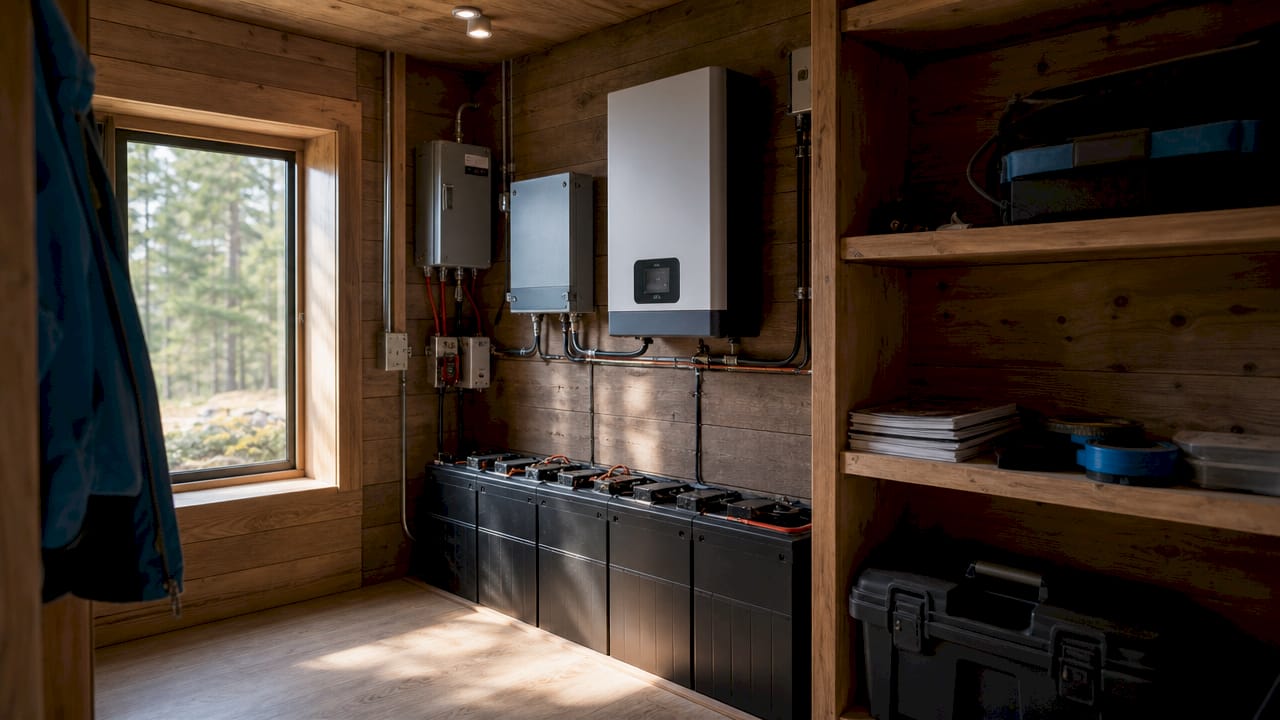
A hybrid inverter is a single power electronics device that combines solar conversion, battery management, and grid connectivity in one unit. Standard inverters handle only one job. A hybrid inverter handles four simultaneously: converting DC solar power to AC, charging batteries, discharging batteries to supply loads, and synchronising with the grid. For anyone building an off-grid setup in a campervan, motorhome, or boat, this matters because it replaces three separate components with one device, reducing wiring complexity and points of failure. Brands like Victron Energy and Hoymiles have made hybrid inverter technology accessible to DIY builders at a range of price points.
How does a hybrid inverter work?
A hybrid inverter manages four-way power flow between solar panels, batteries, the grid, and your loads. That four-way management is what separates it from a standard solar inverter, which only converts DC to AC and feeds it to the grid or your appliances.
The operational sequence works like this:
- Solar input. The inverter accepts DC power directly from your solar panels via a built-in MPPT charge controller. It extracts maximum power from the panels regardless of temperature or shading conditions.
- Battery charging. Surplus solar power charges your battery bank. Because the inverter uses DC coupling, the solar DC goes straight into the battery without first being converted to AC and back again.
- Load supply. The inverter converts DC to AC and powers your appliances. It draws from solar first, then battery, then grid, following a priority order you set.
- Grid interaction. When connected to shore power or the mains, the inverter synchronises with the grid frequency. It can draw from the grid to top up batteries or export surplus solar back to it.
The DC-coupled architecture is a genuine technical advantage. DC coupling improves efficiency by 5–10% compared to older AC-coupled systems that require an extra conversion step. That efficiency gain translates directly into more usable energy from the same solar array.
Modern hybrid inverters also function as smart grid assets, adjusting their output in response to grid voltage and frequency fluctuations. This is called grid ride-through, and it keeps your system stable during minor grid disturbances without switching to battery backup unnecessarily.
Pro Tip: Set your load priority to “solar first, battery second, grid last.” This single configuration change maximises solar self-consumption and extends battery cycle life significantly.
During a power cut, a hybrid inverter switches to battery backup within milliseconds, disconnecting from the grid automatically. Your appliances keep running without a flicker. This is the feature that makes hybrid inverters particularly valuable in RVs and boats where grid reliability is unpredictable.
Hybrid inverter vs solar inverter: advantages and disadvantages
The core advantage of a hybrid inverter system over a standard solar inverter plus separate battery controller is consolidated control. One device manages everything, which reduces hardware costs, simplifies wiring, and gives you a single point of monitoring.
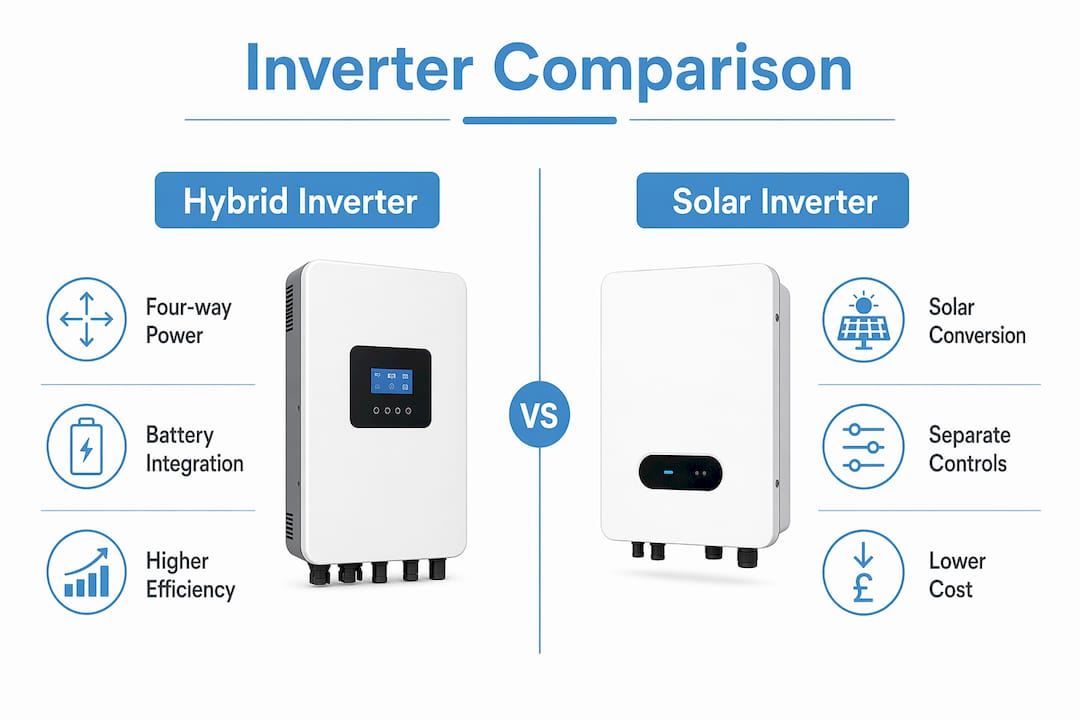
| Feature | Hybrid inverter | Standard solar inverter + separate controller |
|---|---|---|
| DC coupling efficiency | Higher (5–10% gain) | Lower (extra conversion step) |
| Component count | One device | Three or more devices |
| Backup power | Built-in | Requires separate ATS |
| Monitoring | Centralised | Multiple apps or displays |
| Upfront cost | Higher per unit | Lower per component |
| Battery compatibility | Limited to supported protocols | Broader, depending on controller |
The efficiency advantage is real and measurable. DC-coupled hybrid inverters avoid redundant power conversions that AC-coupled systems cannot escape. Over a full year of use, that difference accumulates into meaningful extra kilowatt-hours.
The main drawback is compatibility. Hybrid inverters may not support all battery brands or communication protocols, and a mismatch between inverter and battery BMS causes poor charging behaviour and accelerated battery degradation. This is not a minor issue. It is the most common reason DIY installations underperform.
Pro Tip: Before purchasing, download the inverter’s compatibility list from the manufacturer’s website and cross-reference it against your battery’s BMS communication protocol, whether that is CAN bus, RS485, or a proprietary protocol.
Upfront cost is the other consideration. A quality hybrid inverter from Victron Energy or Hoymiles costs more than a basic string inverter. However, when you factor in the cost of a separate battery charge controller and automatic transfer switch, the total system cost often favours the hybrid approach.
Compatibility and installation for RVs, boats, and off-grid setups
Compatibility is the area where DIY installations most often go wrong. Battery and inverter compatibility issues are the largest single pitfall for self-builders. Getting this right before you buy saves significant time and money.
Key considerations for your installation:
- BMS communication protocol. Your battery’s BMS must speak the same protocol as your inverter. Common protocols include CAN bus, RS485, and Modbus. Victron Energy uses VE.Can and VE.Direct. Hoymiles HYS-series inverters support specific lithium battery brands listed in their documentation. Check both sides before committing.
- Battery voltage compatibility. Hybrid inverters are designed for specific voltage ranges, typically 12V, 24V, or 48V systems. A 48V inverter will not work with a 12V lithium battery bank without a DC-DC converter in between.
- Grid disconnect and islanding. Seamless backup power requires either an automatic transfer switch or internal load-switching, and this feature is not standard in all hybrid inverters. Verify that your chosen model includes it before assuming you will have no-flicker backup.
- Automatic transfer switch (ATS). In RV and marine installations, the ATS disconnects shore power and switches to battery supply during an outage. Some hybrid inverters include this internally. Others require an external ATS unit wired separately.
- Cable sizing and fusing. DC wiring between solar panels, batteries, and the inverter carries high currents. Undersized cables cause voltage drop and heat. Follow the inverter manufacturer’s cable sizing guide precisely.
- Ventilation. Hybrid inverters generate heat under load. In enclosed campervan builds, inadequate ventilation causes thermal throttling and reduces output. Mount the inverter on a metal surface with clear airflow above and below.
For off-grid and leisure energy storage applications, the Hoymiles HYS series offers a practical entry point. The Hoymiles HYS-4.6LV-EUG1 includes WiFi monitoring and grid disconnect functionality in a single unit suited to smaller off-grid builds.
How does monitoring improve hybrid inverter performance?
Real-time monitoring through cloud or Bluetooth apps enables you to optimise energy usage based on solar availability and electricity tariffs. Without monitoring, you are running your system blind. With it, you can make decisions that meaningfully extend battery life and reduce grid consumption.
The practical benefits of good monitoring include:
- Time-of-day tariff management. If you are connected to the grid, you can programme the inverter to charge batteries during off-peak tariff periods and discharge during peak periods, reducing your electricity bill.
- Solar self-consumption tracking. Monitoring shows exactly how much of your solar generation you are consuming directly versus exporting or storing. This data helps you right-size your battery bank.
- Remote firmware updates. Manufacturers push performance improvements and bug fixes via over-the-air updates. WiFi-enabled inverters like the Hoymiles HYS series receive these automatically.
- System health alerts. Good monitoring platforms flag abnormal battery temperatures, low state-of-charge events, and communication faults before they cause damage.
- Battery lifecycle protection. Centralised monitoring and control allows the inverter to adjust charge rates based on battery temperature and state of health, protecting your investment over thousands of cycles.
Victron Energy’s VRM portal and the Hoymiles S-Miles Cloud platform are two well-established monitoring solutions used widely in DIY off-grid builds. Both provide live data, historical graphs, and remote configuration. The role of power electronics in managing these data flows is what makes modern hybrid systems genuinely intelligent rather than simply automated.
Key takeaways
A hybrid inverter is the most efficient single-device solution for managing solar, battery, grid, and load power simultaneously in off-grid, RV, and marine installations.
| Point | Details |
|---|---|
| Four-way power management | A hybrid inverter controls solar input, battery charging, load supply, and grid interaction from one device. |
| DC coupling efficiency | DC-coupled architecture improves round-trip efficiency by 5–10% compared to AC-coupled alternatives. |
| Battery compatibility | Always verify BMS communication protocol compatibility before purchasing an inverter or battery. |
| Backup power requirements | Seamless no-flicker backup requires internal load-switching or an automatic transfer switch, not all inverters include this. |
| Monitoring adds real value | Cloud or Bluetooth monitoring enables tariff optimisation, battery protection, and remote firmware updates. |
What I have learned from hybrid inverter builds
The biggest mistake I see in DIY hybrid inverter installations is buying the inverter first and the batteries second. It should always be the other way around. Your battery bank is the heart of the system. The inverter must serve it, not the other way around. Once you have chosen a lithium battery with a specific BMS protocol, your inverter options narrow considerably, and that is fine. Work with that constraint rather than against it.
The second thing most builders underestimate is the value of monitoring. I have seen setups where the inverter was performing well below its rated capacity for months because a configuration parameter was wrong. The owner had no idea until they checked the monitoring data. A hybrid inverter without monitoring is a missed opportunity.
For RV and boat builds specifically, I would always prioritise an inverter with internal ATS functionality over one that requires an external switch. Every additional component in a mobile installation is another potential failure point. Simplicity is reliability in this context.
Victron Energy’s MultiPlus range remains the benchmark for DIY off-grid builds in the UK. The Victron MultiPlus-II 48/5000 is the model I would recommend for most residential-scale off-grid or leisure vehicle applications. It is not the cheapest option, but the ecosystem support, monitoring quality, and long-term reliability justify the cost.
— John
Skyenergi hybrid inverter solutions for off-grid builds
Skyenergi stocks a range of hybrid inverter systems and compatible solar components suited to campervans, motorhomes, boats, and off-grid residential setups.
The Victron MultiPlus 12/3000 is a proven hybrid inverter for 12V leisure vehicle builds, combining inverter, charger, and transfer switch in one unit. For solar input, the Victron 610W solar panel and Smart MPPT kit pairs directly with Victron hybrid inverters and includes all mounting hardware. Skyenergi sources products directly from manufacturers, keeping prices competitive without compromising on specification. Browse the full range to find the right combination for your system.
FAQ
What is a hybrid inverter in simple terms?
A hybrid inverter is a single device that converts solar DC power to AC, charges and discharges a battery bank, and manages grid connection simultaneously. It replaces a solar inverter, battery charge controller, and automatic transfer switch in one unit.
How does a hybrid inverter differ from a standard solar inverter?
A standard solar inverter only converts DC solar power to AC. A hybrid inverter also manages battery storage and grid interaction, giving you backup power and greater control over energy flow.
Do hybrid inverters work without a grid connection?
Yes. Hybrid inverters operate in off-grid mode, drawing power from solar panels and batteries without any grid connection. This makes them well suited to RVs, boats, and remote off-grid installations.
What batteries are compatible with hybrid inverters?
Compatibility depends on the inverter’s supported BMS communication protocols. Battery and inverter mismatches cause poor charging and battery degradation, so always verify protocol support before purchasing either component.
Is a hybrid inverter worth the cost for a campervan build?
For a campervan or motorhome with solar panels and a lithium battery bank, a hybrid inverter reduces component count, simplifies wiring, and provides automatic backup power. The consolidated system typically costs less overall than buying separate components with equivalent functionality.
Recommended
Prev post

Smart meter integration with battery storage: 2026 guide
Updated on 24 June 2026
Next post

Top 3 baymarinesupply.com Alternatives 2026
Updated on 22 June 2026


