






Why Your Campervan Fridge Cuts Out: 7 Fixes
Your campervan fridge cuts out due to voltage drop, wiring issues, or battery drain. Learn 7 practical fixes and diagnostic steps to keep it running.
Table of Contents
- Why Your Campervan Fridge Cuts Out: Common Causes
- Understanding 12V Fridge Voltage Drop and Battery Health
- Leisure Battery Voltage Levels and Cut-Off Points
- Airflow, Ventilation and Thermal Issues
- Campervan Electrical System Troubleshooting: Step-by-Step
- Wiring, Fuses and Circuit Protection Issues
- Smart Battery Monitoring and Preventative Maintenance
- Upgrading to Lithium: A Long-Term Solution
Last Updated: August 28, 2026
Why Your Campervan Fridge Cuts Out: Common Causes
A campervan fridge cutting out mid-journey is one of the most frustrating electrical failures you'll face. At Skyenergi, we've spent years helping campervan owners diagnose and fix these issues, and the root causes are almost always the same handful of problems.
According to Nohma's survey of 332 campervan builders, 99.4% of people designing their campervan electrical systems make mistakes during installation. A typical 12V fridge draws between 3 and 6 amps per hour when the compressor is running and can consume 30 to 50 amp hours over a 24-hour period depending on ambient temperature and door openings (nohma.com). Most fridge cut-outs are fixable without replacing equipment.
Understanding 12V Fridge Voltage Drop and Battery Health
Your 12V fridge doesn't stop working because your battery is flat. It stops because the voltage at the fridge's input has dropped below its cut-off threshold, typically around 11.0 to 11.5 volts (justanswer.com). Even though your leisure batteries are in good condition and have sufficient capacity, the fridge likely has a built-in low-voltage cut-off feature that shuts it down when voltage dips below this level, primarily if voltage drop is caused by long or thin wiring, or if the fridge momentarily draws high current during compressor start-up.
"Even though your leisure batteries are in good condition and have sufficient capacity, the fridge likely has a built-in low-voltage cut-off feature that shuts it down when the voltage at its input dips below a certain level, typically around 11.0 to 11.5 volts." -- KevinWhiteJA, Verified Home Appliance Technician at JustAnswer UK (JustAnswer UK, 2025)
How voltage drop affects compressor startup
When your compressor first engages, it draws a surge of current far higher than its steady-state draw. This momentary spike can cause a temporary voltage collapse at the fridge's terminals, triggering the low-voltage cut-off even though the battery voltage itself hasn't actually dropped. A VW T6 Transporter owner replaced thin wires in the fridge feed with thicker 27amp wire (approximately 4mm), reducing voltage drop from 2V to 0.5V and allowing the fridge to operate until the leisure battery reached 11.1V instead of cutting out at 12.6V.
Checking wiring gauge and connection resistance
Your wiring gauge is the first place to check. The resistance in undersized cable causes voltage to drop as current flows through it. Use a multimeter to test the voltage at the battery terminals, then test it again at the fridge inlet. If the difference exceeds 0.5V under load, you've found your problem.
Leisure Battery Voltage Levels and Cut-Off Points
Leisure battery voltage doesn't behave the way most people expect. A battery showing 12V on a voltmeter might have almost no usable power left, depending on the battery chemistry and how deeply it's been discharged.

Why your fridge stops at 11.5V even with charge remaining
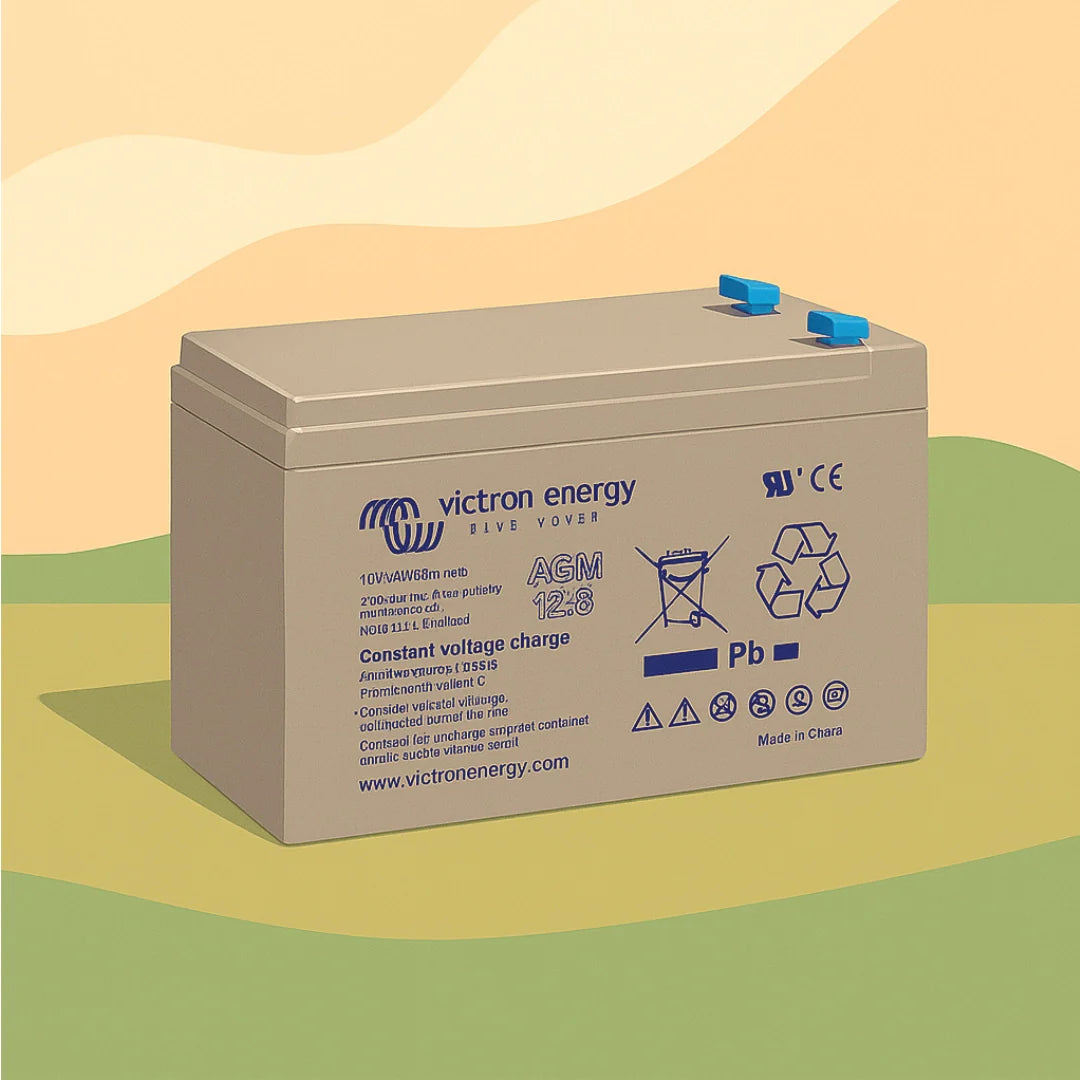
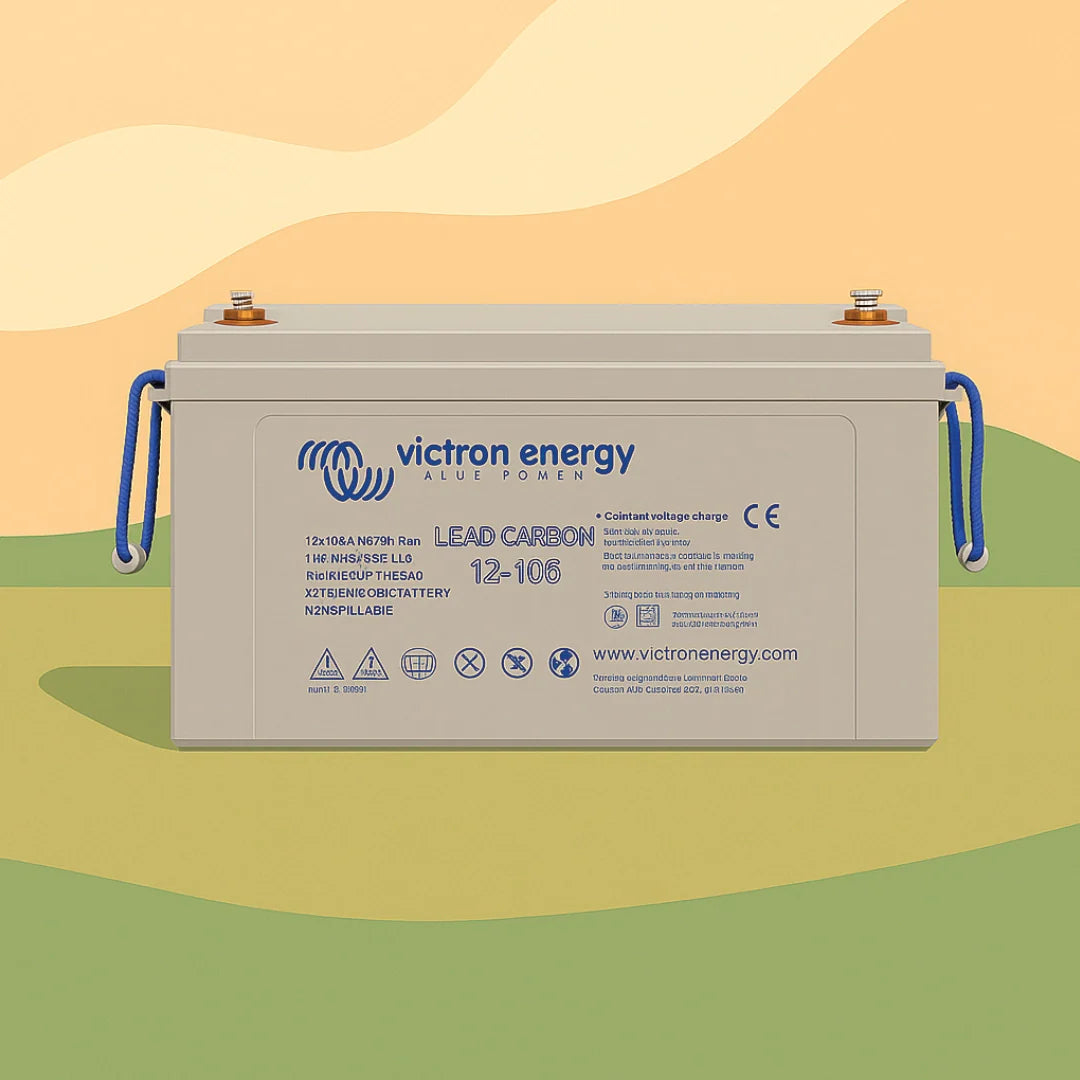
Lead-acid leisure batteries have a usable capacity of roughly 50% of their rated amp-hour capacity. A 100Ah leisure battery at 50% usable capacity provides 50Ah. However, once the voltage drops below 11.5V, the battery is already at approximately 40-50% depth of discharge, and continued deep discharge will damage it permanently. Most fridges cut out at 11.0 to 11.5V because they're protecting your battery from damage. Discharge a lead-acid battery below 10.5V and you'll shorten its lifespan dramatically.
Usable capacity and deep cycle battery depletion
Your battery might show 12.2V on a basic voltmeter, but if you're drawing 40 amps continuously, the voltage will sag under load. If your fridge keeps cutting out at what feels like an arbitrary point, the problem is usually one of three things: insufficient battery capacity for your usage pattern, undersized wiring causing voltage drop, or a battery that's already degraded and can't hold voltage under load.
Airflow, Ventilation and Thermal Issues
A fridge running in a poorly ventilated cupboard can consume 30 to 50% more power than the same unit with proper airflow. This excess power draw accelerates battery depletion and makes voltage sag worse.
How poor airflow forces your fridge to work harder
Compressor fridges reject heat through a condenser. If that condenser is starved of fresh air, the fridge's internal pressure rises, forcing the compressor to work longer and harder to achieve the target temperature. Caravan fridge performance declines markedly at ambient temperatures above 30°C, especially when the fridge is sited on the nearside of the van with vents into a hot awning or when an open caravan door covers the vents and reduces airflow over cooling fins.
"Caravan fridge performance can decline markedly at ambient temperatures above 30°C. This is exacerbated by siting the fridge on the nearside of the van which means that the fridge vents into a hot awning and worse that an open caravan door can cover the vents and reduce the efficiency of the air flow over cooling fins." -- Dometic's Technical Manager (Club Together, 2022)
Ambient temperature and cooling efficiency
Check that your fridge has at least 10 centimetres of clearance on all sides, particularly around the condenser vents. If your campervan fridge is mounted in a locker or cupboard, ensure there's adequate ventilation. Some owners drill additional air vents or install small 12V fans to force air circulation around the condenser.
Campervan Electrical System Troubleshooting: Step-by-Step
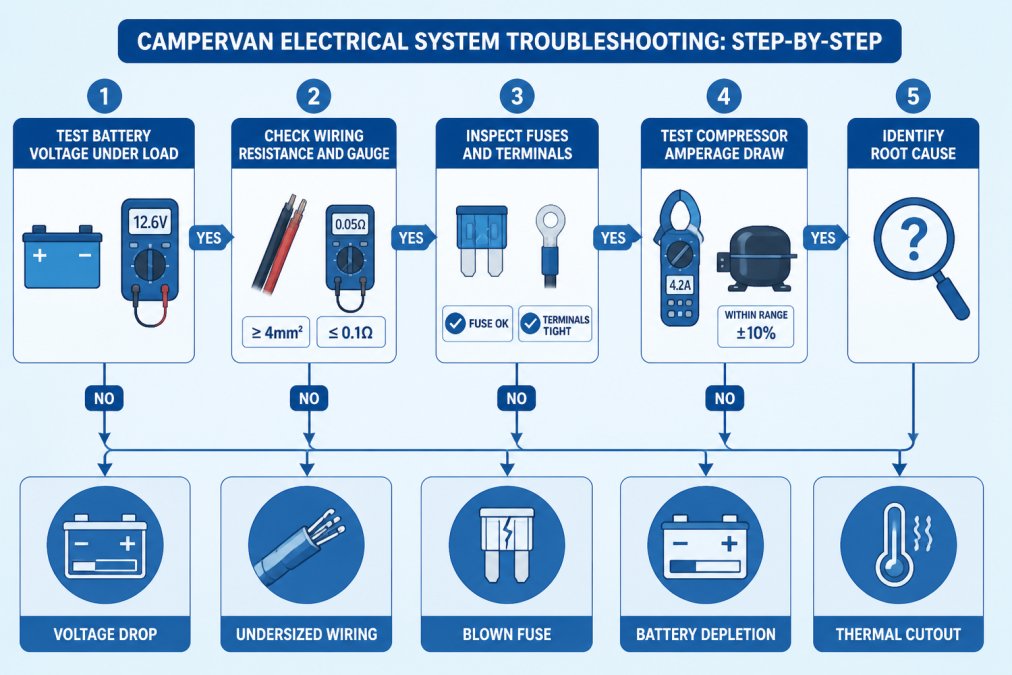
Most people try random fixes. Instead, follow a systematic diagnostic process to identify the actual cause.
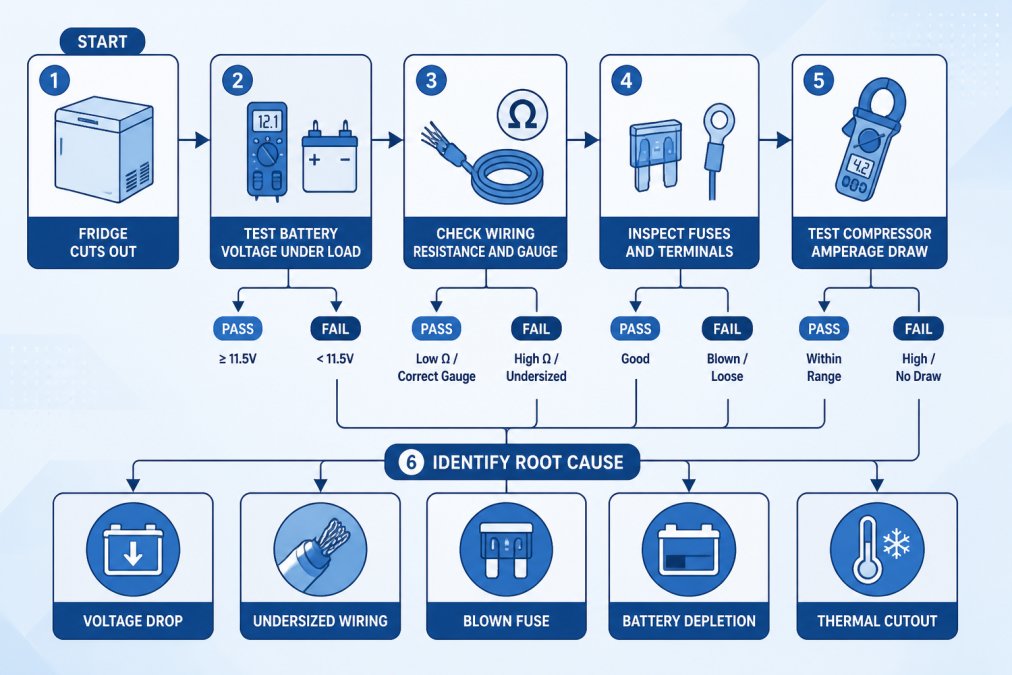
Step 1: Test voltage at the battery and at the fridge inlet
Turn on the fridge and let the compressor run for 30 seconds. Using a multimeter set to DC voltage, measure the voltage directly at the battery terminals while the compressor is running. Then measure the voltage at the fridge's power inlet. The difference between these two readings is your voltage drop. If the voltage at the fridge has dropped to 11.5V or below, that's your cut-off point. If the voltage drop between the battery and the fridge exceeds 0.5V, your wiring is the culprit.
Step 2: Inspect wiring, terminals and crimp connections
Turn off all appliances and disconnect the battery. Inspect every connection in the fridge circuit: battery terminal, main distribution block, fuse holder, and fridge inlet. Look for corrosion, loose nuts, or damaged insulation. Crimp connections are common failure points. A poorly crimped terminal creates resistance that generates heat and causes voltage drop. If you find a dodgy crimp, cut it off and re-crimp with a proper crimping tool and appropriately sized terminal.
Step 3: Check fuses, circuit breakers and thermal cutouts
Your fridge circuit should have a fuse or circuit breaker rated for the fridge's maximum amperage. A blown fuse is an obvious sign of an electrical fault. If the fuse blows repeatedly, something is wrong with the fridge itself or the wiring is damaged and shorting. Some fridges have a thermal cutout that trips if the compressor overheats. If your fridge cuts out and then restarts after cooling, a thermal cutout may be the issue, usually pointing to poor ventilation or an overworked compressor.
Step 4: Test compressor amperage draw and startup surge
A multimeter with an amperage clamp attachment lets you measure how much current the fridge is actually drawing. A healthy 12V compressor fridge should draw 3 to 6 amps during steady-state cooling. If it's drawing significantly more, the compressor is struggling, likely due to heat or low voltage. Watch the amperage during compressor startup. If that spike exceeds your battery's ability to supply current without sagging below 11V, the fridge's low-voltage cut-off will trigger.
Wiring, Fuses and Circuit Protection Issues
Undersized cable is the single most common cause of fridge cut-outs in campervans. It's also the easiest to fix.
Undersized cable and resistance calculations
Cable resistance increases with length and decreases with gauge. For a 12V fridge circuit, calculate the voltage drop based on the cable run length and the expected current draw. For a 3-metre run carrying 6 amps, use 10mm² cable. For a 5-metre run, use 16mm² cable. For a 10-metre run, use 25mm² cable. Most campervan conversions use 4mm² or 6mm² cable, which is inadequate for anything beyond a 1-metre run.
Blown fuses and tripped circuit breakers
A fuse rated at 20 amps will blow if the circuit draws more than 20 amps for several seconds. If your fridge's fuse keeps blowing, something is drawing excessive current. Replace the fuse with the correct rating (usually 20 amps for a 12V fridge). If it blows again immediately, there's a fault in the circuit that needs to be found and fixed.
Smart Battery Monitoring and Preventative Maintenance
Real-time monitoring transforms your ability to prevent cut-outs before they happen. Instead of discovering your fridge has stopped when you open the door to a warm interior, you'll see the battery voltage dropping and take action.
Real-time voltage and amperage monitoring
A battery monitor like the Victron SmartShunt connects between your battery and the main distribution block, measuring voltage, current, and state of charge in real time. The SmartShunt connects via Bluetooth to the VictronConnect app, showing you exactly how much power your fridge is drawing and how long your battery will last at current consumption rates. This data transforms decision-making. If you see your battery voltage sagging below 12V with the fridge running, you know immediately that either your wiring is too thin or your battery capacity is insufficient.

Scheduled maintenance and battery health checks
Test your battery voltage under load once a month. If it's consistently sagging below 11.5V with the fridge running, address the root cause before it becomes a problem. Check all crimp connections and terminals every six months, especially if you're in a damp climate.
Upgrading to Lithium: A Long-Term Solution
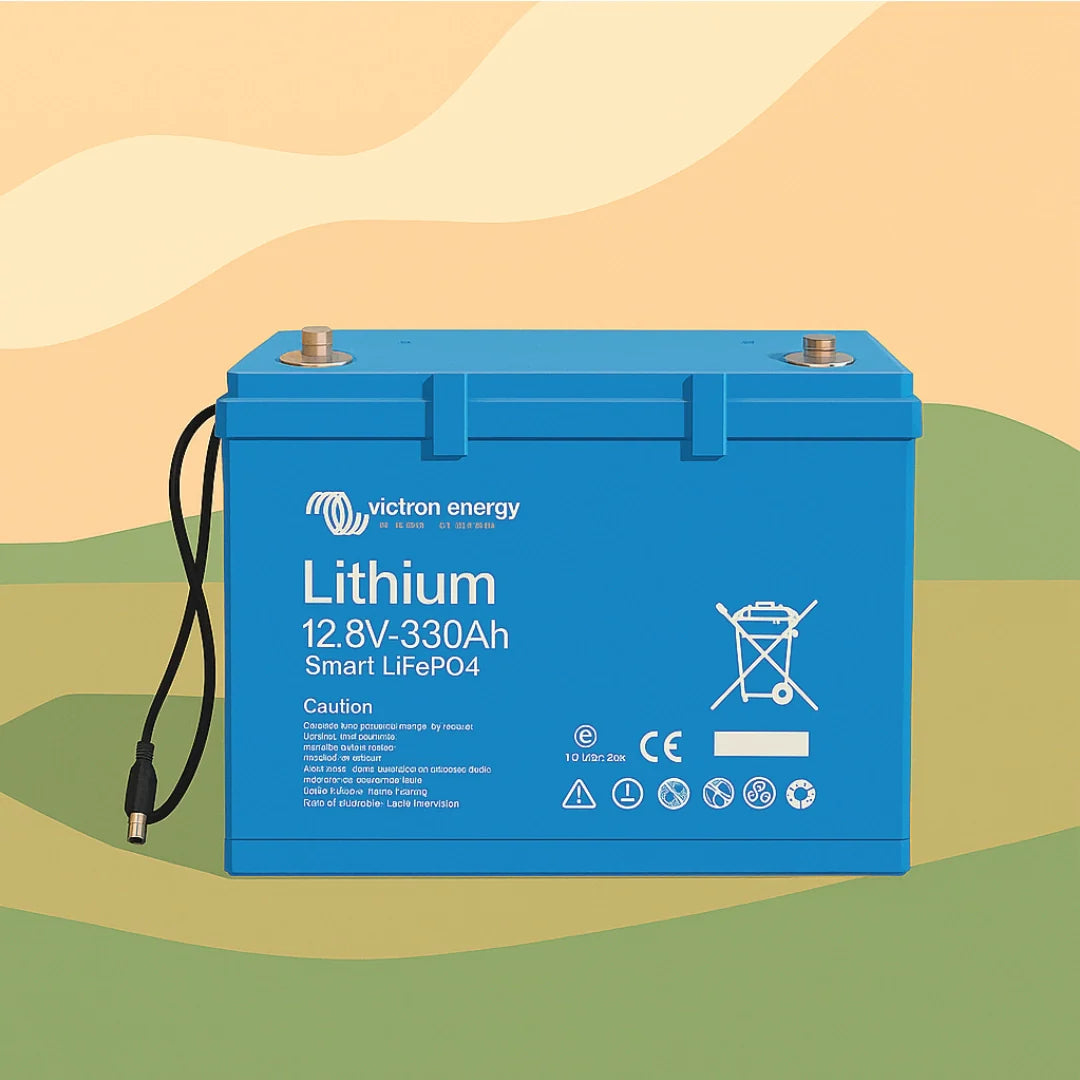
If you're tired of managing voltage sag and battery depletion, lithium leisure batteries offer a fundamentally different approach. Lithium batteries hold voltage steadily throughout the discharge cycle, meaning your fridge won't cut out until the battery is genuinely depleted.
Lithium batteries offer more usable capacity (often 80-100% of rated capacity) compared to lead-acid's 50%, are lighter, charge faster, hold voltage steadily, and last for thousands of charge cycles. A 100Ah lithium battery delivers 80-100Ah of usable power, compared to 50Ah from a lead-acid equivalent.
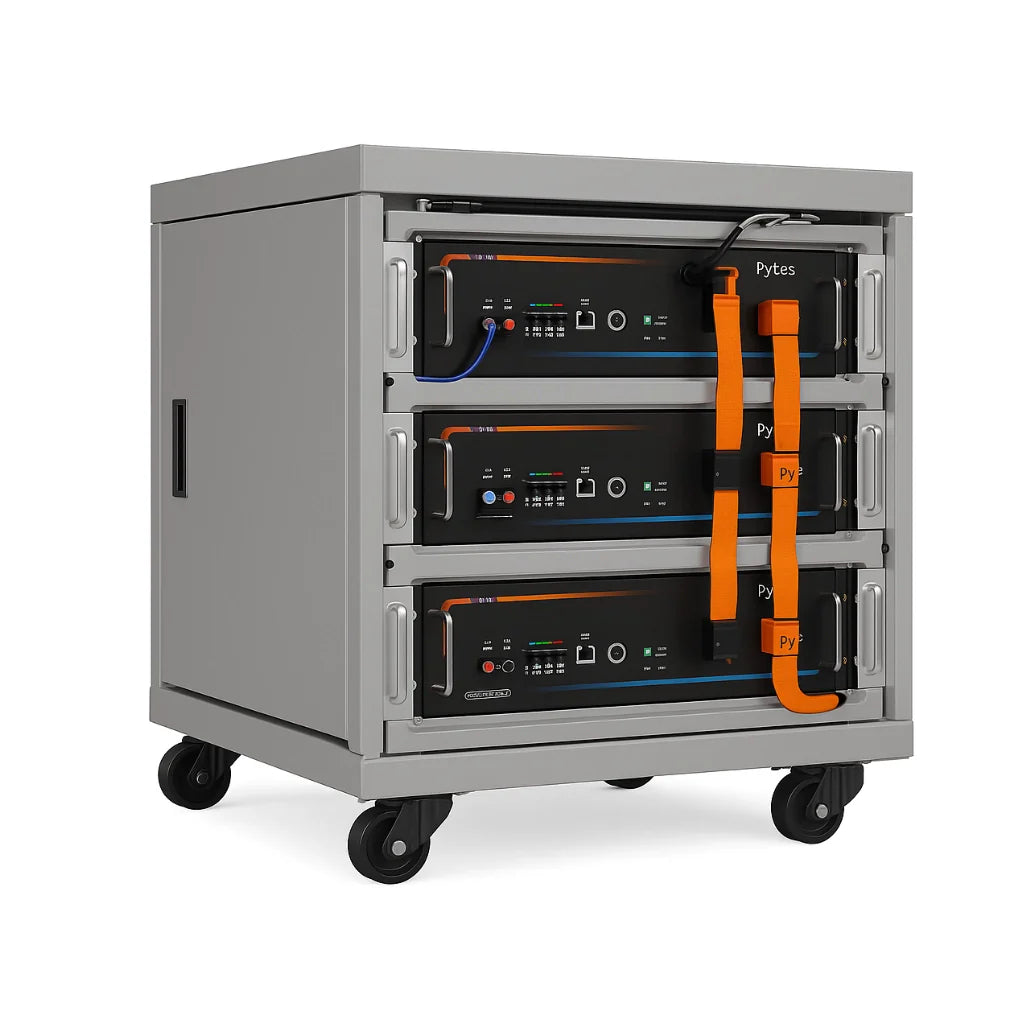
Skyenergi supplies high-performance lithium batteries designed specifically for campervan and motorhome applications. A lithium system eliminates the voltage sag problem entirely because lithium batteries maintain voltage until they're nearly empty. You'll also benefit from faster charging (both from solar and from your alternator via a DC-DC charger), lighter weight, and a lifespan of 5,000+ charge cycles instead of 500-1,000 cycles for lead-acid. For serious campervan users, lithium has become the standard choice.
| Issue | Symptom | Quick Fix | Long-Term Solution |
|---|---|---|---|
| Voltage drop from thin wiring | Fridge cuts out at 12.6V even though battery feels full | Upgrade cable gauge to 10-16mm² | Replace entire fridge circuit with proper-sized cable |
| Low battery capacity | Fridge cuts out after 8-12 hours of use | Reduce other loads, improve ventilation | Add additional leisure battery or upgrade to lithium |
| Poor ventilation | Fridge works harder, draws more power | Clear vents, add airflow, reduce ambient heat | Relocate fridge or install ducting for fresh air |
| Degraded lead-acid battery | Voltage sags under load, fridge cuts out frequently | Test battery health, consider replacement | Upgrade to lithium with certified BMS |
| Blown fuse or tripped breaker | Fridge stops immediately when compressor starts | Replace fuse with correct rating | Investigate root cause (short circuit, oversized load) |
Your campervan fridge cutting out is a solvable problem, but it requires systematic diagnosis rather than guesswork. Most issues trace back to voltage drop in undersized wiring, insufficient battery capacity, or poor ventilation forcing the compressor to work harder than it should. Start with the step-by-step troubleshooting process above, identify the root cause, and implement the fix that matches your situation. If you're upgrading to a reliable lithium system with proper wiring and monitoring, Skyenergi can supply the batteries, smart monitoring equipment like the Victron SmartShunt, and the charging systems you need to keep your fridge running reliably throughout your journey.
Frequently Asked Questions
Why does my campervan fridge keep shutting off even when the leisure battery is not completely flat?
Most 12V compressor fridges have a built-in low-voltage cut-off set between 11.0 and 11.5 volts to protect the battery from deep discharge damage. However, this shutdown can occur even when your battery has charge remaining if voltage drop in the wiring is significant. Long or undersized cables cause resistance; when the compressor draws 3 to 6 amps, the voltage at the fridge inlet drops below the cut-off threshold, even though the battery itself measures higher. A VW T6 owner solved this by upgrading thin wires to 4mm (27 amp) cable, reducing voltage drop from 2V to 0.5V and allowing the fridge to run until the battery reached 11.1V instead of cutting out at 12.6V. Test voltage directly at the fridge inlet using a multimeter while the compressor is running to confirm voltage drop.
How much power does a 12V campervan fridge actually draw, and how long will it run on a leisure battery?
A typical 12V compressor fridge draws 3 to 6 amps per hour when the compressor is running, consuming roughly 40 to 70 watts. Over a 24-hour period, expect 30 to 50 amp hours (Ah) of draw, depending on ambient temperature and how often you open the door. A 100Ah leisure battery at 50% usable capacity (the safe limit for lead-acid) provides 50Ah, giving approximately two full days of operation before recharge is needed. If you're driving daily or using solar, you'll extend this considerably. Lithium batteries offer 80 to 100% usable capacity, so a 100Ah lithium unit delivers closer to 100Ah of real power. Monitor your actual draw with a Victron SmartShunt (£54.84 to £76.29) to understand your specific consumption pattern.
Can poor airflow around my campervan fridge cause it to cut out more often?
Yes. A fridge running in a poorly ventilated cupboard can consume 30 to 50% more power than the same unit with proper airflow. When cooling efficiency drops, the compressor runs longer and draws more amperage, depleting your battery faster and triggering cut-off sooner. Dometic's technical team confirms that caravan fridge performance declines markedly above 30°C, especially when vents are blocked by an open door or restricted by poor cupboard design. Ensure at least 50mm clearance on all sides of the fridge, keep vents clear, and avoid placing it in direct sunlight or against hot surfaces. This single improvement can reduce power draw by one-third.
What's the difference between lead-acid and lithium leisure batteries when it comes to preventing fridge cut-outs?
Lead-acid batteries lose voltage as they discharge, dropping from 12V to 11.5V relatively quickly, which triggers your fridge's cut-off. They also offer only 50% usable capacity safely (beyond that, deep discharge damages them). Lithium (LiFePO4) batteries maintain a steady voltage throughout discharge and offer 80 to 100% usable capacity, so your fridge runs longer before voltage sag occurs. Lithium batteries also charge faster, last 5,000+ cycles compared to 500 cycles for lead-acid, and integrate with smart Battery Management Systems (BMS) for real-time monitoring. If your fridge cuts out frequently, upgrading to a lithium system with an MPPT solar charge controller and a smart battery monitor resolves the issue permanently.
This article was written using GrandRanker
Prev post

Is Lithium Battery Worth the Cost in 2026?
Updated on 29 August 2026
Next post

Best Lithium Battery for Motorhome 2026
Updated on 27 August 2026


