





Guide to Lithium Battery Maintenance for Campervans
Explore this expert guide to lithium battery maintenance for UK campervans, detailing every step from inspection to system optimisation for lasting reliability.
Reliable power is the backbone of every off-grid British campervan adventure, but lithium battery maintenance often presents hidden challenges. Safeguarding your energy supply starts with proper safety equipment and thorough inspection routines, protecting both you and your investment from unexpected battery failures or safety hazards. By mastering step-by-step strategies and learning to spot early warning signs, you can dramatically improve the efficiency and lifespan of your lithium battery system, ensuring every journey remains as stress free and dependable as you have planned.
Table of Contents
- Step 1: Prepare Battery Tools And Safety Equipment
- Step 2: Inspect Battery Connections And Physical Condition
- Step 3: Clean Terminals And Check Ventilation Setup
- Step 4: Test Performance Using Bluetooth Monitoring
- Step 5: Optimise System Settings For Efficiency
Quick Summary
| Key Insight | Explanation |
|---|---|
| 1. Ensure Proper Safety Equipment | Use non-conductive gloves, safety glasses, and proper clothing to protect against battery hazards during maintenance work. |
| 2. Inspect Connections Thoroughly | Regularly check for corrosion and physical damage to prevent electrical resistance and maintain battery efficiency. |
| 3. Clean Battery Terminals Regularly | Maintain electrical efficiency and prevent corrosion by cleaning terminals with a baking soda solution and ensuring good ventilation. |
| 4. Monitor Battery Performance via Bluetooth | Use manufacturer apps to track battery metrics like voltage and temperature, anticipating maintenance needs early on. |
| 5. Optimise Battery Management Settings | Adjust charging limits and temperature thresholds to enhance battery life and adapt to varying travel conditions. |
Step 1: Prepare battery tools and safety equipment
Preparing the right tools and safety equipment is crucial when working with lithium batteries in your campervan. Your safety depends on having appropriate protective gear and understanding potential risks before starting any battery maintenance work.
First, gather essential safety equipment such as non-conductive protective gloves, safety glasses or goggles, and protective clothing that covers exposed skin. Safe battery handling requires specific protective measures to prevent potential chemical exposure or electrical accidents. You will also need insulated tools made from non metallic materials like rubber handled screwdrivers, insulation tape, and a proper fire extinguisher rated for electrical fires.
In addition to protective gear, prepare a clean workspace away from flammable materials with good ventilation. Ensure you have a non conductive work surface such as a rubber mat or wooden workbench. Keep a spill kit nearby in case of any unexpected leakage, and have the battery manufacturer’s safety documentation readily accessible. Check that your tools are in good condition and appropriate for lithium battery work.
Practical Advice: Always inspect your safety equipment before starting any battery maintenance to ensure there are no tears or damage that could compromise your protection.
Step 2: Inspect battery connections and physical condition
Inspecting your campervan lithium battery connections and physical condition is a critical maintenance step that helps prevent potential safety issues and performance degradation. By thoroughly examining your battery system, you can catch early warning signs of wear or damage before they become serious problems.
Battery degradation mechanisms require careful visual and physical inspection. Start by checking all electrical connections for signs of corrosion, looseness, or oxidation. Ensure terminal connections are clean, tight, and free from any green or white powdery residue that might indicate electrical resistance. Examine battery casings for any visible signs of swelling, deformation, cracks, or physical damage that could compromise structural integrity.

Pay special attention to wiring insulation, looking for any fraying, cuts, or exposed metal that might create short circuit risks. Verify that all mounting brackets and fasteners are secure and that the battery sits firmly in its designated location without any movement. If you notice any unusual warmth around connections or detect any strange odours, these could be indicators of underlying electrical issues requiring immediate professional assessment.
Practical Advice: Use a digital caliper or ruler to measure battery dimensions and compare against manufacturer specifications to detect subtle changes in battery shape that might signal internal degradation.
Here is a summary of common inspection findings and their possible implications:
| Inspection Finding | Possible Implication | Recommended Action |
|---|---|---|
| Corrosion on terminals | Increased electrical resistance | Clean and protect terminals |
| Battery swelling | Internal cell damage | Replace battery immediately |
| Loose connections | Risk of arcing or system failure | Tighten and secure all lugs |
| Frayed wire insulation | Potential short circuit risk | Repair or replace wiring |
Step 3: Clean terminals and check ventilation setup
Cleaning battery terminals and ensuring proper ventilation are critical maintenance tasks for your campervan lithium battery system. These steps help prevent corrosion, maintain electrical efficiency, and reduce potential safety risks during battery operation.
Battery terminal maintenance requires careful attention and specific procedures. Begin by putting on protective gloves and safety glasses. Use a mixture of baking soda and water to create a neutralising cleaning solution. Apply this solution to the terminals using a wire brush or specialised battery cleaning tool, gently scrubbing away any white or green powdery corrosion. Rinse thoroughly with clean water and dry the terminals completely using a lint-free cloth to prevent moisture buildup.
Ventilation is equally important in battery management. Ensure your battery compartment has adequate airflow and is not enclosed in a completely sealed space. Check that ventilation openings are clear of debris and not blocked by equipment or storage items. If your campervan has a dedicated battery compartment, consider installing small passive vents or a low-power extraction fan to help dissipate any potential heat or gas buildup.
Practical Advice: Keep a small log documenting each cleaning session, noting the condition of terminals and any observations about ventilation to track your battery system’s health over time.
Step 4: Test performance using Bluetooth monitoring
Bluetooth monitoring provides a sophisticated way to track your campervan lithium battery system’s health and performance in real time. This technological approach allows you to gain insights into your battery’s condition without invasive testing methods.
Lithium battery monitoring technologies enable precise tracking of critical performance metrics. Download the manufacturer’s official Bluetooth monitoring app to your smartphone or tablet. Ensure your device has a stable Bluetooth connection with the battery system. The app will typically display key parameters such as current charge level, voltage, temperature, and overall battery health status. Pay close attention to any unusual readings or warning indicators that might suggest potential performance issues.
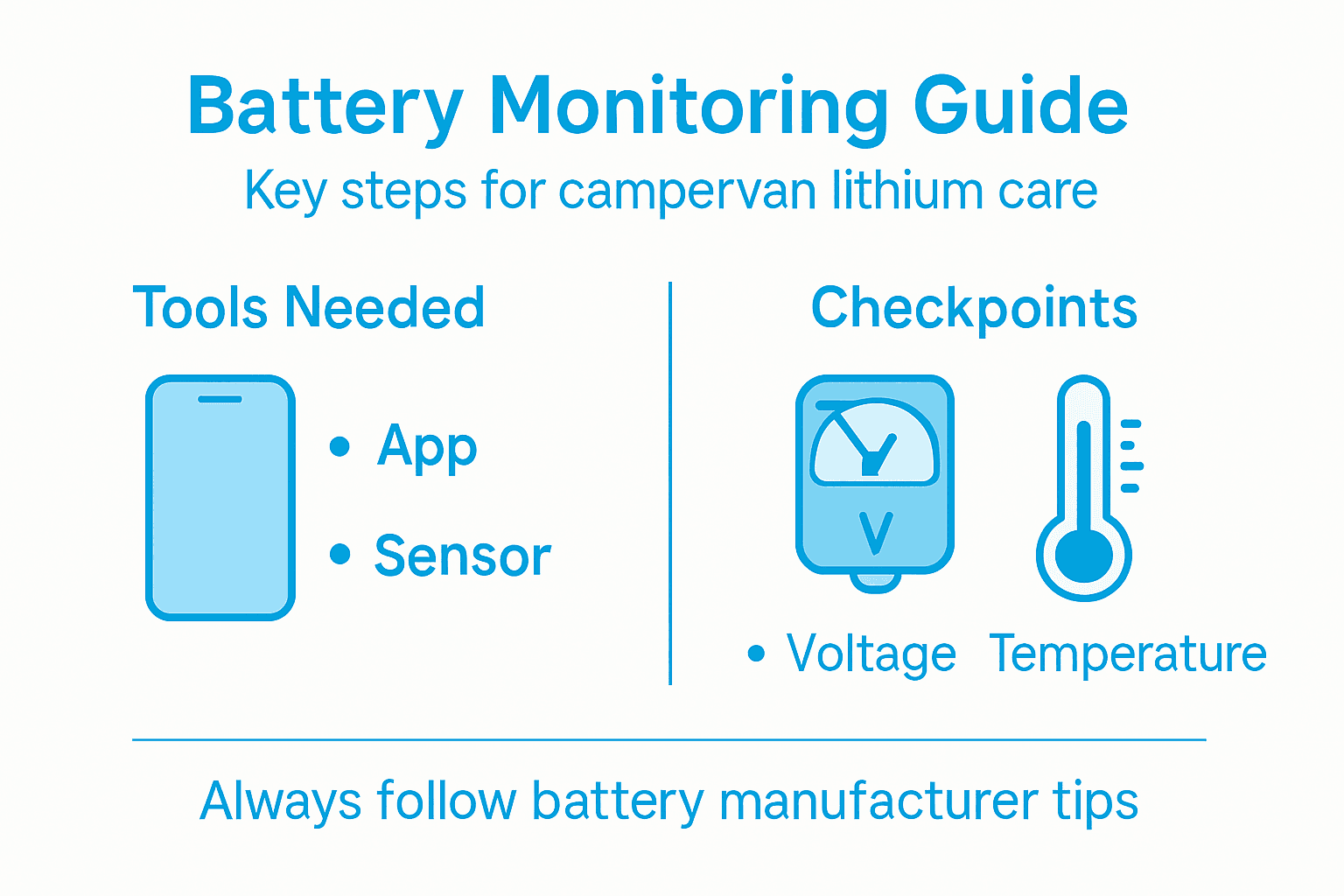
Compare the current readings against the manufacturer’s recommended baseline values. Look for consistent patterns in temperature variations, discharge rates, and charging efficiency. If the app provides historical data tracking, review the performance trends over time to understand how your battery system is ageing and functioning under different usage conditions. Some advanced monitoring systems will even provide predictive maintenance alerts, helping you anticipate potential problems before they become critical.
Practical Advice: Take screenshots of your battery performance data periodically to create a comprehensive maintenance log for future reference and potential warranty claims.
Compare key Bluetooth battery monitoring metrics for better system awareness:
| Metric | What It Shows | Why It Matters |
|---|---|---|
| Voltage | Charge level accuracy | Prevents deep discharge or overcharge |
| Temperature | Thermal condition | Avoids overheating, extends lifespan |
| Charge/Discharge | Power usage trends | Identifies abnormal consumption |
| Health status | Overall battery condition | Anticipates maintenance needs |
Step 5: Optimise system settings for efficiency
Optimising your campervan lithium battery system’s settings is crucial for maximising performance, extending battery life, and ensuring reliable energy management during your travels. Understanding how to fine tune your battery management system can significantly impact your overall energy efficiency.
Battery performance optimisation requires careful configuration of multiple parameters. Access your battery management system settings through the manufacturer’s mobile app or dedicated software. Focus on key settings such as charging cut-off voltage, discharge depth limits, and temperature protection thresholds. Set a maximum charge limit around 80 to 90 percent to reduce battery stress, and avoid consistently discharging below 20 percent to prevent unnecessary wear. Adjust temperature protection settings to match your typical operating environments ensuring the battery operates within its optimal thermal range.
Regularly review and update your system settings based on your specific usage patterns. If you frequently use your campervan in extreme temperature conditions, consider more conservative charge and discharge settings. Some advanced battery management systems allow you to create custom profiles for different usage scenarios such as stationary camping or extended driving. Take advantage of these features to tailor your battery performance precisely to your unique requirements and travel style.
Practical Advice: Create multiple system profiles for different travel scenarios and document the performance differences to refine your battery management strategy over time.
Keep Your Campervan Lithium Battery Reliable and Safe with Skyenergi
Maintaining your campervan lithium battery system involves critical steps such as careful inspection of battery connections, cleaning terminals, and optimising system settings for maximum efficiency. The challenges of avoiding corrosion, ensuring proper ventilation, and monitoring battery health through Bluetooth technology are common concerns for every campervan owner who wants dependable power on the road.
Skyenergi offers expertly engineered lithium battery systems and intelligent battery management solutions that directly address these pain points. Our products feature Bluetooth monitoring capabilities, allowing you to track your battery’s performance in real time and receive predictive maintenance alerts so you never miss early warning signs. Whether you need high-quality lithium leisure batteries, advanced solar charging accessories, or Victron-compatible components, Skyenergi provides reliable options designed for seamless integration and safe off-grid energy independence.
Explore how you can enhance your campervan battery safety and performance today with our proven renewable energy solutions. Visit Skyenergi to discover our range of products and start maintaining your lithium battery with confidence. Take control of your energy system now and enjoy worry-free adventures with a power system you can trust. Learn more about our lithium leisure batteries and accessories that make battery maintenance simpler and more effective.
Frequently Asked Questions
What safety equipment do I need for lithium battery maintenance in my campervan?
To safely maintain your lithium battery, use non-conductive protective gloves, safety glasses, and clothing that covers exposed skin. Gather insulated tools, a proper fire extinguisher rated for electrical fires, and set up a clean, well-ventilated workspace away from flammable materials.
How can I inspect my campervan lithium battery for issues?
Begin by checking all electrical connections for corrosion, looseness, and oxidation, ensuring they are clean and tight. Regularly assess the physical condition of the battery casing and wiring insulation for any signs of damage such as swelling or fraying to prevent serious safety issues.
What steps should I follow to clean battery terminals in my campervan?
Start by wearing protective gloves and safety glasses, then use a baking soda and water solution to scrub away any corrosion on the terminals with a wire brush. Rinse with clean water and dry the terminals thoroughly with a lint-free cloth to prevent moisture accumulation.
How do I monitor my lithium battery’s performance using Bluetooth?
Download the official Bluetooth monitoring app for your battery system and ensure it connects to your smartphone or tablet. Track key metrics like charge level, voltage, and temperature, comparing these readings against manufacturer specifications to identify any performance issues.
What settings should I optimise for my campervan lithium battery system?
Access your battery management system and adjust settings such as charging cut-off voltage and discharge depth limits. Set a maximum charge limit of 80 to 90 per cent to extend battery life and avoid discharging below 20 per cent, adapting settings based on your specific usage patterns for optimal efficiency.
How often should I perform maintenance on my lithium battery in a campervan?
Aim to conduct battery maintenance checks every 30 days, including inspections, cleaning terminals, and performing performance tests. Regular maintenance will help you catch and address any potential issues early, promoting the longevity and reliability of your battery system.
Recommended
Prev post

Benefits of Home Energy Storage – Powering UK Homes
Updated on 21 January 2026
Next post

Home Energy Storage: Powering Off-Grid UK Living
Updated on 19 January 2026


