





How to Install Lithium Leisure Battery
Learn how to install lithium leisure battery safely. Step-by-step guide covering wiring, BMS setup, compatibility checks and common mistakes.
Table of Contents
- What You'll Need Before Starting
- Lithium Battery Installation Tools and Safety Gear
- Lithium Battery Safety Precautions and Disconnection
- Preparing Your Installation Space and Battery Mounting
- How to Wire a Battery-to-Battery Charger for Lithium
- Installing and Configuring Your Lithium Leisure Battery
- Common Installation Mistakes and Troubleshooting
- Conclusion
Last Updated: August 14, 2026
What You'll Need Before Starting
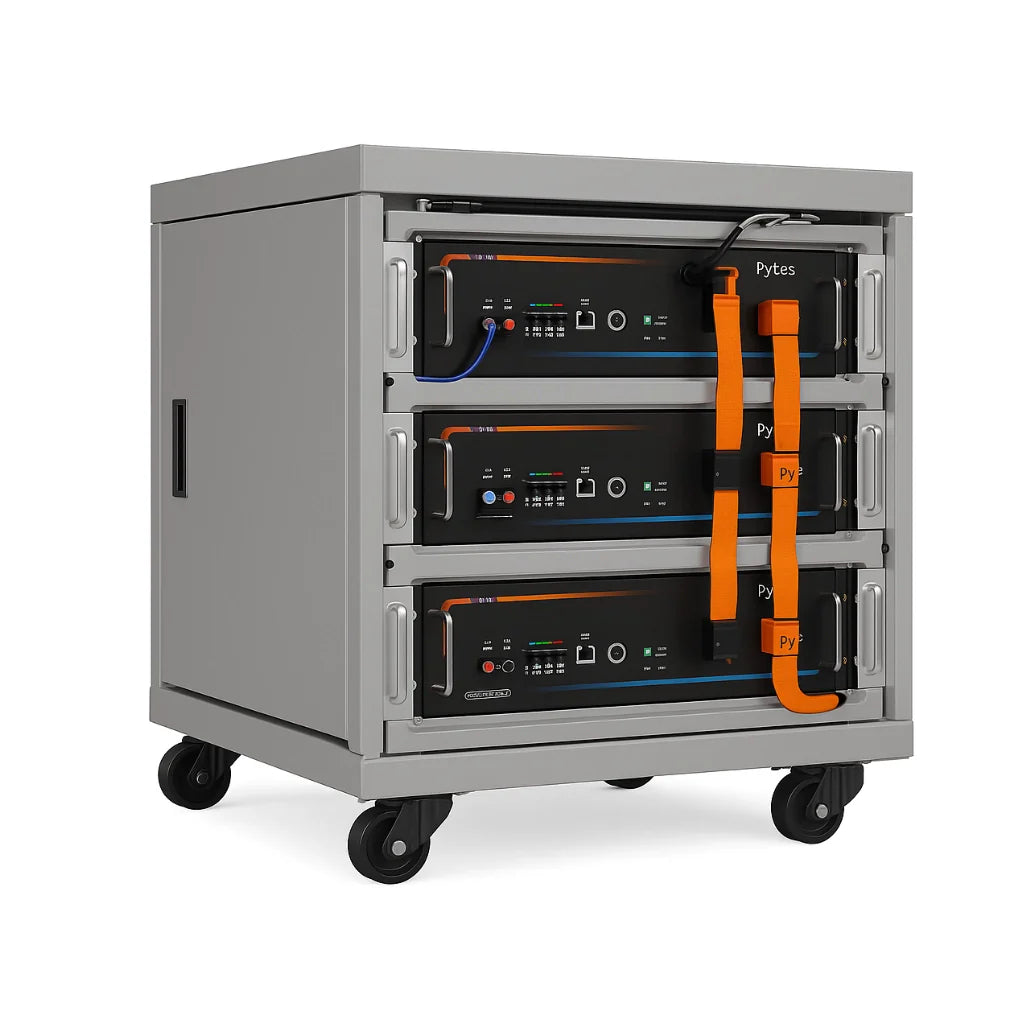
Before installing a lithium leisure battery, gather the right equipment and understand how lithium differs from lead-acid systems. Lithium batteries operate at different voltage thresholds and require compatible charging infrastructure. The battery management system (BMS) built into modern lithium batteries like the Skyenergi Edge and Elite ranges protects against overcharge, over-discharge, and thermal runaway, but only if your charger and regulator are compatible.
Check your current setup:
- What's your existing leisure battery capacity (amp-hours)?
- Do you have a split charge relay, DC-DC charger, or MPPT solar regulator installed?
- What's the condition of your existing wiring and terminals?
- Is your mounting space designed for lead-acid weight, or can it handle lithium's lighter profile?
Lithium batteries are typically 40-50% lighter than lead-acid equivalents at the same capacity, which changes weight distribution in your vehicle.
Lithium Battery Installation Tools and Safety Gear
Installing a lithium leisure battery requires precision tools and proper safety equipment. Incorrect terminal torque or loose connections create voltage drop and can damage your BMS.
Essential tools you'll need:
- Crimper and cable lugs - for secure terminal connections
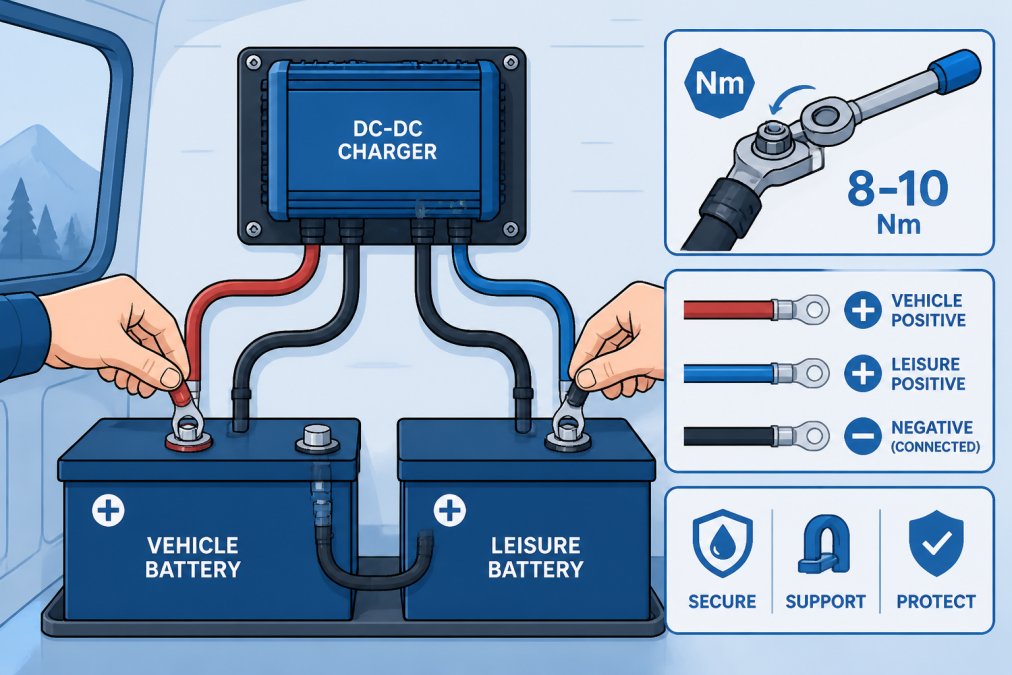
- Torque wrench (10-15 Nm range) - battery terminals must be torqued to 8-10 Nm for M6 studs
- Wire stripper and electrical tape - for safe cable preparation
- Multimeter - to verify voltage and check for continuity
- Socket set and spanners - for mounting bracket installation
- Insulated screwdrivers - to avoid accidental shorts
- Cable ties and conduit - to organise and protect wiring runs
Safety equipment (non-negotiable):
- Heavy-duty insulated gloves
- Safety glasses
- Fire extinguisher rated for electrical fires
- First aid kit
- Spanner to disconnect your alternator or existing battery
Before you touch anything, disconnect your vehicle's existing battery using an appropriate spanner. Remove the negative terminal first, then the positive.
Lithium Battery Safety Precautions and Disconnection
Safety during lithium leisure battery installation centres on three principles: isolation, grounding, and understanding your BMS limits.
Isolation first. Disconnect your vehicle's alternator or existing leisure battery completely. Remove the negative terminal first, then the positive. Wait at least five minutes after disconnection to allow residual charge to dissipate safely. Your multimeter should read zero volts across the old battery terminals before you proceed.
Grounding and thermal protection. Lithium batteries generate heat during charging and discharging. The BMS monitors cell temperature and will shut down the battery if it exceeds safe limits, typically around 60°C. Ensure your mounting location has adequate ventilation and isn't directly above or beside heat sources like diesel heaters or engine compartments. Ground your installation properly by connecting the negative terminal of your lithium battery to the vehicle chassis via a dedicated earth cable of appropriate gauge.
Disconnection procedure for safety work:
- Turn off all loads (fridge, inverter, chargers)
- Disconnect the alternator or existing battery (negative terminal first)
- Wait five minutes for charge dissipation
- Verify zero volts with a multimeter across battery terminals
- Place an insulated cover over both terminals to prevent accidental contact
- Only then begin removal or wiring work
The BMS in modern lithium batteries like Skyenergi's Edge and Elite models includes built-in disconnection relays. If the battery detects a dangerous condition, extreme temperature, cell imbalance, or over-current, it will internally disconnect. This is protection, not a malfunction.
Preparing Your Installation Space and Battery Mounting
Your lithium leisure battery needs a secure, ventilated location that won't shift during vehicle movement or off-road driving. Poor mounting causes vibration, which damages terminal connections and internal cell contacts over time.
Mounting location criteria:
- Ventilation: Leave at least 50mm clearance on all sides, or ensure active ventilation.
- Temperature stability: Avoid locations subject to extreme heat or cold. Engine bays are unsuitable. Underfloor lockers with some insulation are ideal for UK climates.
- Accessibility: You'll need to access the terminals for maintenance and monitoring.
- Weight distribution: Centre-line mounting or low placement improves stability.
Mounting bracket installation:
Use heavy-duty brackets rated for the battery weight plus 50% safety margin. For a Skyenergi Edge 280Ah battery (approximately 30kg), brackets should handle at least 45kg. Secure brackets with M8 bolts through the vehicle frame or floor using threadlock compound on bolt threads to prevent vibration-induced loosening.

Cable routing and organisation:
Run positive and negative cables separately to prevent inductive coupling. Use conduit or cable loom to protect wires from abrasion and heat sources. Keep the positive and negative runs at least 100mm apart where possible.
How to Wire a Battery-to-Battery Charger for Lithium
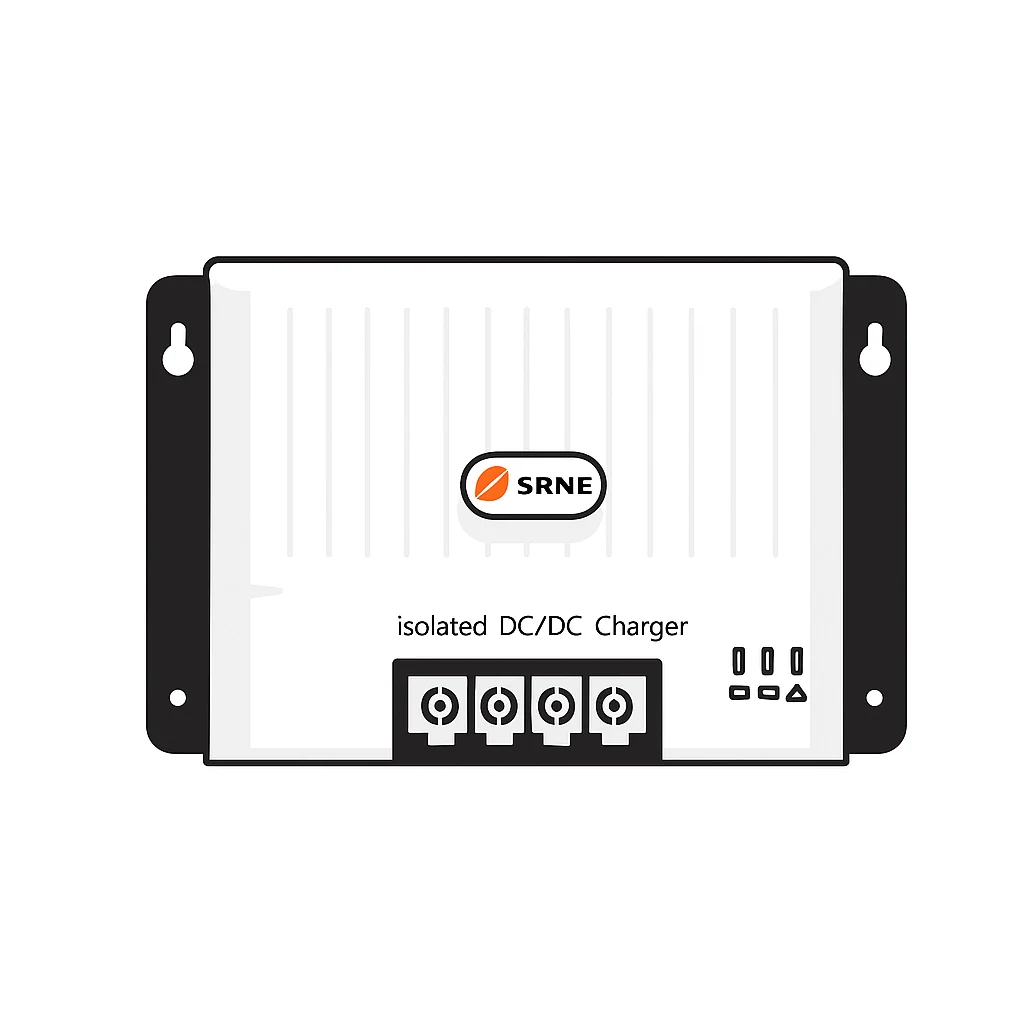
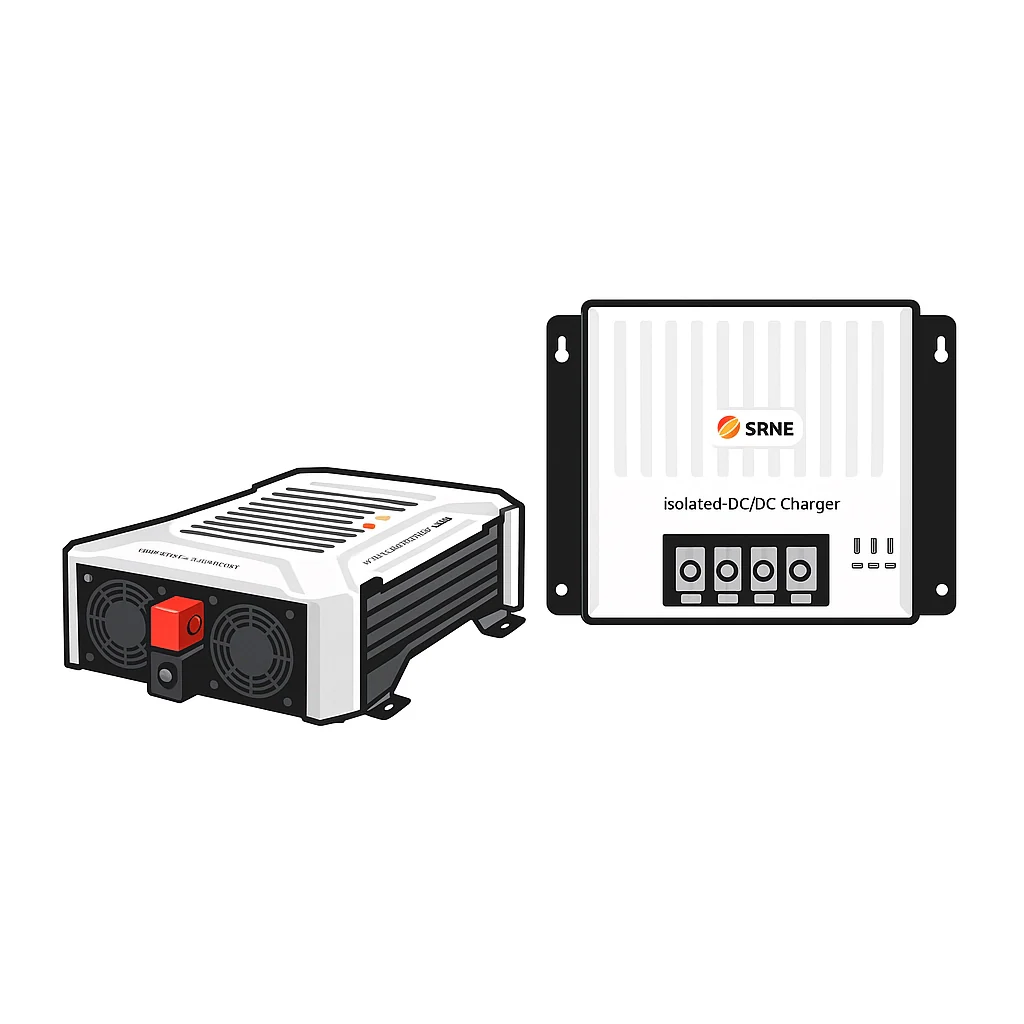
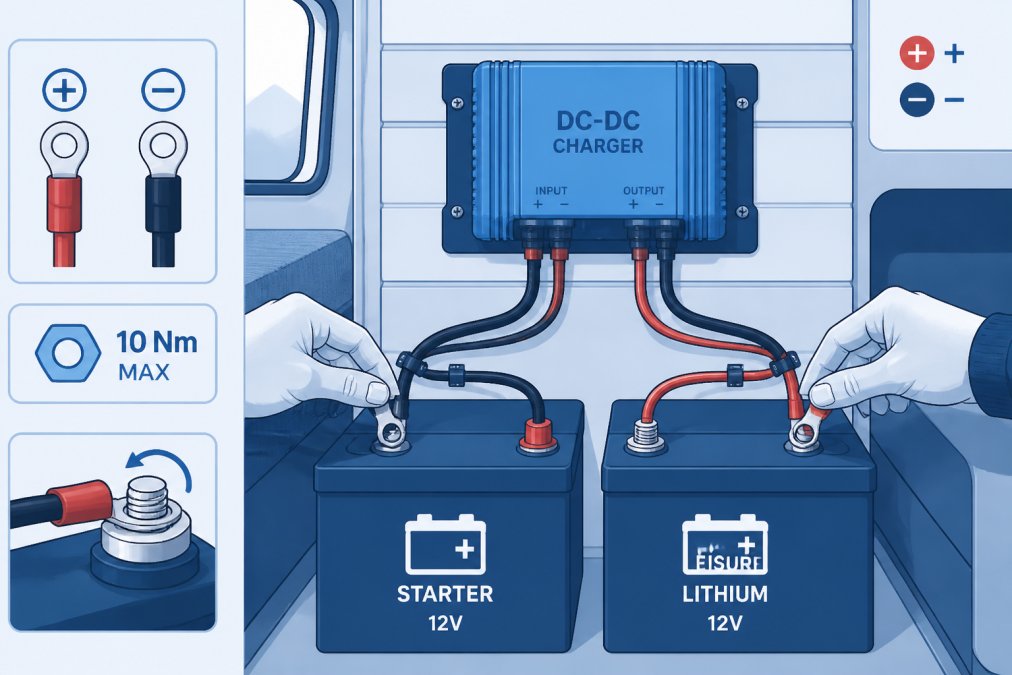
A DC-DC charger (often called a B2B charger) is essential when installing a lithium leisure battery in a vehicle with an alternator. It regulates voltage from your alternator down to the safe charging profile your lithium battery requires, typically 14.2-14.6V for absorption phase and 13.8V for float.
Wiring sequence for DC-DC charger installation:
- Isolate power - Disconnect both the alternator and existing leisure battery (negative terminal first).
- Size your cables - The cable from alternator to charger input should be 6mm² or larger, depending on alternator output (typically 80-120A). The cable from charger output to lithium battery should be 4mm² minimum.
- Connect alternator to charger input - Strip 5mm of insulation from the cable end. Crimp a cable lug rated for the wire gauge. Insert the lug into the charger input terminal and torque to 8-10 Nm.
- Connect charger output to battery positive - Use the same process: strip, crimp, insert, torque.
- Ground the charger - Connect the charger's negative terminal to the vehicle chassis or the negative terminal of your lithium battery using a cable of the same gauge as the positive run.
- Install fuse protection - Place an inline fuse holder as close as possible to the charger input (within 300mm). Use a fuse rated for your alternator output (typically 80-100A for most vehicles).
Charging profile configuration:
Once wired, your DC-DC charger needs to be set to the correct profile for lithium. Set your charger to:
- Bulk voltage: 14.2-14.4V (charger supplies maximum current until battery reaches this voltage)
- Float voltage: 13.8V (charger maintains this voltage indefinitely to top up losses)
- Absorption time: 30-60 minutes
If your charger has no lithium profile option, disable any equalisation or desulfation modes. These modes send high-voltage pulses that can damage your BMS.
Terminal Connection and Wiring Best Practices
Terminal connections are where most lithium leisure battery installations fail. A loose connection creates resistance, which generates heat and eventually damages the terminal or BMS connector.
Correct crimping technique:
Use a proper crimper tool, not pliers. After crimping, tug the cable hard, it should not slide out of the lug. If it does, recrimp with a fresh lug.
Torque specification:
Your lithium battery terminals (typically M6 studs) must be torqued to 8-10 Nm. Use a torque wrench; hand-tight is not adequate.
Cable gauge selection:
For a 4-metre run from alternator to charger to battery, use:
- 80A alternator: 6mm² cable minimum
- 100A alternator: 8mm² cable minimum
- 120A alternator: 10mm² cable minimum
Aim for less than 0.5V drop at maximum charge current.
BMS Functionality and Charging Profile Setup
The battery management system (BMS) in your lithium leisure battery monitors cell voltage, temperature, and current flow, shutting down the battery if any parameter exceeds safe limits.
BMS protection thresholds:
- Over-voltage: Typically 4.3V per cell (15.9V for a 48V battery). If your charger pushes voltage above this, the BMS disconnects internally.
- Over-current (discharge): Usually 100-150A continuous. Exceeding this triggers a temporary disconnect that resets when load drops.
- Over-temperature: Typically 60°C. The BMS will reduce charging current or disconnect entirely if the battery gets too hot.
- Under-voltage: Typically 2.5V per cell (9.2V for a 48V battery). This protects cells from deep discharge damage.
When your BMS disconnects, it's doing its job. Don't force it back online; investigate why the threshold was reached.
Charging profile compatibility:
Your lithium battery's BMS expects a specific charging profile from your DC-DC charger or MPPT solar regulator. Skyenergi Edge and Elite batteries are optimised for constant current bulk phase (maximum 80-100A input), constant voltage absorption phase at 14.2-14.4V, and float voltage at 13.8V.

If your charger doesn't support these settings, the BMS will either charge slowly, refuse to charge, or shut down repeatedly. Upgrading to a lithium-compatible regulator is often necessary.
State of charge (SOC) monitoring:
The BMS calculates SOC by integrating current flow over time. Once per month, if possible, charge your battery to 100% and let it sit for an hour. This recalibrates the BMS and improves SOC accuracy. Don't rely on SOC percentage alone, use voltage as a secondary check: a healthy lithium battery at rest should be 13.2-13.8V.
Compatibility with Solar Charge Controllers
If your campervan or motorhome has solar panels, your MPPT or PWM regulator must support lithium charging profiles. Connecting a lead-acid charger to a lithium battery will damage the BMS within weeks.
MPPT regulator requirements:
Your MPPT controller needs a dedicated lithium profile (sometimes called LiFePO4 mode). This profile sets maximum charge voltage at 14.2-14.4V, float voltage at 13.8V, and disables equalisation or desulfation pulses. If your existing MPPT doesn't have a lithium profile, upgrade to a lithium-compatible model or use a DC-DC charger between the MPPT and battery.
Series and parallel solar connections:
Connect panels in series (positive to negative, daisy-chain) rather than parallel. Series connection increases voltage, which reduces current for the same power output. Lower current means smaller cables and less voltage drop.
Voltage regulation during solar charging:
Set your MPPT to a voltage 0.2V below your battery's absorption voltage. If your battery absorbs at 14.2V, set the MPPT to 14.0V. This gives the battery's BMS priority and prevents conflicts.
Common Installation Mistakes and Troubleshooting
Most lithium leisure battery installation problems aren't caused by the battery itself, but by charger incompatibility, loose connections, or incorrect configuration.
Mistake 1: Using a lead-acid charger with a lithium battery.
A lead-acid charger applies 14.8-15.5V during bulk phase, which exceeds the lithium battery's safe absorption voltage. Your BMS will disconnect repeatedly.
Fix: Upgrade to a lithium-compatible DC-DC charger or MPPT regulator. Skyenergi can advise on compatible charging equipment.
Mistake 2: Undersized cables creating excessive voltage drop.
Your lithium battery charges slowly or won't charge above 50% SOC. If the charger can't maintain its programmed voltage due to cable resistance, it reduces current or stops charging.
Fix: Measure voltage at the battery terminals while charging. If it's more than 0.5V below the charger's set voltage, increase cable gauge.
Mistake 3: Loose terminal connections.
Your battery works fine for two weeks, then won't charge. You've likely got a loose terminal connection that's corroded or oxidised.
Fix: Disconnect the battery and inspect all terminals. Re-crimp any suspicious connections. Clean terminal studs with a wire brush and apply a light coat of dielectric grease before reconnecting. Torque to specification.
Mistake 4: Incorrect BMS configuration or old firmware.
Your battery disconnects randomly during use, or the BMS won't communicate with your charger.
Fix: Check if your battery manufacturer has released a firmware update. Contact Skyenergi support for advice on whether a firmware update is available.
Troubleshooting common errors:
- BMS shows "over-voltage" error: Your charger is set too high. Reduce bulk voltage to 14.2V and float to 13.8V.
- Battery won't charge above 80% SOC: Charger voltage is too low, or cable voltage drop is excessive.
- Fridge cuts out during charging: Your charger is pulling so much current that it's starving other loads. Reduce charger current limit or upgrade your alternator.
- Battery feels warm during charge: Normal if charging current is high (80A+), but if it's warm during light load, check that ventilation isn't blocked.
Installing a lithium leisure battery transforms your campervan or motorhome into a genuinely independent power system. The installation itself is straightforward if you understand three principles: isolation, proper connection, and correct charger configuration. Skyenergi's Edge and Elite lithium batteries are built with strong BMS protection that handles most mistakes gracefully, but getting the fundamentals right from the start prevents weeks of troubleshooting.
The most common barrier isn't technical complexity; it's charger compatibility. Many existing solar regulators and DC-DC chargers don't support lithium profiles. Before you start, verify that your charging equipment can deliver the 14.2-14.4V absorption voltage and 13.8V float voltage that lithium requires. If your current setup doesn't support it, upgrading to a lithium-compatible charger is the single best investment you can make. Skyenergi supplies integrated charging solutions designed specifically for lithium leisure batteries, eliminating guesswork and ensuring your system works reliably from day one.

Frequently Asked Questions
Do I need a new charger when switching to a lithium leisure battery?
Not always, but you may need to adjust settings. Most leisure batteries charge at 14.4V, but lithium batteries require a lower absorption voltage of around 13.6V to prevent damage to the BMS. A DC-DC charger or dedicated lithium charger ensures your alternator charges safely without overvolting. If your existing charger cannot adjust its profile, upgrading to a lithium-compatible unit is essential for long battery life.
How do I ensure my split charge relay is compatible with lithium?
A standard split charge relay works with lithium, but it must trigger based on voltage rise from your alternator, not a time delay. Set the activation voltage to 13.2V or higher to avoid nuisance triggering. The relay itself doesn't need replacement, but you should install a DC-DC charger between your alternator and lithium battery to regulate charging voltage properly and protect the BMS from voltage spikes.
What happens if my lithium battery voltage drops too quickly in cold weather?
Lithium batteries lose usable capacity in cold conditions because the BMS reduces discharge current to protect the cells. A heat pad, available on models like the Skyenergi Core, maintains internal temperature and preserves capacity when temperatures fall below 5°C. Without heating, you may only access 50-70% of rated capacity in winter. This is not a fault, it's a safety feature that prevents cell damage and extends overall cycle life.
Can I install a lithium leisure battery in the same space as my old lead-acid battery?
Usually yes. Lithium batteries are significantly lighter and more compact than lead-acid equivalents. A 100Ah lithium battery weighs around 12 kg versus 30 kg for lead-acid, and occupies less physical space. However, check your mounting locker dimensions and ensure the BMS and wiring connections have adequate clearance. Weight savings also improve your vehicle's payload capacity, allowing room for additional solar panels or other systems.
This article was written using GrandRanker
Prev post

Lithium Battery Storage – Powering Off-Grid Adventures
Updated on 31 December 2025
Next post

Why Use Lithium Leisure Batteries in Campervans
Updated on 30 December 2025


