





Bluetooth Battery Monitoring: Smarter Power On The Road
Bluetooth battery monitoring gives UK campervan owners real-time energy data, enhanced safety, longer battery life, and stress-free off-grid travel.
Keeping track of power levels during a British road trip can mean the difference between a relaxing holiday and unexpected setbacks. For owners and builders of campervans and motorhomes, understanding battery health is vital for uninterrupted adventures across the United Kingdom. A Bluetooth battery monitor empowers you with immediate insights and smart alerts straight to your phone, making modern energy management both simple and highly dependable.
Table of Contents
- Bluetooth Battery Monitoring Explained For Campers
- Key Features And Real-Time Data Benefits
- Types Of Bluetooth Battery Monitors Compared
- Installation, Setup, And Compatibility Explained
- Common Pitfalls And How To Avoid Them
- Comparing Bluetooth Versus Traditional Monitoring
Key Takeaways
| Point | Details |
|---|---|
| Real-Time Insights | Bluetooth battery monitors provide instant, precise data on battery health, voltage, and charging status for better power management. |
| Installation Ease | Most monitors are designed for simple, non-invasive installations, allowing campers to set up without extensive electrical knowledge. |
| Variety of Options | Different monitor types accommodate various battery chemistries and voltages, ensuring compatibility with diverse camper systems. |
| Proactive Maintenance | With continuous monitoring and predictive alerts, these systems help prevent unexpected electrical failures during travels. |
Bluetooth Battery Monitoring Explained For Campers
Bluetooth battery monitoring represents a revolutionary approach for campers seeking real-time insights into their vehicle’s electrical system. Modern leisure vehicles require sophisticated power management, and these intelligent monitoring systems provide crucial data about battery health, voltage levels, and charging status.
The Bluetooth battery monitor transforms how campers track their power resources. Using wireless technology, these compact devices connect directly to your leisure battery and transmit critical information to your smartphone or tablet. Ultimate9 battery monitoring systems offer an excellent example of this technology, enabling continuous tracking without complex installation.
Key features of Bluetooth battery monitoring for campers include:
- Real-time voltage tracking
- Historical data storage
- Mobile app connectivity
- Low voltage alerts
- Easy installation without battery terminal removal
These monitoring systems are particularly valuable for off-grid travellers who depend on reliable battery performance. By providing instant feedback about charge levels and potential issues, campers can make informed decisions about power consumption and prevent unexpected electrical failures during their adventures.
Pro tip: Always check your Bluetooth battery monitor’s compatibility with your specific battery type and voltage system before purchasing.
Key Features And Real-Time Data Benefits
Bluetooth battery monitoring technology offers campers an unprecedented level of insight into their vehicle’s electrical systems. Smart battery monitoring solutions enable users to track critical power metrics with exceptional precision and convenience.
The real-time data benefits provide campers with comprehensive electrical system intelligence. Modern Bluetooth monitors deliver instantaneous information about voltage levels, charging status, and potential battery health concerns. This continuous monitoring allows travellers to make proactive decisions about power management and prevent unexpected electrical interruptions during their adventures.
Key features of advanced Bluetooth battery monitoring include:
- Instant voltage tracking
- Comprehensive battery health assessment
- Automatic trip log recording
- Low battery notifications
- Bluetooth 5.0 connectivity
- Smartphone app integration
Continuous battery monitoring transforms how campers understand and manage their vehicle’s electrical ecosystem, turning potential surprises into predictable, manageable experiences.
Professional-grade monitors go beyond simple voltage readings. They provide nuanced insights into battery performance, cranking capacity, and charging efficiency. By offering detailed historical data and predictive analytics, these devices empower campers to maintain their electrical systems with unprecedented sophistication.
Pro tip: Calibrate your Bluetooth battery monitor regularly to ensure the most accurate readings and long-term reliability.
Types Of Bluetooth Battery Monitors Compared
Bluetooth battery monitors come in various configurations, each designed to meet specific camper requirements. Ultimate9 Bluetooth Battery Monitor demonstrates the diverse range of monitoring technologies available for leisure vehicles and off-grid applications.
The battery monitor types can be categorised based on several critical parameters, including voltage compatibility, battery chemistry support, and advanced feature sets. Different models cater to specific electrical system configurations, ranging from 12V lead-acid systems to more complex lithium-based setups.
Key variations in Bluetooth battery monitor types include:
- 12V Lead-Acid Specific Monitors
- Dual-Voltage (12V/24V) Monitors
- Lithium Battery Specialised Monitors
- Advanced Multi-Chemistry Monitors
- Basic Voltage Tracking Devices
- Professional-Grade Performance Monitors
Not all Bluetooth battery monitors are created equal. Selecting the right monitor depends on your specific vehicle’s electrical architecture and power management needs.
Most modern Bluetooth battery monitors offer sophisticated features beyond basic voltage tracking. They provide comprehensive data including battery health diagnostics, charging efficiency metrics, and predictive maintenance insights. These advanced devices transform raw electrical data into actionable intelligence for campers and off-grid enthusiasts.
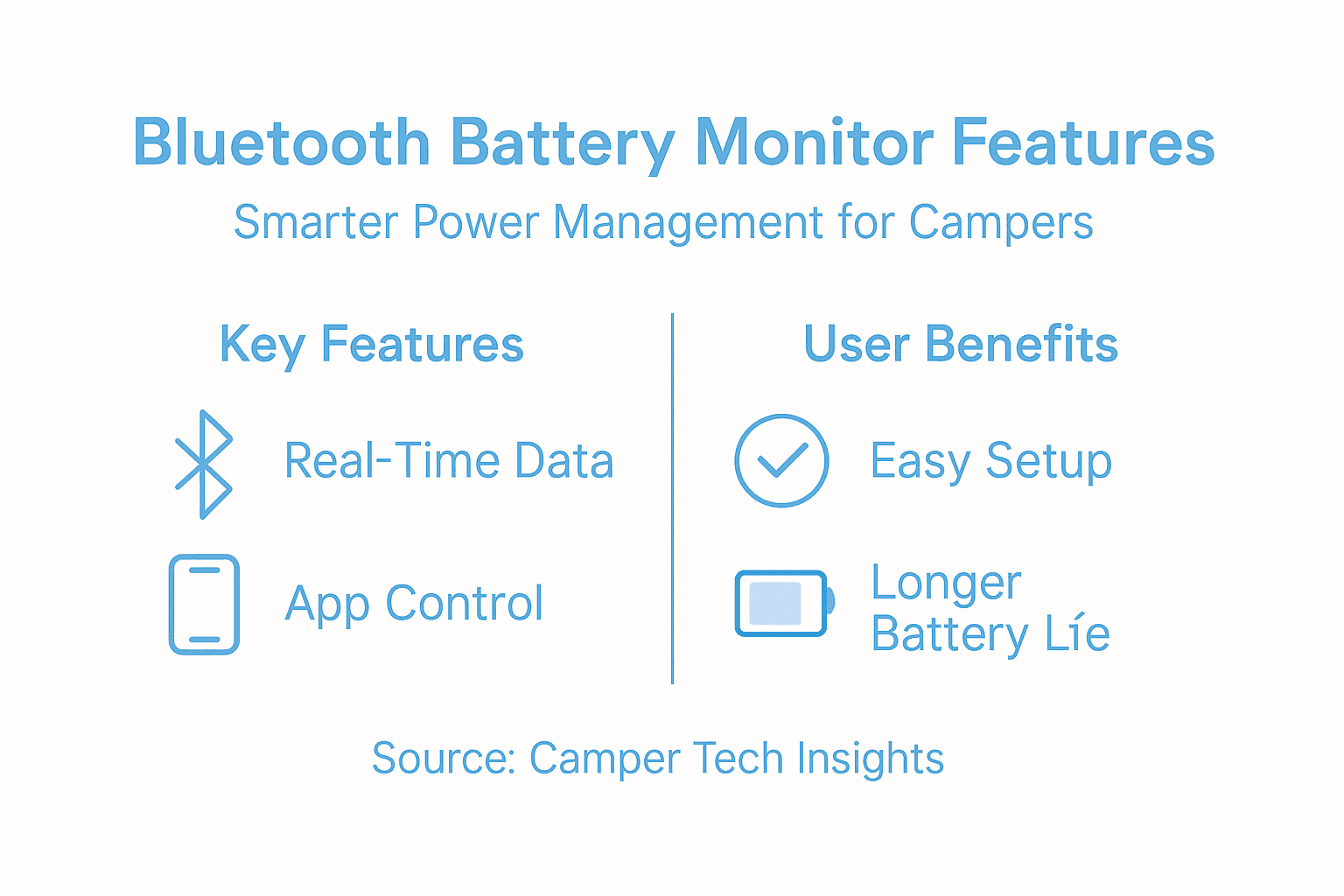
Here is a summary comparing the most common types of Bluetooth battery monitors for campers:
| Monitor Type | Supported Battery Types | Key Distinguishing Feature | Typical User Scenario |
|---|---|---|---|
| 12V Lead-Acid Only | Lead-acid (12V) | Basic compatibility and functions | Classic campervans or small vehicles |
| Dual-Voltage (12V/24V) | Lead-acid (12V, 24V) | Handles multiple voltage systems | Larger motorhomes or trucks |
| Lithium Specialised | Lithium-ion, LiFePO4 | Advanced lithium battery analytics | Modern, high-capacity setups |
| Multi-Chemistry Advanced | Lead-acid, AGM, Gel, Lithium | Universal support, detailed data | Mixed-chemistry fleets |
| Basic Voltage Monitoring Devices | Most common batteries | Simple voltage readouts only | Occasional monitoring needs |
| Professional-Grade Performance | All major chemistries | Full diagnostics and analytics | Off-grid explorers, frequent travellers |
Pro tip: Always verify a Bluetooth battery monitor’s compatibility with your specific battery type and voltage system before making a purchase.
Installation, Setup, And Compatibility Explained
Installing a Bluetooth battery monitor requires careful consideration of your vehicle’s specific electrical system. Ultimate9 battery monitor installation demonstrates how modern monitoring devices can be integrated without complex technical expertise.
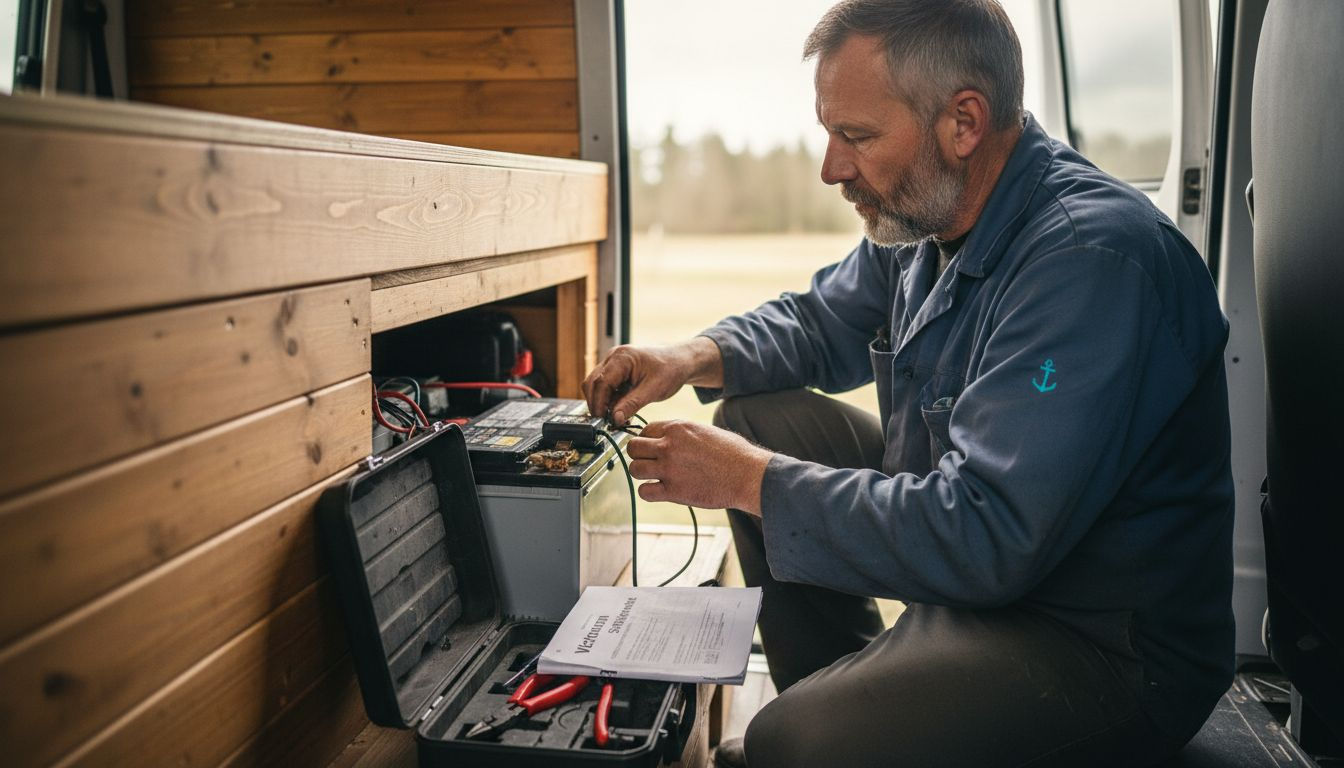
The installation process typically involves straightforward connections that do not require extensive electrical knowledge. Most Bluetooth battery monitors are designed for simple, non-invasive attachment, allowing campers to quickly set up monitoring systems without risking damage to existing electrical configurations.
Key compatibility and installation considerations include:
- Battery voltage system requirements
- Terminal connection methods
- Bluetooth signal range
- Smartphone app compatibility
- Power source requirements
- Environmental durability ratings
Professional installation is recommended for complex electrical systems or when unsure about proper connection techniques.
Modern Bluetooth battery monitors offer remarkable flexibility across different vehicle types. They can typically integrate with various battery chemistries, including lead-acid, AGM, gel, and lithium-ion systems. This adaptability ensures that campers can find a monitoring solution tailored to their specific power setup.
Pro tip: Always consult your vehicle’s electrical system documentation and the monitor’s specification sheet to ensure complete compatibility before installation.
Common Pitfalls And How To Avoid Them
Bluetooth battery monitoring can be transformative for campers, but several common mistakes can compromise system effectiveness and reliability. Understanding these potential pitfalls is crucial for maintaining accurate battery performance tracking and preventing unexpected electrical issues.
The most frequent errors in Bluetooth battery monitoring often stem from incorrect installation, misunderstanding device capabilities, or neglecting fundamental maintenance practices. Campers must approach battery monitoring with a systematic and informed strategy to maximise their monitoring system’s potential.
Common pitfalls in Bluetooth battery monitoring include:
- Incorrect terminal connection techniques
- Incompatible battery chemistry selections
- Ignoring calibration requirements
- Neglecting firmware updates
- Misinterpreting monitoring data
- Failing to understand device limitations
Technology is only as effective as the user’s understanding. Careful attention to detail separates successful battery monitoring from potential system failures.
Electrical system complexity demands a nuanced approach to battery monitoring. Campers should invest time in understanding their specific vehicle’s electrical architecture, battery type, and the precise capabilities of their chosen Bluetooth monitoring device. This knowledge helps prevent misconfigurations that could lead to inaccurate readings or potential damage to sensitive electrical components.
Pro tip: Read the entire device manual before installation and maintain a log of your battery’s performance metrics to track long-term health trends.
Comparing Bluetooth Versus Traditional Monitoring
The evolution of battery monitoring technology has dramatically transformed how campers track and manage their vehicle’s electrical systems. Traditional monitoring methods, which relied on manual measurements and basic voltage indicators, have been comprehensively revolutionised by modern Bluetooth battery monitoring technologies.
Traditional monitoring approaches typically involved periodic manual checks and analogue voltage meters, requiring direct physical interaction and subjective interpretation. In contrast, Bluetooth monitoring systems provide real-time, continuous digital tracking that eliminates human error and delivers precise, instantaneous insights into battery performance.
Key differences between Bluetooth and traditional monitoring include:
- Real-time data transmission
- Smartphone app integration
- Automated historical data logging
- Remote monitoring capabilities
- Predictive maintenance alerts
- More comprehensive battery health diagnostics
Bluetooth technology transforms battery monitoring from a reactive to a proactive management strategy, giving campers unprecedented control over their electrical systems.
The technological leap from traditional to Bluetooth monitoring represents more than just a convenience upgrade. These advanced systems provide nuanced, data-driven insights that enable campers to understand their battery’s performance, predict potential failures, and make informed decisions about power management and maintenance.
The following table contrasts Bluetooth battery monitoring with traditional methods for camper use:
| Criteria | Bluetooth Monitoring | Traditional Monitoring |
|---|---|---|
| Data Access | Real-time, via mobile app | Manual, requires on-site check |
| Historical Data Storage | Automatic, extensive logs | Not available or minimal |
| Installation Complexity | Simple, usually tool-free | May require wiring skills |
| Predictive Maintenance | Automated alerts and analytics | Rarely available |
Pro tip: Consider complementing your Bluetooth monitor with traditional periodic manual checks to ensure comprehensive battery health assessment.
Take Control Of Your Power With Skyenergi’s Smart Battery Solutions
Camping adventures demand reliable, real-time insight into your battery’s health and performance. The article highlights common challenges with manual monitoring, installation pitfalls, and the overwhelming array of Bluetooth battery monitors available. If you want to avoid compatibility issues or confusing data, choosing a well-engineered lithium battery system with integrated Bluetooth monitoring is essential.
Skyenergi specialises in premium lithium leisure batteries and complete off-grid power setups designed specifically for campervans and motorhomes. Our intelligent battery management systems ensure you get accurate voltage tracking, low voltage alerts, and historical performance data without complicated installs. Visit Skyenergi to discover how our products deliver seamless Bluetooth monitoring for greater peace of mind on the road.

Experience smarter power management today with our high-performance lithium solutions and Victron-compatible accessories. Start your journey to reliable, stress-free battery monitoring now by exploring our full range and see why so many campers trust Skyenergi for energy independence and worry-free adventures.
Frequently Asked Questions
What are the main advantages of Bluetooth battery monitoring for campers?
Bluetooth battery monitoring offers real-time insights into your vehicle’s electrical system, including voltage levels and battery health. This technology simplifies power management, improves reliability for off-grid travellers, and helps prevent unexpected electrical failures.
How easy is it to install a Bluetooth battery monitor?
Most Bluetooth battery monitors are designed for straightforward installation without extensive electrical knowledge. They typically require simple connections that don’t damage existing electrical configurations, allowing users to set up monitoring quickly and easily.
What types of batteries are compatible with Bluetooth battery monitors?
Bluetooth battery monitors are compatible with various battery chemistries, including lead-acid, AGM, gel, and lithium-ion batteries. Make sure to check the monitor’s specifications to ensure compatibility with your specific battery type before installation.
How can I avoid common pitfalls when using a Bluetooth battery monitor?
To avoid pitfalls, ensure correct terminal connection techniques, choose a monitor compatible with your battery type, regularly calibrate the device, keep firmware updated, and be aware of the monitor’s limitations. Reading the manual thoroughly can also prevent misconfigurations.
Recommended
- Bluetooth Battery Monitoring – Empowering Off-Grid Travel – Skyenergi
- Bluetooth Battery Monitoring – Real-Time Power Insights – Skyenergi
- Lithium Battery Maintenance Workflow for Off-Grid Systems – Skyenergi
- Victron Energy BMV-712 Smart Battery Monitor - BAM030712000R – Skyenergi
- 7 Praktische energie management systemen voorbeelden voor thuis
Prev post

Troubleshooting Battery Systems for Off-Grid Performance
Updated on 30 January 2026
Next post

Top 8 Solar Battery Systems for Small Installers 2026
Updated on 28 January 2026


