





Best Solar Controller for Lithium: 2026 Guide
Find the best solar controller for lithium batteries. Compare MPPT vs PWM, LiFePO4 settings, and top models. Learn what your system needs.
Table of Contents
- Why Your Lithium Battery Needs the Right Solar Controller
- MPPT vs PWM for Lithium Batteries: Which Technology Matters
- Understanding Lithium Charging Stages and Voltage Profiles
- LiFePO4 Solar Charge Controller Settings: What You Need to Configure
- SRNE Solar Controller Lithium Profile: Intelligent Charging for Leisure Batteries
- Victron SmartSolar and BlueSolar: Premium MPPT Controllers for Lithium
- How to Choose the Right Solar Controller for Your Lithium System
- Common Mistakes When Setting Up Lithium Charge Controllers
Last Updated: August 15, 2026
Why Your Lithium Battery Needs the Right Solar Controller
Choosing the wrong solar controller for a lithium battery system is one of the most common mistakes campervan and motorhome owners make. A standard PWM (Pulse Width Modulation) controller designed for lead-acid batteries won't deliver the charging precision that lithium chemistry demands, resulting in incomplete charges, reduced battery lifespan, or systems that refuse to charge when temperatures drop.
At Skyenergi, we've worked with campervan converters and off-grid installers across the UK and seen this problem repeatedly. Lithium batteries (particularly LiFePO4) require specific voltage profiles and charging stages that PWM controllers cannot deliver.
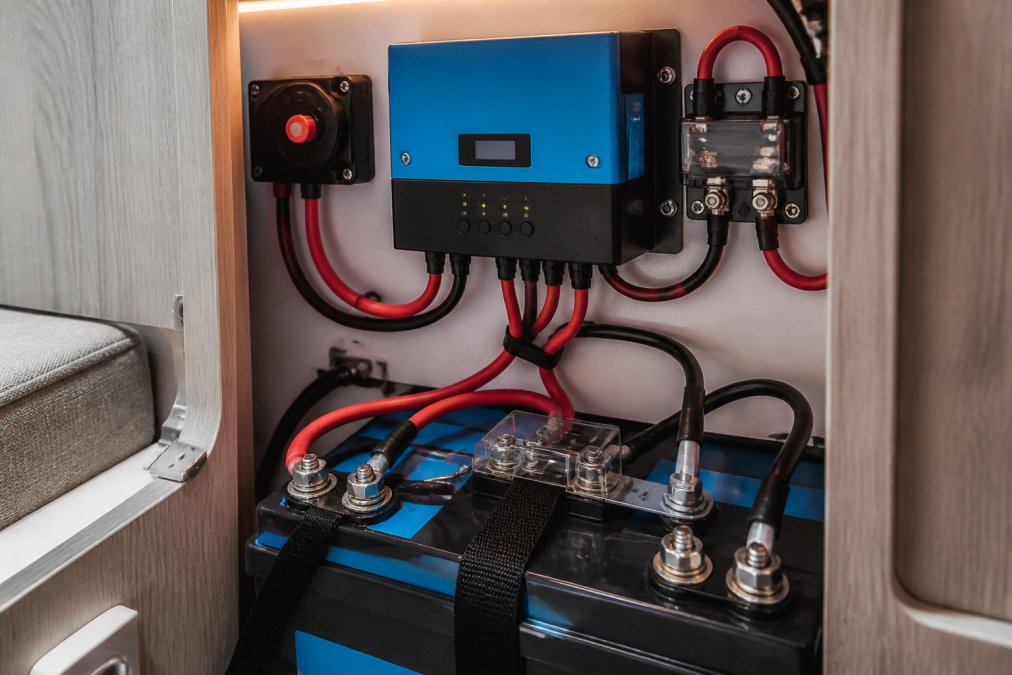
Your lithium battery needs a controller that handles three critical charging stages: bulk charging (maximum current flow), absorption charging (steady voltage with tapering current), and float charging (maintenance voltage). The controller must communicate with your battery's BMS (Battery Management System) to prevent overcharging. The right solar controller extends battery life, prevents voltage sag, and provides real-time visibility into system performance.
MPPT vs PWM for Lithium Batteries: Which Technology Matters
MPPT (Maximum Power Point Tracking) and PWM represent fundamentally different approaches to harvesting solar energy. PWM controllers switch solar panel voltage down to match battery voltage, losing 20-30% of available solar power as heat. MPPT controllers operate solar panels at their optimal voltage point and convert that power down to battery voltage using a DC-DC converter, recovering that wasted energy and delivering 20-30% more power to your battery.

For lithium systems, the real distinction is precision. MPPT controllers can be programmed with lithium-specific charging profiles, understanding absorption and float voltages, temperature compensation, and BMS integration. PWM controllers lack this sophistication. A quality MPPT controller like the SRNE Shiner 2430 (£99.00) can offer improved charging efficiency and extended battery life.
Understanding Lithium Charging Stages and Voltage Profiles
Lithium batteries, specifically LiFePO4 chemistry, charge through three distinct stages. A solar controller designed for lithium must handle each stage correctly, or you'll either undercharge or risk battery damage.
Bulk, Absorption, and Float Charging
Bulk charging is the initial phase where the controller delivers maximum current. For a typical 12V lithium system, bulk charging continues until the battery reaches approximately 13.8V. Once the battery hits bulk voltage, the controller switches to absorption charging, holding voltage steady while current tapers gradually. Float charging maintains the battery at a steady maintenance voltage (typically 13.6V for 12V lithium) with minimal current flow.
A PWM controller cannot execute this sequence with the precision lithium requires. MPPT controllers from SRNE allow you to program absorption voltage, absorption time, float voltage, and temperature compensation, the exact parameters lithium chemistry demands.
Temperature Compensation and BMS Integration
Temperature dramatically affects lithium charging behaviour. Cold weather reduces charging efficiency and can trigger BMS protection shutdowns if the controller doesn't compensate. Warm weather increases charging speed but risks overcharging if the controller doesn't dial back voltage.
A proper lithium-compatible controller includes an internal temperature sensor that adjusts absorption and float voltages based on ambient conditions. The SRNE MA2440N15 and SRNE MD1250 automatically reduce float voltage by approximately 3mV per degree Celsius when temperatures rise, protecting the battery from thermal stress.
BMS integration is equally critical. Your lithium battery's BMS monitors individual cell voltages and disconnects the battery if any cell reaches dangerous levels. Some controllers, including SRNE dual-input models, support CAN or RS485 communication protocols that allow the controller to read BMS status in real time.
LiFePO4 Solar Charge Controller Settings: What You Need to Configure
Once you've selected an MPPT controller compatible with lithium, configuration determines the difference between a properly tuned system and an underperforming one.

Absorption Voltage: Set this to your battery manufacturer's specification, typically 13.8V for 12V LiFePO4 systems. Too low and the battery won't fully charge; too high and you risk cell damage.
Absorption Time: For lithium, 30-60 minutes is typical. Longer times don't improve charge; they waste solar energy once the battery is full.
Float Voltage: Set this to approximately 13.6V for 12V systems (check your battery datasheet). This is the maintenance voltage the controller uses once the battery is fully charged.
Temperature Compensation: Enable this if your controller supports it. A typical setting is -3mV per degree Celsius.
Low Voltage Disconnect (LVD): Set LVD to trigger at approximately 11.5V for a 12V system. This prevents over-discharging and protects appliances from voltage sag.
The SRNE controllers sold through Skyenergi come with preset lithium profiles that handle most of these settings automatically. The SRNE Shiner 2430 (£99.00) includes eight pre-programmed algorithms selectable via a rotary switch, with lithium profiles built in. For more advanced customisation, the SRNE SAA 1250 (£369.00) and SRNE MD1250 (£221.00) allow full programmability via the mobile app.

SRNE Solar Controller Lithium Profile: Intelligent Charging for Leisure Batteries
SRNE has engineered its controllers specifically for the leisure battery market, campervans, motorhomes, boats, and off-grid cabins. This focus shows in how their controllers handle lithium charging profiles.
The SRNE product range sold through Skyenergi includes models that cover the full spectrum of campervan and motorhome installations, each designed with lithium compatibility as a core feature.
SRNE Shiner 2430: Compact MPPT with Bluetooth Monitoring
The SRNE Shiner 2430 (£99.00) is an entry point into MPPT charging for lithium systems. It delivers 30A charging current and supports solar panels up to 400W on 12V systems or 800W on 24V, enough for most campervan roof installations.
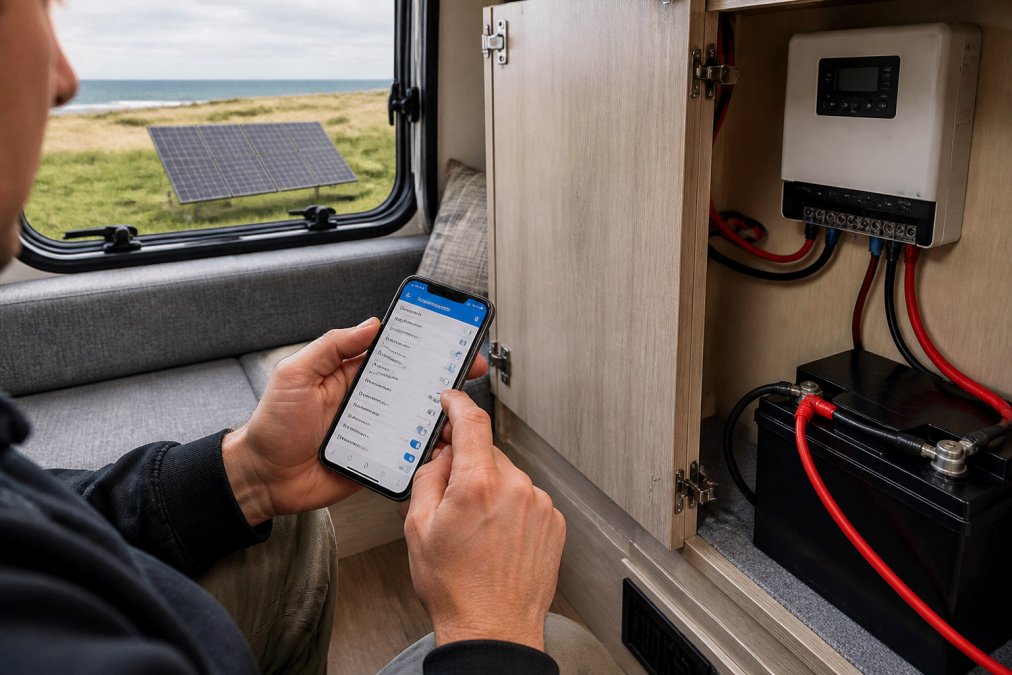
What makes the Shiner 2430 stand out is the built-in Bluetooth connectivity. You can monitor your system in real time through the SRNE mobile app, checking battery voltage, charging current, and power harvested. The controller includes eight pre-programmed charging algorithms, with lithium profiles selectable via a simple rotary switch. Thermal management is passive, no fan means no noise and no moving parts to fail.
SRNE MA2440N15: High-Capacity MPPT for Larger Arrays
The SRNE MA2440N15 (£177.00) steps up to 40A charging capacity and supports solar arrays up to 520W on 12V or 1,040W on 24V. It can deliver rapid charging with headroom for winter performance.
The higher amperage rating means faster charging in good sunlight. The higher maximum PV input voltage of 150V allows you to configure solar panels in series, improving efficiency compared to parallel connections. Like the Shiner 2430, the MA2440N15 includes Bluetooth connectivity and pre-programmed lithium profiles. The controller also supports RS485 and optional CAN communication, enabling integration with more sophisticated energy management systems.
SRNE SAA 1250: Three-in-One Charging from Multiple Sources
The SRNE SAA 1250 (£369.00) combines solar MPPT charging, DC-DC alternator charging, and mains AC charging, functionality that would typically require three separate devices. For campervan owners, this integration is transformative. The SAA 1250 charges your leisure battery from solar panels during the day, automatically switches to alternator charging when you're driving, and tops up from mains power when parked at a site with hookup.
The DC-DC alternator charging supports up to 65A from the vehicle alternator with up to 98% efficiency. For long-distance touring, this feature can significantly extend your off-grid range. The SAA 1250 supports up to 700W solar panels on 12V systems and includes 50A AC charging capability from mains power. The lithium charging profile is fully customisable via the Bluetooth app, with temperature compensation and BMS communication built in.
SRNE MD1250 and MD12100: Dual-Input Controllers for Vehicle Systems
The SRNE MD1250 (£221.00) and SRNE MD12100 (£449.00) are purpose-built for dual-battery vehicle systems where you need simultaneous solar and alternator charging. The MD1250 handles 50A solar charging and up to 50A alternator charging on a 12V system. The MD12100 steps up to 95A solar input and 100A alternator charging, suitable for larger installations. Both include MPPT tracking efficiency greater than 99% and conversion efficiency up to 96%.
The controller automatically engages alternator charging when the starter battery voltage rises above 13.7V (indicating the engine is running) and disengages at 13.2V to protect the vehicle's electrical system. Both models support lithium batteries with full BMS communication via CAN or RS485.
How to Choose the Right Solar Controller for Your Lithium System
Selecting the correct solar controller requires matching three variables: your solar array size, your battery voltage and capacity, and your charging speed requirements.
Matching Amperage and Voltage to Your Setup
Start by calculating your maximum solar input. If you're installing 400W of solar panels on a 12V system, divide 400W by 12V to get approximately 33A of input current under peak sunlight. Your controller must handle this amperage comfortably.
Most campervan installations fall into one of three categories:
Small systems (up to 400W solar): The SRNE Shiner 2430 (£99.00) at 30A handles these adequately. These systems are typical for campervans with limited roof space or owners who prioritise weight and cost over charging speed.
Medium systems (400-800W solar): The SRNE MA2440N15 (£177.00) at 40A is a common choice. These deliver rapid charging without excessive complexity.
Large systems (800W+ solar): The SRNE MD1250 (£221.00) or SRNE MD12100 (£449.00). These are specified by professional installers building expedition vehicles or off-grid homes with substantial power demands.
Voltage selection is simpler: choose 12V for most campervans and motorhomes, 24V for larger installations, and 48V only for substantial off-grid homes.
Cold Weather Charging Limits and Firmware Updates
UK winters present a specific challenge for lithium charging. LiFePO4 batteries have a cold-weather charging cutoff, typically around 0°C. Below this temperature, the battery's BMS will refuse to accept charge. This is a safety feature, not a limitation of your controller. A quality SRNE controller will simply wait for the battery temperature to rise. During winter camping, you might not be able to charge from solar during the coldest periods. This is why experienced off-grid users combine solar with backup charging, either an alternator connection (via the SAA 1250 or MD series) or a mains charger for campsite hookups.
Firmware updates are critical. SRNE regularly releases firmware updates that improve lithium compatibility and enhance efficiency. The Bluetooth-enabled controllers make firmware updates straightforward via the mobile app.
Retrofitting vs New Builds: Controller Compatibility
If you're retrofitting a lithium battery into an existing campervan electrical system, compatibility becomes crucial. Your new controller must work with existing wiring, fuse sizes, and battery terminals. Most SRNE controllers use standard Anderson SB50 connectors for solar input and M6 or M8 terminals for battery connection, industry standards that fit most existing systems.
Skyenergi can advise on compatibility when you specify your existing system. The key information needed: your current controller model (if any), solar panel connector type, battery terminal size, and fuse/breaker configuration.
Common Mistakes When Setting Up Lithium Charge Controllers
After years of supporting campervan conversions, Skyenergi has seen predictable patterns in controller setup errors. Avoiding these mistakes will save you frustration and potential battery damage.
Mistake 1: Not adjusting absorption voltage for lithium. Many installers leave the controller on its default lead-acid settings (typically 14.4V for a 12V system). Lithium batteries should absorb at approximately 13.8V. Charging at 14.4V will trigger the BMS disconnect and leave your battery perpetually undercharged.
Mistake 2: Setting absorption time too long. Absorption doesn't improve charge quality once the battery is full. Setting absorption to 4 hours when 45 minutes is sufficient just wastes solar energy.
Mistake 3: Ignoring temperature compensation. In summer, if your controller doesn't reduce float voltage as temperature rises, you're applying unnecessary stress to the battery. Temperature compensation extends battery life significantly.
Mistake 4: Failing to configure BMS communication. If your lithium battery includes a BMS with CAN or RS485 communication, and your controller supports it, enable it. This two-way communication prevents conflicts between the controller and battery protection systems.
Mistake 5: Undersizing the controller for future expansion. Many DIY installers choose a 30A controller for a 400W solar array, assuming they won't expand. Choosing a 40A controller initially provides upgrade flexibility.
Mistake 6: Not updating firmware. SRNE releases firmware updates that improve lithium compatibility. Check for updates annually and install them via the mobile app.
Selecting the best solar controller for lithium requires matching technology to your specific system size, climate, and usage patterns. For most UK campervan owners, an MPPT controller with lithium-specific charging profiles will deliver years of reliable service and faster charging than PWM alternatives.
The SRNE range, available through Skyenergi, offers exceptional value. The SRNE Shiner 2430 (£99.00) provides entry-level MPPT performance with Bluetooth monitoring. For larger systems, the SRNE MA2440N15 (£177.00) is a commonly specified controller. If you need alternator charging integration, the SRNE SAA 1250 (£369.00) eliminates the need for separate DC-DC chargers and mains chargers, a genuine all-in-one solution.
Whichever SRNE controller you choose, invest time in proper configuration. Correct absorption voltage, temperature compensation, and BMS communication settings will repay themselves through faster charging, extended battery life, and fewer frustrating system failures during your travels.
| Controller | Amperage | Max Solar (12V) | Best For |
|---|---|---|---|
| SRNE Shiner 2430 | 30A | 400W | Small systems, budget-conscious |
| SRNE MA2440N15 | 40A | 520W | Medium systems, most campervans |
| SRNE SAA 1250 | 50A solar / 50A alternator | 700W | Multi-source charging, integrated solution |
| SRNE MD1250 | 50A solar / 50A alternator | 700W | Dual-battery vehicles |
Get started with Skyenergi and find the right solar controller for your lithium system. Our team can advise on sizing, compatibility with your existing setup, and configuration for optimal performance. With fast UK delivery and expert support, we'll help you build a reliable power system that keeps your campervan or off-grid installation running independently.
Frequently Asked Questions
Do lithium batteries require a specific solar charge controller?
Yes. Lithium batteries, particularly LiFePO4, require controllers that support their specific charging profile. Unlike lead-acid batteries, lithium needs precise voltage regulation across bulk, absorption, and float stages. Standard PWM controllers lack the intelligence to manage lithium safely. MPPT controllers with programmable lithium profiles, such as SRNE models or Victron SmartSolar, deliver the correct charging curve and protect against over-voltage damage. Many controllers now include dedicated lithium presets that automatically configure absorption voltage, float voltage, and current limits for your battery chemistry.
What is the difference between MPPT and PWM for lithium charging?
MPPT (Maximum Power Point Tracking) continuously monitors your solar array and adjusts voltage to extract maximum power, typically delivering 20-40% more energy than PWM in variable light. PWM (Pulse Width Modulation) simply switches the panel voltage to match battery voltage, wasting energy as heat. For lithium systems, MPPT is strongly recommended because it maximises charging efficiency and works better with the high voltage ranges lithium batteries tolerate. SRNE MPPT controllers achieve over 99% tracking efficiency and support user-defined lithium settings. Victron SmartSolar MPPT models add remote monitoring via Bluetooth, making system diagnostics easier during off-grid use.
What are the key LiFePO4 solar charge controller settings I need to configure?
Critical settings include absorption voltage (typically 3.5-3.6 V per cell, or 14.0-14.4 V for a 12 V system), float voltage (3.2-3.3 V per cell, or 12.8-13.2 V for 12 V), bulk charge current (limited by your BMS and controller amperage rating), and temperature compensation. Most modern controllers like the SRNE Shiner 2430 or SRNE MA2440N15 include a lithium preset that sets these automatically. You should also configure over-voltage protection, typically 15.5 V for 12 V systems, and enable temperature sensing if your controller has it. Cold weather charging should be limited or disabled below 0°C to protect cell integrity. Firmware updates often improve lithium profile accuracy, so check for updates regularly.
Why are SRNE controllers recommended for lithium battery setups?
SRNE controllers combine intelligent MPPT technology, dedicated lithium charging profiles, and multi-source charging capability at a competitive price point. Models like the SRNE SAA 1250 integrate solar MPPT, DC-DC alternator charging, and mains AC charging in one unit, eliminating the need for three separate devices. The SRNE Shiner 2430 offers 99% MPPT tracking efficiency and Bluetooth monitoring via the SRNE app for real-time system diagnostics. Larger systems benefit from the SRNE MD1250 or MD12100, which handle dual-input charging from both solar and alternator. All SRNE lithium-compatible models support customisable charging parameters, temperature compensation, and comprehensive protection against over-voltage, reverse polarity, and short circuits.
Can I retrofit a lithium-compatible solar controller into my existing campervan system?
In most cases, yes, provided your existing solar array, battery bank, and wiring can support the new controller's specifications. Check that your solar panel voltage and current ratings match the controller's input limits. If you're upgrading from a PWM to MPPT controller, verify your battery voltage (12 V, 24 V, or 48 V) and total amperage capacity. Many retrofits require rewiring or fusing updates to handle higher MPPT currents safely. Cold weather performance matters: if you frequently park in sub-zero conditions, ensure your controller supports low-temperature charging cutoffs or has firmware that can be updated. SRNE controllers and Victron models both support firmware updates, so future improvements can be applied without hardware replacement.
This article was written using GrandRanker
Prev post

Lithium Battery Voltage Drop Explained
Updated on 16 August 2026
Next post

Lithium vs Lead Acid Battery Campervan: A 2026 Guide
Updated on 13 August 2026


