





5 Best 12V Power Distribution Solutions for DIY Van Conversions
Compare 5 12V power distribution solutions for campervan conversions.
Table of Contents
- What Makes a Good 12V Power Distribution Solution
- 1. SRNE DB12 Distribution Box: Smart Monitoring and Control
- 2. Skyenergi ST Blade Fuse Block: Compact 12-Circuit Solution
- 3. Skyenergi BX2054 Multi-Circuit Fuse Box: Heavy-Duty High-Current Distribution
- Essential Campervan Electrical System Components for Distribution
- Campervan 12V Wiring and Fuse Sizing for Safe Distribution
- Integrating a Campervan DC-to-DC Charger with Your Distribution System
- How to Choose the Right Solution for Your Build
- Frequently Asked Questions
Last Updated: October 6, 2026

What Makes a Good 12V Power Distribution Solution
A solid 12V power distribution system keeps your campervan's electrical setup organised, safe, and scalable, consolidating battery power, protecting individual circuits with fuses, and simplifying troubleshooting.
Most DIY builders overlook distribution until they've wired half the van. Your choice of distribution block, fuse configuration, and busbar setup determines how many circuits you can run, how easy upgrades become, and whether the system survives years of vibration and moisture.
The difference between a mediocre setup and a professional one comes down to three things: circuit count, current capacity, and integration with monitoring systems. A cheap fuse block might handle 12 circuits, but if it can't talk to your control system, you're flying blind. If your busbar chokes above 250A, you'll hit a ceiling once you add an inverter and solar charger.

At Skyenergi, we've helped hundreds of converters choose the right distribution architecture. Here's what matters when selecting a 12V power distribution solution.
1. SRNE DB12 Distribution Box: Smart Monitoring and Control
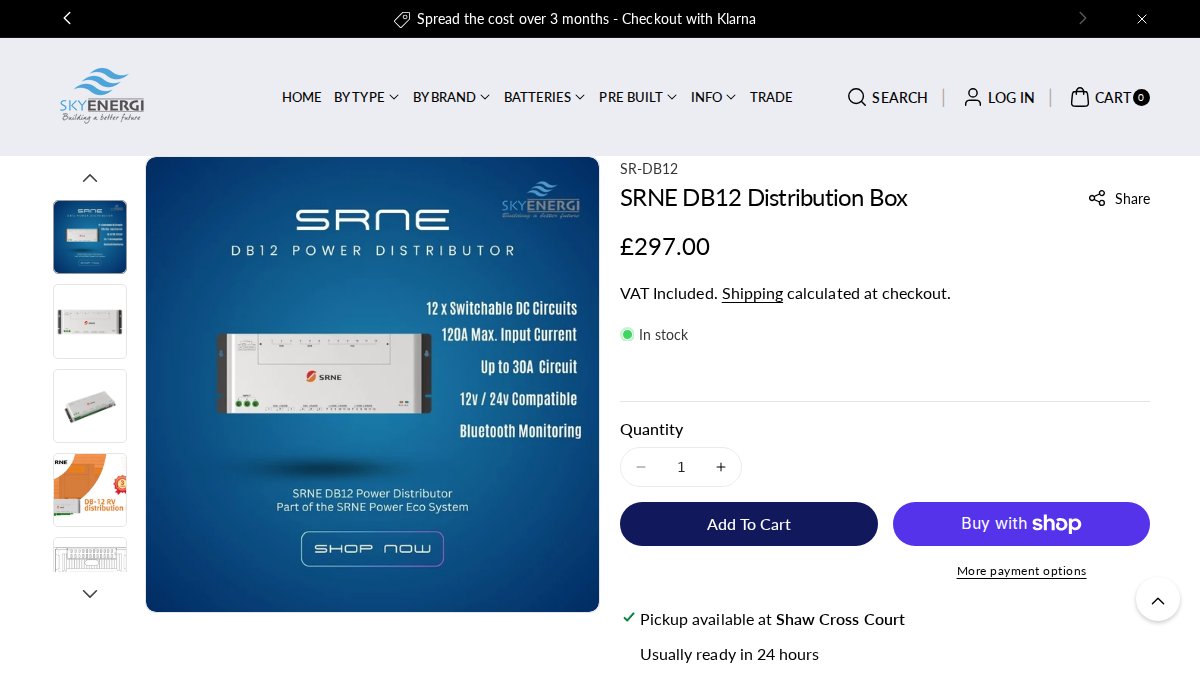
The SRNE DB12 Distribution Box is the standout choice if you want intelligence built into your distribution.

What sets it apart: The DB12 pairs with the SRNE CU2 Control Centre and RMA7 touch displays. Every one of your 12 circuits gets individual fuse protection and current monitoring.
Most distribution blocks are dumb: you flip a switch, power flows, and you have no idea what's happening. The DB12 gives you visibility.
Integration and control: The DB12 connects seamlessly to other SRNE components: battery shunts, charge controllers, inverter chargers. If you're building a complete system with SRNE monitoring, the DB12 is the natural choice for distribution.
The tradeoff: At £297.00, it's the most expensive option on this list. You're paying for the smart features. If you just need basic distribution and don't care about monitoring, you're overspending.
Best for: Builders who want full visibility into their 12V system, anyone integrating multiple SRNE components, and converters planning complex automation or load management.
2. Skyenergi ST Blade Fuse Block: Compact 12-Circuit Solution
The Skyenergi ST Blade Fuse Block 5026 is the practical middle ground: 12 independently fused circuits in a compact footprint without the smart monitoring overhead.
What you get: A tin-plated copper fuse block with 12 circuits fed from a single input busbar.
Why this matters: The integrated negative busbar saves wiring complexity. Instead of running separate negative wires to a separate busbar, you terminate them all here.
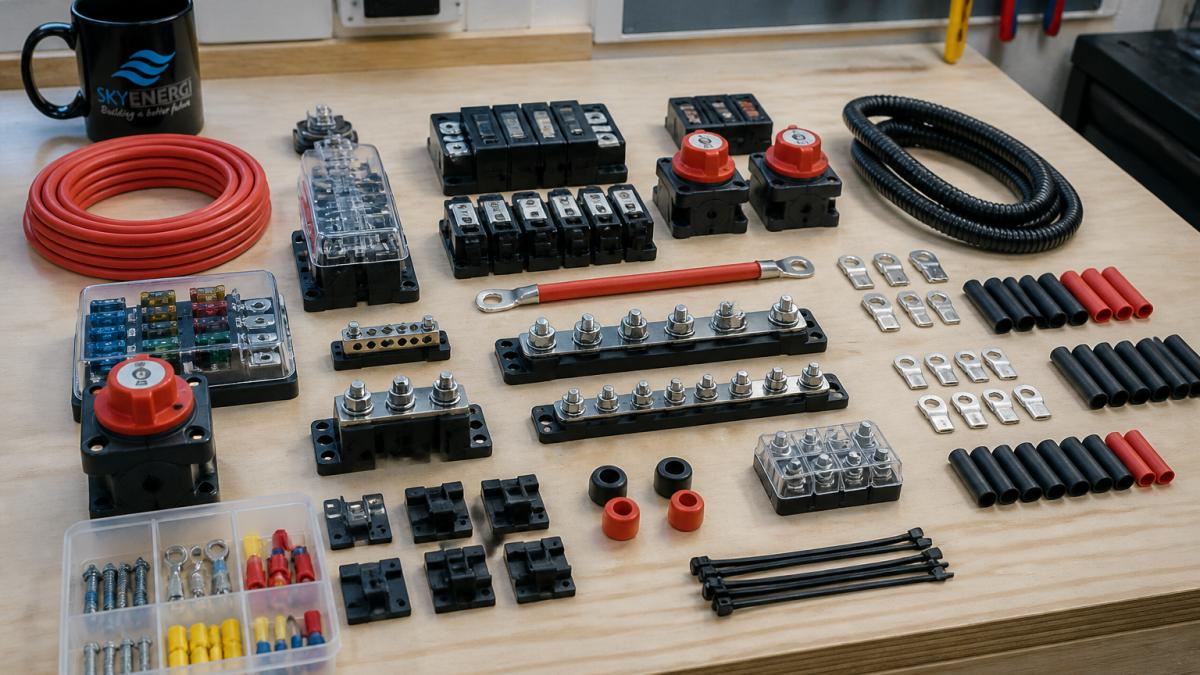
The blade fuse format (ATO/ATC) is standard and cheap to replace. If a circuit trips, pop out the blown fuse and drop in a new one.
The limitation: At 100A total block rating, this isn't suitable for high-current systems with inverters.
Installation: Straightforward. Mount it accessibly, run your positive feed from the battery, connect loads to the individual circuits, and terminate negatives on the built-in busbar.
Cost: At £24.95, it's affordable and excellent value for basic distribution. You're not paying for monitoring or extreme current capacity, just solid, reliable 12-circuit fusing.
Best for: Mid-size conversions (motorhomes, small campervans), builders who prioritise simplicity and cost, systems with moderate total loads under 100A.
3. Skyenergi BX2054 Multi-Circuit Fuse Box: Heavy-Duty High-Current Distribution
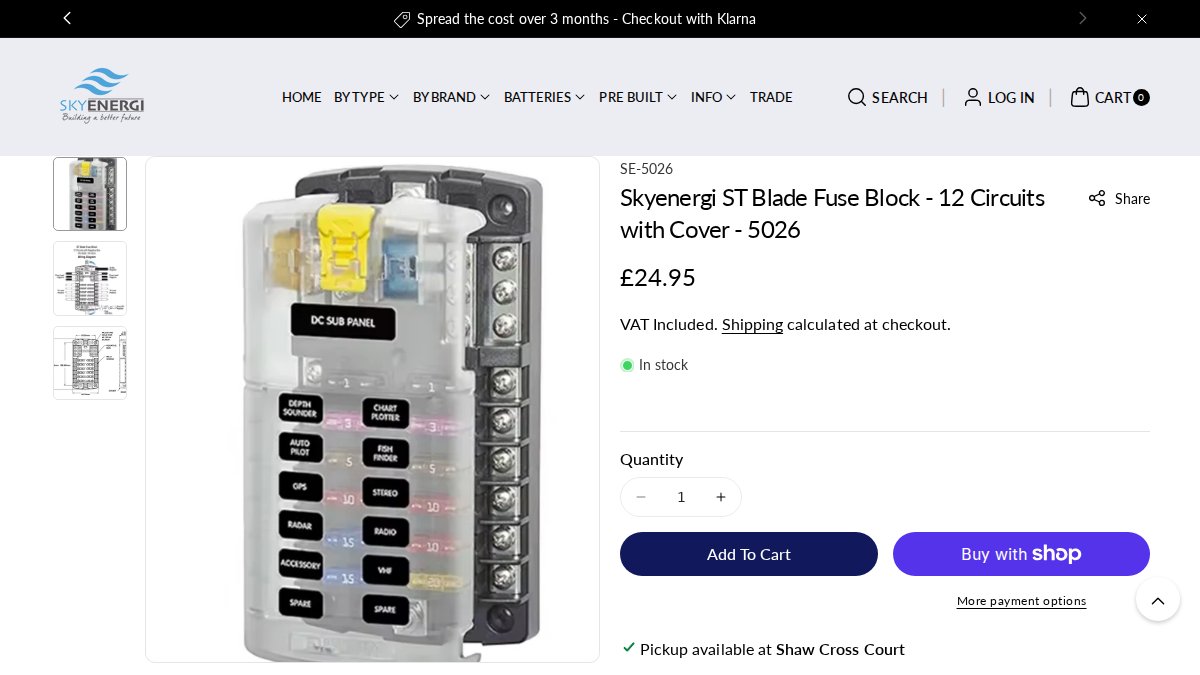
The Skyenergi BX2054 is built for systems that demand serious current handling.
When you need this: If your build includes a large inverter (2-3kW), multiple charge controllers, or a battery bank over 400Ah, the BX2054 handles current loads where smaller blocks would choke.
Design: Heavy-duty polycarbonate base, M5 nuts and locking washers on MIDI circuits, M8 nuts on the MEGA fuse, everything designed to stay tight under vibration.
The trade-off: You need to buy fuses separately. MIDI and MEGA fuses aren't expensive, but you'll need to know what ratings to select.
At £14.95, it's one of the most affordable high-current options. You're getting serious current capacity without inflated pricing.
Installation complexity: Slightly higher than the ST Blade Block. You're dealing with larger fuses and heavier cables, but the principle is the same: battery in, loads out, fuses protect each path.
Best for: Large battery banks, systems with inverters over 2kW, builders running multiple high-current loads, professional installers handling complex builds.
Essential Campervan Electrical System Components for Distribution
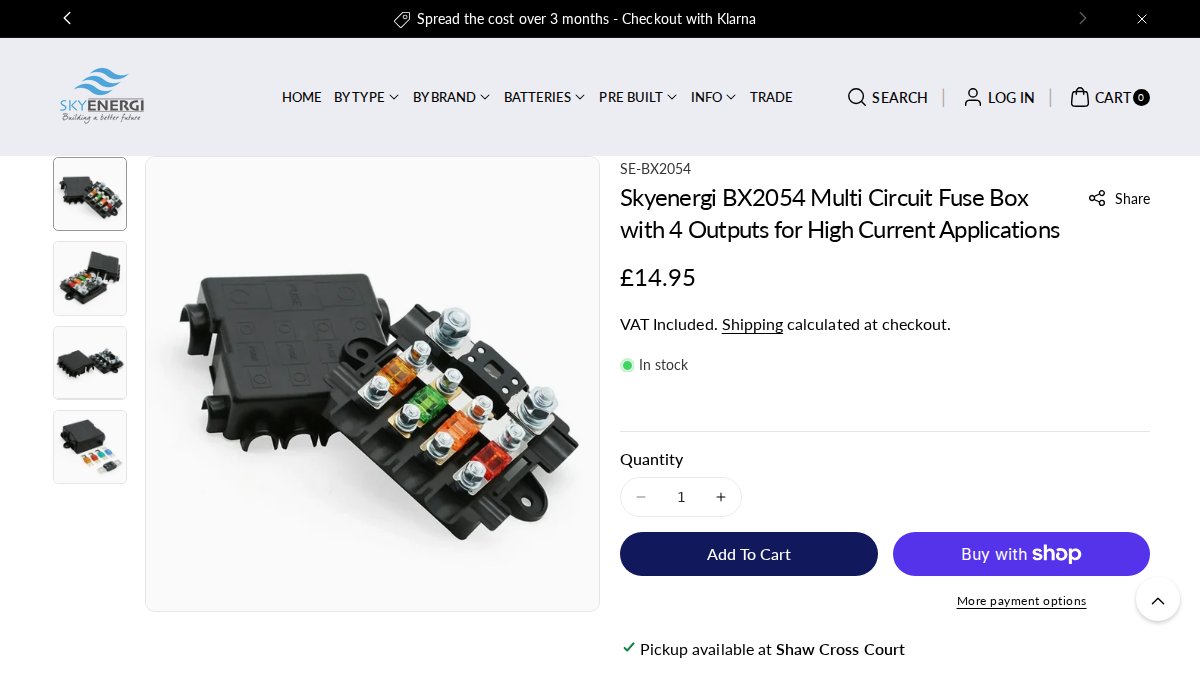
Beyond the distribution block itself, three components work together to make your 12V system safe and functional: battery switches, busbars, and fuse holders.
Properly securing these connections ensures long-term reliability, though maintaining such a system eventually requires the same precision as using DIY repair tools to troubleshoot automotive electrical faults.Battery Switches and Protection Devices
A battery switch isolates your entire system from the battery when you're not using the van. This prevents parasitic drain, protects against accidental short circuits, and gives you a kill switch in emergencies.
The Skyenergi Mini On-Off Battery Switch (6006) is compact and rated for 300A continuous, 500A intermittent. At £18.00, it's ideal for smaller builds where space is tight. The knob design makes it easy to operate by hand, and ignition protection makes it safe for any environment.
For larger systems, the Victron Energy Battery Switch 275A (£29.13) handles serious current. Rated for 275A continuous at 48V with 455A surge capacity, it suits battery banks over 400Ah or systems with large inverters (Battery switch gets too hot: would Victron Switch ON/OFF 275A improve things?). The manual toggle mechanism is bombproof: no relays to fail, just solid mechanical switching.
Skyenergi ST Blade Fuse Block - 12 Circuits with Cover - 5026 →
Busbars for High-Current Consolidation
A busbar consolidates multiple high-current connections into a single point. Instead of running separate cables from the battery to your inverter, solar charger, and DC-to-DC charger, you run one cable to the busbar and branch out. This reduces voltage drop, simplifies wiring, and makes the system cleaner.
The Skyenergi 250A 4-Port Busbar (£19.95) handles most mid-size builds. Rated for 250A continuous, it's compact and includes a protective cover. Four M8 studs let you connect up to four heavy cables, consolidating your main battery feeds before they split to individual fused circuits.
For systems exceeding 300A, the Skyenergi 600A 4-Stud Busbar (£45.00) is the upgrade. Copper PCB construction ensures excellent conductivity and heat dissipation. At 600A DC capacity, it handles the largest leisure battery setups without voltage drop.
The FlexiFuse 3-Position Busbar (£5.75) serves a different purpose: linking three MEGA fuse holders into a single distribution point. Typical setup is one input from your battery and two protected outputs to high-current loads. At 500A capacity, it manages multiple MEGA-fused circuits from a single source.
Campervan 12V Wiring and Fuse Sizing for Safe Distribution
Wire gauge and fuse selection are non-negotiable. Get either wrong and you risk fire, battery damage, or equipment failure.
Wire sizing: The longer the cable run, the thicker the wire needs to be to prevent voltage drop. A 2-metre run at 100A needs different gauge than a 10-metre run at the same current.
Always terminate cables with ring or fork terminals crimped properly, no bare wire twisted under a bolt. Corrosion kills connections, especially in damp van environments.
Fuse selection: A fuse should be rated slightly above the maximum expected current of that circuit, not way above. If a circuit normally draws 20A, use a 25A fuse. A 50A fuse defeats the protection: the circuit could draw 45A before it blows, overheating the cable and potentially starting a fire.
For blade fuses (in the ST Blade Block), common ratings are 15A, 20A, 25A, 30A. For MIDI fuses (in the BX2054), ratings go up to 200A. For MEGA fuses, you'll see 200A, 250A, 300A, and higher.
Integrating a Campervan DC-to-DC Charger with Your Distribution System
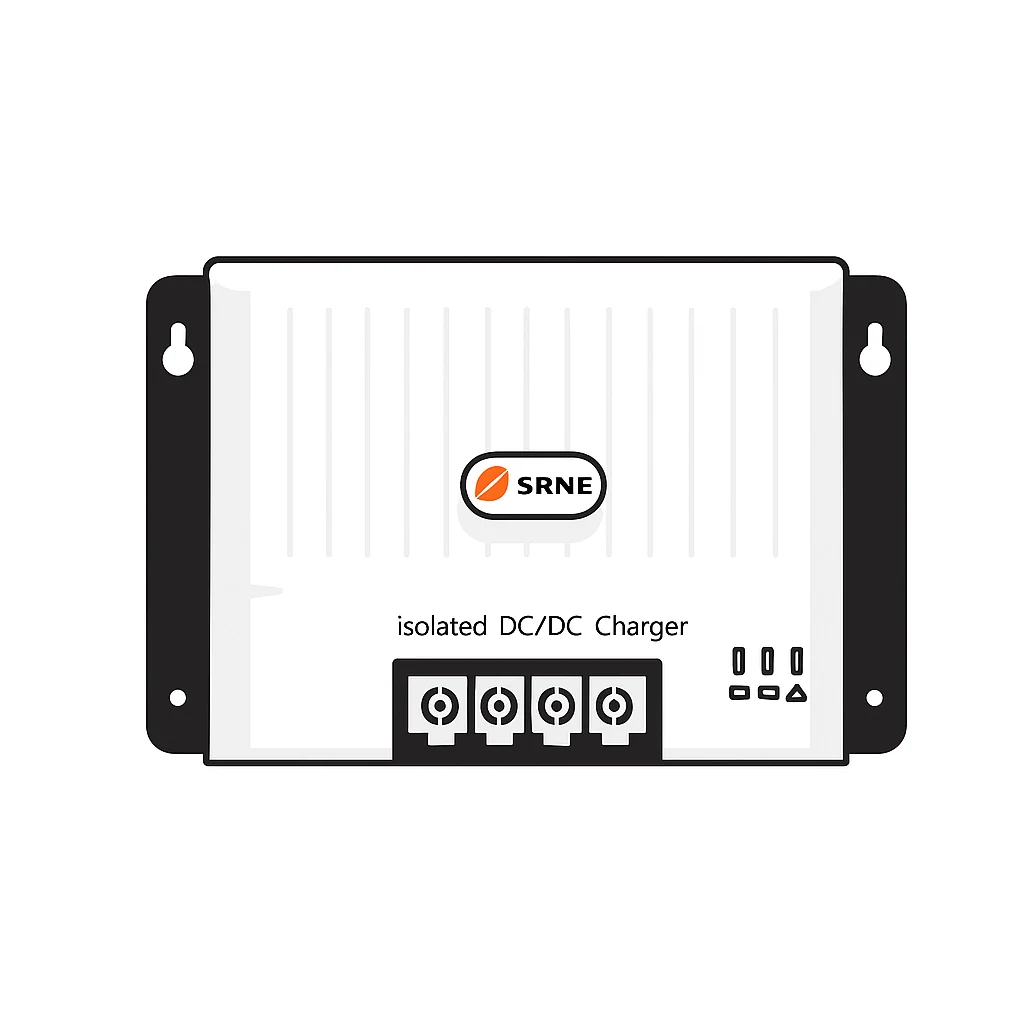
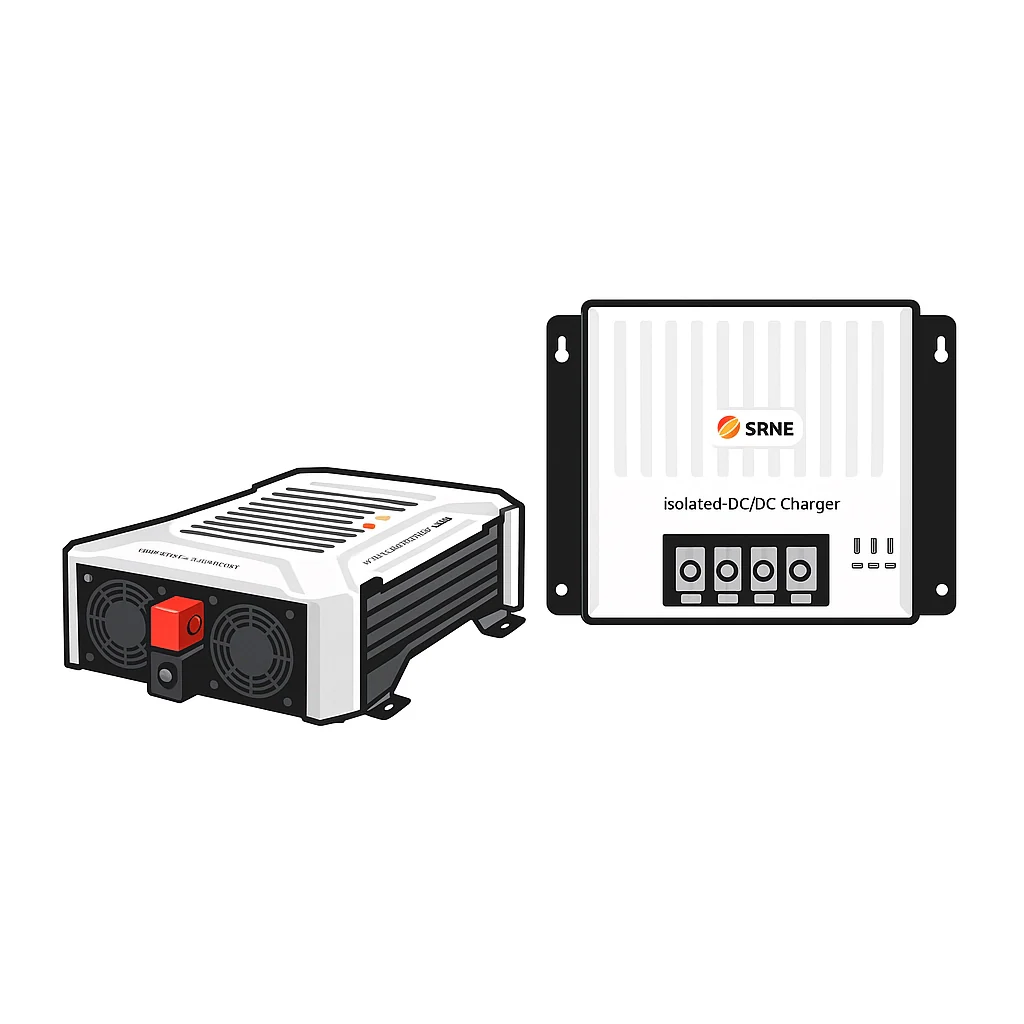
A DC-to-DC charger tops up your leisure battery from the vehicle's alternator while driving. It's essential for maintaining battery charge between camp stops.
The charger connects between your starter battery and your leisure battery through your distribution system. It needs its own fused circuit, typically a 100A or 150A MIDI fuse depending on the charger's output.
Here's the wiring sequence: starter battery → main fuse (200A MEGA) → DC-to-DC charger input (protected by 150A MIDI fuse) → charger output → leisure battery via your distribution block.
The charger has its own internal protection, but the fuse protects the cable run: if the cable gets damaged, the fuse blows before the cable melts.
If you're using an SRNE DB12, the DC-to-DC charger can integrate with the SRNE CU2 for monitoring.
For simpler setups without SRNE monitoring, any quality DC-to-DC charger works fine, just ensure it's properly fused and wired with appropriate cable gauge.
How to Choose the Right Solution for Your Build
Start by answering three questions.
1. How many circuits do you need? Count every load: lights, fans, fridge, water pump, heating, USB outlets, inverter, solar charger, DC-to-DC charger. Most campervans need 8-16 circuits.
2. What's your total system current? Add up the maximum simultaneous draw: inverter (usually 100-200A), solar charger (60-100A), DC-to-DC charger (50-100A), plus all 12V loads.
3. Do you want monitoring? If yes, the SRNE DB12 is the only option here: real-time circuit monitoring, app integration, and automation. If no, the ST Blade Block is simpler and cheaper.
| Solution | Circuit Count | Max Total Current | Monitoring | Price | Best For |
|---|---|---|---|---|---|
| SRNE DB12 | 12 | 100A | Yes (SRNE app) | £297.00 | Smart systems, professional builds |
| ST Blade Block | 12 | 100A | No | £24.95 | Mid-size builds, cost-conscious builders |
| BX2054 | 5 | 500A (MEGA) | No | £14.95 | High-current systems, inverters over 2kW |
Most DIY converters choose between the ST Blade Block (simple, affordable, 12 circuits) and the SRNE DB12 (smart, monitored, same circuit count but triple the price).
The BX2054 isn't a replacement for the other two, it's a different category for high-current primary distribution.
Choosing the right 12V power distribution solution shapes your entire electrical system.
If you're building a campervan electrical system from scratch, Skyenergi stocks all the distribution blocks, busbars, fuses, and switches you need.
Frequently Asked Questions
What is a 12V power distribution system in a campervan?
A 12V power distribution system manages electrical flow from your leisure battery to all onboard appliances and accessories. It uses fuse blocks, busbars, and circuit protection to safely split one main battery connection into multiple protected circuits for lights, fridges, pumps, and USB outlets. Proper distribution prevents voltage drop, protects against overload, and keeps your system organised and maintainable.
How do I choose a campervan 12V fuse box for my van conversion?
Choose based on circuit count, current capacity, and your build complexity. The Skyenergi ST Blade Fuse Block handles 12 circuits at 30A each for simpler builds, whilst the Skyenergi BX2054 supports mixed MIDI and MEGA fuses for higher-current systems. Count your planned loads (lighting, fridge, fans, USB) and select a box with 20-30% spare capacity for future additions.
What fuse size should I use for 12V campervan circuits?
Size fuses 1.25 to 1.5 times the expected circuit current. A 15A fridge circuit needs a 20A fuse; a 10A lighting circuit needs a 15A fuse. Use MIDI fuses (30A-200A) for medium loads and MEGA fuses (200A+) for main battery feeds and inverters. Always match cable gauge to fuse rating, undersized cable causes overheating even if the fuse is correct.
Do I need a DC-to-DC charger as well as a solar charge controller?
Yes, they serve different purposes. A solar charge controller regulates power from solar panels into your battery. A DC-to-DC charger converts engine alternator voltage (13.6V+) into stable 12V charging when driving. Together, they maximise charging from both solar and vehicle movement, keeping your battery topped up in all conditions.
Can I use an SRNE distribution box with my existing campervan electrical setup?
The SRNE DB12 integrates with SRNE's ecosystem (CU2 control centre, RMA7 touch panels, battery shunt) for real-time monitoring and smart circuit control. If you already have SRNE components or plan to add them, the DB12 works seamlessly. For standalone setups without SRNE monitoring, simpler fuse blocks like the Skyenergi ST offer reliable distribution at lower cost.
Prev post

Benefits of Switching to Lithium Leisure Batteries for Caravans
Updated on 08 October 2026
Next post

Is It Safe to Use Lithium Leisure Batteries in Cold Weather?
Updated on 06 October 2026


