





Lithium Battery Voltage Drop Explained
Lithium battery voltage drop explained: why it happens, how load current and internal resistance affect performance, and how to prevent it.
Table of Contents
- What Is Lithium Battery Voltage Drop?
- Why Voltage Drops After a Full Charge
- Lithium Battery Voltage Under Load
- The Role of Internal Resistance in Voltage Sag
- BMS Voltage Cutoff Explained
- SRNE Charge Controller Settings for Voltage Stability
- Skyenergi Battery Maintenance to Prevent Voltage Dips
- How to Monitor and Prevent Voltage Drop
Last Updated: August 16, 2026
What Is Lithium Battery Voltage Drop?
Lithium battery voltage drop is the reduction in electrical potential when a battery delivers current to a load. Terminal voltage immediately decreases from its open-circuit value due to internal resistance and electrochemical processes inside the cells.
Understanding voltage drop is essential for off-grid power systems. In a campervan or motorhome, voltage sag directly affects appliance performance, your fridge cuts out, your inverter shuts down, your solar charge controller misreads battery state. These are symptoms of voltage instability, not equipment failures.
Lithium cells maintain flatter discharge curves than lead-acid, keeping voltage more stable across a wider discharge range. However, they're still subject to voltage drop under heavy current draw. SRNE charge controllers and Skyenergi's monitoring systems are specifically designed to track and compensate for these voltage shifts, keeping your system stable during peak demand.
Why Voltage Drops After a Full Charge
A freshly charged lithium battery sits at its nominal voltage, typically 13.6V for a 12V system. The moment you draw current, voltage falls instantly, this is completely normal.
The primary cause is internal resistance. Every battery cell contains resistance to electron flow. When current passes through this internal resistance, voltage drop occurs according to Ohm's Law: voltage drop equals current multiplied by resistance. A 100A discharge through 0.05 ohms of internal resistance produces a 5V drop, causing terminal voltage to plummet from 13.6V to 8.6V under peak load.
Temperature plays a significant role. Cold lithium cells exhibit higher internal resistance than warm ones. A battery at 0°C might show 50% more voltage sag than the same battery at 20°C. This is why motorhome owners in winter report sudden voltage dips that disappear when the battery warms up.
State of charge also influences voltage behaviour. As a lithium battery discharges, its terminal voltage gradually decreases even at zero load. Under load, this voltage drop compounds on top of the baseline decline. At 20% state of charge, drawing 50A produces more voltage sag than drawing 50A at 80% state of charge.
Lithium Battery Voltage Under Load
When current flows from your lithium battery, terminal voltage drops immediately and proportionally to the load. This voltage sag is critical to understand for system design.
A typical 12V lithium battery maintains 13.2V at rest. Connect a 100A load and voltage might drop to 12.8V instantly. Connect a 200A load and it might drop to 12.4V. The relationship is linear, governed by internal resistance.
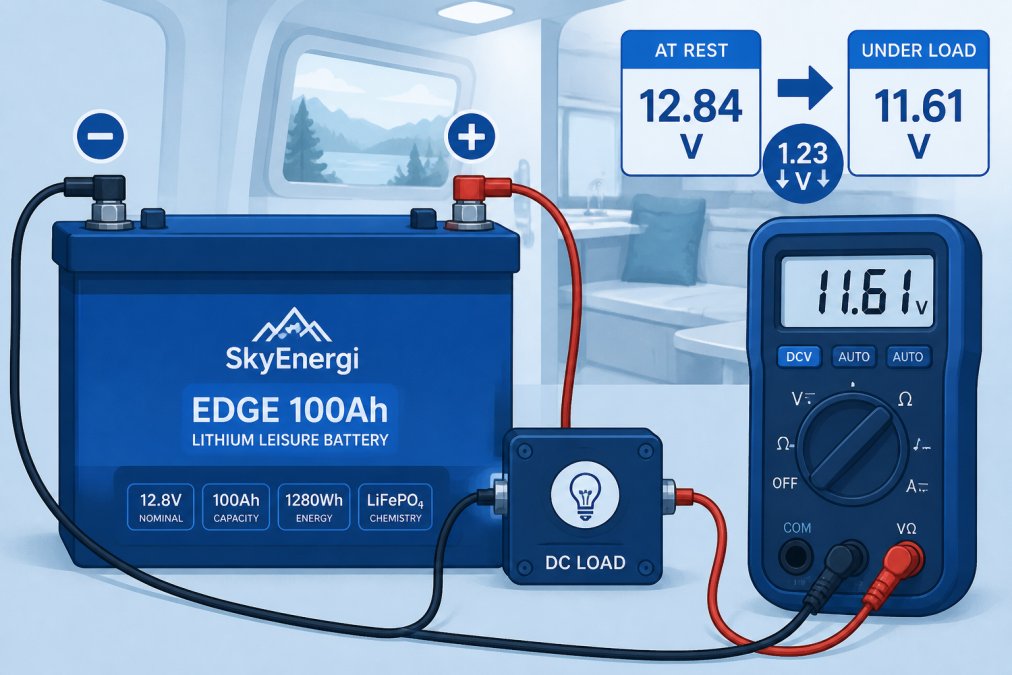
Peak loads are where voltage sag becomes critical. When your microwave, water heater, and inverter all draw current simultaneously, combined load can exceed 200A and system voltage might collapse to 11.5V or lower. At this point, many devices cut out. Victron inverters have a low-voltage shutdown typically set at 10.5V, cross that threshold and your power disappears.
The discharge curve of lithium batteries is flatter than lead-acid, which is why they're superior for off-grid applications. A lead-acid battery might drop from 12.6V to 11.2V across its usable capacity. A lithium battery drops from 13.6V to 10.0V, providing more stable voltage for longer.
Current draw duration matters as well. A 10-second 200A draw produces less voltage sag than a sustained 100A draw over 30 seconds. Short peaks are absorbed by the battery's capacitive properties. Sustained loads reveal the true internal resistance.
The Role of Internal Resistance in Voltage Sag
Internal resistance is the cumulative resistance of battery terminals, cell connectors, electrolyte, and electrochemical pathways inside each cell. Every milliohm translates to voltage drop under load.
A new lithium battery might have internal resistance of 0.03 ohms. As it ages, this resistance increases gradually. By 80% of its rated cycle life, internal resistance might climb to 0.05 ohms or higher, explaining why older lithium batteries show more voltage sag under the same load.
Temperature directly affects internal resistance. At 0°C, internal resistance can double. At -10°C, it can triple. This is why winter camping produces dramatic voltage dips, your battery isn't dead, it's operating at higher internal resistance.
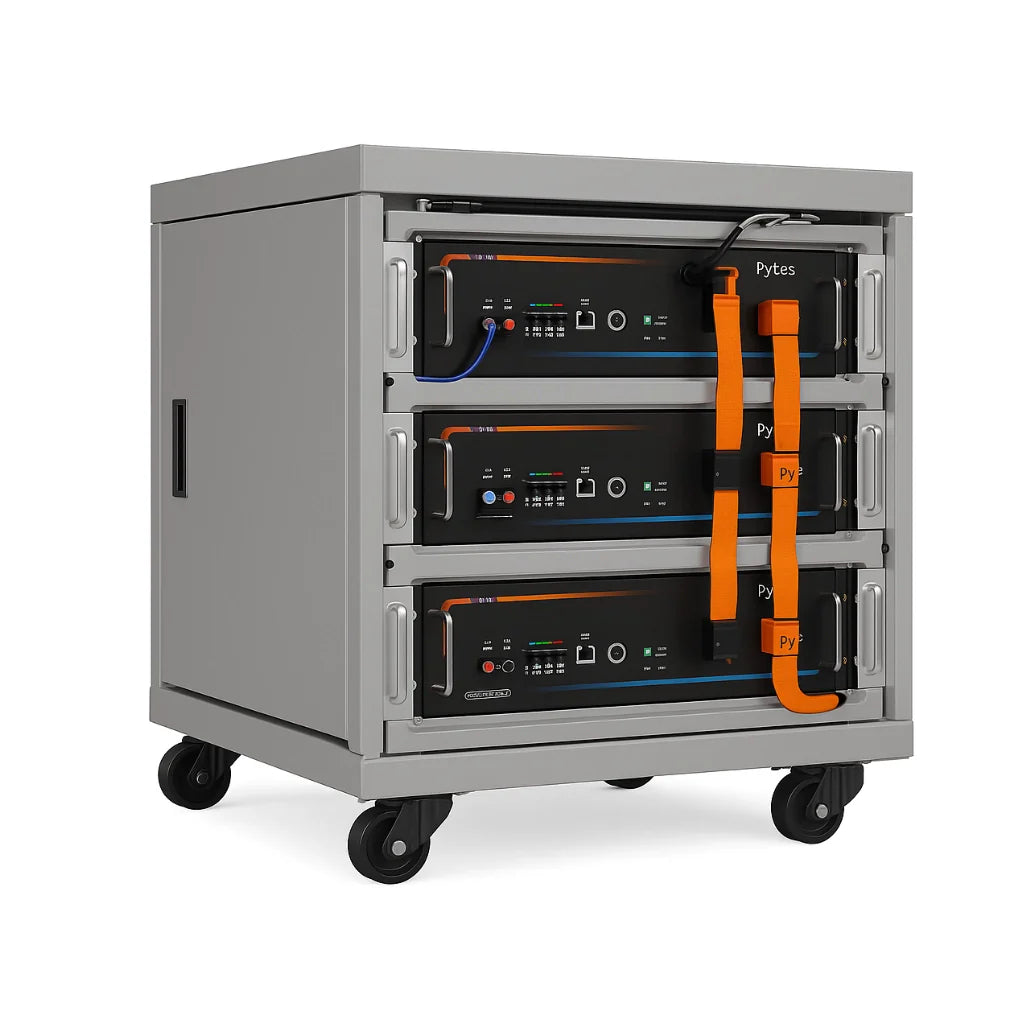
LiFePO4 (lithium iron phosphate) cells typically have higher internal resistance than NCA or NCM chemistries, but offer superior cycle life and thermal stability. Skyenergi's Edge and Elite lithium batteries are optimised for leisure applications where reliable voltage stability matters more than absolute peak power.
Series and parallel configurations change how internal resistance behaves. Two batteries in series add their internal resistances. Two batteries in parallel reduce total internal resistance by half. Larger systems with multiple battery modules show less voltage sag than single-battery systems due to parallel paths providing lower overall resistance.
The BMS (Battery Management System) cannot eliminate internal resistance, but it can compensate for its effects. Advanced BMS algorithms predict voltage behaviour based on current draw and temperature, then adjust charging profiles to maintain stability. SRNE charge controllers integrate with compatible BMS systems to read these predictions and adjust output accordingly.
BMS Voltage Cutoff Explained
The BMS voltage cutoff is a safety threshold programmed into your battery's management system. When terminal voltage drops below this threshold, the BMS disconnects the battery from the load to prevent over-discharge and cell damage.
Typical BMS cutoff voltages for 12V lithium systems range from 10.0V to 10.5V. Below 10V, lithium cells begin to degrade rapidly. The BMS prevents this by cutting power, a protective feature, not a failure.
However, BMS cutoff can create false positives. During a brief high-current spike, voltage might dip below the cutoff threshold momentarily, triggering a disconnect even though the battery has plenty of usable capacity remaining. Some BMS systems use voltage hysteresis to prevent this, they cut at 10.5V but don't reconnect until voltage rises to 11.0V, preventing rapid cycling between connected and disconnected states.
Another consideration is voltage calibration. The BMS measures voltage at battery terminals, but long cable runs create additional voltage drop. A reading of 12.0V at the battery might only deliver 11.4V at a distant inverter. Skyenergi recommends proper cable sizing and, for larger systems, remote voltage sensing on the BMS.
SRNE Charge Controller Settings for Voltage Stability
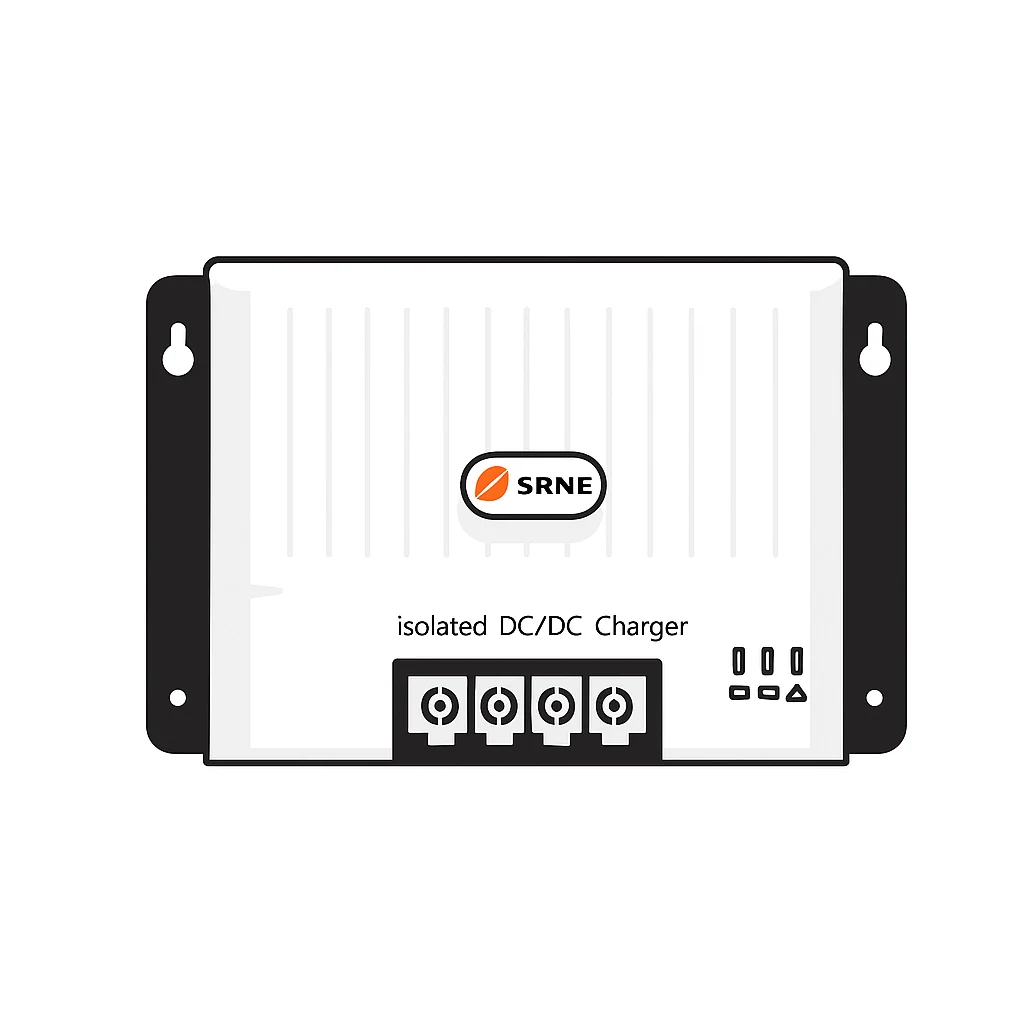
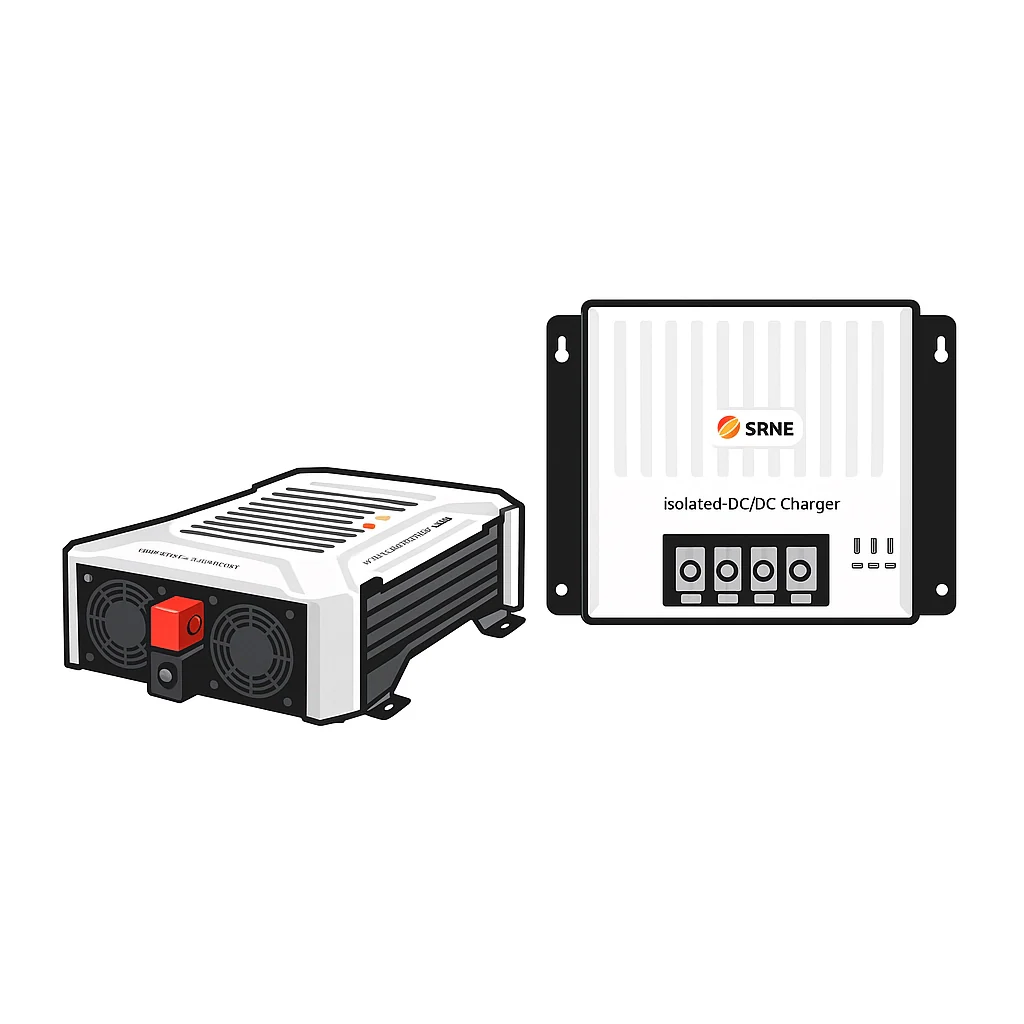
SRNE charge controllers are widely used in campervan and off-grid systems because they offer sophisticated voltage management. Proper configuration prevents many voltage-drop issues before they occur.
The bulk charge voltage setting is critical. This is the voltage at which the controller stops charging at full current and transitions to absorption mode. Most SRNE controllers default to 14.4V for 12V lithium systems, which is appropriate for LiFePO4 chemistry.
Float voltage is the maintenance voltage the controller holds after absorption is complete. For lithium, this is typically 13.6V. The controller maintains this voltage indefinitely, compensating for self-discharge and minor load currents.
The absorption time setting determines how long the controller holds bulk charge voltage before transitioning to float. For campervan systems, 2-3 hours is typical. SRNE controllers allow manual adjustment here.
Temperature compensation is where voltage stability really happens. If your SRNE controller has a temperature sensor, it adjusts charge voltage based on battery temperature. Cold batteries need higher charge voltage to accept the same energy. Hot batteries need lower voltage to prevent overcharging. This automatic compensation prevents the voltage sag you'd otherwise see in cold weather.
Skyenergi Battery Maintenance to Prevent Voltage Dips
Proper maintenance of your Skyenergi lithium battery directly impacts voltage stability. Preventive care prevents the internal resistance creep that causes increasing voltage sag over time.
Keep terminals clean and tight. Corrosion and loose connections increase resistance at the connection point. Every 6 months, disconnect the battery, clean the terminals with a wire brush, and reconnect with firm pressure. Use dielectric grease on the terminals to prevent oxidation. A loose connection adding 0.01 ohms of resistance produces 1V of voltage drop at 100A load.
Monitor internal temperature. Lithium batteries perform best between 10°C and 30°C. If your battery is mounted in an uninsulated compartment, temperature swings create voltage instability. In winter, insulate the battery box. In summer, ensure ventilation. Skyenergi's Edge and Elite batteries include internal temperature sensors that communicate with compatible BMS systems to adjust performance based on thermal conditions.
Balance your loads. Sustained high-current draws age batteries faster than intermittent loads. Spread high-load operations across multiple periods when possible. This reduces internal resistance degradation and extends battery life.
Avoid deep discharges. Keep your usable capacity window between 20% and 80% state of charge when possible. This single practice can double cycle life compared to regular 0-100% cycling.
Use a quality battery monitor. Install a Victron SmartShunt or BMV battery monitor to track voltage behaviour over time. If you notice voltage sag increasing gradually, it's an early warning that internal resistance is rising. The Victron SmartShunt 300A provides Bluetooth monitoring and is ideal for smaller systems.

Firmware updates for your BMS. If your Skyenergi battery supports firmware updates, check periodically for improvements. Manufacturers often release updates that improve voltage stability algorithms and BMS calibration.
How to Monitor and Prevent Voltage Drop
Effective voltage drop prevention starts with monitoring. You can't manage what you don't measure.
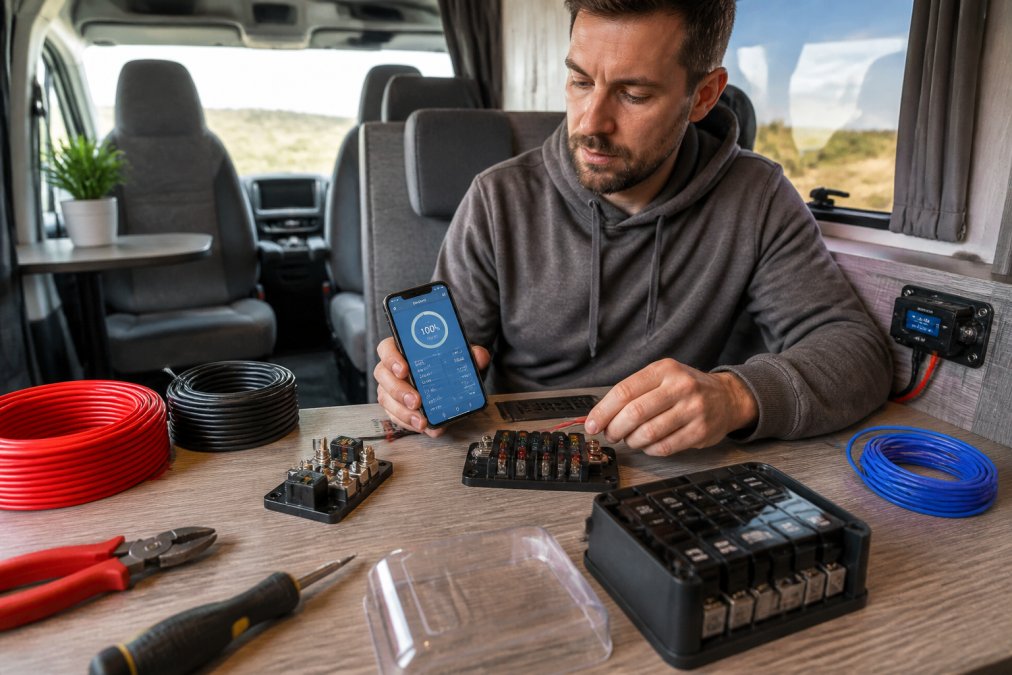
Install a battery monitor. A quality monitor displays real-time voltage, current, and state of charge. More importantly, it logs historical data so you can identify patterns. The Victron BMV-712 Smart Battery Monitor offers Bluetooth connectivity and integrates with Skyenergi systems. The Victron BMV-700 is a cost-effective alternative for basic monitoring.
Measure voltage at the load, not the battery. Cable voltage drop is real. A 4mm² cable run of 5 metres between battery and inverter might drop 0.3V at 100A load. Use remote voltage sensing if your monitor supports it, positioning sense wires directly at the load terminals.
Establish baseline voltage profiles. Record your system voltage under various loads and conditions. This baseline helps you identify when something changes. If your voltage suddenly sags more than it used to under the same load, internal resistance has likely increased.
Size cables properly. Undersized cables are a silent killer of voltage stability. A 10mm² cable might seem adequate for a 12V system, but at 200A load over a 3-metre run, it drops 0.6V. Upgrade to 16mm² or 25mm² depending on your expected peak current.
Use a quality SRNE charge controller. The controller is your first line of defence against voltage instability. A controller with temperature compensation and proper voltage calibration prevents many voltage-drop issues before they affect your loads. Configure it correctly for your battery chemistry and expected loads.
Parallel multiple batteries if possible. A single 200Ah battery shows more voltage sag than two 100Ah batteries in parallel under the same 200A load. The parallel configuration provides lower total internal resistance.
Manage peak loads. Not everything needs to run simultaneously. Stagger your high-load appliances. Run the heater while the solar panels are generating. Use a timer or manual control to prevent accidental simultaneous operation of multiple high-current devices.
Monitor battery age. As lithium batteries age, internal resistance increases and voltage sag becomes more pronounced. After 5-7 years of regular use, a Skyenergi battery might show noticeably more voltage drop than when new. Plan your replacement accordingly.
A practical monitoring routine involves checking your battery monitor weekly during normal use. Note the voltage under your typical loads. Every month, record peak voltage sag during high-load periods. Every quarter, review the trend. If voltage sag is increasing steadily, investigate the cause, it might be corroded terminals, loose connections, or simply aging batteries approaching end-of-life.
Voltage drop is inevitable in any battery system, but it's manageable. The difference between systems that work reliably and those that fail is monitoring and prevention. Start with a quality battery monitor like the Victron SmartShunt or BMV series, configure your SRNE charge controller correctly for your Skyenergi lithium battery, and maintain clean connections and proper cable sizing. These fundamentals keep your campervan, motorhome, or off-grid system stable through years of reliable operation.
Frequently Asked Questions
Why does my lithium battery voltage drop under load?
Lithium battery voltage drops under load because of internal resistance within the cells and connections. When current flows, this internal resistance causes an ohmic drop that temporarily reduces the terminal voltage. The higher the current draw, the greater the voltage sag. This is normal behaviour and typically recovers once the load is removed, though BMS systems may cut off power if voltage drops below the cutoff threshold to protect cell integrity.
What voltage is too low for a 12V lithium battery?
Most 12V lithium batteries have a BMS cutoff voltage between 10V and 10.5V. Allowing the battery to discharge below this point can damage cells permanently. However, voltage drop under load is temporary and different from state of charge. A fully charged lithium battery may momentarily dip to 12.8V under peak load, which is normal. Monitor your battery's state of charge curve rather than instantaneous voltage readings alone to avoid confusion between voltage sag and true discharge.
Does cold weather affect lithium battery voltage?
Yes, temperature-induced voltage sag is significant in cold conditions. Internal resistance increases in low temperatures, causing greater voltage drop during load. A battery that performs normally at 20°C may show 0.5V-1V additional sag at 0°C or below. Lithium batteries also temporarily reduce their available capacity in cold weather until they warm up. For campervan and off-grid applications, ensure your battery management system accounts for seasonal temperature variation and consider thermal management if operating in harsh winter conditions.
How do I prevent voltage dips in my lithium battery system?
Prevent voltage dips by: (1) using properly sized cabling to minimise resistance losses, (2) keeping the battery state of charge above 20% to maintain voltage stability, (3) spreading high current loads over time rather than drawing peak load continuously, (4) installing a quality battery monitor like the Victron SmartShunt to track real-time voltage and current, and (5) configuring your SRNE charge controller with appropriate absorption and float voltages. Regular Skyenergi battery maintenance, including cell balancing checks, also helps maintain consistent voltage performance.
This article was written using GrandRanker
Prev post

12V Lithium Battery for Tight Spaces: Complete Guide
Updated on 18 August 2026
Next post

Best Solar Controller for Lithium: 2026 Guide
Updated on 15 August 2026


