


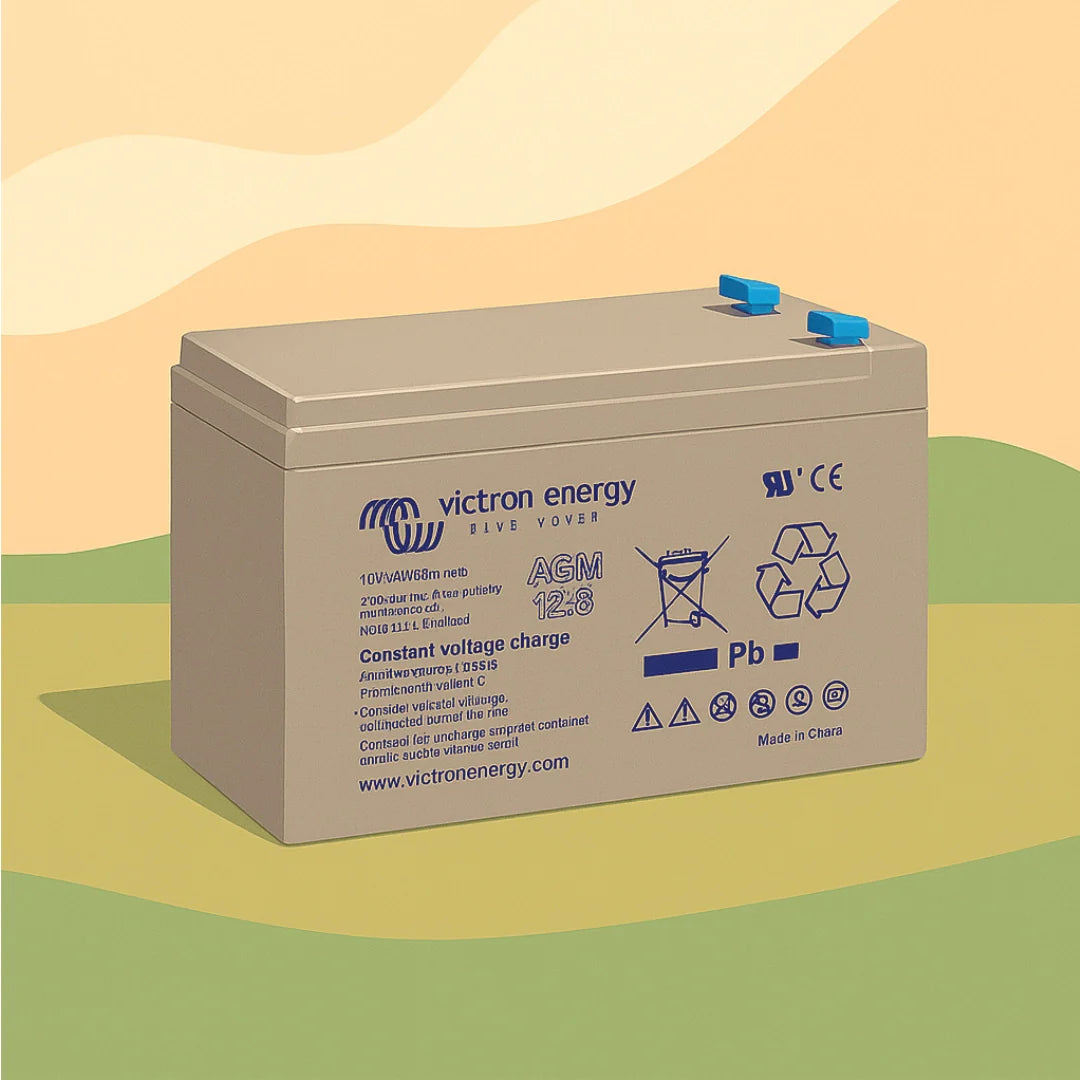
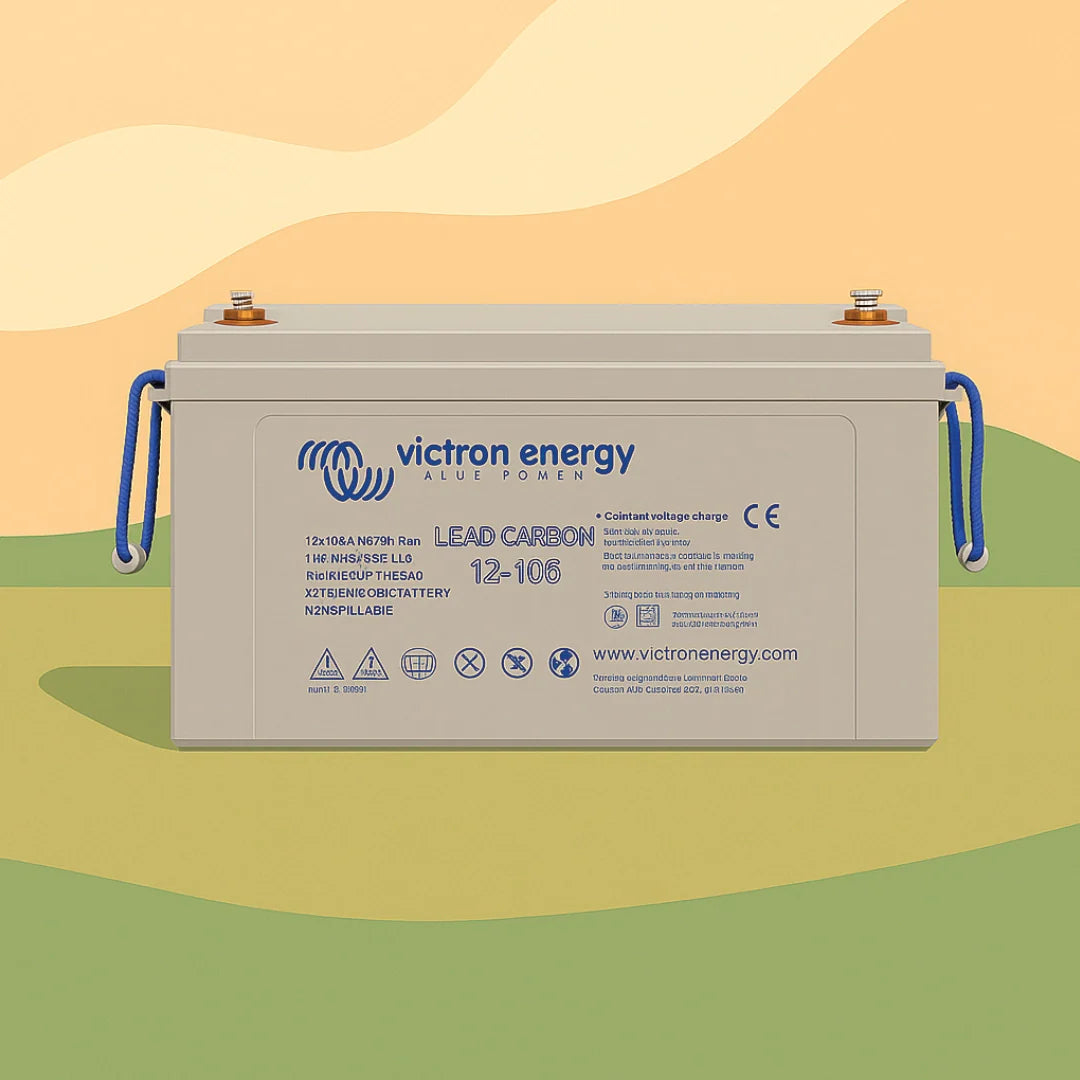
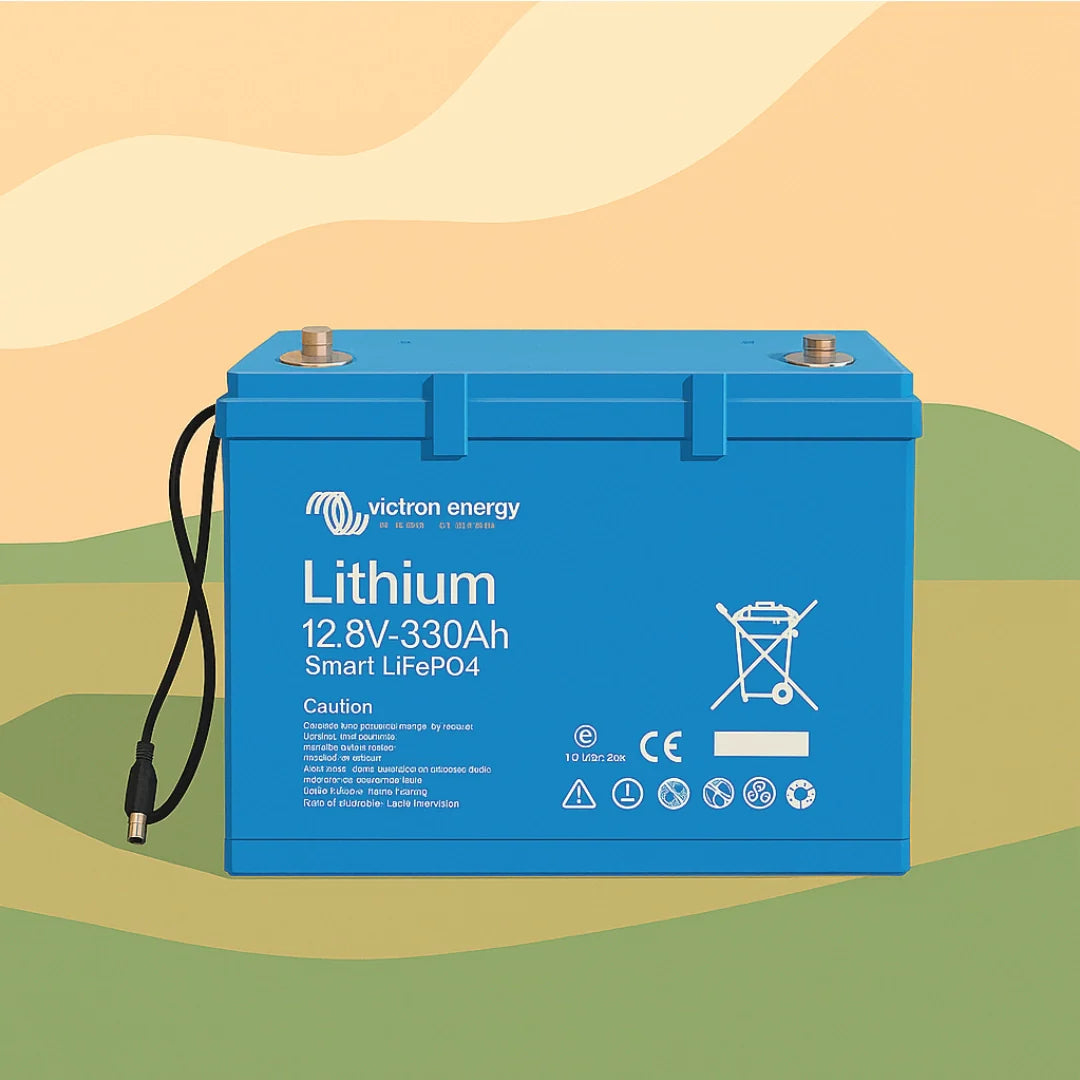

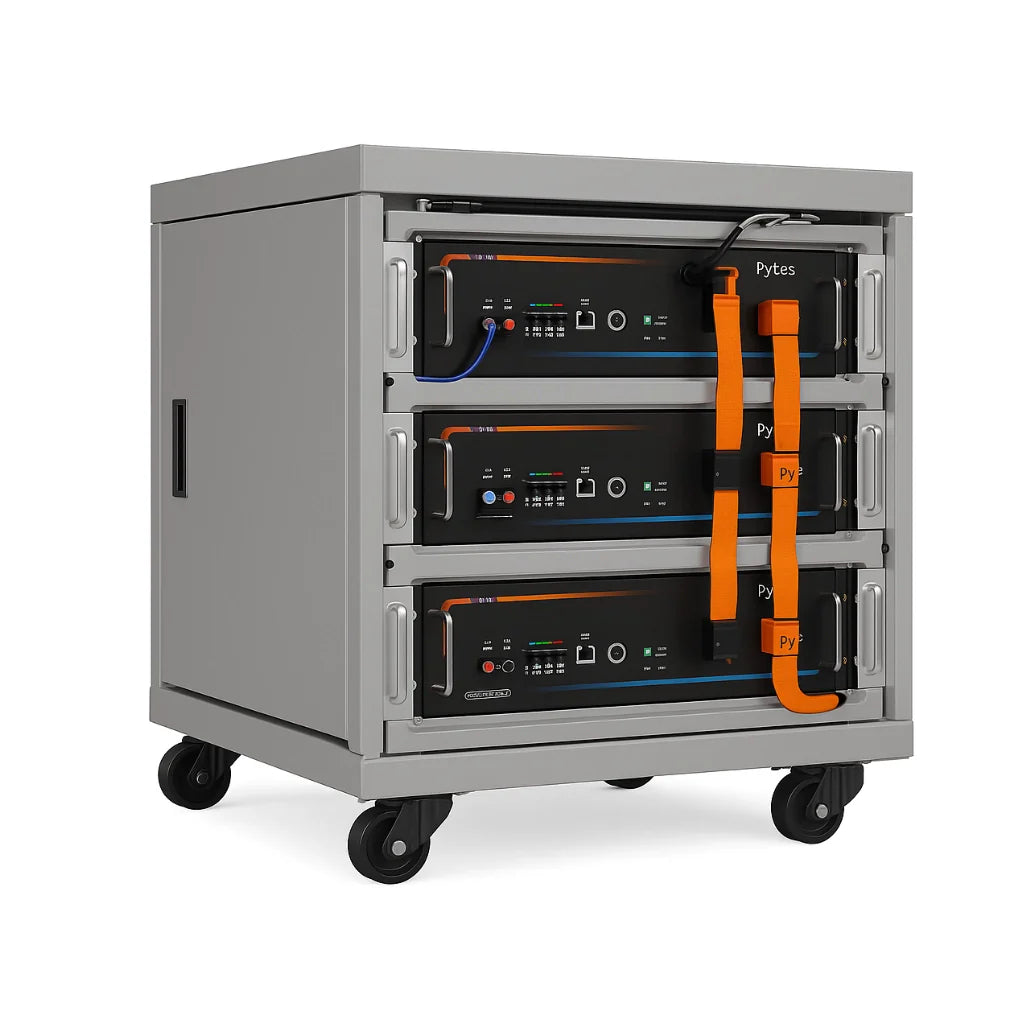



Best Campervan Battery Management System: 2026 Guide
Find the best campervan battery management system for off-grid power. Compare BMS options, features and pricing for lithium leisure batteries. Learn more.
Table of Contents
- What Is a Battery Management System for Campervans?
- Campervan Battery Monitor vs BMS: Key Differences
- LiFePO4 vs Lead-Acid: Why BMS Requirements Differ
- Top Battery Management Systems for Campervan Use
- SRNE Solar Charge Controller Features and Integration
- 12V Electrical System Design for Campervans
- Key Features to Look for in a Campervan BMS
- Installation and Cold Weather Performance
Last Updated: August 30, 2026
What Is a Battery Management System for Campervans?
A battery management system (BMS) is an intelligent control module that monitors and protects lithium leisure batteries in campervans, preventing damage from overcharging, deep discharge, and thermal stress. Unlike passive lead-acid setups, a BMS actively manages cell voltage, current flow, and temperature in real time, extending battery life from 3-5 years to 10-15 years.
According to MarketsandMarkets' UK Battery Management System Market analysis, the UK BMS market is valued at £320 million in 2026 and is projected to grow at 16.1% annually through 2029. A quality BMS monitors individual cell voltages to detect imbalances, limits charging and discharge currents to safe levels, disconnects loads or charge sources when voltage thresholds are breached, and provides real-time data via Bluetooth or wired display.
Campervan Battery Monitor vs BMS: Key Differences
A battery monitor is a passive measurement device that sits in the negative cable between battery and loads, measuring voltage and amperage to calculate state of charge and remaining runtime.
A battery management system is an active protective device that monitors cell voltages, temperature, and current, then automatically disconnects charge sources or loads when limits are exceeded. The SRNE BP 2470N15 Battery Protect combines low-voltage disconnect, over-current protection, and over-voltage protection in a single unit, cutting power to non-essential loads automatically if battery voltage drops below safe thresholds.

Most modern campervan systems use both: the BMS protects the battery from physical damage, while the monitor provides visibility into system performance.
| Component | Function | Active/Passive | Best For |
|---|---|---|---|
| Battery Monitor (Shunt) | Measures voltage and current flow | Passive | Real-time visibility and data logging |
| BMS | Protects battery, disconnects loads/chargers | Active | Preventing damage and extending life |
| Combined System | Protection + visibility | Both | Complete electrical safety and awareness |
Pairing them costs less than £150 total and covers both needs.
LiFePO4 vs Lead-Acid: Why BMS Requirements Differ
Lead-acid batteries tolerate overcharging and can recover from occasional over-discharge. LiFePO4 lithium batteries are unforgiving. Overcharging a single cell above 3.65V per cell causes permanent damage, while deep discharge below 2.5V per cell renders the cell unusable. Charging below freezing temperatures can cause lithium plating and fire risk. A BMS is essential for lithium safety.
According to Future Market Insights' Demand for Battery Management System analysis, lithium-ion BMS will dominate with a 39.7% market share in the UK by 2026, with centralized BMS topologies leading at 50.0% of installations.
A properly sized Skyenergi lithium battery paired with an SRNE MPPT controller and quality inverter delivers 95%+ of rated capacity in typical UK conditions, with cold snaps reducing this to 85-90%, significantly better than lead-acid's 50% winter penalty. For campervan owners upgrading to lithium, the BMS becomes as essential as the battery itself.
Top Battery Management Systems for Campervan Use
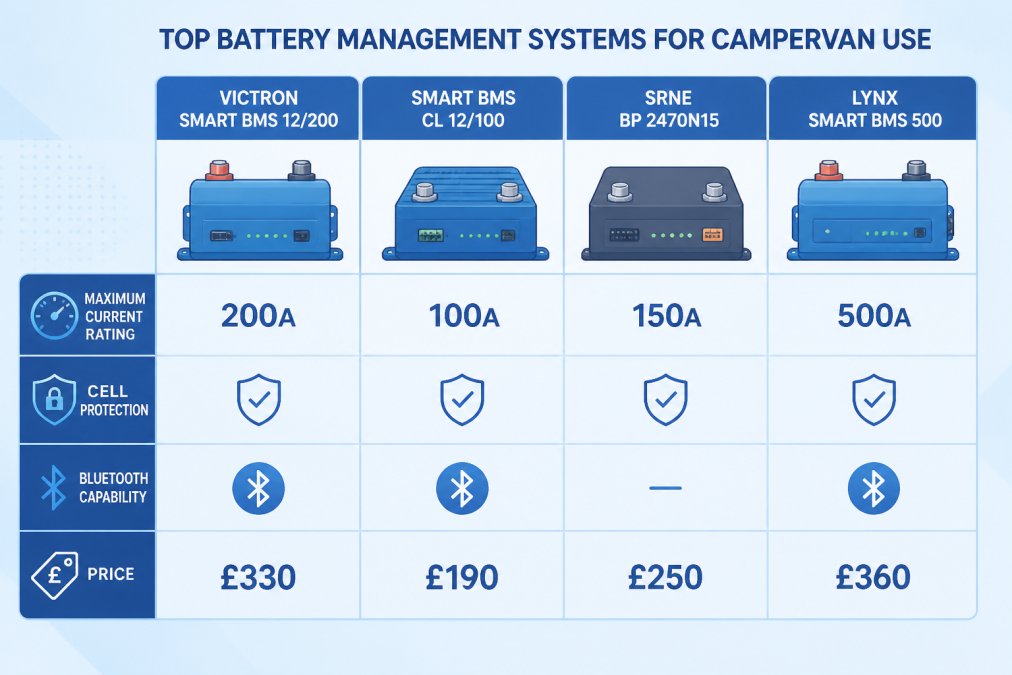
Victron Energy Smart BMS 12/200
The Victron Smart BMS 12/200 is the gold standard for 12V lithium campervan systems. It combines a current limiter for alternator charging, a battery combiner to safely connect starter and leisure batteries, and a battery protector to disconnect loads before deep discharge.

This unit electronically limits alternator current to approximately 90% of the fuse rating, protecting both the battery and alternator from overload. It monitors all four cells in each Victron LiFePO4 battery and disconnects the alternator, chargers, or loads if any cell exceeds safe voltage limits or temperature thresholds. Bluetooth connectivity via the VictronConnect app gives real-time monitoring.
Pros: Handles vehicle alternators safely; strong protection across all critical parameters; trusted by professional installers.
Cons: More expensive than budget options; overkill for small single-battery systems under 200Ah.
Best for: Campervans with large leisure batteries (300Ah+) and high-capacity alternators; systems combining leisure and starter batteries.
Victron Energy Smart BMS CL 12/100
The Victron Smart BMS CL 12/100 is the practical choice for most campervan conversions. It delivers the same cell-level protection as the 12/200 but limits charge current to 100A, which suits typical leisure battery banks (100-280Ah) and smaller alternators.
This unit monitors individual cells and automatically disconnects the alternator if any cell voltage exceeds safe limits. It includes three protective outputs: a load disconnect output that cuts power to non-essential loads when voltage drops below safe levels, a pre-alarm output that triggers a warning before disconnection, and a charge disconnect output that stops the charger if voltage gets too high.
Pros: Perfect balance of protection and price for typical campervan builds; Bluetooth monitoring via VictronConnect; handles most alternator types safely.
Cons: Limited to 100A charge current; requires Victron batteries for full compatibility.
Best for: Single-battery campervan systems (100-280Ah); DIY converters wanting professional-grade protection.
SRNE BP 2470N15 Battery Protect
The SRNE BP 2470N15 is the budget-conscious choice and entry point for BMS protection. It's an intelligent low-voltage disconnect and over-current protection module designed for 12V, 24V, 36V, and 48V systems, making it versatile across different campervan electrical architectures.
This unit prevents deep discharge by disconnecting loads when voltage drops below a safe threshold (typically 10.8V for 12V systems, adjustable). It includes over-current and over-voltage protection to prevent damage from charging spikes. The IP65 enclosure makes it weather-resistant, critical for outdoor van installations. SRNE is a globally established manufacturer of solar controllers and RV power solutions, with the BP 2470N15 designed specifically for mobile and off-grid applications. According to SRNE product documentation, the BP 2470N15 includes TTL/Modbus communication capability and optional Bluetooth monitoring via an add-on module.
Pros: Most affordable option; compact and rugged; works with any battery chemistry; simple installation.
Cons: No Bluetooth monitoring included (optional extra); no cell-level monitoring like Victron units; manual voltage threshold adjustment required.
Best for: Budget builds and first-time upgraders; systems where cost matters more than advanced features; DIY installers wanting basic protection.
Victron Energy Lynx Smart BMS 500
The Victron Lynx Smart BMS 500 is the premium integrated solution for large, complex campervan systems. It combines a dedicated BMS for Victron lithium batteries with a modular busbar distribution system, integrating battery management, power distribution, and monitoring into a single compact unit.
The Lynx contains positive and negative busbars, a BMS contactor driven by battery management logic, and an integrated 1000A shunt for accurate battery monitoring. It communicates via Bluetooth (VictronConnect app) and VE.Can for integration with other Victron equipment.
Pros: Most comprehensive solution available; modular expansion; professional-grade monitoring; integrates seamlessly with Victron solar and inverter systems.
Cons: Far more complex than needed for typical campervan use; overkill for single-battery systems.
Best for: Professional campervan converters; large systems with 500Ah+ capacity; installations requiring integration with Victron solar and inverter equipment.
SRNE Solar Charge Controller Features and Integration
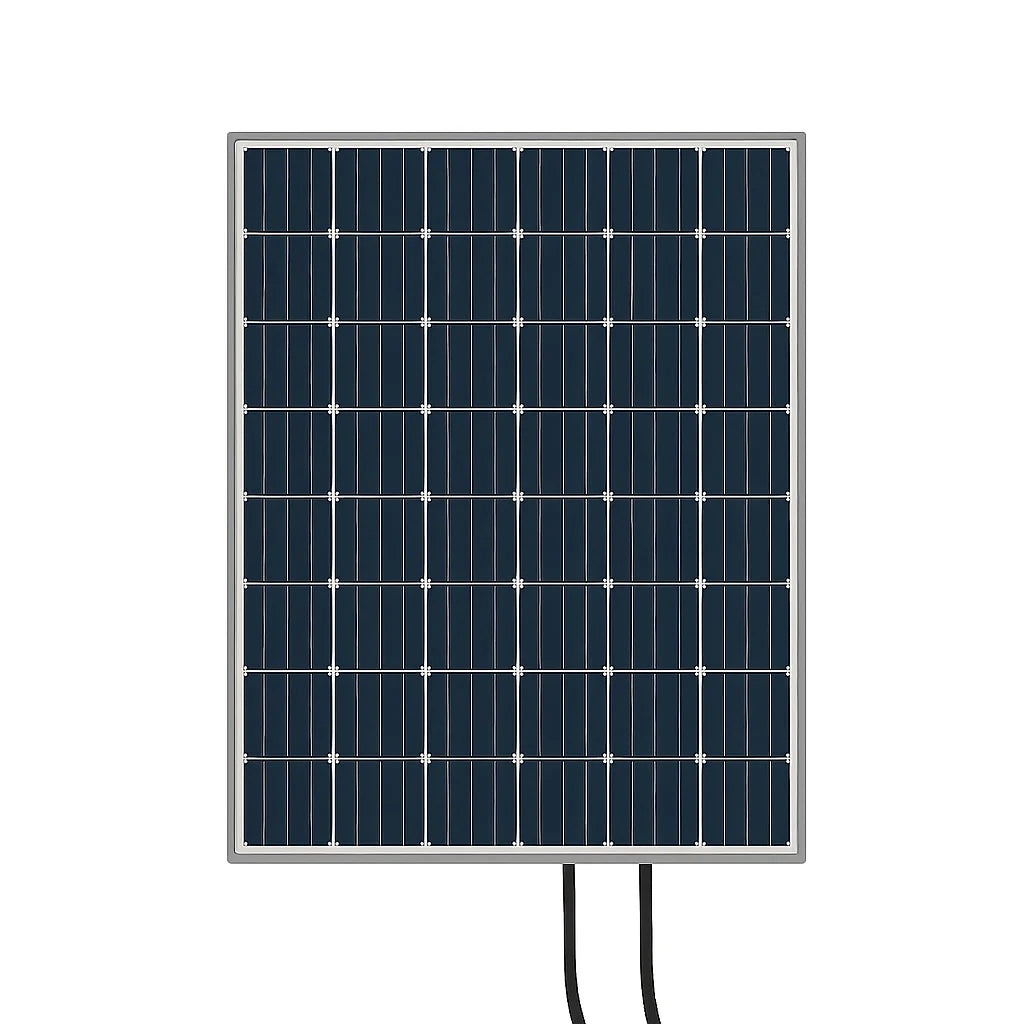
The SRNE solar charge controller (MPPT type) optimises solar panel output, extracting up to 30% more power than basic PWM controllers. In a campervan system, the SRNE MPPT controller sits between solar panels and the battery, managing how much current flows from the panels while communicating with the BMS to respect charge current limits.
The SRNE controller supports voltage ranges from 12V to 48V, matching the flexibility of the BP 2470N15 battery protector. Key features include MPPT algorithm that adjusts voltage and current 50+ times per second to track maximum power point, temperature compensation adjusting charge voltage based on ambient temperature, load control outputs allowing the controller to manage auxiliary loads, and data logging recording daily energy harvest and system performance.
Integration with Skyenergi's battery systems is seamless. Skyenergi stocks SRNE controllers alongside Victron BMS units, allowing customers to design complete systems where every component communicates and works together.
12V Electrical System Design for Campervans
A proper 12V electrical system starts with understanding the power triangle: battery capacity (amp-hours), charging rate (amps), and load consumption (watts).
Battery capacity is measured in amp-hours (Ah). A 100Ah lithium battery stores 100 amps of current for one hour, or 10 amps for ten hours. You should never discharge a lithium battery below 10% capacity to maximise lifespan, so a 100Ah lithium battery gives you 90Ah of usable power. camping gear essentials.
Charging rate depends on your sources. A vehicle alternator typically charges at 50-100A depending on engine RPM. Solar panels charge at 10-30A depending on weather and panel size. A mains charger can charge at 16A or higher. Load consumption drains your battery: a fridge draws 3-5A continuously, a water heater draws 10-20A, and LED lights draw 0.5-2A. A typical campervan uses 20-40A per day. Calculate your daily consumption, then size your battery to store 2-3 days of power.
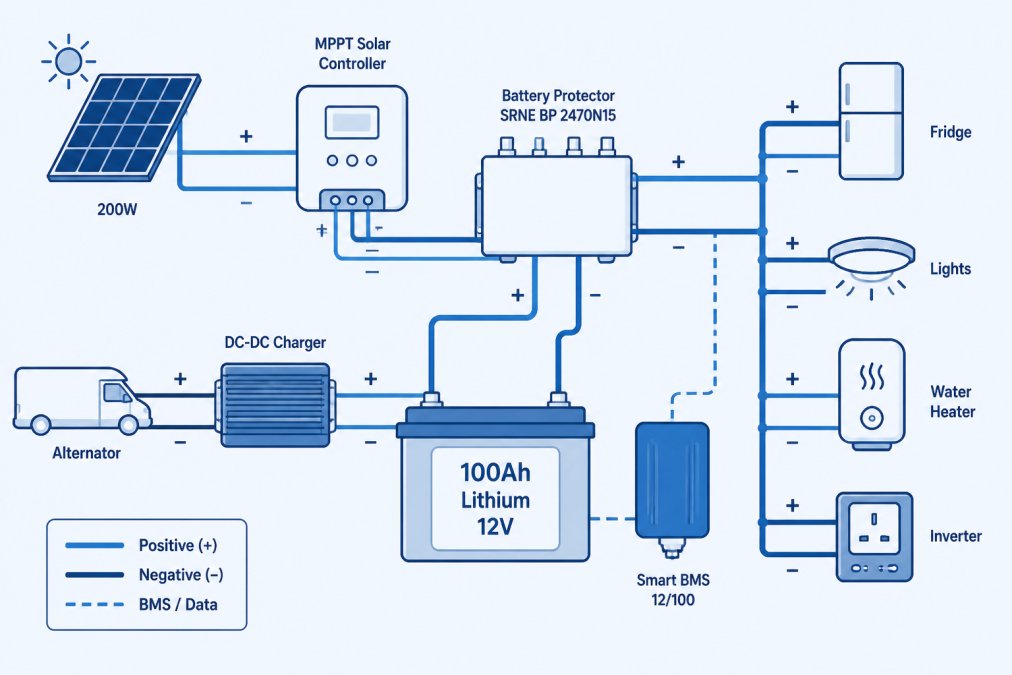
The BMS sits at the heart of this system, monitoring battery voltage and disconnecting the load if voltage drops too low, monitoring charge current from the alternator and limiting it to safe levels, and monitoring solar input to allow the MPPT controller to charge safely.
A typical campervan electrical system includes a lithium leisure battery (100-280Ah, 12V or 24V), battery management system (Victron Smart BMS or SRNE BP 2470N15), solar charge controller (SRNE MPPT, 200-400W typical), DC-DC charger from alternator (60-100A), battery monitor or shunt, inverter (2-3kW for 12V systems), fuses and breakers on every circuit, and wiring sized for current and distance. Skyenergi supplies all these components as a complete system, with matching specifications so everything works together.
Key Features to Look for in a Campervan BMS
When evaluating a BMS, focus on these non-negotiable features:
Cell-level voltage monitoring. The BMS must monitor each cell individually, not just pack voltage. Lithium cells drift over time, and a BMS that monitors only pack voltage won't catch an imbalanced cell until it's too late.
Adjustable disconnect thresholds. Different applications need different voltage setpoints. The best BMS units let you adjust low-voltage disconnect and pre-alarm thresholds via Bluetooth (Victron) or manual settings (SRNE).
Over-voltage and over-current protection. These prevent damage from charger failures or load spikes. All units in this guide include both.
Temperature monitoring. Lithium batteries are sensitive to temperature. A BMS with a thermistor input can disable charging in freezing conditions and disable operation in extreme heat. Premium units like the Victron Smart BMS 12/200 include this; budget units may require an optional temperature sensor.
Remote on/off capability. Being able to disable the BMS via a dashboard switch or Bluetooth is essential for safety. All units here support this.
Bluetooth connectivity and data logging. Modern BMS units should give you visibility into battery health, showing state of charge, voltage, current, and historical data. The SRNE BP 2470N15 offers optional Bluetooth via an add-on module.
Scalability. If you're planning to expand your system later, choose a BMS that scales. The Victron Smart BMS 12/200 supports up to five batteries in parallel. The SRNE BP 2470N15 works at any voltage from 12V to 48V.
Installation and Cold Weather Performance
Installing a campervan BMS is straightforward but requires attention to detail. The BMS sits between the battery and all loads and chargers, so every wire in your system passes through it.
Basic installation steps:
- Disconnect the leisure battery's negative terminal
- Run a heavy gauge cable from battery positive to the BMS positive input
- Run a heavy gauge cable from the BMS negative output to the main fuse/breaker
- Connect all chargers (alternator, solar, mains) to the appropriate BMS inputs
- Connect all loads through the BMS load output
- Run remote on/off wiring to a dashboard switch (optional)
- Configure voltage thresholds via Bluetooth (Victron) or manual settings (SRNE)
- Test: battery voltage should be stable, and loads should disconnect if voltage drops below the preset threshold
Cold weather performance separates good systems from poor ones. In freezing conditions, lithium batteries lose usable capacity and charging becomes dangerous. A BMS with low-temperature cut-off protection prevents charging below 0°C, avoiding lithium plating and fire risk.
A properly configured system delivers 85-90% of rated capacity in UK winter conditions (0-5°C), compared to lead-acid's 50% penalty. For most UK campervan owners in freezing conditions, disconnect the solar charger and rely on the alternator or mains charger, which deliver higher current and warm the battery faster. The BMS will handle it safely.
Choosing the right campervan battery management system comes down to matching your battery size, charging sources, and budget. For most UK campervan owners, the Victron Smart BMS CL 12/100 paired with a Skyenergi lithium battery and SRNE MPPT solar controller delivers professional-grade protection and monitoring. The SRNE BP 2470N15 is the budget entry point if cost is critical. For larger systems or professional builds, the Victron Lynx Smart BMS 500 integrates battery management with power distribution in a modular platform.

Skyenergi supplies all these components as complete, tested systems, ensuring compatibility and performance. With fast UK delivery and specialist support, upgrading your campervan electrical system to lithium power with proper BMS protection is now straightforward for DIY converters and professional installers alike.
Frequently Asked Questions
What is the difference between a battery monitor and a battery management system?
A battery monitor (like the Victron SmartShunt 300A, £54.84) measures state of charge, voltage and amperage, giving you real-time data via Bluetooth. A battery management system (BMS) actively protects your battery by disconnecting loads or chargers when voltage, temperature or current exceed safe limits. Many modern lithium batteries have both: an integrated BMS for protection and a shunt for monitoring. For campervans, you typically need both functions working together to keep your system safe and efficient.
Do I need an external BMS if my lithium battery already has an internal one?
It depends on your system complexity. Most quality lithium leisure batteries include an internal BMS that protects individual cells. However, an external BMS like the Victron Smart BMS 12/200 (£190.76) or SRNE BP 2470N15 (£54.00) adds critical functions: managing multiple batteries in parallel, protecting your alternator from overcharge, controlling load disconnection, and providing monitoring and remote shutdown. For multi-battery setups or when integrating with solar and DC-DC chargers, an external BMS is essential for system-level safety.
How does a BMS protect my campervan battery during cold weather?
A quality BMS prevents charging when battery temperature drops below safe limits, typically around 0°C. This is critical because charging lithium batteries in freezing conditions can cause internal damage. Advanced systems like those from Victron incorporate low-temperature cut-off protection. Some premium batteries include integrated heating elements controlled by the BMS, allowing safe operation in sub-zero environments. For UK winter camping, look for a BMS with temperature monitoring and cold-weather capability, or pair your system with a battery heater pad controlled by the BMS output.
What is the typical lifespan of a lithium campervan battery with proper BMS management?
A quality lithium leisure battery with proper BMS management typically lasts 10 to 15 years, compared to 3 to 5 years for lead-acid. Lithium batteries are designed for 2,000 to 5,000 charge cycles, far exceeding lead-acid's 300 to 500 cycles. The BMS extends this lifespan by preventing deep discharge, over-voltage, over-current and thermal stress. Real-world testing shows that a properly sized Skyenergi battery paired with an SRNE MPPT controller delivers 95% of rated capacity in typical UK conditions, with cold snaps reducing this to 85-90%, still significantly better than lead-acid's 50% winter penalty.
This article was written using GrandRanker
Prev post

Lithium Battery Fast Charging: Benefits & Best Practices
Updated on 31 August 2026
Next post

Is Lithium Battery Worth the Cost in 2026?
Updated on 29 August 2026


