





Run an Induction Hob on 12V Lithium: A How-To Guide
Induction hob 12V lithium: Can you run a portable induction hob on 12V lithium? Yes—with the right inverter and battery capacity.
Table of Contents
- Can You Run a Portable Induction Hob on 12V Lithium?
- Why Induction Hobs Need AC Power and an Inverter
- Inverter Size for Induction Hob: Calculating Your Requirements
- Induction Hob Battery Consumption: Power and Energy Demands
- How Long Will a Lithium Battery Run an Induction Hob?
- Choosing a 12V Lithium Battery for Induction Hob Cooking
- Safe Installation and System Setup
- Frequently Asked Questions
Last Updated: October 12, 2026
Can You Run a Portable Induction Hob on 12V Lithium?
Yes, you can run a portable induction hob 12V lithium battery system. But it requires careful system design. An induction hob demands AC power, which your 12V battery cannot supply directly. You'll need a pure sine wave inverter to convert DC to AC. The inverter must handle the hob's peak power draw, and your lithium battery must have sufficient capacity and discharge capability.

At Skyenergi, we've helped countless campervan owners and off-grid enthusiasts build systems that support induction cooking. The reality is simpler than many guides suggest: match your inverter size to the hob's wattage, choose a lithium battery with adequate amp-hour capacity, and install everything safely.
This guide walks you through the exact requirements. We'll cover inverter sizing, battery capacity calculations, runtime estimates, and safe installation. By the end, you'll know whether induction cooking fits your 12V system, and how to make it work if it does.
Why Induction Hobs Need AC Power and an Inverter
Induction hobs are designed for mains AC electricity. They don't accept 12V DC input directly. A standard portable induction hob operates at 230V AC in the UK.
Your 12V lithium battery stores energy as DC (direct current). An inverter converts that DC into AC (alternating current) at the voltage your hob expects. Without an inverter, the hob simply won't turn on.
Why not step up the voltage directly? A voltage converter would add cost and complexity. An inverter is the standard solution for mobile and off-grid systems. It also provides safety features built in: overload protection, thermal shutdown, and automatic cutoff if the battery voltage drops too low.
The inverter sits between your battery and the hob. When you plug the hob in, current flows from the battery through the inverter, which transforms it into the AC power the hob needs.
A critical point: Not all inverters suit induction cooking. You need a pure sine wave inverter. Modified sine wave inverters produce choppy, irregular AC output that can damage sensitive electronics. Induction hobs are sensitive. A pure sine wave inverter delivers smooth, stable power that keeps your hob running safely.
Inverter Size for Induction Hob: Calculating Your Requirements
The inverter must be large enough to handle your hob's power draw. This is where most mistakes happen.
Start with the hob's wattage. A typical portable induction hob draws between 1,500 and 3,000 watts depending on the model and heat setting. Check your hob's manual or the label on the back for the rated wattage.
Inverter continuous power vs. surge power. Inverters have two ratings:
- Continuous power: The steady wattage the inverter can supply indefinitely
- Surge power: The peak wattage for a few seconds when the hob first switches on
Induction hobs have a brief power spike at startup. Your inverter's continuous rating should match or exceed the hob's rated wattage. The surge rating should be 20-30% higher to handle the startup spike.
Example calculation: If your hob is rated 2,000 watts, you need an inverter with at least 2,000 watts continuous. A 2,500 or 3,000 watt inverter gives you headroom and efficiency.
Many users make this mistake: they buy a 1,500 watt inverter thinking it's "enough" and then the hob won't heat properly or the inverter shuts down under load. The undersized inverter can't deliver the power the hob demands.
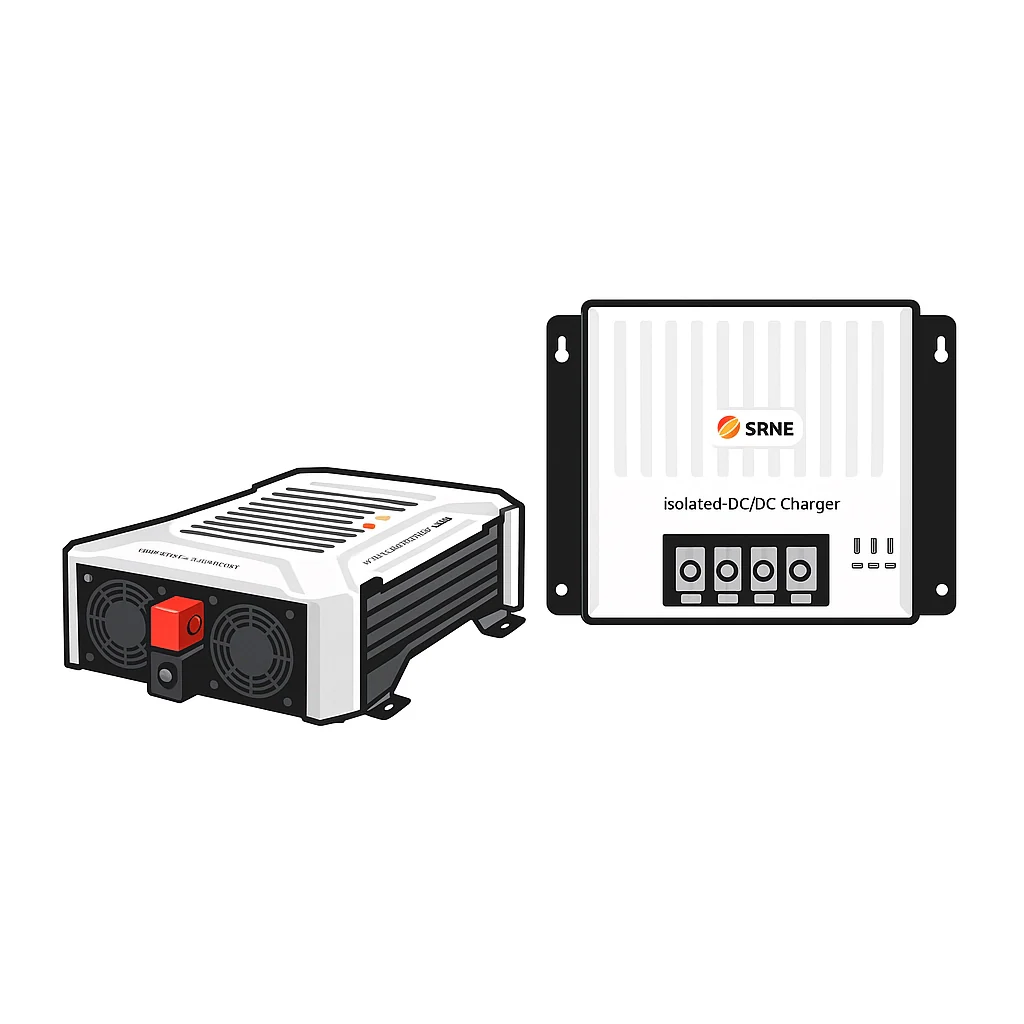
The SRNE SR-IBC12-2kW Pure Sine Wave Inverter is a popular choice for induction cooking. For larger hobs or higher power settings, the SRNE SR-IBC12-3kW offers 3,000 watts continuous, providing more flexibility.

Both SRNE inverters include built-in transfer switching, so if you're parked at a site with mains power, the inverter automatically switches to utility input and saves your battery. That's a practical feature for campervan owners who move between off-grid and serviced pitches.
Induction Hob Battery Consumption: Power and Energy Demands
An induction hob is power-hungry. Understanding how much energy it uses helps you choose the right battery and predict runtime.
Power vs. energy: Power is instantaneous draw (watts). Energy is power used over time (watt-hours). Your hob might draw 2,000 watts, but how long you run it determines total energy consumed.
At full power, a 2,000 watt hob uses:
- 2,000 watt-hours (2 kWh) per hour
- 33 watt-hours per minute
- 550 watt-hours for a 15-minute cooking session
In practice, most cooking uses lower settings. A medium heat setting might draw 1,200 watts. A simmer might use 800 watts. Lower settings consume proportionally less energy.
Inverter efficiency matters. Your inverter doesn't convert 100% of battery power to AC power. A pure sine wave inverter typically operates at 85-92% efficiency. That means some energy is lost as heat.
If your hob draws 2,000 watts, the battery must supply about 2,200 watts to account for inverter losses. This is why battery capacity calculations need a safety margin.
Real-world example: Boiling water for a hot drink takes about 5-10 minutes at full power. A full meal prep, say, 30 minutes of cooking at mixed settings, might draw 15,000-20,000 watt-hours from your battery, depending on heat levels.
The takeaway: induction cooking is energy-intensive. Your lithium battery must have enough capacity to handle both the instantaneous power draw and the cumulative energy use without dropping below its safe voltage limit.
How Long Will a Lithium Battery Run an Induction Hob?
Runtime depends on three factors: battery capacity, power draw, and the inverter's efficiency.
Battery capacity is measured in amp-hours (Ah). A 100 Ah lithium battery stores 100 amps of current for one hour, or 50 amps for two hours. At 12V nominal, a 100 Ah battery holds roughly 1,200 watt-hours of usable energy.
Usable capacity is key. Most lithium batteries allow discharge down to 10% state of charge. A 100 Ah battery with 90% usable capacity gives you 1,080 watt-hours to work with.
Quick runtime estimates:
A 100 Ah lithium battery running a 2,000 watt hob at full power:
- 1,080 watt-hours ÷ 2,000 watts = 0.54 hours = 32 minutes
The same battery running the hob at 1,200 watts (medium heat):
SRNE SR-IBC12-3kW Pure Sine Wave Inverter →
- 1,080 watt-hours ÷ 1,200 watts = 0.9 hours = 54 minutes
A larger 280 Ah Skyenergi Edge battery:
- 3,024 watt-hours ÷ 2,000 watts = 1.5 hours = 90 minutes at full power
- 3,024 watt-hours ÷ 1,200 watts = 2.5 hours at medium heat
What about battery voltage sag? As your battery discharges, its voltage drops. Most lithium batteries have a battery management system (BMS) that cuts off discharge when voltage reaches a minimum threshold, typically around 10V. Once the BMS triggers, the inverter stops working.
This is why a larger battery gives you more practical runtime. A 280 Ah battery handles the voltage sag better than a 100 Ah battery. The voltage stays higher during discharge, so the inverter keeps running longer.
Continuous discharge rating also matters. Lithium batteries have a maximum continuous discharge current, usually stated in amps. A 100 Ah battery might have a 100 A continuous rating. At 2,000 watts on a 12V system, you're drawing about 167 amps (accounting for inverter efficiency).
This is a real constraint. Many smaller lithium batteries can't support induction cooking at full power because their discharge current limit is too low.
Choosing a 12V Lithium Battery for Induction Hob Cooking
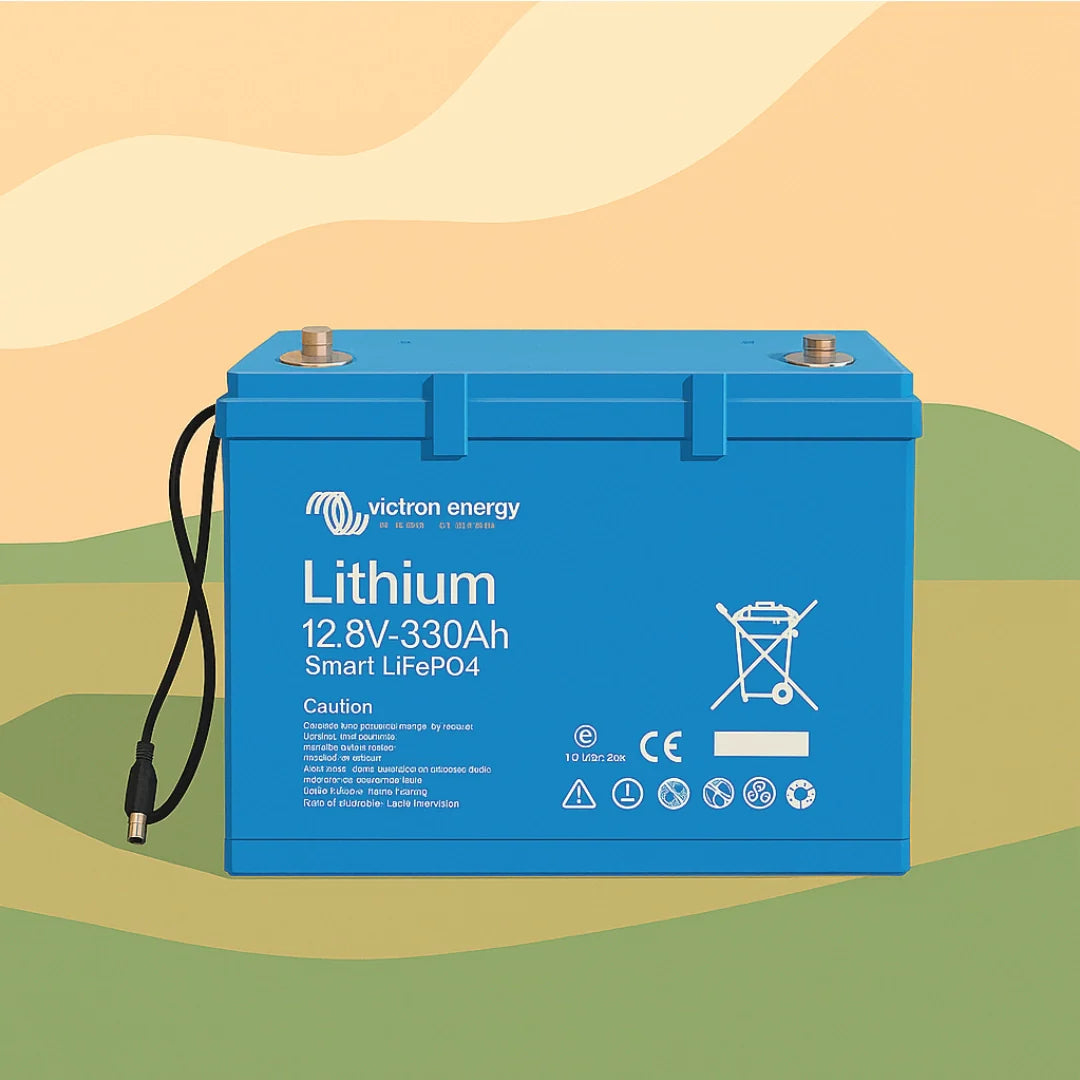
Not all 12V lithium batteries are equal for induction hob 12V lithium use cases. You need a battery that handles high discharge current and has enough capacity for meaningful cooking time.
Capacity: Start with at least 200 Ah. A 100 Ah battery gives you only 30 minutes of cooking at full power, barely enough to boil water and fry an egg.
Continuous discharge rating: Look for a battery rated for at least 150 A continuous discharge. This ensures the battery can supply the current your inverter demands without triggering the BMS cutoff.
Battery management system (BMS): The BMS protects the battery from over-discharge, over-charge, and over-current. A quality BMS is essential. It should have low-voltage cutoff set around 10V to protect the battery while maximizing usable capacity.
Chemistry: Lithium iron phosphate (LiFePO₄) is the standard for leisure batteries. It's safer, more durable, and more stable than other lithium chemistries. Avoid older lead-acid alternatives, they can't handle the discharge rates induction cooking demands.
The Skyenergi Edge range offers two practical options:
The Skyenergi Edge 100Ah is compact and affordable. It's suitable for light cooking tasks, boiling water, quick meals, occasional use. For regular induction cooking, it's marginal. You'll hit the voltage sag limit quickly.

The Skyenergi Edge 280Ah is the better choice for induction cooking. It has the capacity and discharge capability to handle sustained cooking at mixed power levels.
Both Edge batteries use a JBD BMS and Grade A EVE lithium cells. They're rated for 3,000+ charge cycles and come with an IP65-rated waterproof housing, essential for mobile applications.
System integration: Your battery doesn't exist in isolation. You'll also need:
- Cables and fuses: Heavy-duty cables between battery and inverter (typically 35-50 mm² cross-section for a 2,000+ watt inverter) and a DC-rated fuse near the battery
- Battery monitor: A Victron SmartShunt or similar device to track state of charge and current draw
- Charging system: A DC-to-DC charger (if your van has an alternator) or an MPPT solar charge controller (if you're using solar panels)
Skyenergi supplies all these components. The SRNE inverters integrate well with Skyenergi batteries and charging equipment, so you get a cohesive system rather than mismatched parts.
Safe Installation and System Setup
Induction cooking on a 12V system is safe if installed correctly. Poor installation causes fires, battery damage, and inverter failure.
Cabling is critical. The cable between battery and inverter carries high current, often 150+ amps. Undersized cable generates heat and can melt insulation.
Keep the cable run as short as possible. Every metre of cable adds resistance and voltage drop.
Fusing and disconnection: Install a DC-rated fuse between the battery positive terminal and the inverter. The fuse protects the cable if a short circuit occurs.
Install a battery disconnect switch so you can isolate the inverter when not in use. This prevents parasitic drain from the inverter's standby circuits.
Grounding: The inverter chassis and any exposed metal parts must be grounded to the battery negative terminal.
Ventilation: Inverters generate heat, especially under heavy load. Mount the inverter in a well-ventilated location with airflow around it.
Testing before use: Before plugging in the induction hob, test the system with a smaller load, a kettle or a lamp.
Monitoring: Watch the battery voltage and current draw while cooking. If the voltage drops below 11V or the current draw exceeds the battery's continuous rating, stop using the hob.
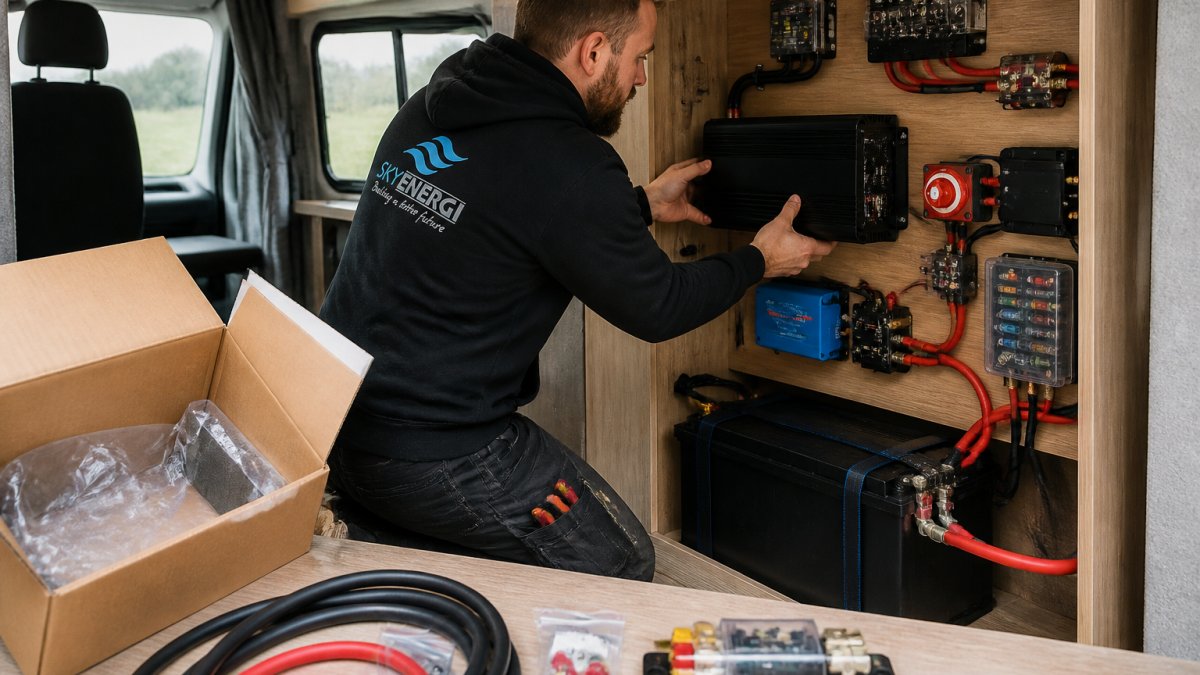
Running a portable induction hob on 12V lithium is practical and reliable when you match the right inverter to your battery.
Frequently Asked Questions
Can I connect an induction hob directly to a 12V lithium battery?
No. Induction hobs require AC mains power (230V in the UK), but 12V lithium batteries supply DC power. You must use a pure sine wave inverter to convert DC to AC. A direct connection will damage the hob and create a safety hazard. The inverter converts your battery's DC output into clean AC electricity that the hob can safely use.
What size inverter do I need for a portable induction hob?
Most portable induction hobs draw 1500-2000W at full power. You need an inverter rated for at least the hob's continuous wattage plus a safety margin. The SRNE SR-IBC12-2kW pure sine wave inverter (£429) handles standard portable hobs reliably. For higher-power models or simultaneous loads, the 3kW SRNE SR-IBC12-3kW (£476) provides extra headroom. Always check your hob's rated wattage and choose an inverter that exceeds it.
How long can a 12V lithium battery run an induction hob?
Runtime depends on battery capacity and hob power setting. A 100Ah lithium battery (approximately 1.28 kWh usable energy) running a 1500W hob at full power delivers roughly 50 minutes of cooking time, accounting for inverter losses. A 280Ah battery extends this to over 2 hours. Lower hob settings significantly extend runtime. Use this formula: (Battery capacity in Ah × 12V × 0.85 efficiency) ÷ Hob wattage = minutes of runtime.
Is a lithium battery better than lead-acid for running an induction hob?
Yes. Lithium batteries discharge at higher rates safely and maintain stable voltage throughout discharge, which induction hobs need for consistent performance. Lead-acid batteries risk voltage sag under the heavy current draw, causing the hob to underperform or shut down. Lithium also offers deeper usable capacity (typically 80-100% versus 50% for lead-acid), meaning you get more cooking time from the same physical size. The Skyenergi Edge lithium range is specifically engineered for high-power appliances in campervans and off-grid setups.
Next post

Are Lithium Batteries Worth the Money?
Updated on 11 October 2026


