





MPPT vs PWM Solar Charge Controller for Campervan
MPPT vs PWM solar charge controller for campervan: compare efficiency, lithium compatibility and sizing. Find the best controller for your setup.
Table of Contents
- MPPT vs PWM Solar Charge Controller for Campervan: Quick Comparison
- How MPPT and PWM Controllers Work Differently
- Efficiency and Real-World Energy Harvest Compared
- Best Solar Charge Controller for Lithium Batteries
- How to Size a Solar Charge Controller for Your Campervan
- SRNE MPPT Controller Performance and Skyenergi Options
- When PWM Still Makes Sense for Small Campervan Systems
- Conclusion
- Frequently Asked Questions
Last Updated: September 16, 2026
MPPT vs PWM Solar Charge Controller for Campervan: Quick Comparison
The MPPT vs PWM solar charge controller for campervan decision comes down to one number: MPPT controllers capture 25-43% more energy than PWM units, according to The Green Watt's efficiency comparison for off-grid solar systems. For a van running a compressor fridge and lithium leisure battery, that gap decides whether you wake up to a full bank or a voltage alarm.
At Skyenergi, we supply both technologies and see where each one earns its place. This guide covers how they work, what they cost, and which suits your build.
Winner: MPPT for any campervan running lithium, a panel above 100W, or panels wired in series. Choose PWM only for a small, cost-driven setup where panel voltage matches battery voltage closely.
| Factor | MPPT | PWM |
|---|---|---|
| Energy harvest | 25-43% more | Baseline |
| Panel voltage flexibility | High (series arrays fine) | Must match battery closely |
| Lithium charging control | Full multi-stage | Limited |
| Typical cost | Higher | Lower |
| Best for | Lithium, larger arrays | Small, budget builds |
How MPPT and PWM Controllers Work Differently
The core difference is voltage handling. A PWM controller pulls panel voltage down to battery voltage, discarding the excess. An MPPT controller lets the panel run at its maximum power point and converts the surplus into usable current.

Pulse Width Modulation: Simple Voltage Matching
Pulse Width Modulation (PWM) is a charge control method that rapidly switches the solar array connection on and off to regulate average voltage down to the battery's level. It is cheap, compact, and mechanically simple, which is why it survives in small builds. The catch: if your panel produces 18V and your battery sits at 12V, that 6V difference is lost as heat rather than harvested.
Maximum Power Point Tracking: Active Optimisation
Maximum Power Point Tracking (MPPT) is a charge control method that continuously adjusts the electrical operating point of the solar array to extract maximum available power, then converts it to the voltage your battery needs. As Truck Camper Adventure's controller guide explains, PWM is limited to bulk-charging at constant voltage, while MPPT optimises the bulk, absorption, and float stages properly.
Efficiency and Real-World Energy Harvest Compared
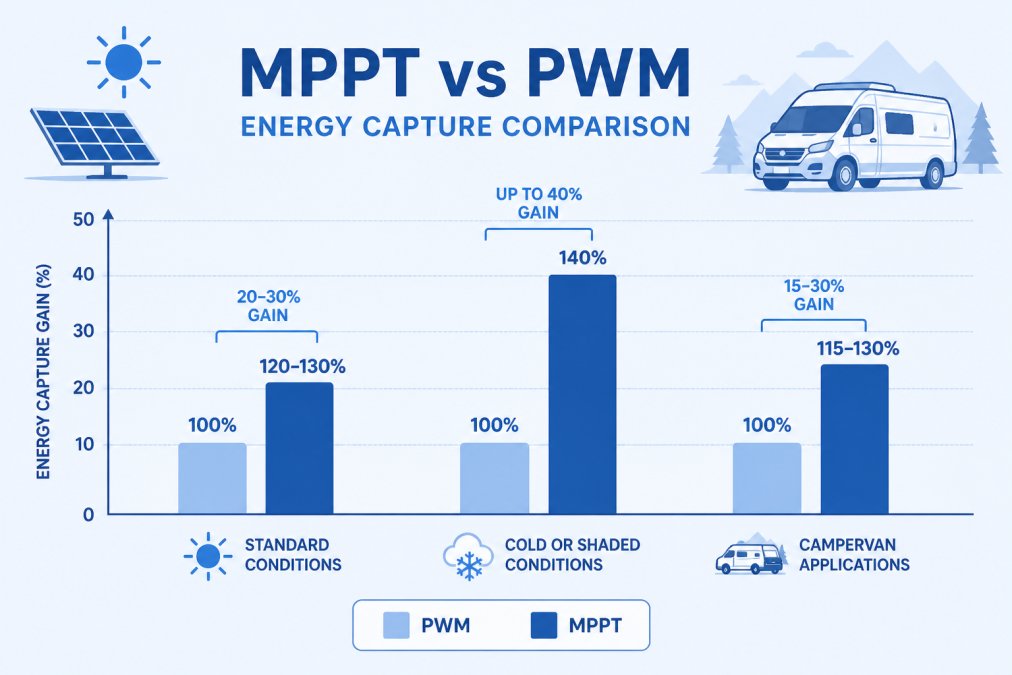
Expect 20-30% more charging from MPPT in normal conditions, rising to 40% in cold or shaded weather. Those gains matter most in exactly the conditions campervans meet: overcast mornings, partial shade from trees, and low winter sun.
Best Solar Charge Controller for Lithium Batteries
MPPT is the correct choice for lithium. LiFePO4 batteries need precise control of charging parameters, and PWM's constant-voltage bulk approach cannot deliver the staged profile lithium cells require for longevity.
How to Size a Solar Charge Controller for Your Campervan
Match the controller's rated current to your array's output, then leave headroom. The formula is simple: take your total panel wattage, divide by battery voltage, and add 20-25% margin.
Wiring Gauge and Voltage Drop: The Hidden Sizing Factor
Most guides stop at the current formula, but cable selection often decides whether your controller performs as rated. Voltage drop across the run from panel to controller reduces the input voltage the MPPT sees, which can push it off the maximum power point. The longer the run and the thinner the cable, the worse the loss.
Series vs Parallel Array Configuration
Series wiring raises voltage and lowers current, suiting MPPT controllers and long cable runs. Parallel wiring keeps voltage lower but current higher, which can be useful if partial shade is a frequent issue, though bypass diodes in modern panels mitigate this. For campervans, series is often preferred because it reduces cable weight and voltage drop, and MPPT handles the higher input voltage efficiently.
Victron Energy SmartSolar MPPT 75/15 →
Three Practical Checks Before You Buy
- Panel voltage: confirm the controller's maximum PV open-circuit voltage exceeds your array's coldest-condition Voc. Cold increases voltage, so a 100V controller may be needed for a 36V nominal array in winter.
- Battery chemistry: verify the controller lists your exact battery type, not just "lithium compatible". SRNE units offer user-defined profiles for LiFePO4 and other chemistries.
- Wiring distance: longer cable runs increase voltage drop, which pushes you toward higher input voltages and MPPT. Calculate drop before committing to a gauge.
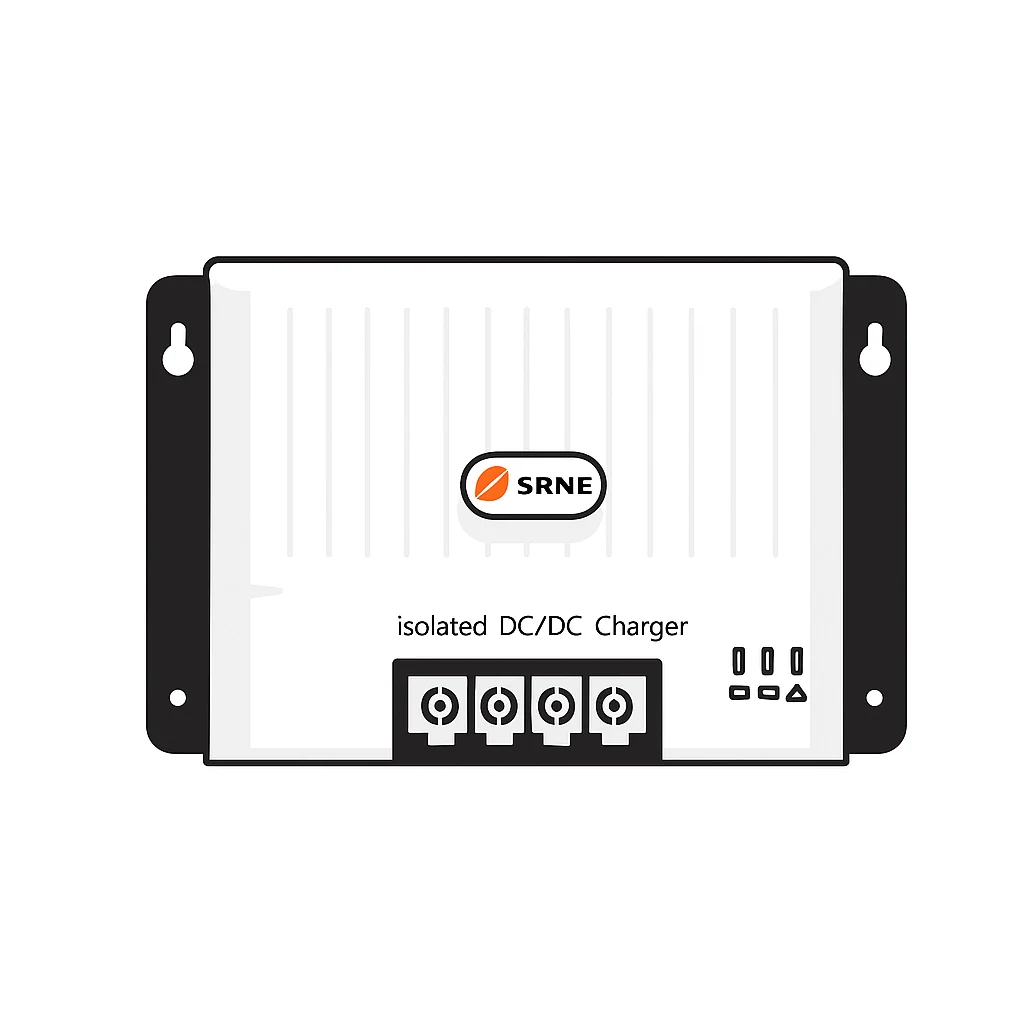
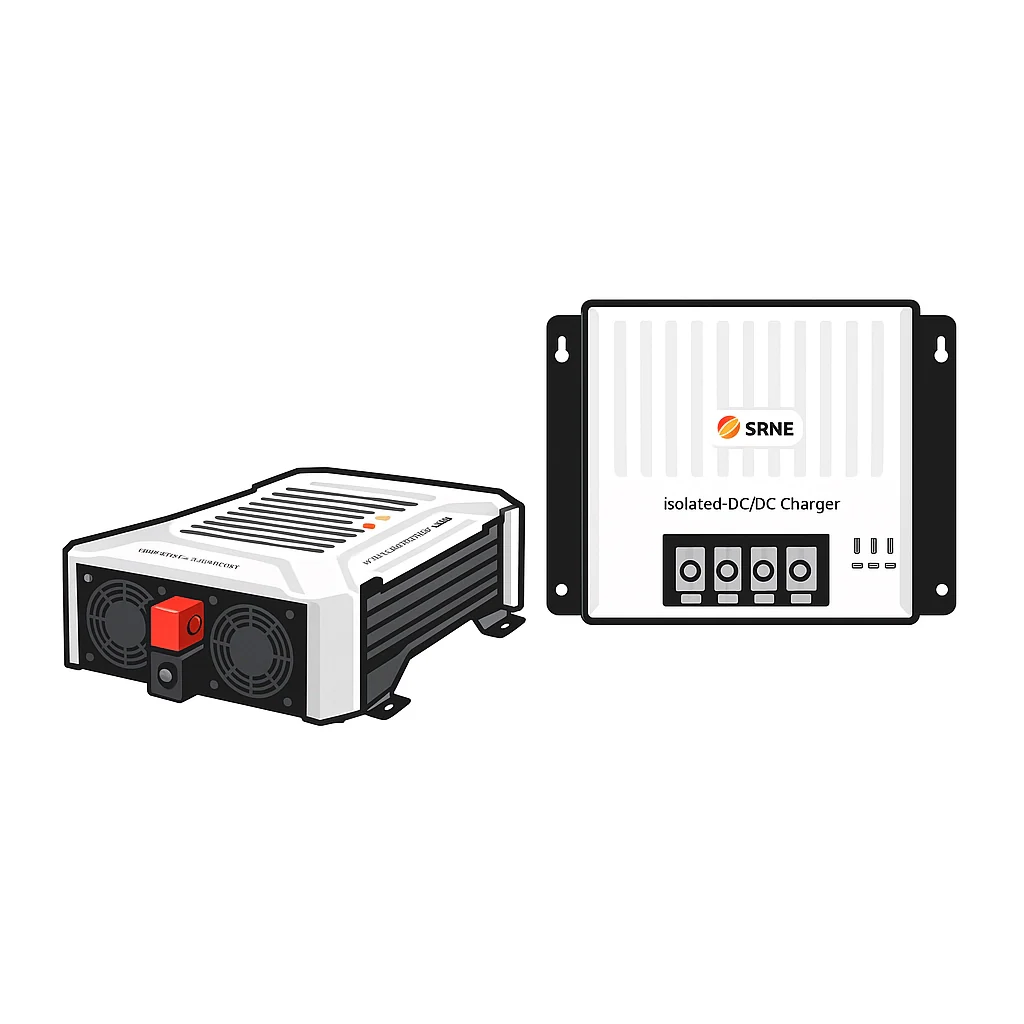
SRNE MPPT Controller Performance and Skyenergi Options
SRNE controllers cover most campervan builds, from a single-panel setup to a full multi-source electrical system. The range scales with your ambitions rather than forcing a compromise.
| Model | Price | Key Strength | Best For |
|---|---|---|---|
| Victron BlueSolar MPPT 75/15 | £36.90 | Lowest-cost true MPPT | Budget builds, single panel |
| Victron SmartSolar MPPT 75/15 | £48.95 | Built-in Bluetooth, load output | Small systems wanting monitoring |
| SRNE Shiner 2430 MPPT 30A | £99.00 | 30A, multi-chemistry, 3-year warranty | Most campervan builds |
| SRNE MD1250 Dual DC-DC & MPPT | £221.00 | Solar plus alternator input | Vans charging from both sources |
| SRNE SAA 1250 3 in 1 | £369.00 | Solar, alternator, and mains in one | Full system builds |
When PWM Still Makes Sense for Small Campervan Systems
PWM is not obsolete. For a tiny setup with a perfectly matched panel and a tight budget, it does the job without the premium. But the case for PWM is narrower than most guides admit, and it hinges on factors that are often overlooked.
The Temperature Coefficient Reality
Most comparisons ignore how heat affects panel voltage. Solar panels have a negative temperature coefficient for voltage, typically around -0.3% per °C for silicon. On a hot van roof, cell temperatures can reach 60-70°C, well above the 25°C standard test condition. This reduces panel voltage, which narrows the gap between the panel's maximum power point and battery voltage. In extreme heat, a PWM controller may lose very little because there is little excess voltage to waste.
The Wiring Cost Trade-Off
PWM controllers operate at lower voltage and higher current, which demands thicker cable to keep voltage drop acceptable. That cable is heavier and more expensive. For a 5m run at 10A, you might need 4mm² cable with PWM versus 2.5mm² with MPPT (which can run higher voltage at lower current). The cost difference can be £15-£30, plus the weight penalty.
Two Scenarios Where PWM Still Wins
First, a small system where a nominal 12V panel pairs directly with a 12V battery, so there is little excess voltage to lose anyway. Second, consistently hot environments where voltage drop is less of a performance penalty. PWM units are also cheaper, lighter, and simpler, which some owners value for long-term reliability in remote locations.
Conclusion
The choice is rarely close. If you run lithium, wire panels in series, or want reliable charging through overcast weather, MPPT is the answer, and the efficiency data backs it decisively.
Frequently Asked Questions
What is the best solar charge controller for a campervan?
For most campervan setups with lithium batteries, an MPPT controller is the better choice. MPPT controllers deliver 20-30% more energy harvest than PWM units in standard conditions, and gains can reach 40% in cold or overcast weather. The SRNE Shiner 2430 MPPT 30A with Bluetooth (£99.00) offers over 99% tracking efficiency, supports lithium, AGM and gel batteries, and includes a 3-year warranty. It suits 12V and 24V systems up to 400W solar input.
Can a PWM controller damage a lithium battery?
PWM controllers will not damage a lithium battery if configured correctly, but they charge less effectively. PWM units pull panel voltage down to battery voltage, which means they cannot fully optimise the bulk, absorption and float stages that lithium batteries need. MPPT controllers adjust charging parameters to suit the battery type, which helps extend lithium battery life. If you are running LiFePO4, an MPPT controller is the safer long-term option.
What size MPPT controller do I need for a 400W solar panel?
For a 400W panel on a 12V system, you need a controller rated for at least 30A. Divide the panel wattage by the battery voltage: 400W ÷ 12V = 33.3A. Round up to the nearest standard size, so a 30A controller works if your panel rarely hits peak output, but a 40A unit gives more headroom. The SRNE Shiner 2430 MPPT 30A handles 400W at 12V and 800W at 24V, making it a good match for this setup.
Why is MPPT more efficient than PWM in overcast weather?
MPPT controllers constantly track the panel's maximum power point, adjusting voltage and current to extract the most available power. When light intensity drops, panel voltage fluctuates and PWM controllers lose more energy because they cannot adapt. MPPT efficiency gains over PWM can reach up to 40% in cold or shaded conditions. This matters for campervan owners who camp in variable weather or rely on solar through autumn and winter.
Is a PWM controller better than MPPT for small systems?
PWM controllers suit very small, cost-driven setups where the solar panel voltage closely matches the battery voltage. They are lighter, cheaper and simpler. If your panel is 100W or less and your battery is a standard lead-acid type, PWM works fine. Once you move to 200W or more, or switch to lithium, MPPT pays for itself through higher energy harvest and better charging control.
Prev post

Fogstar Battery Alternative for Campervans: Skyenergi Picks
Updated on 17 September 2026
Next post

DC to DC Charger: The 2026 Buyer's Guide
Updated on 15 September 2026


