





12V Lithium Battery for Tight Spaces: Complete Guide
Find the right 12V lithium battery for tight spaces in your campervan or van conversion. Compare slimline options, installation tips, and space-saving.
Table of Contents
- Why 12V Lithium Batteries Outperform Lead-Acid in Confined Spaces
- Slimline Design and Weight Reduction Benefits
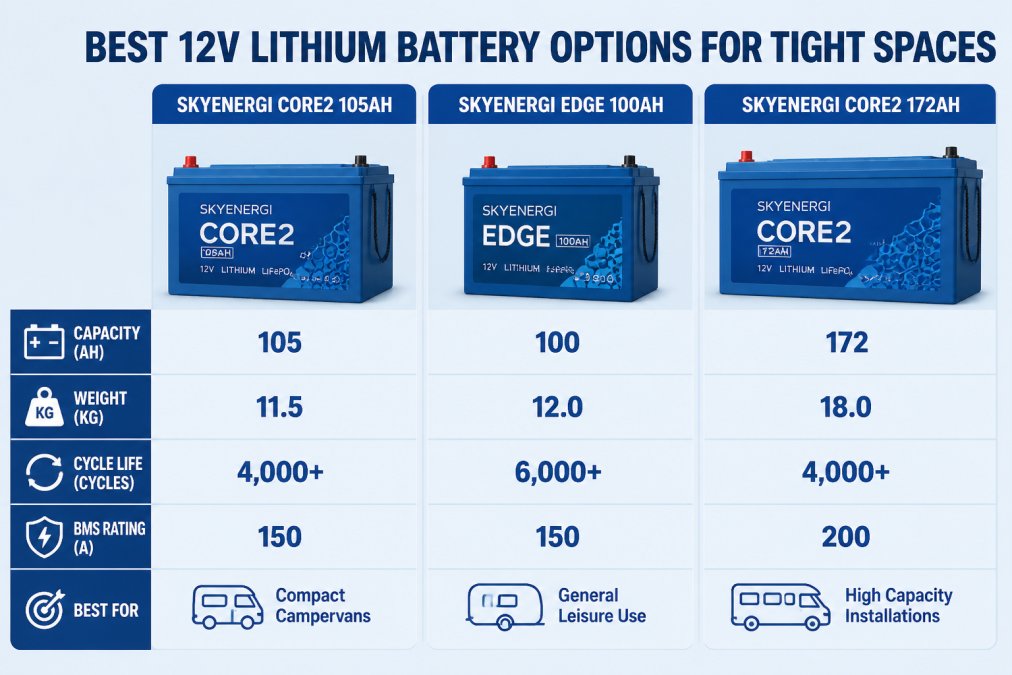
- Best 12V Lithium Battery Options for Tight Spaces
- Van Electrical System Design for Compact Batteries
- Installing Lithium Batteries in Small Spaces
- SRNE Solar Charge Controller Compatibility
- Safety Features of LiFePO4 Technology
- How to Choose the Right Battery for Your Space
Last Updated: August 18, 2026
Why 12V Lithium Batteries Outperform Lead-Acid in Confined Spaces
A 12V lithium battery for tight spaces solves a critical problem for campervan and motorhome owners: fitting reliable power into vehicles where every centimetre counts. In 2024 alone, over 22,000 home battery systems were installed in the UK, with monthly installations rising from dozens per month in 2022 to over 1,000 per month in 2024 (Enlit World, 2026). This acceleration reflects a fundamental truth: lithium works where lead-acid doesn't, especially when space is the constraint.
A 100Ah lithium unit weighs approximately 12-14kg compared to 25-30kg for a traditional AGM battery of similar capacity. LiFePO4 batteries boast a round-trip efficiency of 95-98%, while lead-acid batteries are typically around 70-85%. Your solar panels charge faster, your inverter draws less parasitic power, and your fridge stays cold longer on the same stored energy.
At Skyenergi, we've tracked this transition closely. Campervan owners now know that lithium won't strand them mid-trip, won't require constant maintenance, and will outlast three or four lead-acid replacements.
Slimline Design and Weight Reduction Benefits
Compact design is the difference between a usable van layout and one where the battery dominates the living space. Modern lithium batteries have improved energy density by up to 30% compared to previous models, allowing more energy storage in less weight.
A campervan that's 15-20kg lighter sits lower, handles corners better, and uses less fuel. A slimline 12V lithium battery can slot into spaces where lead-acid simply wouldn't fit, under seats, in narrow lockers, behind kitchen units, or in floor cavities of a Mercedes Sprinter or Ford Transit.
Thermal management becomes easier with a lighter, more compact unit. The surface-area-to-volume ratio improves, meaning the battery runs cooler under the same load.
Best 12V Lithium Battery Options for Tight Spaces
When space is the constraint, capacity must match physical dimensions, weight, and mounting location.
Skyenergi Core2 105Ah: Ultra-Compact Performance
The Skyenergi Core2 105Ah delivers approximately 1,344 Wh of usable energy, enough for a weekend trip with moderate power draw. The 100A JBD Battery Management System protects against overcharge, over-discharge, over-current, and temperature extremes. Integrated heat pad technology enables safe charging in freezing conditions. Bluetooth connectivity via the Skyenergi app provides real-time state of charge, voltage, current, and temperature monitoring. Cycle life reaches 2,000 cycles at 80% depth of discharge, meaning over 10 years in typical leisure use.
Best for: Solo travellers, short trips, or secondary batteries in dual-battery systems.
Skyenergi Edge 100Ah: Budget-Friendly Compact Option
The Skyenergi Edge 100Ah delivers 100Ah capacity while stripping away Bluetooth and heat pad features. The 100A JBD BMS and Grade-A EVE lithium cells ensure consistent performance. The IP65-rated waterproof housing is rugged for demanding outdoor use. For installers and DIY enthusiasts wanting proven reliability without smart features, the Edge is the pragmatic choice. You can pair it with a Victron SmartShunt for monitoring if needed.
No heat pad means charging in sub-zero temperatures requires external warming or delay until natural warming occurs. For most UK touring, this is acceptable.
Best for: Budget-conscious installers, DIY enthusiasts, or secondary batteries.
Skyenergi Core2 172Ah: Space-Efficient DIN Fit
The Skyenergi Core2 172Ah uses a standard DIN case format, allowing it to physically replace traditional lead-acid leisure batteries in existing installations. At 172Ah, you get approximately 2,202 Wh of usable energy. The 250A JBD BMS suits mid-range systems. Cycle life extends to 2,000 cycles at 80% depth of discharge. The DIN format simplifies installation: drop the lithium battery into the existing lead-acid battery box without redesigning your electrical layout. Heat pad technology and Bluetooth monitoring are included.
Best for: Upgrading from lead-acid in existing systems, DIN-compatible motorhomes, or installations where the battery bay is already defined.
Comparison Table: Capacity vs. Physical Footprint
| Battery Model | Capacity (Ah) | Usable Energy (Wh) | Weight (kg) | Cycle Life | BMS Rating (A) | Best For |
|---|---|---|---|---|---|---|
| Skyenergi Edge 100Ah | 100 | 1,280 | ~13 | 2,000 | 100 | Budget builds, secondary systems |
| Skyenergi Core2 105Ah | 105 | 1,344 | ~14 | 2,000 | 100 | Compact primary batteries, tight spaces |
| Skyenergi Core2 172Ah | 172 | 2,202 | ~22 | 2,000 | 250 | DIN-fit upgrades, mid-range systems |
Van Electrical System Design for Compact Batteries
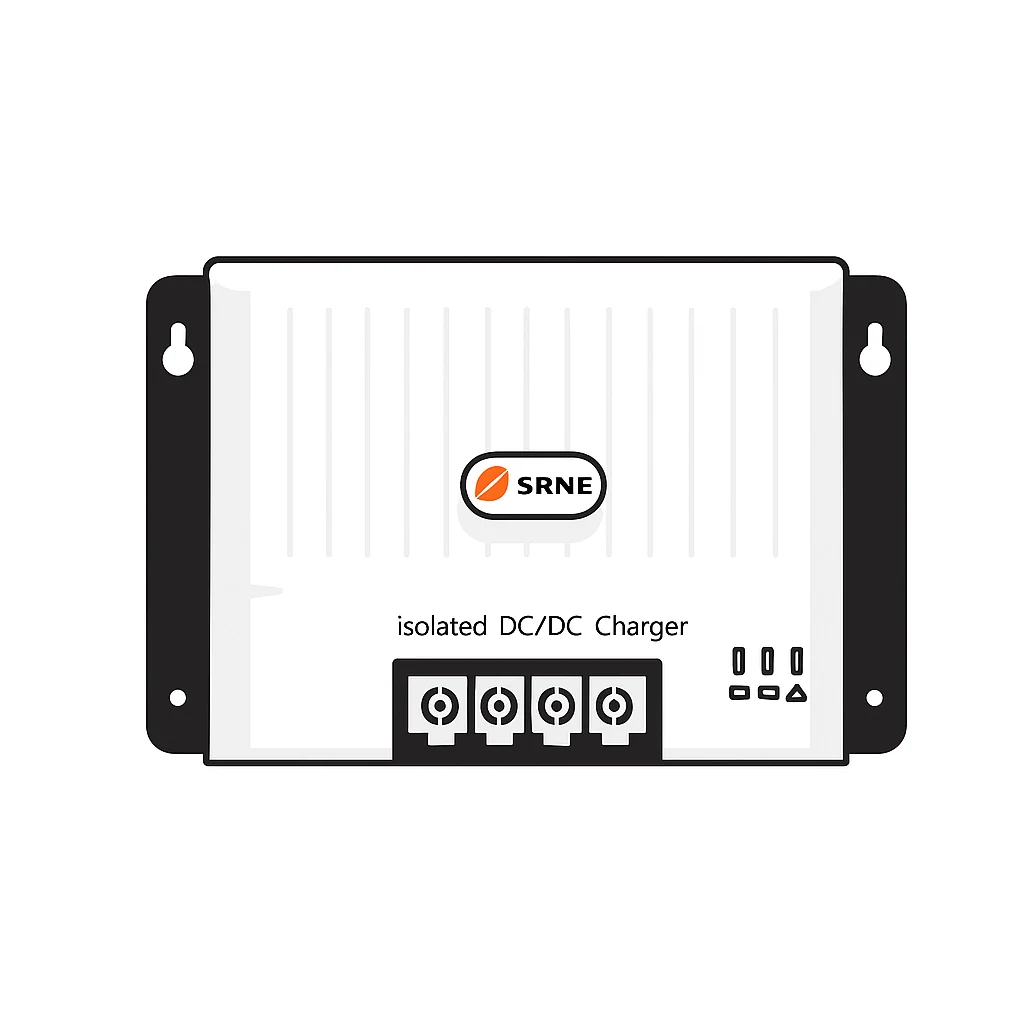
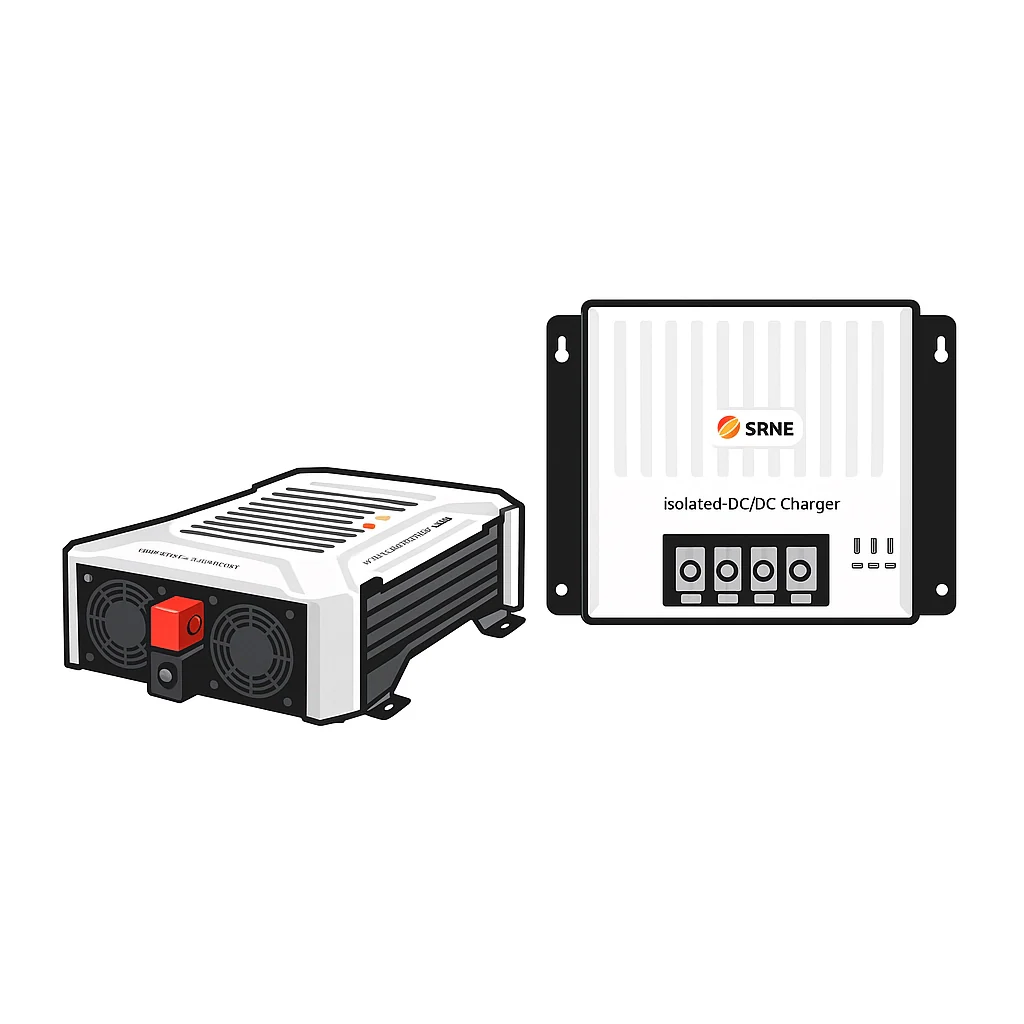
Designing a van electrical system around a compact battery requires thinking about the entire circuit. Your alternator charges when the engine runs; a DC-DC charger steps down voltage from the vehicle's 24V system if needed. Solar panels charge via an MPPT solar charge controller. All three can run simultaneously but need to work together without overcharging or damaging the battery.
SRNE solar charge controllers are engineered to work seamlessly with lithium batteries, recognising their different charging profiles compared to lead-acid. A standard PWM controller assumes lead-acid chemistry and will overcharge a lithium battery. An SRNE MPPT controller adjusts charge current and voltage dynamically based on the battery's state of charge and temperature, extending cycle life and preventing damage.
The battery management system is your second line of defence. The JBD BMS in Skyenergi batteries monitors voltage, current, and temperature across every cell. If any parameter goes out of bounds, overcharge, over-discharge, over-current, temperature extremes, the BMS disconnects the battery to protect it.
Cable sizing matters more in compact systems. For every 10 amps of current, you need at least 2.5mm² cable. Plan your routing carefully to avoid heat buildup.
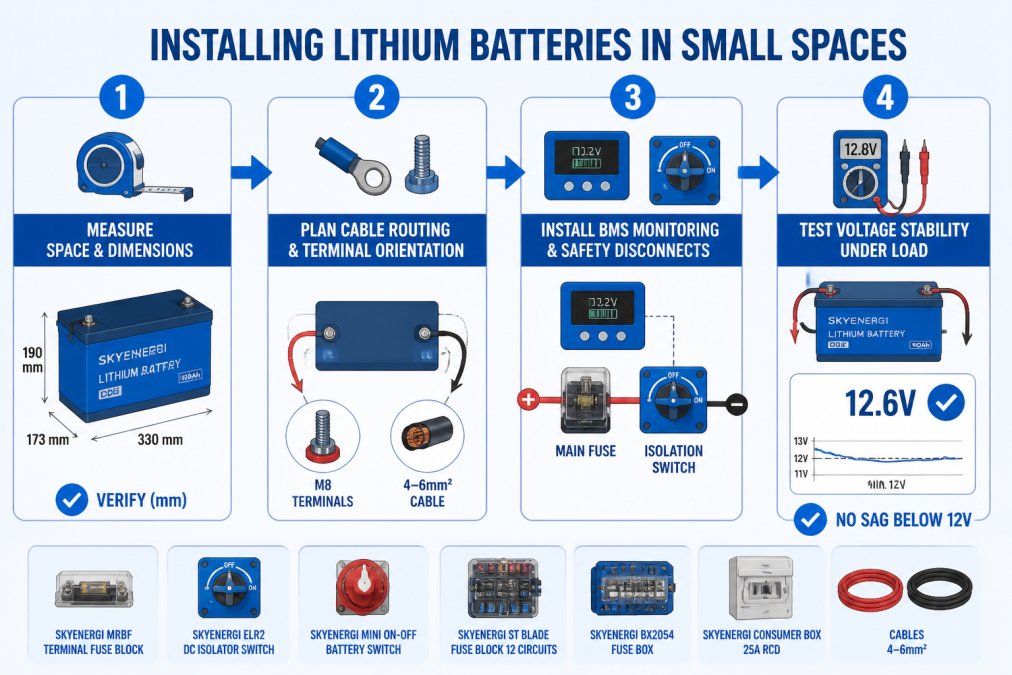
Installing Lithium Batteries in Small Spaces
Installation in tight spaces follows standard lithium battery principles, with extra attention to ventilation, cable management, and thermal monitoring.
Mounting Orientation and Cable Management
Most lithium batteries are designed to mount upright or horizontally, but check manufacturer specifications. Measure your available space precisely: footprint, height above and below, and clearance on all sides.
Plan your cable path before installation. Your battery needs to connect to a main fuse or disconnect switch, then to your DC-DC charger, solar controller, and load distribution. Use cable trays or conduit to keep cables organised and separated from heat sources. Keep positive and negative cables apart; running them side-by-side reduces EMI.
Skyenergi Core2 batteries use strong M8 terminals that accept 4-6mm² cable easily. If your space is truly constrained, consider a battery with larger terminals even if slightly bulkier; the heat reduction is worth it.

Thermal Management in Enclosed Areas
A lithium battery in an enclosed space, under a bed, in a locker, behind a kitchen unit, generates heat that has nowhere to go. Passive thermal management: drill ventilation holes at the bottom and top of the enclosure, allowing convection to draw heat out. Active thermal management: install a small 12V fan that runs when battery temperature exceeds a threshold.
Monitor internal enclosure temperature, not just battery temperature. If the enclosure hits 50°C, the battery is probably approaching 55°C or higher. At that point, reduce discharge current to let the battery cool. In a tight, enclosed space, limit maximum discharge current to 50-75A.
SRNE Solar Charge Controller Compatibility
An SRNE solar charge controller is essential when pairing a compact lithium battery with solar panels. Standard PWM controllers don't understand lithium chemistry and will overcharge the battery, reducing cycle life and risking thermal damage.
SRNE MPPT controllers continuously track the solar panel's maximum power point and adjust charge current and voltage in real time. When the battery is fully charged, the controller backs off automatically instead of forcing charge current into a full battery. This is especially important in tight spaces where thermal headroom is limited.
An SRNE MPPT controller communicates with a lithium battery's BMS via CAN bus or Modbus protocol. The battery reports its state of charge, temperature, and voltage; the controller adjusts its output accordingly. This conversation prevents overcharging and thermal stress. For Skyenergi batteries, the JBD BMS supports standard CAN bus communication. Most SRNE controllers recognise this protocol out of the box.
In a tight space where you can't afford to waste energy as heat, an SRNE controller paired with a lithium battery delivers 15-20% more usable energy from the same solar array compared to a PWM controller with lead-acid.
Safety Features of LiFePO4 Technology
LiFePO4 chemistry, used in all modern leisure batteries including Skyenergi Core2 and Edge ranges, is fundamentally safer than older lithium chemistries. LiFePO4 has a higher thermal runaway temperature threshold, making it far more resistant to catching fire even if damaged or overcharged.

The JBD BMS in Skyenergi batteries monitors overcharge protection (disconnects if voltage exceeds 13.6V per cell), over-discharge protection (disconnects if voltage drops below 10V per cell), over-current protection (disconnects if discharge current exceeds the rated limit), and temperature protection (limits current or disconnects if internal temperature exceeds 60°C or drops below 0°C).
Your second layer is a main fuse between the battery and the rest of your system. Size the fuse to match your maximum expected discharge current plus 20% headroom. Your third layer is cable management. Undersized cables overheat and melt insulation, creating short circuits. Proper cable sizing, conduit, and separation of positive and negative cables prevents most electrical failures.
In a tight, enclosed space, add a temperature monitor. Many Skyenergi Core2 batteries include Bluetooth monitoring, which sends temperature alerts to your phone. If enclosure temperature climbs above safe limits, you'll know immediately and can reduce load or increase ventilation.
How to Choose the Right Battery for Your Space
Choosing a 12V lithium battery for tight spaces requires matching four variables: usable capacity (Ah), physical dimensions (mm), weight (kg), and your specific needs.
Step 1: Calculate your daily energy demand. Add up the amp-hours your appliances consume per day. A fridge draws 2-4A continuously; LED lights draw 0.5-1A; a laptop charger draws 5-10A for a few hours. If you use 30Ah per day, a 100Ah battery gives you three days of autonomy before charging.
Step 2: Measure your available space. Get exact dimensions of where your battery will go: length, width, height. Add 50mm clearance on all sides for cable routing and heat dissipation. Compare that to the battery's dimensions.
Step 3: Consider your charging sources. If you have a large solar array and run your engine frequently, a smaller battery (100Ah) works fine because you're charging constantly. If you have minimal solar and rarely run the engine, you need a larger battery (172Ah or more) for autonomy.
Step 4: Check compatibility. Verify that your DC-DC charger, SRNE solar controller, and distribution board are all compatible with your chosen battery's terminal configuration and BMS protocol.
The decision matrix is simple:
- Tight space, modest power needs: Skyenergi Edge 100Ah or Core2 105Ah
- Tight space, higher power needs: Core2 172Ah (if it fits)
- Budget priority: Edge 100Ah
- Features priority: Core2 105Ah or Core2 172Ah (Bluetooth + heat pad)
Choosing a 12V lithium battery for tight spaces is no longer a compromise; it's a clear upgrade over lead-acid. Modern lithium batteries weigh less, fit in smaller spaces, charge faster, and last longer. Proper cable management, thermal planning, and SRNE solar controller compatibility ensure your compact battery system runs reliably for years. Start with the Skyenergi Core2 105Ah or Edge 100Ah, design your enclosure for heat dissipation, and you'll have a power system that transforms how you travel.
Frequently Asked Questions
What is the advantage of a slimline 12V lithium battery in a van conversion?
Slimline 12V lithium batteries reduce overall project weight by up to 30% compared to lead-acid equivalents. A 100Ah lithium unit weighs 12-14 kg versus 25-30 kg for a traditional AGM battery of similar capacity. This weight saving translates to increased payload for gear and equipment, better vehicle handling, and improved fuel efficiency. Slimline designs also fit into confined spaces such as under-seat installations, cupboards, and tight engine bays without requiring structural modifications.
Can I mount a 12V lithium battery on its side in a tight space?
Most LiFePO4 batteries, including Skyenergi Core2 and Edge models, can be mounted in various orientations depending on terminal configuration. However, always check the manufacturer's specifications before installation. Mounting orientation affects cable routing and thermal airflow; side-mounted batteries in enclosed spaces require careful cable management to prevent voltage drop and ensure the BMS can function properly. Vertical or tilted mounting is generally preferred in tight spaces to optimise cooling and maintain stable discharge rates.
How do slim lithium batteries compare to standard deep-cycle batteries for space efficiency?
Deep-cycle lithium batteries offer 95-98% round-trip efficiency compared to 70-85% for lead-acid alternatives. This means more usable energy from the same physical footprint. Lithium batteries also maintain stable voltage under load, reducing voltage sag that causes appliances like fridges to cut out. A Skyenergi Core2 230Ah battery delivers approximately 2,944 Wh of usable energy in a compact form, whereas an equivalent lead-acid battery would require significantly more space and weight for the same output. Lithium also supports 4,000-8,000 cycles versus 500-1,000 for lead-acid, making it far more efficient over the battery's lifetime.
How do I calculate the battery capacity needed for a small van electrical system?
Start by listing all appliances: fridge (50-100W continuous), lighting (20-50W), water pump (10-20W), inverter (varies by load). Multiply watts by hours of daily use to get watt-hours (Wh). For example, a 60W fridge running 8 hours = 480 Wh. Sum all appliances and multiply by days of autonomy (typically 2-3 days off-grid). Divide total Wh by 12V to get amp-hours (Ah). A small van needing 2,400 Wh per day for 2 days requires roughly 400 Ah at 12V, though a Skyenergi Core2 230Ah or parallel configuration of smaller units (105Ah + 172Ah) covers typical weekend usage.
This article was written using GrandRanker
Prev post

Can I Mix Lithium and Solar? Safety Guide
Updated on 19 August 2026
Next post

Lithium Battery Voltage Drop Explained
Updated on 16 August 2026


