






How to Calculate Battery Capacity: A 2026 Guide
Learn how to calculate battery capacity in Ah and Wh with step-by-step formulas. Covers amp-hours, watt-hours, runtime and practical examples for.
Table of Contents
- Understanding Battery Capacity: Amp-Hours and Watt-Hours
- The Basic Formula: How to Calculate Battery Capacity
- How to Calculate Battery Runtime with Your System
- Lithium Battery Depth of Discharge and Usable Capacity
- Watt-Hours vs Amp-Hours Explained
- Real-World Factors That Affect Battery Capacity
- Monitoring Your Battery Capacity in Real Time
- Conclusion
Last Updated: August 20, 2026
Understanding Battery Capacity: Amp-Hours and Watt-Hours
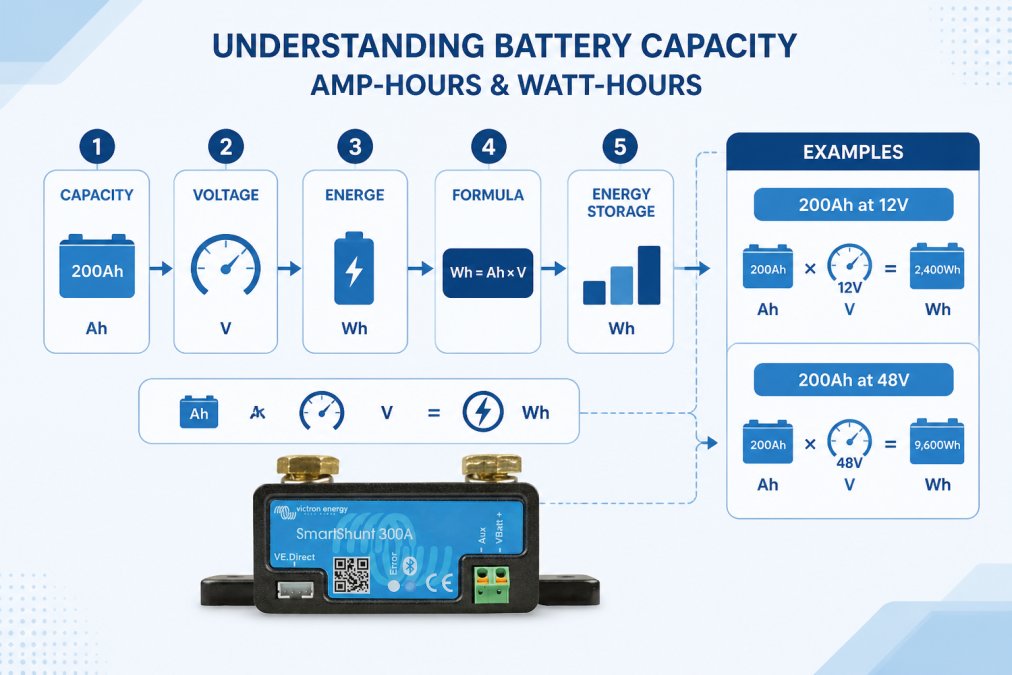
Battery capacity is measured in two units: amp-hours (Ah) and watt-hours (Wh). Both describe how much energy a battery stores, but they answer different questions. Amp-hours tell you how much current a battery can deliver over time. Watt-hours tell you the total energy available. For practical system design, you need both.
What Are Amp-Hours (Ah)?
Amp-hours (Ah) measure the charge capacity of a battery. One amp-hour means the battery can deliver one ampere of current for one hour before being fully discharged. A 200 Ah lithium battery can power a 20-amp load for 10 hours.
The formula is straightforward:
Capacity (Ah) = Current (A) × Time (hours)
However, amp-hours alone don't tell the complete story because they don't account for voltage, a critical variable in real systems.
What Are Watt-Hours (Wh) and Kilowatt-Hours (kWh)?
Watt-hours (Wh) measure the actual energy stored in a battery. This is the most important figure for calculating how long your system will run. One watt-hour is the energy delivered by one watt of power over one hour.
Kilowatt-hours (kWh) are used for larger systems; 1 kWh equals 1,000 Wh.
The relationship between amp-hours and watt-hours depends on the battery's nominal voltage:
Energy (Wh) = Capacity (Ah) × Voltage (V)
For example, a 200 Ah battery at 12V nominal voltage stores 2,400 Wh or 2.4 kWh of energy. The same 200 Ah battery at 48V would store 9,600 Wh or 9.6 kWh. Voltage matters enormously.
According to Kind Energy's 2025 Solar Battery Size Guide, most UK homes need 8-14 kWh battery capacity for solar systems. A typical 3-bedroom home consuming 8-12 kWh daily requires a 10-12 kWh battery for optimal performance.
The Basic Formula: How to Calculate Battery Capacity
To calculate battery capacity correctly, you need three inputs: your daily power consumption, your system voltage, and your desired backup duration.
Step 1: Determine Your Power Consumption
List every appliance that will draw power from your battery system. For campervans, this typically includes fridges, lighting, water pumps, heating, device charging, and entertainment systems.
Find the wattage rating on each device. If you only have amp ratings, multiply amps by voltage: Power (W) = Current (A) × Voltage (V).
Estimate daily usage hours realistically. A fridge runs 24/7 but compressors cycle on and off. Lighting might run 6 hours daily. Calculate daily energy consumption:
Daily Energy (Wh) = Power (W) × Hours per day
Sum all appliances to get total daily consumption.
Step 2: Convert to Daily Energy Requirements
Once you have daily consumption in watt-hours, determine the battery capacity needed. You can't use 100% of battery capacity in real systems. Lithium batteries are rated with a depth of discharge (DoD) limit, typically 80-90% for leisure applications.
If your daily consumption is 10 kWh and your battery has an 80% usable capacity:
Required Capacity (Wh) = Daily Consumption (Wh) ÷ Usable Percentage Required Capacity = 10,000 Wh ÷ 0.80 = 12,500 Wh or 12.5 kWh total capacity
This accounts for the battery never being fully discharged, which extends its lifespan significantly.
Step 3: Account for System Voltage
Your system voltage determines how the amp-hour rating translates to usable energy. Most leisure vehicles use 12V systems, though larger installations use 24V or 48V.
Once you know your required capacity in watt-hours and your system voltage, calculate amp-hours:
Capacity (Ah) = Capacity (Wh) ÷ Voltage (V)
For a 12.5 kWh requirement in a 12V system:
Capacity (Ah) = 12,500 Wh ÷ 12V = 1,042 Ah
This is impractical for a campervan. At 48V, the same 12.5 kWh requirement becomes:
Capacity (Ah) = 12,500 Wh ÷ 48V = 260 Ah
Higher voltage systems are more efficient and require lighter wiring, which is why professional installers often recommend 48V for larger systems.
How to Calculate Battery Runtime with Your System
Understanding how long your battery will actually power your appliances requires accounting for continuous current draw and realistic load patterns.
Understanding Continuous Current and Load
Continuous current is the steady amp draw from your system while appliances are running. To find continuous current, divide your total power consumption by system voltage:
Continuous Current (A) = Total Power (W) ÷ System Voltage (V)
If your campervan draws 2,000 watts continuously at 12V:
Continuous Current = 2,000 W ÷ 12V = 167 amps
Load is the actual power demand at any moment. Real-world loads vary constantly. Your fridge cycles on and off. You use the water pump intermittently. Average load is typically 30-60% of peak load.
Practical Runtime Example for Campervan Systems
You have a 200 Ah lithium battery at 12V (2,400 Wh total). Your average continuous load is 100 watts (8.3 amps at 12V).
With 80% usable capacity (160 Ah usable):
Runtime (hours) = Usable Capacity (Ah) ÷ Continuous Current (A) Runtime = 160 Ah ÷ 8.3 A = 19.3 hours
For a more conservative estimate accounting for voltage drop under load, assume 85% efficiency:
Adjusted Runtime = 19.3 hours × 0.85 = 16.4 hours
A 200 Ah 12V lithium battery typically provides 16-18 hours of mixed-use campervan operation before requiring recharge.
According to Habo Energy's 2026 UK Home Battery Tracker, UK homeowners installed 2,760 home batteries in March 2025 alone, a sevenfold increase from September 2023.
Lithium Battery Depth of Discharge and Usable Capacity
Depth of discharge determines how much of your battery's rated capacity you can actually use without damaging the cells.
Why Depth of Discharge Matters
Lithium batteries degrade faster when cycled deeply and frequently. A battery cycled from 100% to 0% every day will fail years before one cycled from 100% to 20%.
Depth of discharge (DoD) is the percentage of battery capacity you use before recharging. A 100 Ah battery with 80% DoD limit means you use 80 Ah and reserve 20 Ah as a safety buffer.
Different battery chemistries have different DoD limits:
- Lithium iron phosphate (LFP): 80-95% DoD safe
- Lithium nickel manganese cobalt (NMC): 70-80% DoD safe
- Lead-acid: 50% DoD recommended
Most modern leisure lithium batteries use LFP chemistry, which is safer and allows deeper discharge.
Calculating Usable Capacity from Total Capacity
If you buy a 200 Ah battery with an 80% DoD limit, your usable capacity is:
Usable Capacity (Ah) = Total Capacity (Ah) × DoD Percentage Usable Capacity = 200 Ah × 0.80 = 160 Ah
In watt-hours at 12V:
Usable Capacity (Wh) = 160 Ah × 12V = 1,920 Wh or 1.92 kWh
For a campervan system with 10 kWh daily consumption and 80% DoD:
Required Total Capacity = 10 kWh ÷ 0.80 = 12.5 kWh total
Properly sized batteries can reduce electricity bills by 70-85% when paired with solar, according to Kind Energy's 2025 analysis.
Watt-Hours vs Amp-Hours Explained
Both measurements describe battery capacity, but they serve different purposes in system design.
The Conversion Formula
The relationship between watt-hours and amp-hours is fixed by voltage:
Wh = Ah × V
Or rearranged:
Ah = Wh ÷ V
A 200 Ah battery at 12V equals 2,400 Wh. The same 200 Ah at 48V equals 9,600 Wh. Comparing batteries by amp-hours alone is misleading if voltages differ.
Which Measurement Should You Use?
Use amp-hours when:
- Specifying wiring gauge and breaker sizes
- Calculating continuous current draw
- Sizing battery cables and connectors
- Matching battery capacity to charge controller specifications
Use watt-hours when:
- Calculating daily energy consumption
- Determining runtime with known power loads
- Comparing batteries across different voltage systems
- Planning solar array size to recharge the battery preparing for power outages.
In practice, use both. Watt-hours for energy planning, amp-hours for electrical design. Skyenergi supplies complete 12V and 48V systems with both specifications clearly marked. Our Edge and Elite lithium batteries include watt-hour and amp-hour ratings, plus usable capacity at your system's voltage.
Real-World Factors That Affect Battery Capacity
Rated capacity assumes ideal conditions. In the real world, several factors reduce usable energy.
Temperature Impact on Capacity
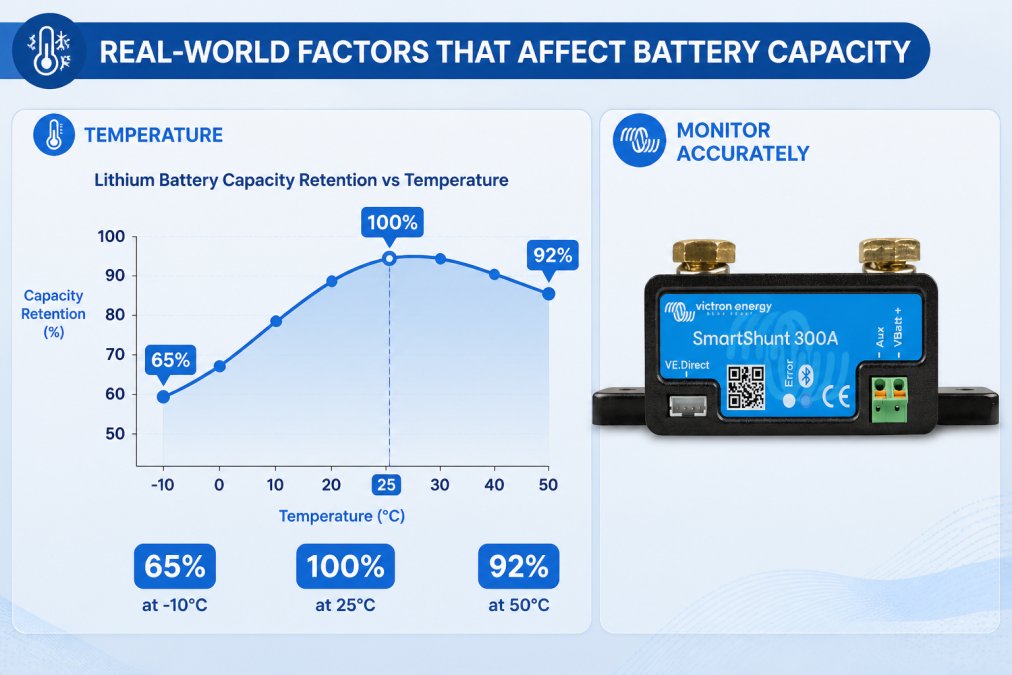
Lithium batteries perform best between 15°C and 35°C. At 0°C, capacity drops to approximately 80-85% of rated capacity. At -10°C, capacity falls to 60-70%. At 50°C, capacity decreases to roughly 90-95% of rated and degradation accelerates.
For winter camping or off-grid systems in cold climates, plan for 20% capacity loss. If you need 10 kWh usable energy and temperatures drop below 5°C regularly, size your battery for 12.5 kWh to maintain performance.
Discharge Rate and C-Rating
Battery discharge rate dramatically affects available capacity. A battery's C-rating is its capacity divided by discharge time in hours. A 200 Ah battery discharged over 10 hours is a 0.2C discharge rate. The same battery discharged over 1 hour is a 1C rate.
Higher discharge rates generate more heat and internal resistance, reducing voltage and available energy. At 2C discharge, you might only access 85-90% of rated capacity before voltage collapses.
The practical takeaway is simple: faster discharge means less usable energy. Size your battery assuming your typical discharge rate.
Battery Degradation Over Time
Lithium batteries lose capacity gradually with age and cycling. Most quality leisure batteries retain 80% capacity after 5 years of typical use, 70% after 10 years.
Degradation accelerates with deep discharge cycles, high temperatures, fast charging, and overcharging. To minimize degradation, maintain 20-80% state of charge in daily use, charge slowly when possible, and keep batteries cool. A well-managed lithium system lasts 10-15 years.
Installed battery energy storage system (BESS) capacity in Britain has surpassed the country's nuclear generating capacity for the first time, according to Drax Global's 2026 UK Battery Storage Report, rising from 10 MW to nearly 7 GW in under a decade.
Monitoring Your Battery Capacity in Real Time
Once your system is installed, monitor actual capacity and state of charge continuously. This prevents over-discharge and helps you understand real consumption patterns.
Battery monitors measure amp-hours flowing in and out, calculating state of charge. The Victron Energy BMV-712 Smart Battery Monitor provides real-time capacity data via Bluetooth, showing remaining energy in amp-hours and watt-hours simultaneously. It's an industry standard for campervan and off-grid systems.

For larger systems or multiple battery banks, the Victron Energy SmartShunt 500A offers the same monitoring capability in a compact form factor. It connects via Bluetooth to your phone, displaying state of charge, voltage, current, and power consumption in real time.

These monitors track voltage drop under load, alerting you to wiring issues or failing cells. They also log historical data, showing consumption patterns and helping you optimize future system upgrades.
Skyenergi supplies both Victron monitors as part of our complete system packages.
Monitor your battery capacity weekly. If usable capacity drops below 80% of rated capacity before your system is 5 years old, investigate the cause. Early detection prevents catastrophic failure during remote camping.
Calculating battery capacity correctly prevents costly mistakes and ensures reliable power when you need it. The process combines daily consumption analysis, system voltage selection, and realistic accounting for depth of discharge and environmental factors.
Skyenergi supplies lithium batteries with full capacity specifications in both amp-hours and watt-hours, plus integrated monitoring systems from Victron Energy. Our Edge and Elite batteries are designed for campervan and off-grid applications, with 10-year warranties and comprehensive technical support. Get started with Skyenergi and eliminate the guesswork from battery sizing.
Frequently Asked Questions
What is the formula for calculating battery capacity?
The basic formula is: Battery Capacity (Wh) = Voltage (V) × Amp-Hours (Ah). For example, a 12V battery with 100Ah capacity equals 1,200Wh or 1.2kWh. To find amp-hours from watt-hours, divide Wh by voltage: Ah = Wh ÷ V. Most campervan and off-grid systems use this calculation to determine total energy storage available for your appliances.
How does depth of discharge affect my lithium battery capacity?
Depth of Discharge (DoD) is the percentage of battery capacity you can safely use before recharging. Lithium batteries typically allow 80-90% DoD, meaning a 100Ah battery with 80% DoD provides only 80Ah of usable capacity. Lead-acid batteries, by contrast, should only be discharged to 50% to avoid damage. This is why lithium batteries deliver more usable energy from the same physical size, making them ideal for campervan and off-grid applications.
What's the difference between Ah and Wh when calculating capacity?
Amp-hours (Ah) measure electrical charge over time, whilst watt-hours (Wh) measure total energy. Wh is more useful for real-world applications because it accounts for voltage. A 100Ah 12V battery stores 1,200Wh, whilst a 100Ah 24V battery stores 2,400Wh, same amp-hours, double the energy. For calculating how long your fridge or inverter will run, use watt-hours, as it directly reflects the energy available to your appliances.
How long will a 100Ah battery run a 1,000W inverter?
A 100Ah 12V lithium battery stores 1,200Wh. A 1,000W inverter running continuously would theoretically drain it in 1.2 hours (1,200Wh ÷ 1,000W). However, real-world runtime is shorter due to system losses (5-10%) and depth of discharge limits. With 80% DoD, usable capacity is 960Wh, giving approximately 57 minutes of runtime. Most campervan systems don't run inverters continuously, so actual usage patterns extend this significantly.
This article was written using GrandRanker
Prev post

SRNE MD12100 Review: Dual-Battery Charging for Campervans
Updated on 21 August 2026
Next post

Can I Mix Lithium and Solar? Safety Guide
Updated on 19 August 2026


