





Alternatives to Split Charge Relays for Van Conversions
Upgrade your van with the best alternatives to split charge relays. Compare DC-DC chargers for smart alternators and lithium batteries. Get reliable power.
Table of Contents
- Why Split Charge Relays Fail in Modern Van Conversions
- DC-DC Battery Charger Benefits for Van Electrical Systems
- Smart Alternator Compatibility: Why Euro 6 Vans Need DC-DC Chargers
- SRNE DC-DC Charger Performance: A Cost-Effective Alternative
- Top DC-DC Charger Kits for Van Conversions
- Split Charge Relay vs DC-DC Charger: Cost and Performance Over 5 Years
- Conclusion: Choosing the Right Charging System for Your Van
- Frequently Asked Questions
Last Updated: September 23, 2026
Why Split Charge Relays Fail in Modern Van Conversions
Split charge relays often only charge leisure batteries to roughly 80%-90% of full capacity, and that shortfall is the single biggest reason owners start looking at alternatives to split charge relays for van conversions. A voltage sensitive relay simply connects your starter battery to your leisure battery once the engine runs. It has no way to regulate what arrives at the other end. According to charging efficiency limitations of traditional relay systems, many owners discover the gap only after their fridge cuts out on the second night off-grid.
DC-DC Battery Charger Benefits for Van Electrical Systems
A DC-DC charger takes whatever voltage the alternator supplies and converts it into a stable, correct charging profile for your leisure battery. That is the core of the DC-DC battery charger benefits story: voltage regulation, current limiting, and a multi-stage charge algorithm that relays cannot provide. Off Grid Power Solutions resource library notes that connecting two dissimilar batteries directly via a relay can cause electrical imbalances, whereas a DC-DC charger delivers a controlled, safer charging profile.
Smart Alternator Compatibility: Why Euro 6 Vans Need DC-DC Chargers
Smart alternator compatibility is the dealbreaker, and it is also the point where most generic guides stop short. Euro 5 and Euro 6 engines use variable-output alternators controlled by the ECU. When the starter battery reaches roughly 80% state of charge, the ECU drops alternator output to around 12.4V-13.2V to reduce engine load and emissions. A voltage sensitive relay sees that as "engine off" or "battery full" and either never closes or opens again within minutes.
How to identify your alternator type in ten minutes
You do not need a dealer diagnostic session. A basic multimeter and a helper will do it:
- Resting voltage. Leave the van overnight. A healthy starter battery should read around 12.6V-12.8V. If it reads 12.2V or lower, charge it first or the test is meaningless.
- Engine running, no load. Start the engine and hold the meter across the starter battery terminals. A traditional alternator will sit at 14.2V-14.6V and stay there. A smart alternator will often start high, then fall to 12.4V-13.2V within a minute or two as the ECU backs off.
- Load test. Switch on headlights, heater blower, and rear screen demist. A traditional alternator holds voltage. A smart alternator may briefly rise, then drop again once the ECU decides the starter battery is topped up.
- Regeneration check. On many Euro 6 vans, lifting off the throttle or braking triggers a brief voltage spike to 14.5V+ as the system recovers energy. If you see that pattern, you have a smart alternator.
Vehicles that almost always need a DC-DC charger
A common pattern across converters is that the following families are effectively guaranteed to need one:
- Ford Transit Custom and Transit Mk8 (2016 onward), Euro 6 with smart charging as standard.
- Volkswagen Transporter T6 and T6.1, smart alternator on the majority of EU6 builds.
- Mercedes Sprinter (907) and Vito (W447), intelligent alternator management across the range.
- Renault Trafic and Master (2015 onward), smart charging on most Euro 6 variants.
- Peugeot Boxer, Citroën Relay, Fiat Ducato (2016 onward), Euro 6 models with variable voltage control.
- Vauxhall Vivaro and Movano (2015 onward), shared platforms with the Renault and Fiat groups above.
What a DC-DC charger does differently
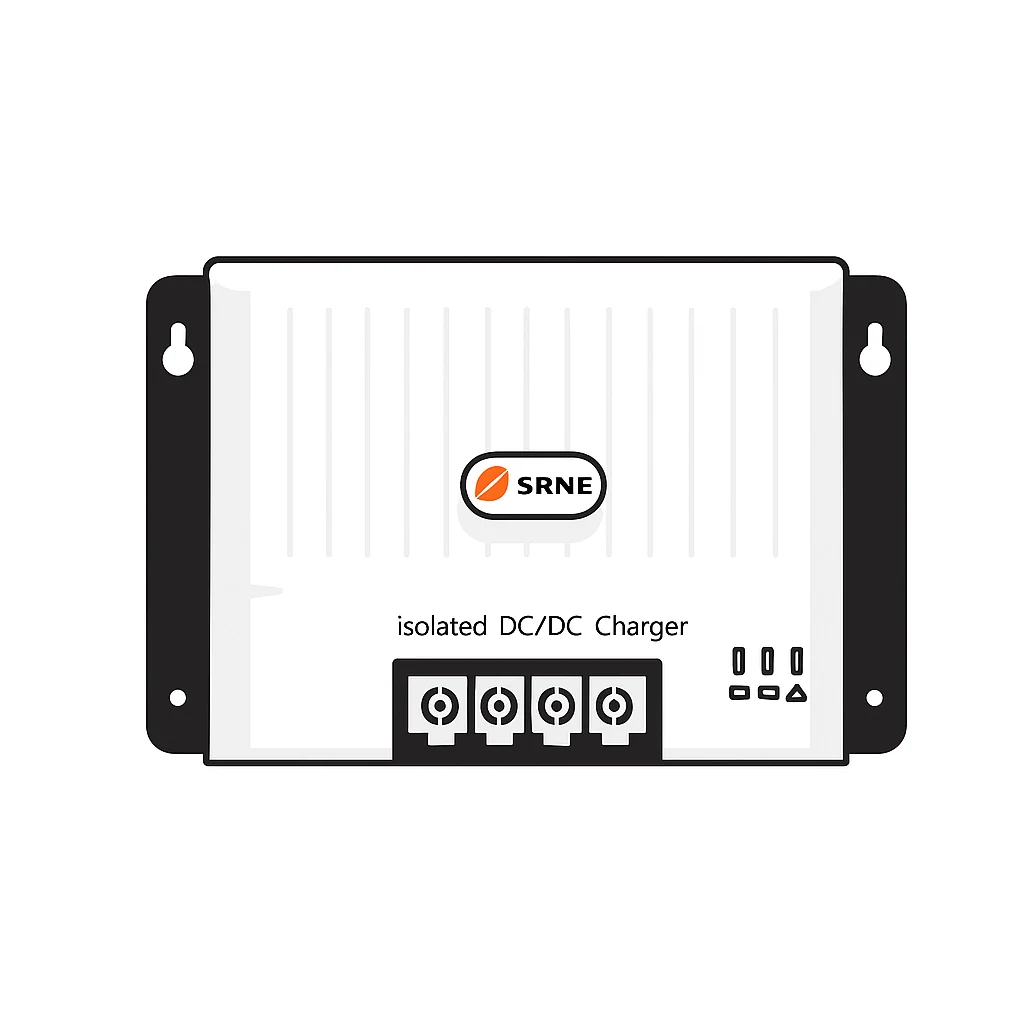
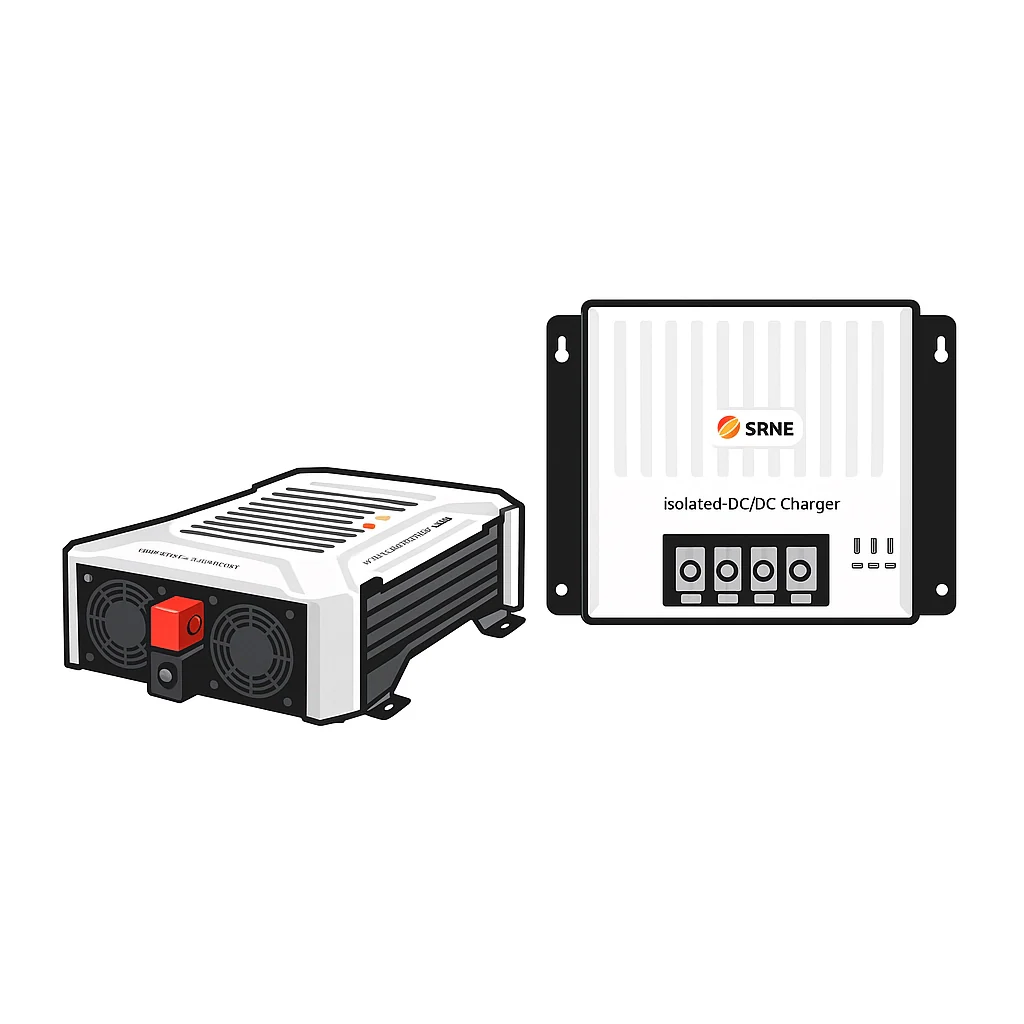
A DC-DC charger, such as the SRNE DCI12-1230 kit, does not care whether the alternator is outputting 12.4V or 14.6V. It accepts anything from 10V to 16V, boosts or bucks that to the correct absorption and float voltages for your leisure battery, and limits current so the alternator is never overloaded. That is why it works on a smart alternator where a relay cannot.

SRNE DC-DC Charger Performance: A Cost-Effective Alternative
SRNE DC-DC charger performance offers a cost-effective solution for many builds. The SRNE DCI12-1230 kit delivers 30A from a fully isolated unit, with a 10-16V input range, roughly 92% conversion efficiency, and support for lithium, AGM, GEL, and flooded lead-acid. It ships with fuses, cable, and terminals at £149.00. Bluetooth and CAN/RS485 let it slot into your monitoring setup, and the fanless IP43 casing fits tight compartments.
Top DC-DC Charger Kits for Van Conversions
Choosing between kits comes down to output current, isolation, and how much you want to spend. All five options below are battery-to-battery chargers that replace a relay outright.
| Kit | Output | Price | Best For |
|---|---|---|---|
| SRNE DCI12-1230 | 30A, isolated | £149.00 | Best value, tight spaces |
| Victron Orion-Tr 18A Isolated | 18A, isolated | £122.40 | Small systems, lowest cost |
| Victron Orion-Tr 30A Non-Isolated | 30A, non-isolated | £152.80 | Standard 12V installs |
| Victron Orion 30A Kit | 30A, non-isolated | £210.00 | Complete kit with fuses and cable |
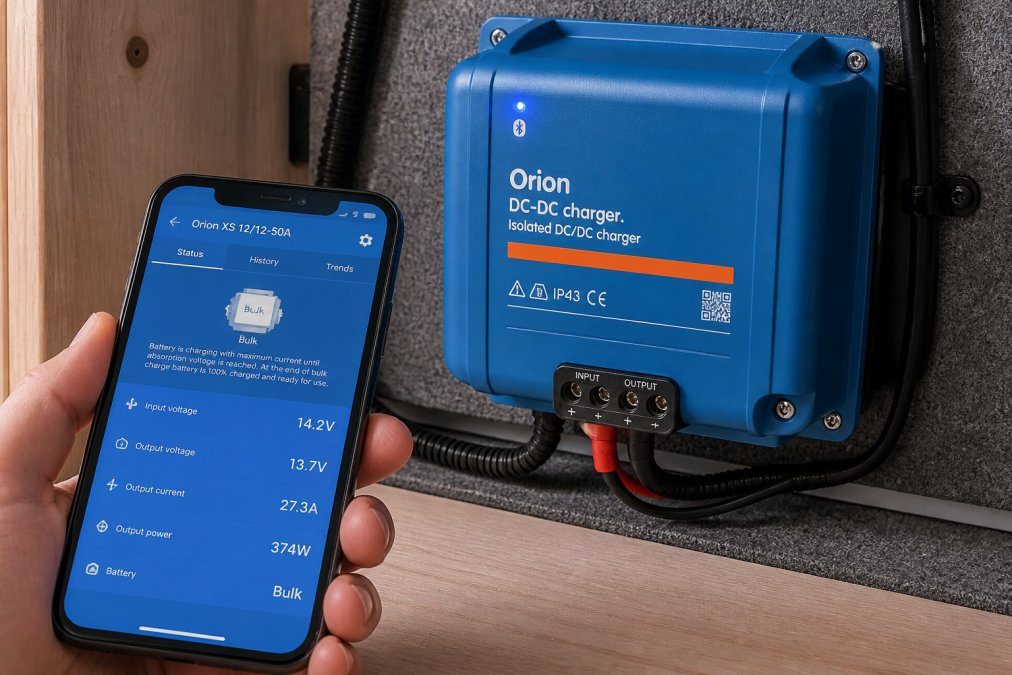
| Victron Orion XS 50A Kit | 50A, non-isolated | £339.00 | Fast charging, large lithium banks |
Isolated chargers separate input and output grounds, which matters on marine and mixed-metal builds where ground loops cause noise. Non-isolated units are cheaper and fine for most steel and aluminium vans. ::: Electrical stability remains a priority when integrating auxiliary power sources, and choosing the right portable solar chargers ensures that your secondary battery bank stays topped up without introducing unwanted interference into the vehicle's sensitive grounding architecture.
Split Charge Relay vs DC-DC Charger: Cost and Performance Over 5 Years
Most guides compare a relay and a DC-DC charger on purchase price alone. That is the wrong comparison. The real question is what each system costs you across a realistic five-year ownership period, including battery replacements, charging shortfall, and the knock-on cost of running a generator or hookup because your leisure battery never reaches full charge.
12V Battery To Battery Charger Kit →
The five-year cost model
Take a typical van build with a 100Ah lithium leisure battery and a daily drive pattern of 45 minutes. The figures below are illustrative.
| Cost item | Split charge relay | DC-DC charger (SRNE DCI12-1230) |
|---|---|---|
| Upfront hardware | £25-£80 | £149.00 |
| Typical charge reached | 80%-90% | 100% |
| Usable capacity from 100Ah | 80-90Ah | 100Ah |
| Battery cycles to 80% DoD | ~500-800 | ~2,000+ |
| Likely battery replacements in 5 years | 1-2 | 0 |
| Replacement battery cost (100Ah lithium) | £300-£500 each | £0 |
| Generator or hookup top-ups per year | 15-30 | 0-5 |
| Five-year total (mid estimate) | £700-£1,200 | £149-£250 |
Why the relay shortens battery life
A relay does not just charge slowly. It charges incompletely. A lithium battery held at 80%-90% state of charge for months will drift out of balance, because the cell balancing circuit only activates during the absorption phase at full voltage. Over time, the weakest cell drags the pack down, capacity falls, and the battery fails early. A lead-acid battery fares no better: partial state of charge causes sulphation on the plates, which is irreversible.
The hidden cost of a relay: generator and hookup dependency
If your leisure battery only reaches 85%, you have 15% less usable capacity every night. On a 100Ah lithium bank, that is 15Ah, roughly the difference between running a 45W fridge for a full day and running it for most of a day. Owners compensate by:
- Running a generator, at roughly £1.50-£2.50 per hour in fuel.
- Paying for electric hookup, at £5-£10 per night on many UK sites.
- Cutting trips short or driving further to charge.
When the relay still makes sense
There are two narrow cases where a relay remains defensible:
- A pre-2015 van with a conventional alternator and a small lead-acid leisure battery, where the owner drives long distances daily and accepts the capacity shortfall.
- A temporary build where the leisure battery will be replaced within a year anyway and the owner wants the cheapest possible interim solution.
The SRNE DCI12-1230 as the value benchmark
The SRNE DCI12-1230 kit at £149.00 sits at the point where the five-year maths tips decisively. It delivers 30A from a fully isolated unit, with a 10-16V input range, roughly 92% conversion efficiency, and support for lithium, AGM, GEL, and flooded lead-acid. It ships with fuses, cable, and terminals, so there is no hidden extras cost. Bluetooth and CAN/RS485 let it slot into your monitoring setup, and the fanless IP43 casing fits tight compartments.
Conclusion: Choosing the Right Charging System for Your Van
If your van has a smart alternator or a lithium leisure battery, a DC-DC charger is not optional. Start with the SRNE DCI12-1230 kit at £149.00 if you want value and a compact footprint, or step up to the Victron Orion XS 50A kit if you run a large bank and want the fastest charge. Skyenergi supplies both, along with the cable, fuses, and terminals to complete the job, backed by fast delivery and specialist support.

Frequently Asked Questions
Are split charge relays any good for a modern van?
For vans with smart alternators, split charge relays are not effective. They often only charge a leisure battery to 80-90% capacity because they cannot regulate the varying voltage from a smart alternator. A DC-DC charger is required to provide a stable, correct charging profile for modern vehicles.
Can I use a split charge relay with a lithium leisure battery?
No, a split charge relay is not suitable for a lithium leisure battery. Lithium batteries require a specific charging profile with precise voltage and current regulation that a relay cannot provide. Using a relay can damage the battery or lead to an electrical imbalance. A DC-DC charger is the correct solution for safely charging lithium batteries.
How does a DC-DC charger protect my vehicle's alternator?
A DC-DC charger protects the alternator by limiting the current it draws to a safe level, preventing overload. It also isolates the starter and leisure batteries, ensuring the alternator is not damaged by a deeply discharged auxiliary battery. This controlled charging process is essential for modern, voltage-sensitive electrical systems.
Do I need a DC-DC charger if I have solar panels installed?
Yes, a DC-DC charger and solar panels serve different purposes. Solar panels are excellent for maintaining charge when parked, but they cannot charge your leisure battery while you are driving. A DC-DC charger is the primary method for charging from the alternator, which provides the most power for charging on the move.
Prev post

5 Ways to Wire Campervan Solar Panels: 2026 Guide
Updated on 24 September 2026
Next post

Top battery setup tips for reliable motorhome power
Updated on 23 September 2026


