


SRNE DB12 Fuse Sizing Guide for Campervan DC Circuits
This SRNE DB12 fuse sizing guide explains how to match fuses to each of the 12 DC circuits, calculate cable gauge and protect your campervan system safely.
Last Updated: 23 November 2026
Quick Summary
SRNE DB12 fuse sizing means matching each fused output to the cable and load it feeds, so the fuse protects the wiring first. The DB12's 10A, 20A and 30A channel bands are ceilings, not fuse ratings, so fit a fuse at or below the cable's current capacity.
- The DB12 has 12 outputs split into 10A, 20A and 30A channel bands.
- Fuse for the cable, then confirm the load's draw fits inside that rating.
- A 30A-output DC-DC charger can draw roughly 33 to 35A input, so a 40A fuse suits.
- Battery-side fuses must be DC-rated for system voltage and sit close to the positive terminal.
- Never fit a larger fuse to stop nuisance blowing; the fuse is warning you of a fault.
Table of Contents
- What the SRNE DB12 Does and Why Fuse Sizing Matters
- The DB12's Factory Circuit Ratings and What They Mean for Fuses
- DC-DC Charger Fuse Sizing in a DB12 System
- Calculating Cable Gauge for 12V Inverters and High-Current Loads
- Choosing Fuse Types: Blade, MIDI and MEGA for Different Circuits
- Battery-Side Protection and Busbar Layout for the DB12
- Common Fuse Sizing Mistakes and a Pre-Installation Safety Checklist
- Planning Your DB12 Installation with Skyenergi
- Frequently Asked Questions
What the SRNE DB12 Does and Why Fuse Sizing Matters
The DB12 is a 12-way DC distribution hub. It gives you individually fused outputs for lighting, pumps, fans and USB outlets, plus monitoring when paired with SRNE control hardware.
Here is the part most guides miss: the DB12 does not set your fuse sizes. Your cable and your load do. The DB12 just gives you a safe, organised place to put them.
The DB12's Factory Circuit Ratings and What They Mean for Fuses
The DB12 ships with 12 independent DC outputs, split into three current bands: SRNE's DB12 specifications. Those are channel ratings, not fuse ratings. A 30A channel can carry up to 30A, but the fuse you fit must still suit the cable on that circuit.
If you want to see the unit itself before working through the numbers, the SRNE DB12 distribution box page shows the layout and connections.
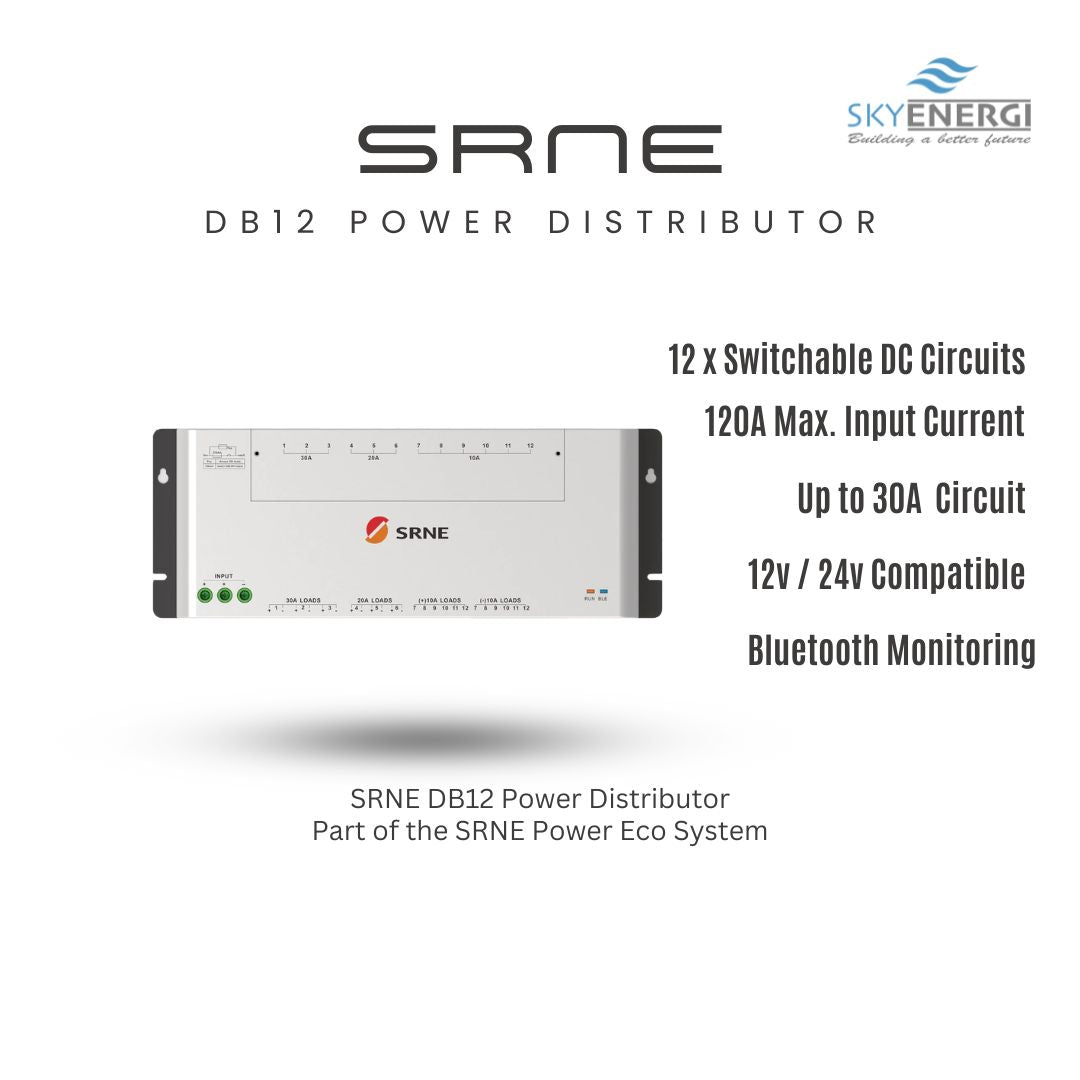
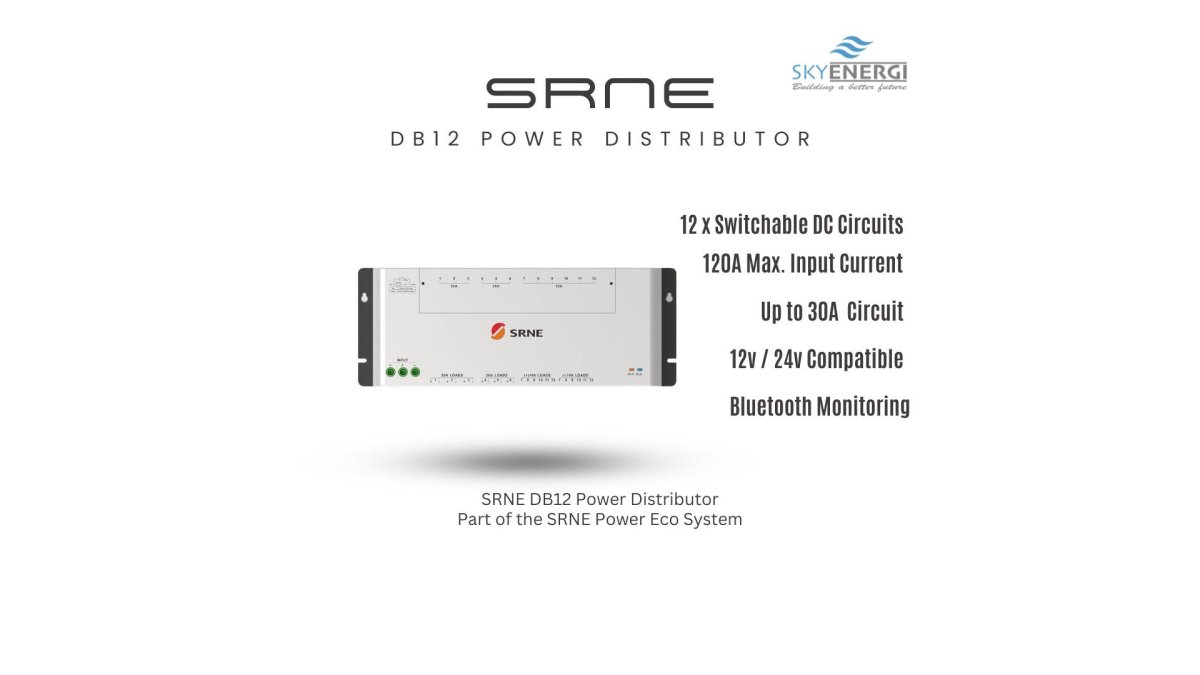
30A, 20A and 10A Outputs: Matching Fuse Ratings to Each Channel
Treat each band as a ceiling, not a target:
- 10A channels: lighting, USB, small fans. Usually 5A to 10A blade fuses.
- 20A channels: water pumps, larger fans, modest inverter feeds.
- 30A channels: heavier DC loads, but check cable size first.
For the full wiring sequence, our 7-step DB12 installation guide covers how each output is terminated.
Treat each current band as a ceiling rather than a target, then match the fuse to the cable on that circuit.
| DB12 channel band | Typical loads | Usual fuse range |
|---|---|---|
| 10A channels | Lighting, USB, small fans | 5A to 10A blade fuses |
| 20A channels | Water pumps, larger fans, modest inverter feeds | Suit the cable on that circuit |
| 30A channels | Heavier DC loads | Check cable size first |
DC-DC Charger Fuse Sizing in a DB12 System
DC-DC charger fuse sizing follows one rule: fuse for the cable, then confirm the charger's own draw fits inside that.
Work it out like this:
- Find the charger's maximum input current from its datasheet. This is the current drawn on the starter-battery side, not the output current delivered to the leisure bank. A charger rated at 30A output does not draw 30A input; it draws more, because output watts plus conversion losses must come from the input side.
- Choose cable that carries that input current with acceptable voltage drop over the run length. On a campervan, the starter battery to charger run is often 3 to 6 metres, and voltage drop matters more than ampacity alone.
- Fit a fuse rated above the charger's maximum input current but below the cable's safe current limit. The fuse protects the cable; the charger protects itself.
A worked example makes the relationship clear. Take a DC-DC charger with a 30A output rating on a 12V system. Output power is roughly 360W.
Watch out: sizing the fuse to the charger's output rating rather than its input current can produce repeated nuisance blows, and fitting a larger fuse to stop them can leave the cable unprotected.
Input Current Versus Output Current: Why the Difference Matters
The gap between input and output current widens as charger output rises. A 50A output charger on 12V delivers around 600W; at 88 per cent efficiency the input side pulls roughly 680W, or about 57A at 12V nominal. Fuse that circuit at 30A or 40A and it will not survive a depleted leisure bank on a cold morning. Always read the input current figure from the datasheet, and if the datasheet only quotes output current, calculate the input side using the efficiency figure the manufacturer publishes.
Cable Coordination on the Starter-Battery Side
The fuse on the starter-battery side of a DC-DC charger protects the long cable run to the charger, so it belongs close to the starter battery positive terminal. Choose cable with a continuous current rating above the fuse rating, not equal to it.
If you are already chasing voltage drop symptoms, our guide to troubleshooting DC-DC charger voltage drops explains what to look for before you re-fuse anything.
Where the DB12 Fits
The DB12 is a distribution point, not a charger. Its fused outputs feed loads, lighting, pumps, fans, USB, not the DC-DC charger's input. The charger's input fuse sits on the starter-battery side; its output connects to the leisure battery positive, with its own fuse close to that battery. Keep those three protection points separate in your head: starter-battery fuse protects the charger feed cable, leisure-battery fuse protects the charger output cable, and DB12 channel fuses protect the load circuits.
Calculating Cable Gauge for 12V Inverters and High-Current Loads
Cable gauge for a 12V inverter starts with continuous current: watts divided by volts, then adjusted for inverter efficiency. A 1,000W inverter at 12V draws roughly 83A continuously before losses, and noticeably more on surge.
Then pick cable that carries that current, and fuse at or just above the cable rating, never above it. Allowing for that brief inrush without compromising cable protection is just as important at a helm, where Toba Marine Technology connects sound fuse choices with careful circuit wiring.
This is the calculation most DIY builds skip, and it is where cable and fuse stop agreeing with each other.
Choosing Fuse Types: Blade, MIDI and MEGA for Different Circuits
Blade fuses suit the DB12's smaller outputs. MIDI and MEGA fuses handle the heavy battery-side and inverter circuits. Standard fuse-sizing shortcuts do not account for cyclic loading or semiconductor protection needs, so Eaton's Bussmann guidance recommends checking manufacturer data sheets rather than relying on rules of thumb.
A practical split:
- Blade (ATO/ATC): smaller DB12 channels
- MIDI: medium-current feeds, up to 200A
- MEGA: very high current battery-side protection
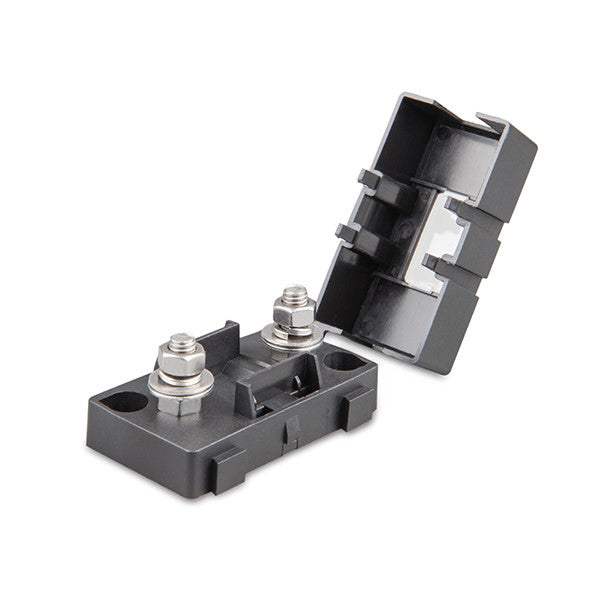
For MIDI circuits, the MIDI fuse holder is the part that physically carries the fuse.
Voltage Rating, Interrupt Rating and DC Suitability
A fuse must be rated for DC at your system voltage, not just amps. DC arcs do not self-extinguish like AC, so a fuse with an inadequate interrupt rating can fail to break a short circuit safely.
This is the point most fuse-sizing guides skip, and it is where a technically correct amp rating can still be unsafe. Three separate ratings matter on a battery-side DC fuse:
- Current rating (amps): the continuous current the fuse will carry without nuisance blowing. This is the figure everyone checks.
- Voltage rating (volts DC): the maximum DC system voltage the fuse is designed to break. A fuse rated for 32V DC is fine on a 12V system; it is not suitable on a 24V or 48V bank. Fitting a 32V fuse on a 48V lithium system is a real risk, not a theoretical one.
- Interrupt rating (amps, sometimes kA): the maximum fault current the fuse can safely break without arcing over or bursting. A lithium battery bank can deliver very high fault currents, far higher than a lead-acid bank of similar capacity, so the interrupt rating must exceed what the battery can deliver into a dead short.
A fuse with the right amp rating but an inadequate interrupt rating may hold during normal operation and then fail catastrophically under fault.
Fuse Type, Cable Size and Location Must Agree
Fuse type selection is not just about current. It is about matching the fuse to the cable it protects and the physical location it sits in:
- Blade fuses in the DB12 are accessible, replaceable and cheap, which suits load circuits where a nuisance blow is an inconvenience rather than a safety event. They are not suitable for battery-side protection because their interrupt rating and holder design are not intended for high fault currents.
- MIDI fuses sit in bolt-down holders and are the practical choice for charger and inverter feeds in the 30A to 200A range. Their holders must be mounted so the fuse is close to the battery positive and the cable is supported.
- MEGA fuses handle the very high currents at the battery bank itself, typically where a large inverter or a busbar take-off needs protection. They require a dedicated holder and correctly torqued stud connections.
In every case, the fuse's current rating must sit at or below the cable's continuous current capacity, and the cable must be sized for the actual load plus voltage-drop margin.
Watch out: a fuse with the correct amp rating but the wrong voltage or interrupt rating is more dangerous than no fuse at all, because it gives the appearance of protection without providing it.
Battery-Side Protection and Busbar Layout for the DB12
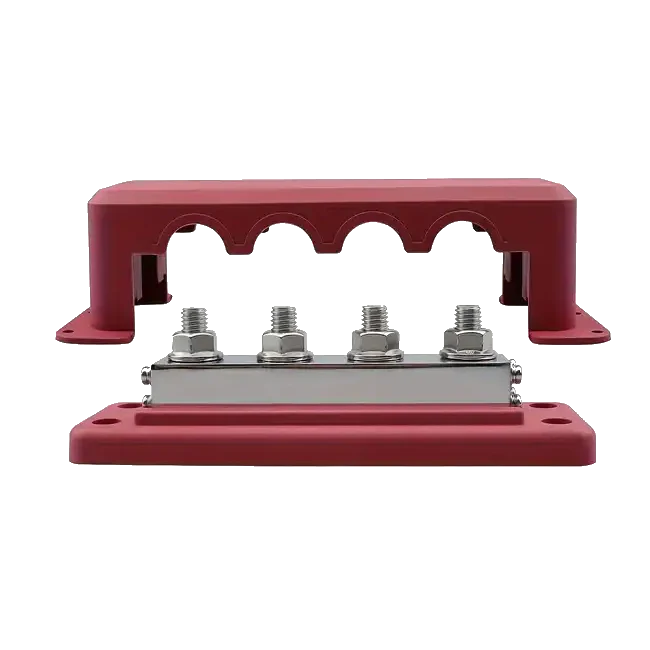
Battery-side protection belongs as close to the battery positive terminal as practical. That fuse protects the cable run to your distribution point, so if that cable shorts, the fuse blows before the cable does. A positive busbar gives you a clean, single take-off point for the DB12 feed and other high-current circuits.
A 600A positive busbar handles that layout neatly, keeping battery, charger and distribution feeds on separate studs.
Common Fuse Sizing Mistakes and a Pre-Installation Safety Checklist
The most common mistake is fusing to the load and ignoring the cable. The second is fitting a fuse with the wrong DC voltage rating. The third is putting battery protection too far from the battery to protect anything.
Before you power up, check:
- Fuse rating is at or below the cable's current capacity
- Fuse is DC-rated for system voltage
- Battery-side fuse sits close to the positive terminal
Watch out: never test a circuit by fitting a larger fuse to stop it blowing. That fuse is telling you something is wrong.
Planning Your DB12 Installation with Skyenergi
A DB12 system only performs as well as the design around it.
Skyenergi supplies the DB12 alongside SRNE charging systems and our own LiFePO4 battery range, with knowledgeable support before and after purchase. If you are unsure which fuse suits a circuit, ask us before you fit it.
Getting fuse sizing right is the difference between a system that runs for years and one that keeps tripping on the first cold morning.
Frequently Asked Questions
What size fuse is required for an SRNE DB12 unit?
The DB12 has 12 individually fused outputs. The fuse you fit depends on the load on each circuit, not on the box as a whole. Size each fuse just above the continuous current the circuit will draw, and never above the channel's factory rating. For a 10A lighting circuit drawing 4A, a 5A blade fuse is appropriate. Always confirm against the SRNE manual and the cable's current capacity before fitting.
Why is correct fuse sizing critical for campervan electrical systems?
A fuse protects the cable, not the appliance. If the fuse rating is too high, a damaged or overloaded cable can overheat and catch fire before the fuse blows. If it is too low, nuisance blowing interrupts essential loads such as fridges and pumps. In a DB12 system, each of the 12 circuits needs its own correctly sized fuse so that a fault on one circuit is isolated without affecting the others. This SRNE DB12 fuse sizing approach keeps the whole installation predictable and safe.
Should I use an ANL or MIDI fuse for my SRNE inverter setup?
MIDI fuses suit medium-current circuits up to around 200A and fit compact holders such as the Skyenergi MIDI fuse holder. MEGA fuses handle higher currents and are typically used for the main battery-to-inverter feed on larger systems. ANL fuses are a separate format with their own holders. Check the inverter manual for the recommended fuse type and rating, and match the fuse's voltage rating and interrupt rating to your 12V or 24V DC system.
How do I calculate the correct fuse rating for my 12V battery system?
Start with the continuous current: divide the load's wattage by the system voltage, then divide by inverter efficiency if applicable. For a 2000W inverter at 12V with 90% efficiency, that is roughly 185A continuous. Apply the 125% rule to get about 231A, then choose the next standard fuse rating above that, provided the cable can carry it. Surge current matters for motor loads, so check the inverter's peak rating and the fuse's time-current curve before finalising.

Next post

7 Fuse Mistakes That Can Damage Your SRNE Inverter
Updated on 24 November 2026


