


7 Fuse Mistakes That Can Damage Your SRNE Inverter
SRNE inverter fuse size explained: how to read the manual, match protection to battery voltage and current, and choose the right fuse for safe UK installs.
Last Updated: November 23, 2026
Quick Summary
The right srne inverter fuse size comes from the manual for your exact model, not from a guess. Check the battery-connection section, confirm the rating for your battery voltage, and contact SkyEnergi or a qualified installer if no clear value is given.
- Read the battery-connection section of your inverter's manual before buying any fuse.
- Protection values are model-specific, so never guess a fuse rating.
- Confirm the battery voltage the manual is written for before choosing.
- Fit the fuse close to the battery positive terminal to protect the whole cable run.
- The fuse must be rated for DC and must not exceed the cable's current capacity.
Table of Contents
- Why the Fuse Size Matters More Than You Think
- Start With the Manual: Reading SRNE Protection Values
- Inverter Fuse Size Calculator: Working Out Current From Power and Voltage
- 12V Inverter Fuse Size: Choosing the Fuse Type and Rating
- Inverter Battery Cable Size and Why It Must Match the Fuse
- Inverter Fuse Location: Where It Goes and Why
- Booking Your Protection Check Before the Next Trip
- Frequently Asked Questions
Why the Fuse Size Matters More Than You Think
Choosing the right fuse for an SRNE inverter protects the cable, the battery and the inverter itself, so the srne inverter fuse you pick deserves careful thought. A fuse that is too small blows for no good reason. A fuse that is too large lets a fault keep flowing until something overheats. Many installers pick a fuse by guesswork, and that is where problems start.
The inverter's own manual is the place to start. The fuse rating depends on the model and the wiring, so one number does not fit every unit. Getting this right is a safety matter, and it is worth doing carefully.
Start With the Manual: Reading SRNE Protection Values
Check the wiring guidance for your inverter, which should cover external protection. Find the section on battery connections and read it before you buy any fuse.
Check the full manual for your exact inverter before selecting protection, as fuse values are model-specific.
Where the manual gives no clear value, do not guess. Contact SkyEnergi's technical team or a qualified installer, and check the SRNE product range to confirm the model you have before choosing an srne inverter fuse.
- Find the battery-connection section in the manual
- Note the fuse or breaker type and rating given for your model
- Confirm the battery voltage the manual is written for
- Keep a copy of the page with your wiring plan
The figures below summarise the checks to make before choosing a fuse, all taken from the guidance above.
| Check | What to confirm | Why it matters |
|---|---|---|
| Battery-connection section | Read it in the manual before buying | Gives the model's own protection guidance |
| Fuse or breaker rating | Value given for your exact model | Model-specific; do not guess |
| Battery voltage | Voltage the manual is written for | Protection values depend on it |
| Missing value | Contact SkyEnergi or an installer | Avoids choosing an unsafe fuse |
| Wiring plan | Keep a copy of the relevant page | Gives you a record for installation |
Inverter Fuse Size Calculator: Working Out Current From Power and Voltage
The calculation is the easy part; knowing what to do with the answer is where installs go wrong. The battery-side current is set by the inverter's output power, the inverter's efficiency and the battery voltage:
Battery current (A) = inverter output power (W) ÷ (battery voltage (V) × inverter efficiency)
A pure sine wave inverter is less than perfectly efficient, so the battery draws more current than the output power alone suggests. A 2,000 W inverter on a 12 V battery therefore draws roughly 2,000 ÷ (12 × 0.85) ≈ 196 A at full continuous output, not the 167 A you get from a naive watts ÷ volts sum. On a 24 V bank the same inverter draws about 98 A, and on 48 V about 49 A, which is why higher-voltage systems use much smaller cable and fusing for the same power.
Worked example with continuous and surge current
Take a 2,000 W SRNE inverter on a 12 V lithium bank:
- Continuous battery current: 2,000 ÷ (12 × 0.85) ≈ 196 A.
- Surge: many inverters allow a short surge of roughly twice rated power for a few seconds, so the battery side can momentarily approach 390 A.
- Fuse choice: the fuse must carry the continuous current with margin (so it does not nuisance-blow on a warm day or during a brief surge) but must still be below the cable's current-carrying capacity so it protects the cable.
The fuse must carry the continuous current with margin, then be checked against both the manual and the cable. Whether a particular fuse rating is appropriate depends on the cable and the manual.
A fuse sized only to the surge current will be too large to protect the cable, so never size to the surge figure alone.
When the manual overrides the calculation
The calculation gives you a sanity check, not a final answer. The manufacturer's stated external protection value for the model takes priority. If the manual says 40 A and your sum says 60 A, the manual wins, the difference usually reflects the model's own internal limits, its rated continuous output or the terminal and internal wiring it was designed around. Use the sum to spot a mismatch (a manual figure far below your calculated continuous current is worth querying), not to overrule the manufacturer.
Keep the three circuits separate
A frequent and unsafe confusion is treating every fuse in the system as interchangeable. They are not:
- Battery-to-inverter fuse, large DC current, sized from the calculation above and the cable, fitted close to the battery positive.
- PV circuit protection, on the solar side, sized to the panel/controller current and the PV cable, and rated for DC at the array's voltage.
- AC output protection, on the 230 V side, a conventional AC breaker or RCBO sized to the inverter's AC output and the fixed wiring.
Each has a different current, a different voltage and a different fault behaviour. Label them clearly in your wiring plan so nobody later swaps a battery fuse for an AC one.
12V Inverter Fuse Size: Choosing the Fuse Type and Rating
On a 12 V system the currents are high enough that the fuse's construction and ratings matter as much as its amp figure. A fuse that is the right number of amps but the wrong type is still the wrong fuse.
The ratings that actually matter
- DC voltage rating. The fuse must be rated for DC at or above your system voltage. A fuse marked only for AC will not reliably extinguish the arc when it clears a DC fault, because DC does not pass through zero the way AC does. Even on a nominal 12 V bank, choose a fuse with a DC rating that comfortably covers your charging voltage.
- Interrupt (breaking) rating. This is the maximum fault current the fuse can safely break without bursting or arcing over. A lithium bank can deliver very high short-circuit current, so the interrupt rating must exceed the prospective short-circuit current of the battery and its BMS. If in doubt, a higher interrupt rating is the safer choice.
- Time-current behaviour. Fuses are designed to carry their rated current indefinitely and to blow on overload or fault. A slow-blow (time-delay) characteristic tolerates brief surges such as motor start-up; a fast-acting fuse clears faults quicker. Match the characteristic to the load, not just the number.
- Holder and termination. The fuse holder must be rated for the same current and DC voltage as the fuse, with terminals that accept your cable size and can be torqued properly. A high-current fuse in an undersized holder simply moves the weak point.
Common fuse types for battery-side protection
- Class-T fuses, compact, high interrupt rating, well suited to high-current lithium installations where space is tight and fault current is high.
- MEGA and ANL fuses, widely used in leisure and marine installations; check the DC voltage and interrupt ratings of the specific product, as these vary between ranges.
- MRBF (terminal-mount) fuses, bolt directly to the battery post, which keeps the protected cable run as short as possible.
Whichever you choose, the fuse, the holder and the cable should form a matched set. The SkyEnergi MEGA fuse holder is one option where a MEGA-style fuse suits the installation, and the rating you fit must still match your manual and your cable.
Fuse versus circuit breaker
A circuit breaker can be reset and doubles as a handy isolator, which suits installations where you want to disconnect the inverter easily. A fuse is typically simpler, cheaper and has no moving parts to fail. Although the same principle of interrupting current applies in a plug, the fuse there protects a different part of the circuit, as Super Fast Electric explains.
Watch out: a fuse or breaker rated for AC only, or with an interrupt rating below your bank's fault current, may fail to clear a DC fault safely, check the markings before fitting.
Cable coordination is part of the rating
The fuse protects the cable first and the inverter second. The cable's current-carrying capacity, after allowing for installation conditions and bundling, must be at least the fuse rating, so the fuse blows before the cable overheats. Short, thick battery leads with properly crimped terminals keep voltage drop low and let the fuse do its job. If any of this is unclear, have the protection designed and fitted by a qualified person.
Inverter Battery Cable Size and Why It Must Match the Fuse
The fuse protects the cable, so the cable must be able to carry at least the fuse rating without overheating. If the cable is thinner than the fuse can protect, a fault can heat the cable before the fuse blows. Cable current-carrying capacity and fuse rating have to be coordinated.
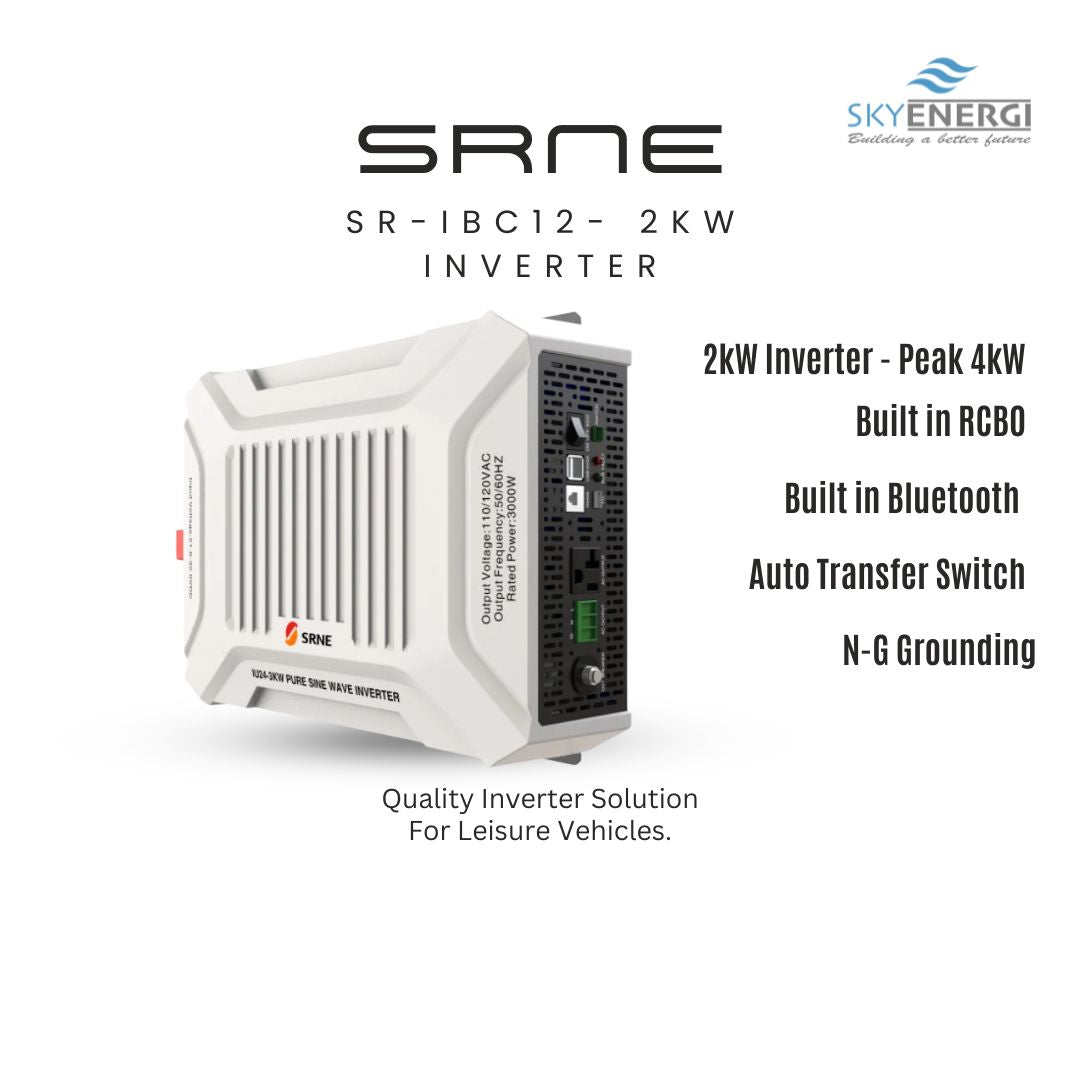
Keep battery cables short and fitted with proper crimped terminals. Long runs add voltage drop, which lowers inverter performance. A pre-made battery-to-inverter cable pair saves time and gives you a correctly sized lead for this connection.
Inverter Fuse Location: Where It Goes and Why
Fit the fuse as close to the battery positive terminal as you can. This protects the whole cable run, not just the part after the fuse. A terminal-mount fuse block is a neat way to do this, and several designs suit this position.
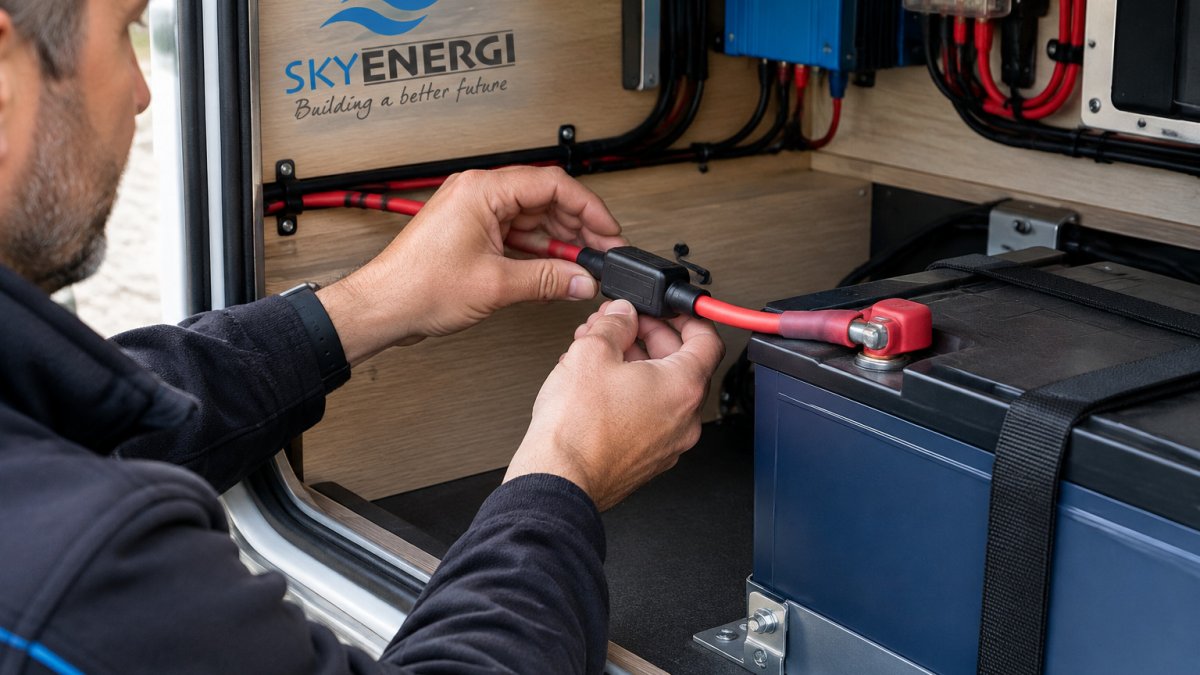
Make sure the fuse is easy to reach and check, but never let it sit where it can short against metal. Keep the wiring clear of heat sources and secure it so it cannot chafe. Installation should follow the manual and be carried out by a qualified person.
Booking Your Protection Check Before the Next Trip
Before you rely on a new fuse, run through the manual, the cable size, the fuse type and the location. A short check now is far cheaper than a fault on the road. If any figure is unclear, stop and ask before you connect anything.
Ask SkyEnergi's team if you want help matching the right components to your system. Starting with the correct manual values is the surest way to protect your inverter and your battery.
Frequently Asked Questions
What size fuse do I need for an SRNE inverter?
There is no single fuse size for every SRNE inverter. The fuse rating depends on the model, so check the manual for your exact unit. Check the model-specific manual for your exact unit, then size the fuse to the battery-side current and cable capacity. If the manual gives no clear value, ask a qualified installer before connecting the system.
Does an SRNE inverter need a fuse on the battery cable?
Yes. An external fuse or circuit breaker on the DC input is a sensible protective measure. Protection on the battery side limits fault current through the cable if a short occurs. The fuse should sit as close to the battery positive terminal as practical, and it should be rated for DC use with a suitable interrupt rating. Do not rely on the inverter's internal protection alone, because it cannot stop a fault in the cable run.
Can I use a circuit breaker instead of a fuse for an inverter?
A DC-rated circuit breaker can be an acceptable alternative to a fuse if its rating and interrupt capacity suit the battery and cable. Breakers are convenient because they can be reset, but they must be DC-rated for the system voltage. Confirm the rating against the model manual and the cable's current-carrying capacity before choosing one.
Why does my SRNE inverter keep blowing its fuse?
Repeated blowing usually means the fuse is undersized for the continuous or surge current, the cable is too thin for the load, a loose or corroded terminal is adding resistance, or there is a genuine fault such as a short or an overloaded appliance. Check the connections first, then measure the load draw. Do not simply fit a larger fuse, because that removes protection and can let the cable overheat. If the problem continues, have a qualified electrician inspect the installation.

Prev post

SRNE DB12 Fuse Sizing Guide for Campervan DC Circuits
Updated on 25 November 2026
Next post

7 Ways SRNE Data Acquisition Units Optimise Solar Power
Updated on 23 November 2026


