





Are You Seeing Signs of Lithium Battery Thermal Runaway?
Spot lithium battery thermal runaway warning signs early to prevent a fire. Learn the stages, causes, and safe actions before it escalates.
Last Updated: October 30, 2026
Quick Summary
The first signs of lithium battery thermal runaway are heat you can feel through the casing, swelling or bulging of the battery body, a sweet or chemical smell, and venting gas or smoke. These appear before flames, so early detection matters in a campervan or off-grid setup where the battery sits close to where you sleep.
- Thermal runaway is a self-sustaining chain reaction that does not need a flame to begin.
- A sustained temperature rise of even 1-2°C per minute after load removal is a red flag.
- If a lithium battery is smoking, get people away first and do not try to move it.
- A standard fire extinguisher will not reliably put out a lithium cell fire, so evacuate.
- LiFePO4 chemistry is more thermally stable than many other lithium-ion chemistries for leisure batteries.
Table of Contents
- What Are the First Signs of Lithium Battery Thermal Runaway?
- Lithium Battery Overheating Signs You Should Never Ignore
- Lithium Battery Thermal Runaway Causes in Campervans and Off-Grid Systems
- What to Do If a Lithium Battery Is Smoking
- LiFePO4 Battery Safety: Why Chemistry Matters for Your Leisure Battery
- How SRNE Monitoring and Skyenergi Batteries Reduce Thermal Risk
- Choosing a Safer Lithium Leisure Battery for Your Next Build
- Frequently Asked Questions
What Are the First Signs of Lithium Battery Thermal Runaway?
The first signs of lithium battery thermal runaway are heat you can feel through the casing, swelling or bulging of the battery body, a sweet or chemical smell, and venting gas or smoke. These appear before flames, which is why early detection matters so much in a campervan or off-grid setup where the battery sits close to where you sleep.
At Skyenergi, we supply lithium leisure batteries and monitoring systems into van conversions and off-grid builds. Thermal runaway is a self-sustaining chain reaction inside a battery cell. Once it starts, the cell generates its own heat, and that heat triggers the next cell. It does not need a flame to begin.
Below, we walk through the signs in the order they usually appear, what causes them, and exactly what to do if a battery starts smoking.
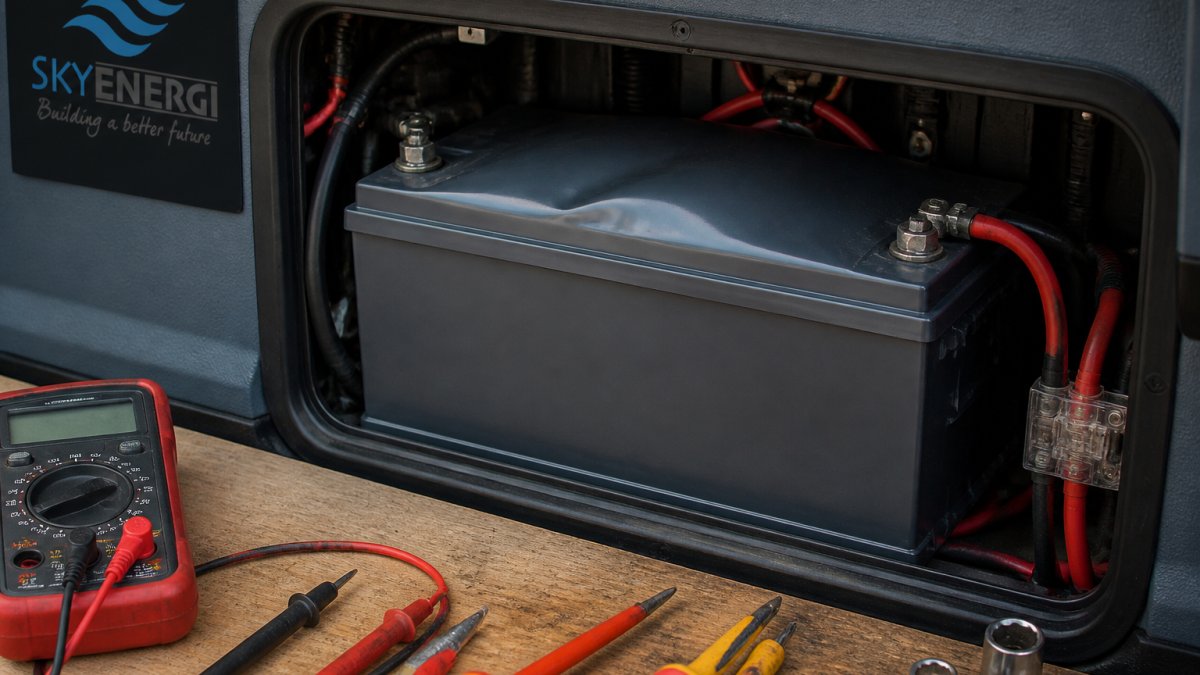
Thermal runaway is a self-sustaining chain reaction in which a battery cell overheats, breaks down internally, and releases enough heat to push neighbouring cells into the same failure. It is a failure mode, not an accident that happens out of nowhere.
The earliest signs, in rough order of urgency:
- Abnormal heat in the battery casing, especially one cell running hotter than the rest
- Swelling or bulging of the case, top plate, or terminals
- A sweet, solvent, or chemical smell with no obvious source
- Venting gas or wisps of smoke from the casing or terminal area
- A sudden voltage drop or a battery that will not hold charge
- Popping, hissing, or crackling sounds from inside the battery
If you want a practical way to check what you are seeing, our guide on monitoring lithium battery health walks through the checks step by step.
Lithium Battery Overheating Signs You Should Never Ignore
Overheating is the sign most people notice first, and the one most often dismissed as normal. A lithium battery that is warm after heavy discharge is normal. A battery that is hot to the touch, or hotter than it was an hour ago with no change in load, is not.
Watch for these overheating signs:
- Heat you cannot hold your hand on for more than a second or two, roughly above 60°C on the casing, though the exact threshold depends on the cell design and housing
- One cell noticeably warmer than its neighbours in a multi-battery bank, a difference of more than a few degrees between parallel batteries is worth investigating
- Heat that keeps climbing after you have stopped charging or discharging, a sustained rise of even 1-2°C per minute after load removal is a red flag
- A hot smell combined with warmth, which points to venting rather than normal losses
- Warped or discoloured casing near the terminals
The rate of temperature rise matters more than the absolute number. A battery climbing steadily is more worrying than one sitting stable at a higher temperature. This is why temperature monitoring beats a one-off check with your hand. Consistent thermal tracking provides the necessary oversight to ensure that vape battery performance remains within safe operational parameters while preventing the accelerated degradation that often accompanies excessive heat.
Measurement limitations are real: a clamp meter or infrared thermometer gives a spot reading, not a continuous profile. Surface temperature can lag internal cell temperature by several degrees, especially in sealed IP65 housings. For that reason, treat any handheld reading as a screening tool, not a diagnosis. If you see a surface temperature above 50°C with no load, stop charging and investigate before the next cycle.
Watch out: never open a swollen or overheating battery to "take a look". Breaking the seal exposes cells to air and moisture and can turn a contained failure into a fire.
Lithium Battery Thermal Runaway Causes in Campervans and Off-Grid Systems
Most lithium battery thermal runaway causes in leisure vehicles fall into a handful of categories, and nearly all of them are avoidable. The common ones we see:
- Overcharging from a charger set to the wrong profile, or a failed charge controller
- External heat exposure, such as a battery box next to an exhaust, a heater, or in direct summer sun
- Physical damage from a dropped battery, a crushed cable, or a loose terminal
- Short circuits from chafed wiring or reversed connections
- Internal cell failure, where a manufacturing fault or age-related degradation starts the chain
- Charging below freezing without a heat pad, which damages cells and can seed later failure
The pattern is consistent: charging faults and heat exposure cause most incidents. A well-matched charging system and a battery designed for cold-weather charging remove a large share of the risk.
What to Do If a Lithium Battery Is Smoking
If a lithium battery is smoking, get people away from it first and do not try to move it. Smoke from a failing lithium battery can contain flammable and toxic gases, and the battery can vent violently without warning.
Follow this order:
- Stop charging and disconnect the load if you can do so safely from a distance, use a remote isolator or breaker if fitted
- Evacuate the vehicle or room and get everyone outside, closing doors behind you if it does not delay you
- Call the fire service and tell them it is a lithium battery fire, mention the chemistry if you know it (LiFePO4 vs other lithium-ion)
- Do not use water on a live electrical fire unless you are trained and the power is isolated
- Keep clear until professionals confirm it is safe, reignition can occur hours or even days after the initial event
A battery that is smoking but not yet alight can still ignite. Treat smoke as a fire in progress.
Skyenergi Edge 100Ah Lithium Leisure Battery →
Reignition and propagation: A lithium cell fire can reignite after appearing extinguished because the internal chain reaction may not be fully quenched. Cell-to-cell propagation is also a risk: in a multi-battery bank, one failing cell can heat its neighbours and trigger a cascade.
After the event: Even after the smoke clears, the battery should be treated as hazardous waste. Do not attempt to recharge or reuse it. Isolate the area, ventilate thoroughly, and arrange safe disposal through a licensed waste carrier.
Differences by setting: In a vehicle, evacuation is the priority because space is confined and escape routes may be limited. In a stationary off-grid installation, isolate the battery room if possible and keep others out. Consumer devices (phones, laptops) present a smaller scale but similar principle: move away, unplug if safe, and do not smother a swelling battery.
Watch out: a standard fire extinguisher will not reliably put out a lithium cell fire. The priority is evacuation, not extinguishing. For circuit protection on your build, a correctly rated MRBF terminal fuse block limits the current a short circuit can draw.
LiFePO4 Battery Safety: Why Chemistry Matters for Your Leisure Battery
LiFePO4 battery safety comes down to chemistry. Lithium iron phosphate cells are more thermally stable than many other lithium-ion chemistries, which makes them the sensible choice for a leisure battery that lives inside a vehicle.
The practical differences:
- Higher tolerance to abuse before a cell reaches the point of no return
- Less oxygen release inside the cell during failure, which reduces the intensity of a fire
- Stable performance across charge cycles, so the cells age more predictably
Chemistry is not a guarantee. A LiFePO4 battery can still fail if it is overcharged, shorted, or cooked. But the margin for error is wider, and in a campervan that margin matters.
If you are weighing up a specific battery, the Skyenergi Core2 230Ah LiFePO4 leisure battery with heat pad and Bluetooth shows what a cold-weather-ready LiFePO4 pack looks like in practice.
How SRNE Monitoring and Skyenergi Batteries Reduce Thermal Risk
Monitoring is the difference between catching a problem early and finding out too late. SRNE charging and monitoring systems can display battery information so that readings are visible to the user.
Our batteries are built with monitoring in mind. The Skyenergi Edge range uses a JBD battery management system and Grade A EVE lithium cells inside an IP65-rated housing. The Elite range adds a heat pad and plug-and-play Victron integration.
For a closer look at how the monitoring side works, read our SRNE monitoring system review.
Choosing a Safer Lithium Leisure Battery for Your Next Build
A safer build starts with three decisions: the right chemistry, a BMS you trust, and monitoring you actually check. Get those right and you remove most of the conditions that lead to thermal runaway.
Use this checklist before you buy:
- LiFePO4 chemistry, not an older lithium-ion blend
- A named BMS
- A heat pad if you charge in cold weather
- A monitoring system you can read at a glance
- Correctly rated fusing on every circuit
- A charger matched to the battery's charge profile
| Decision | What to look for | Why it matters |
|---|---|---|
| Chemistry | LiFePO4 cells | Wider tolerance before failure |
| BMS | Named unit with temperature cut-off | Stops charging before damage |
| Cold charging | Heat pad built in | Prevents freeze-related cell damage |
| Monitoring | Live temperature and voltage | Catches problems early |
| Protection | Rated fuse block | Limits short-circuit current |
Our Skyenergi Core leisure battery range covers the sizes most campervan and off-grid builds need, from compact setups to full off-grid banks.
Thermal runaway is rare, but it is not random, and the warning signs almost always show up before the fire does. The challenge is having the right battery, the right protection, and monitoring you trust enough to act on. Skyenergi supplies lithium leisure batteries with JBD battery management systems, heat pad technology on the Elite range, and SRNE charging and monitoring systems. Get started with Skyenergi and build a power system you can check at a glance.
Frequently Asked Questions
What are the first signs of lithium battery thermal runaway?
The earliest signs usually include unusual heat, a faint sweet or chemical smell, and slight swelling of the battery casing. You may also notice the battery voltage behaving erratically or the BMS disconnecting more often than normal. In a campervan, these signs often appear while charging or after a long drive. Treat any combination of heat, smell, and swelling as a serious warning and stop using the battery immediately.
Can a lithium battery go into thermal runaway without warning?
Complete failure without any warning is rare. Most lithium battery thermal runaway events follow a build-up of heat, gas release, and internal cell pressure that produces observable signs first. A swollen case, unusual odour, or repeated BMS shutdowns are common early indicators. That said, a sudden short circuit or physical impact can accelerate the process, which is why a properly installed BMS and correct charging setup are essential safeguards.
What should I do if a lithium battery is smoking?
Stop charging or discharging immediately, switch off the isolator if it is safe to reach, and evacuate everyone from the vehicle or room. Do not open the battery case or attempt to move a hot battery. Call the fire service and tell them it is a lithium battery fire. Once emergency services have made the area safe, have the system inspected by a qualified installer before any replacement or repair work begins.
Are LiFePO4 batteries immune to thermal runaway?
No battery chemistry is completely immune, but LiFePO4 is significantly more thermally stable than older lithium chemistries. Its higher onset temperature and lower tendency to release oxygen during failure make propagation less likely. LiFePO4 battery safety still depends on correct charging voltages, a functioning BMS, and protection from physical damage. Skyenergi Edge and Elite batteries use Grade A EVE lithium cells with JBD battery management systems.

Prev post

Optimising Solar Charging for Slimline Lithium Batteries
Updated on 01 November 2026
Next post

How to Safely Dispose of Lithium Batteries
Updated on 30 October 2026


