





Lithium battery lifespan in motorhomes: 2026 guide
Lithium battery lifespan in motorhomes: How long do lithium batteries last in motorhomes?
Table of Contents
- Understanding lithium battery lifespan in motorhomes
- Lithium leisure battery charge cycles explained
- 12V 100Ah lithium battery runtime: What to expect
- Factors that affect motorhome lithium battery longevity
- Motorhome lithium battery maintenance for extended life
- Charging lithium batteries in cold weather
- Lithium versus lead-acid: Lifespan comparison
- Extending your motorhome battery lifespan: Practical steps
- Frequently Asked Questions
Last Updated: October 16, 2026
Understanding lithium battery lifespan in motorhomes
A motorhome's lithium leisure battery is its power backbone, and how long it lasts depends on how you use, charge, and care for it, not just its rated lifespan.
At Skyenergi, we help motorhome owners understand what they're really getting from a lithium battery system. Lifespan claims vary widely because manufacturers test under different conditions, what matters is how those conditions compare to your actual usage.
The lithium battery lifespan in motorhomes typically ranges from 5 to 15 years, depending on chemistry, depth of discharge, temperature exposure, and charging practices.
How cycle life translates to years of use
Manufacturers quote lithium battery lifespan in motorhomes in years and charge cycles. A 5,000-cycle rating means little until you know your annual cycle count.
Here's the practical math:
- If you fully discharge and recharge once daily, 5,000 cycles equals roughly 13-14 years
- If you use partial discharges (more common in motorhomes), you'll do fewer full-equivalent cycles, extending the timeline
- If you rarely fully discharge, you might get 10+ years from the same battery
The gap between marketing claims and real-world use comes down to test conditions: manufacturers test under controlled temperature, specific discharge rates, and consistent charging, your motorhome rarely operates that way.
Lithium leisure battery charge cycles explained
A charge cycle is one complete discharge from full to empty, then a full recharge. Each cycle degrades a lithium cell slightly, and after thousands, capacity fades.
Most motorhome owners don't do full discharge cycles regularly, you might use 30% one day, 50% another, and recharge partially from solar or shore power.
The cycle-to-years relationship isn't straightforward: a battery rated for 3,000 cycles at 100% depth of discharge might deliver 7,000 at 50%. Your actual usage pattern matters more than the headline number.
Depth of discharge and usable capacity
Depth of discharge (DoD) is the percentage of capacity you use before recharging. A 100Ah battery at 80% DoD means you use 80Ah, leaving 20Ah as a buffer.

Lithium tolerates deeper discharges than lead-acid but still prefers shallower use. Keeping DoD between 20% and 80% significantly extends battery life.
Actual usable capacity is often less than rated. A 100Ah battery might give 80-85Ah once you account for:
- Battery management system (BMS) protection headroom
- Charging efficiency losses
- Temperature-related capacity reduction in cold weather
Understanding this gap prevents disappointment, you're getting a sustainable working range, not a full 100Ah.
12V 100Ah lithium battery runtime: What to expect
A 12V 100Ah lithium battery is the most common motorhome size, but runtime depends on daily consumption and recharging. Here we work through three realistic setups showing how capacity, loads, and trip frequency translate into years of service.
Calculating real-world power availability
Start with usable capacity: a 100Ah lithium battery at 80% DoD gives roughly 960 watt-hours (Wh) per full cycle. Motorhome owners rarely run a full cycle daily. The table shows three common sizes at 80% DoD:
| Battery size | Usable energy at 80% DoD |
|---|---|
| 100Ah | 960Wh |
| 200Ah | 1,920Wh |
| 230Ah | 2,208Wh |
Worked example: small motorhome (100Ah, weekend use)
A typical small campervan with a 100Ah Skyenergi Edge battery might run:
- Fridge: 40W average (cycling)
- LED lighting: 10W for 4 hours
- Device charging: 60W for 2 hours
- Water pump: 100W for 0.5 hours
Daily energy use: (40W × 24h) + (10W × 4h) + (60W × 2h) + (100W × 0.5h) = 1,170Wh. That exceeds the 960Wh usable capacity, so this setup needs solar or a second battery for a full day off-grid; weekend users often top up via a DC-to-DC charger while driving. At 50% of usable capacity daily (480Wh), you accumulate about 0.5 full-equivalent cycles per day, roughly 500 cycles over 10 years at 100 nights annually, well within a 3,000-5,000 cycle rating and suggesting 15+ years if calendar aging doesn't intervene first.
Worked example: medium motorhome (200Ah, frequent touring)
A 200Ah system (two 100Ah batteries or a single 200Ah unit) with 1,920Wh usable energy supports heavier loads:
- Fridge: 50W average
- Lighting: 15W for 5 hours
- Laptop and devices: 100W for 3 hours
- Water heater (intermittent): 1,000W for 0.5 hours
- Inverter losses: 10% of AC loads
Daily energy use: (50W × 24h) + (15W × 5h) + (100W × 3h) + (1,000W × 0.5h) = 2,075Wh. That's slightly above usable capacity, so you'd rely on solar or alternator charging during the day. Touring 150 nights per year at 60% of usable capacity daily (1,152Wh) gives about 0.6 full-equivalent cycles per day, roughly 900 cycles over 10 years, pointing to 10-15 years of service if temperature and charging are managed.
Worked example: large motorhome (230Ah, full-time use)
A 230Ah system (2,208Wh usable) for a large motorhome with all-electric amenities:
- Fridge: 60W average
- Lighting: 20W for 6 hours
- Laptop, TV, devices: 150W for 4 hours
- Water heater: 1,200W for 0.5 hours
- Microwave: 800W for 0.2 hours
- Inverter losses: 10%
Daily energy use: (60W × 24h) + (20W × 6h) + (150W × 4h) + (1,200W × 0.5h) + (800W × 0.2h) = 2,920Wh. This exceeds usable capacity, so you'd need solar, alternator, or shore power daily. Full-time users cycling 80% of usable capacity daily (1,766Wh) accumulate 0.8 full-equivalent cycles per day, about 1,460 cycles over 5 years, still within a 3,000-cycle rating, though calendar aging and temperature become significant.
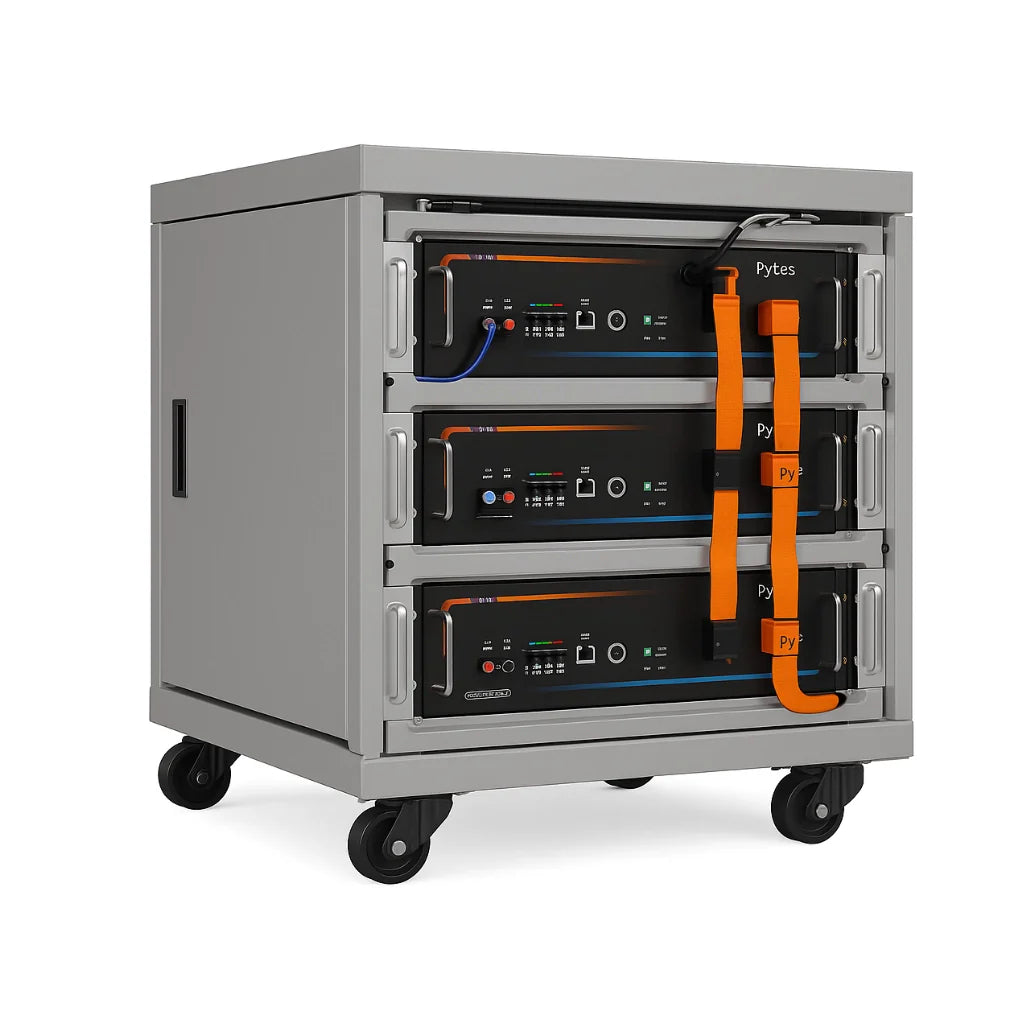
The Skyenergi Edge 100Ah battery provides a solid foundation for small to medium motorhomes. Pair it with an SRNE MPPT solar controller and a DC-to-DC charger, and you shift from "how long will it last?" to "how much energy can I generate daily?" For larger setups, the Skyenergi Elite range with Victron integration offers scalable capacity and cold-weather heating.

Factors that affect motorhome lithium battery longevity
Several factors work together to either extend or shorten your battery's working life.
Temperature, charging habits and usage patterns
Temperature is the single biggest factor in lithium longevity. Cells degrade faster in heat and lose performance in cold; the ideal range is 15-25°C, and every 10°C above that accelerates degradation noticeably.
Charging habits matter equally. Fast charging generates heat and stresses the battery, while slow, controlled charging (especially from solar) is gentler.
Skyenergi Edge 100Ah Lithium Leisure Battery →
Usage patterns determine annual cycle accumulation: frequent travellers who discharge deeply accumulate cycles faster than those mostly on shore power.
Motorhome lithium battery maintenance for extended life
Lithium batteries require less hands-on maintenance than lead-acid, but they still need attention.
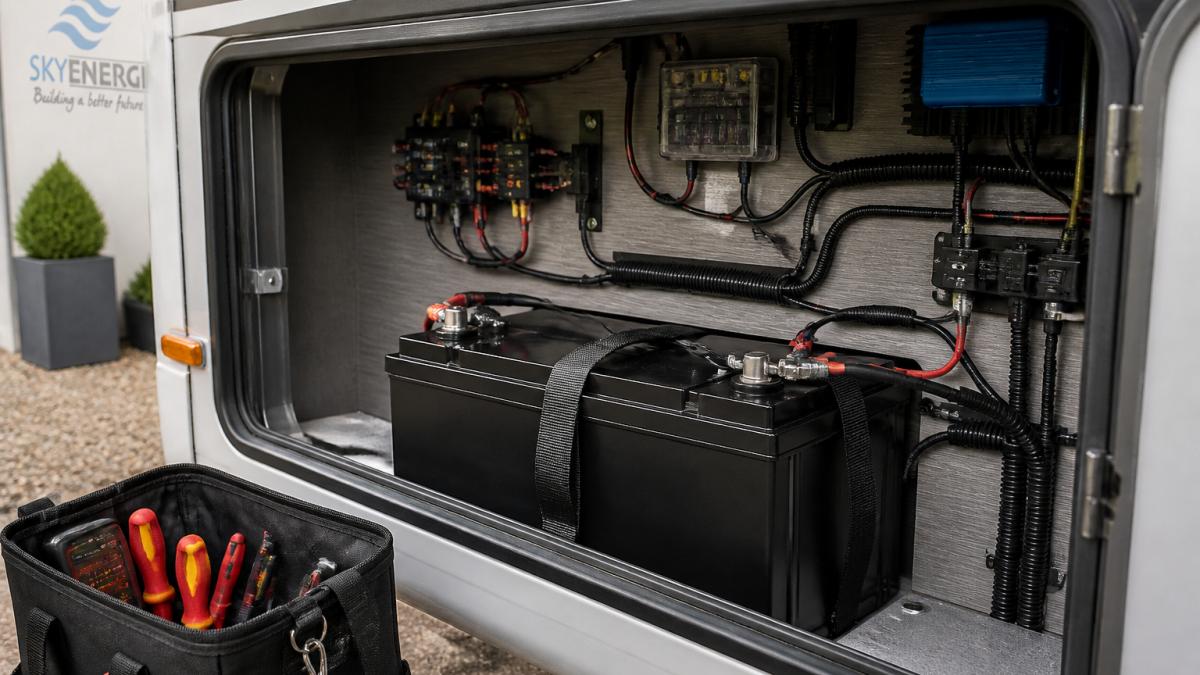
Regular monitoring and seasonal storage
Check state of charge monthly. A quality BMS gives real-time voltage and current data, and many owners use a Victron SmartShunt or similar tool to track performance over time.
Before winter storage, charge to 50-70% and store in a cool, dry location. Lithium self-discharges slowly, so check every few months and top up if it drops below 40%.
Clean terminals and cable connections annually, corrosion is rare with modern batteries, but loose connections cause voltage drops and charging failures.
Charging lithium batteries in cold weather
Cold reduces performance and charging speed. Below 0°C, most lithium batteries stop accepting charge safely to prevent lithium plating, which permanently damages cells. Discharge is still possible down to -20°C with reduced capacity, so your motorhome can still draw power even when charging is blocked.
Battery management systems and low-temperature cutoffs
A quality BMS enforces temperature limits. Most lithium iron phosphate (LiFePO4) batteries cut off charging at 0°C and discharging around -20°C, with the BMS monitoring cell temperature via internal sensors and opening the charging circuit below the threshold. Some advanced units include heating elements.
The Skyenergi Elite range includes heat pad technology: when ambient temperature drops below 5°C, the BMS activates gentle heating to bring the battery to a safe charging temperature (typically 5-10°C) before allowing charge current. This is especially useful for winter touring or unheated storage.
Without heat protection, expect:
- Charging stopping or slowing dramatically below 0°C
- Voltage sag under load in cold conditions
- Reduced usable capacity (often 20-30% less at -10°C)
- Risk of permanent damage if charged below 0°C without cutoff
Charging sources in cold weather
Your charging source affects cold-weather handling:
- Solar: Winter output drops due to shorter days and lower sun angle. An SRNE MPPT controller still harvests what's available, and its temperature compensation adjusts charge voltage based on battery temperature, protecting cells.
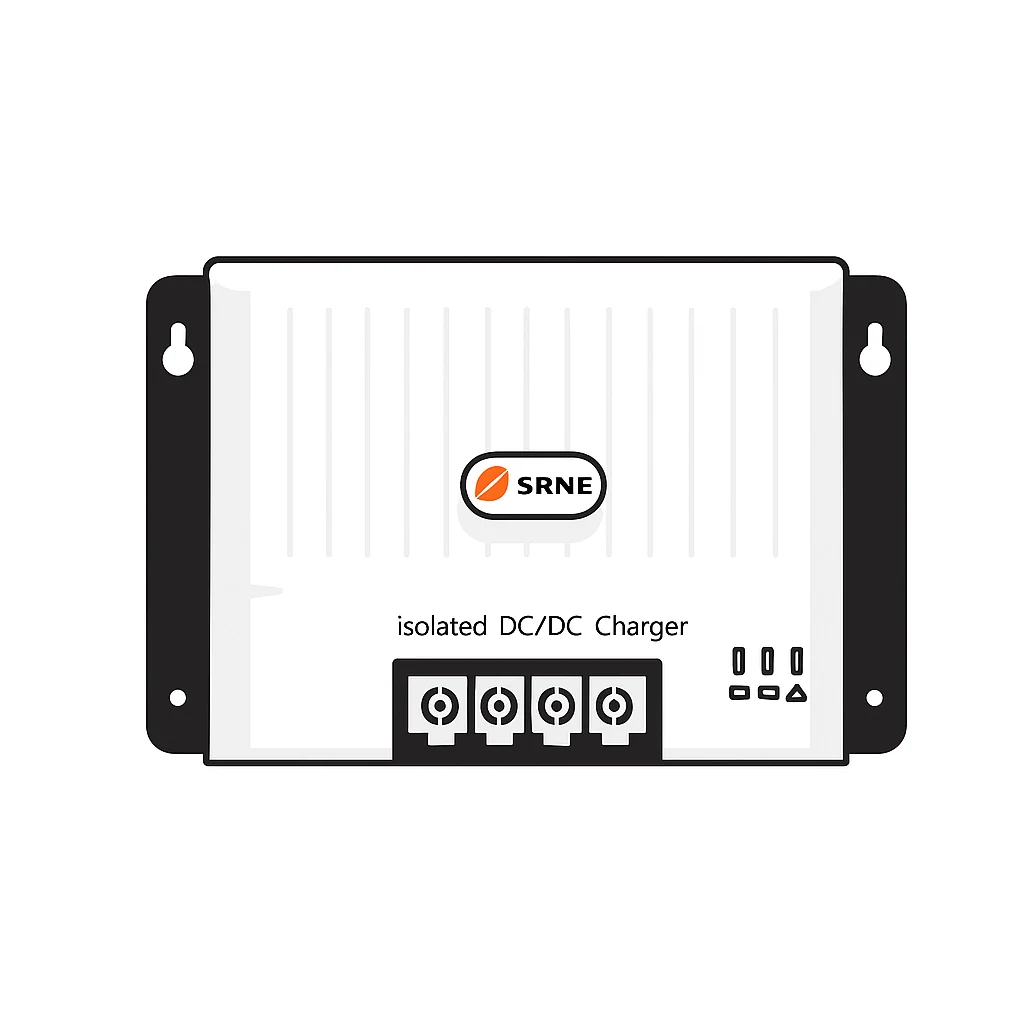
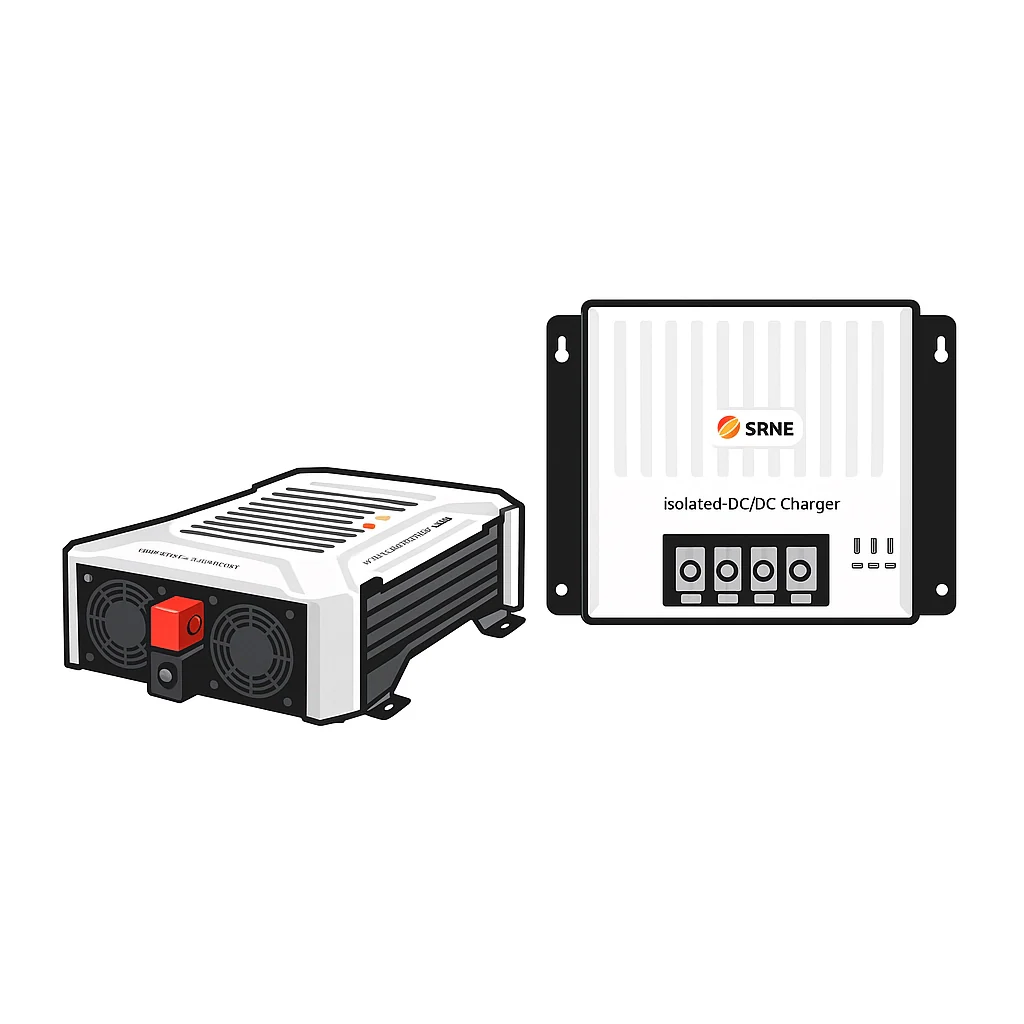
- Alternator via DC-to-DC charger: Temperature sensing reduces charge current when the battery is cold, and some units include a winter mode that limits charging until it warms up.
- Shore power: A quality mains charger with temperature compensation adjusts voltage for cold conditions. Avoid fast charging in cold weather; slow, gentle charging is safer.
If your motorhome sits in cold climates, a heated battery system is worth the investment: it lets you charge from solar or shore power in winter and protects against accidental cold-charging damage. Pair a heated Skyenergi Elite battery with an SRNE DC-to-DC charger and MPPT controller for a fully integrated cold-weather-ready system.
Lithium versus lead-acid: Lifespan comparison
Lead-acid leisure batteries typically last 3-5 years in motorhome use; lithium lasts 5-15. The real difference is degradation: lead-acid declines steadily from year one, while lithium drops gradually at first, then steeper near end-of-life, so you get more usable years before performance becomes unacceptable.
Lead-acid also needs watering, terminal cleaning, and careful charging; lithium is nearly maintenance-free with proper monitoring. Cost-per-year favours lithium for most owners, especially frequent travellers: a Skyenergi Edge 100Ah battery delivers 2-3x the lifespan of a lead-acid equivalent with no maintenance.
Extending your motorhome battery lifespan: Practical steps
You control most factors that determine how long your battery lasts.
Keep temperature moderate: Use ventilation in summer, insulation in winter.
Charge slowly and consistently: Solar is ideal, gentle and free. Avoid fast DC charging unless necessary.
Avoid deep discharges: Stay between 20% and 80% state of charge and don't regularly drop below 10%.
Monitor regularly: Check voltage, current, and temperature monthly to catch problems early.
A motorhome's lithium battery lifespan is not fixed, you extend it through proper charging, temperature management, and monitoring.
At Skyenergi, we provide complete lithium battery systems designed for UK motorhomes and caravans. Our Elite range adds Victron integration and cold-weather heating for maximum lifespan in challenging conditions.
Frequently Asked Questions
How long will a 12V 100Ah lithium battery last in a motorhome?
A 12V 100Ah lithium battery typically delivers 3,000 to 5,000 charge cycles, translating to 5-10 years of regular use in motorhomes. Real-world lifespan depends on depth of discharge, charging practices and temperature management. If you discharge to 80% and recharge regularly, you'll see longer service life than if you regularly deplete the battery fully. The Skyenergi Edge 100Ah, for example, combines Grade A EVE lithium cells with a trusted JBD BMS to support consistent performance across thousands of cycles.
What affects the lifespan of a lithium leisure battery?
Three main factors shorten or extend battery life: temperature, charging habits and usage patterns. Cold weather slows chemical reactions and can temporarily reduce capacity; heat accelerates degradation. Frequent full discharges age the battery faster than shallow cycles. Charging with incompatible equipment or at extreme temperatures also reduces longevity. Batteries with integrated heat pads, like the Skyenergi Elite range, maintain optimal charging conditions even in freezing weather, helping preserve cycle life and prevent premature wear.
How many charge cycles can a motorhome lithium battery provide?
Most lithium leisure batteries for motorhomes provide between 3,000 and 5,000 deep cycles at 80% depth of discharge, though some premium options reach 7,000+ cycles under ideal conditions. A charge cycle counts as one complete discharge and recharge. If you use 50% of your battery's capacity daily, a 3,000-cycle battery lasts roughly 6,000 days (16+ years). However, calendar aging means even unused batteries degrade slightly each year, so real-world lifespan is typically 5-10 years regardless of cycle count.
Can cold weather damage a motorhome lithium battery?
Cold weather does not permanently damage lithium batteries, but it temporarily reduces their capacity and charging speed. Below 0°C, chemical reactions slow significantly, so your battery delivers less usable power. Charging in freezing conditions can cause internal damage if the battery lacks temperature protection. This is why integrated heat pads are valuable: the Skyenergi Elite range includes heat pad technology that maintains safe charging temperatures even in winter, preventing degradation and ensuring reliable performance when you need it most.
Next post

Lithium vs Lead-Acid for Motorhomes: 2026 Guide
Updated on 16 October 2026


