


How to Install a Caravan Consumer Box with RCBO Protection?
Learn how to wire a caravan consumer box with Type A RCBOs, double-pole protection and the tests to run before you energise it.
Quick Summary
A caravan consumer box is the central point where mains power arrives and is split into protected circuits. For most UK caravans with a shore-power hookup and an inverter, installing one is a sensible way to keep the system protected. The box uses RCBOs to protect each circuit against overload, short circuit and earth leakage.
- Use a Type A RCBO for caravan shore-power and inverter circuits, not a Type AC device.
- An MCB alone will not reliably stop a person being shocked by a leakage fault.
- A double-pole RCBO is preferred because polarity cannot be guaranteed on every hookup.
- Test each RCD or RCBO with its test button and a dedicated tester before energising.
- Never bypass or tape up a tripping RCBO; find the fault instead.
Table of Contents
- Do You Need a Consumer Box in a Caravan?
- RCD, RCBO and MCB: What Each Device Does in a Caravan
- Tools, Components and Safety Standards You Need Before Starting
- Step-by-Step: Caravan Consumer Unit Wiring Sequence
- Connecting an Inverter to the Caravan Consumer Box
- Caravan Electrical Safety Checks After Installation
- Booking Your Next Step: Choosing the Right Consumer Box for Your Build
- Frequently Asked Questions
Do You Need a Consumer Box in a Caravan?
Last Updated: November 13, 2026
A caravan consumer box is the central point where mains power arrives and gets split into protected circuits. For most UK caravans with a shore-power hookup and an inverter, a consumer box is a sensible way to keep the system protected, so the answer is generally yes. A properly protected consumer box helps isolate faults between circuits, while troubleshooting RV electrical power loss can clarify whether an interruption stems from the campsite supply or the caravan itself.
Many caravan owners ask whether a consumer box is really necessary. Without one, the supply cable runs straight into appliances with no clear protection. That leaves the wiring exposed to overload and earth faults. A dedicated box gives every circuit its own protective device, so a fault on one circuit does not take out the rest.
Skyenergi's Caravan & Motorhome Consumer Box with 16A RCBO is designed for new SRNE inverter and charger installations, so it suits a build where the inverter is going in from the start.
Watch out: Do not treat a consumer box as optional just because the caravan already has a plug-in hookup. Without protection at the point of supply, a fault can go undetected until it causes damage.
RCD, RCBO and MCB: What Each Device Does in a Caravan
Three protective devices show up in caravan consumer boxes, and each has a different job. An MCB (miniature circuit breaker) protects a cable against overload and short circuits. An RCD (residual current device) cuts the supply when it detects current leaking to earth, which is the main protection against electric shock. An RCBO combines both functions in one device, so a single unit protects against overload, short circuit and earth leakage.
For a caravan with an inverter, an RCBO is often the simplest choice. It gives you RCD protection and circuit protection on each way without needing two separate devices per circuit. The Skyenergi box includes a 16A RCBO Type A, which protects against earth faults and leakage currents.
- MCB: protects the cable from overload and short circuit.
- RCD: detects earth leakage and disconnects quickly.
- RCBO: combines an MCB and an RCD in one device.
A common mistake is assuming an MCB alone is enough. It stops the cable overheating, but it will not reliably stop a person being shocked by a leakage fault.
RCBO Selection Checklist for a Caravan Consumer Box
Choosing the right RCBO is an important step. Use this checklist before you buy or fit one:
- Device type: For caravan and shore-power circuits, a Type A RCBO is the usual minimum because it responds to pulsating DC leakage and AC earth faults. Type AC is not suitable where DC components may be present, such as inverter or charger circuits.
- Current rating: Match the RCBO rating to the cable and load. A 16A RCBO suits a typical 16A shore-power inlet and downstream socket circuit. Do not fit a higher-rated device than the cable can safely carry.
- Breaking capacity: Check the RCBO's short-circuit breaking capacity meets or exceeds the prospective fault current at the caravan inlet. For most shore-power supplies this is modest, but the device must still be rated for it.
- Pole configuration: A double-pole RCBO that switches both live and neutral is preferred for caravan installations, because polarity cannot be guaranteed on every hookup and a double-pole device isolates both conductors.
- Compatibility: Confirm the RCBO is listed for the consumer-unit assembly you are using.
- Trip characteristics: A Type B curve is typical for socket and lighting circuits. Type C may suit motor loads, but check the manufacturer's data before mixing curves in one box.
Watch out: Do not fit an RCBO just because it physically fits the busbar. If the device type, rating or breaking capacity is wrong for the circuit, it may not trip when it should.
Tools, Components and Safety Standards You Need Before Starting
Before you open the box, gather everything you need. A proper install starts with the right parts, not a rush to the wiring.
The core components are the consumer box itself, the RCBO, cable of the correct size, cable glands, and terminations suitable for the circuit. The Skyenergi Caravan & Motorhome Consumer Box with 16A RCBO is priced at £36.00, is made from flame-resistant ABS and conforms to BS EN 60439-1 and BS EN 60439-3.
You will also need a multimeter, a cable stripper, a screwdriver set, and a way to test the circuits once wired.
- Consumer box with RCBO (£36.00)
- Cable suitable for the circuit rating
- Cable glands and terminals
- Multimeter and test equipment
- Cable stripper and screwdrivers
Watch out: Electrical work on a caravan should only be carried out by a competent person. If you are not confident working with mains voltage, use a qualified electrician.
Step-by-Step: Caravan Consumer Unit Wiring Sequence
The order of wiring matters. Work from the supply inwards, and do not energise anything until every connection is checked.
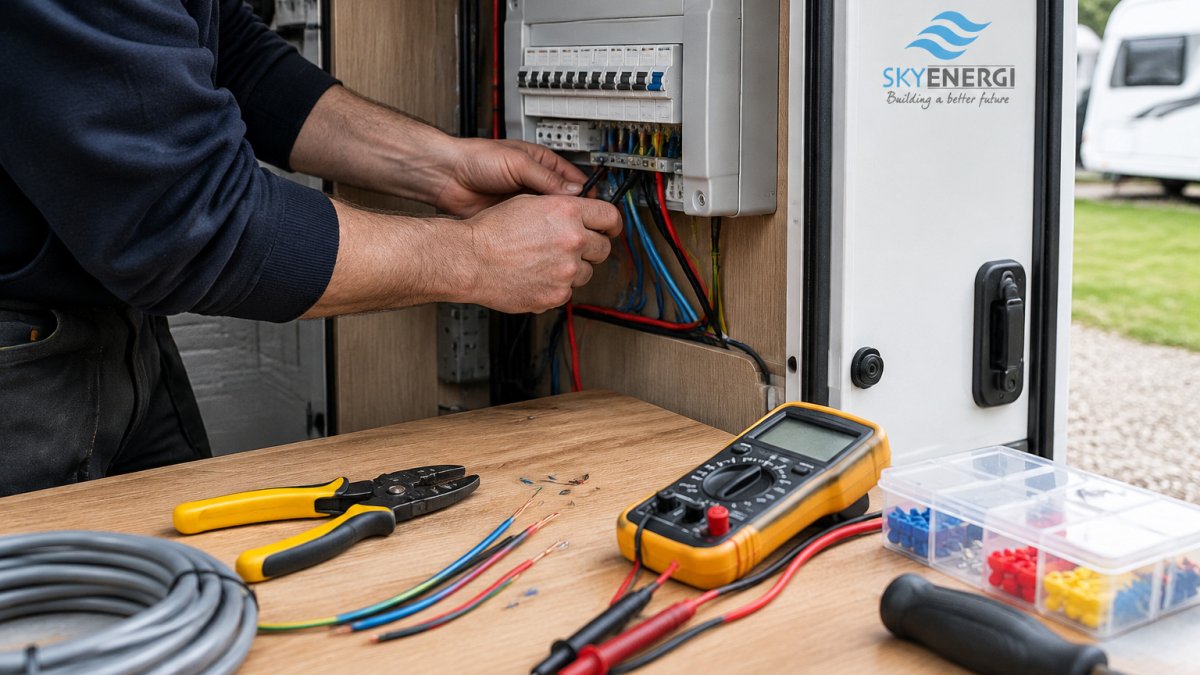
Connecting the Supply and the RCBO
Start by connecting the incoming supply to the RCBO. Keep the supply isolated while you do this. Terminate the cable cleanly, with no loose strands, and tighten every terminal to the manufacturer's torque setting.
Once the supply is in place, check the RCBO is correctly rated for the circuit it protects. Use a test to confirm it trips when the test button is pressed.
Connecting the Outgoing Circuits and Inverter Input
Next, connect the outgoing circuits. Each circuit should go to its own protective device. If you are feeding an SRNE inverter, route its input through the dedicated circuit so the inverter is protected at the point of supply.
Label every circuit as you go. Clear labelling saves time when you test or fault-find later.
Connecting an Inverter to the Caravan Consumer Box
An inverter connects to the consumer box so that mains power can pass through when available and the inverter can take over when it is not. Follow the Skyenergi lithium battery compartment installation steps when connecting an inverter alongside a lithium battery. Keep the inverter's input and output clearly separated in the box layout.
Caravan Electrical Safety Checks After Installation
Once the wiring is finished, test before you use the system. Commissioning is not optional: it is the step that proves the protective devices will actually work. Work through the checks in order, with the supply isolated until each test requires it.
Commissioning Sequence
- Visual inspection: Confirm every terminal is tight, no strands are loose, cable glands are fitted, and the RCBO is the correct type and rating for the circuit. Check labelling matches the outgoing circuits.
- Polarity: Verify live, neutral and earth are correct at the inlet and at each outlet. Reversed polarity is common on shared hookups and will defeat some protective devices.
- Earth continuity: Test continuity between the inlet earth, the consumer-box earth bar and every exposed conductive part. A poor earth path stops an RCD or RCBO from tripping.
- Insulation resistance: With the supply isolated and loads disconnected, test insulation resistance between live and neutral, live and earth, and neutral and earth. A low reading indicates a cable fault or moisture ingress.
- RCBO trip test: Press the test button on each RCBO to confirm the mechanism operates. Then use a dedicated RCD/RCBO tester to verify the device trips within its rated time at the correct leakage current.
- Functional test: Energise the supply and confirm each circuit works, then switch off and confirm isolation at the consumer box.
Record the results, including date, device ratings, insulation readings and trip times, and keep them with the caravan paperwork.
- Confirm polarity is correct on every circuit.
- Check earth continuity across the installation.
- Test each RCD and RCBO with its test button and a dedicated tester.
- Verify insulation resistance before energising.
- Record all results.
Common Trip Causes and Safe Diagnosis
If an RCBO trips repeatedly, do not simply reset it and carry on. Isolate the supply and work through the likely causes:
- Nuisance tripping on shore power: Often caused by moisture in an inlet or a shared hookup with reversed polarity. Check the inlet and lead first.
- Tripping when the inverter is connected: May indicate a neutral-earth bond issue or a Type AC device where a Type A is needed. Confirm the RCBO type and the inverter's earthing arrangement.
- Tripping on one circuit only: Suggests a fault in that circuit's cable or appliance. Disconnect loads one at a time to isolate it.
- Tripping immediately on energising: Points to a wiring fault, such as a short or reversed conductor. Do not re-energise until it is found.
Watch out: Never bypass or tape up a tripping RCBO to keep the supply on. A device that trips is doing its job; find the fault instead.
Booking Your Next Step: Choosing the Right Consumer Box for Your Build
If you are fitting a new SRNE inverter and charger, the Skyenergi Caravan & Motorhome Consumer Box with 16A RCBO is designed for new SRNE Inverter/Charger installations. You can find it on the product page to check the specification before you buy.
Frequently Asked Questions
What does an RCBO do in a caravan consumer unit?
An RCBO combines residual current protection with overcurrent protection in one device. It disconnects the circuit if it detects a leakage current to earth, and it also trips if the current exceeds its rating. In a caravan, this means one device can protect a single circuit from both earth faults and overloads. The Skyenergi Caravan & Motorhome Consumer Box with 16A RCBO includes a 16A Type A RCBO, which is designed for new installations with an SRNE Inverter/Charger. Check the device rating against your inverter and cable sizing before fitting.
Does a caravan need an RCD or an RCBO?
Either an RCD or an RCBO can provide residual current protection, but they differ in what they cover. An RCD protects against earth leakage only and needs an MCB or fuse for overcurrent protection on each circuit. An RCBO does both jobs in one unit, which keeps the layout compact in a small consumer box. For a new inverter installation, an RCBO is often the more convenient choice, and it is the device type used in the Skyenergi 16A consumer box. Always confirm the protection required for your specific supply and wiring.
Can I install a consumer box in a caravan myself?
Installing electrical equipment in a caravan involves mains voltage and the risk of fire or electric shock, so the work should be carried out or checked by a qualified electrician. If you choose to do the work yourself, you should understand the wiring sequence, have the right tools, and arrange a full inspection and test once the installation is complete. Keep a written record of the test results. Where there is any doubt, use a registered professional rather than relying on this guide alone.
What checks should be carried out after installing a caravan consumer box?
After installation, check that all connections are tight, that cables are correctly identified and secured, and that no bare conductors are exposed. Confirm that the RCBO trips when its test button is pressed. Check earth continuity and polarity before energising the system, and where possible carry out insulation resistance testing with suitable test equipment. Record the results so that any later fault can be traced. A qualified person should verify the work before the caravan is used on a supply.

Prev post

How to Size an SRNE Solar Kit for a UK Home
Updated on 16 November 2026
Next post

How to Mount Solar Panels on a UK Roof with a Skyenergi Kit
Updated on 14 November 2026


