






Home Solar Array: Costs, Sizing & Battery Storage
Plan your home solar array with confidence. Compare costs, sizing, battery storage and MPPT benefits, then explore Skyenergi and SRNE kit options.
Table of Contents
- What a Home Solar Array Actually Costs
- How Many Panels Does Your Home Need?
- Solar Battery Storage Systems: Lithium vs Lead-Acid
- MPPT Solar Charge Controller Benefits Explained
- DIY Solar Installation Safety: What You Must Get Right
- Grid-Tied, Off-Grid or Hybrid: Choosing Your Home Solar Array Setup
- Frequently Asked Questions
Last Updated: September 11, 2026
What a Home Solar Array Actually Costs
A home solar array is a linked set of photovoltaic panels, an inverter, mounting hardware and often battery storage, sized to generate electricity for a property. According to Sunsave's 2026 solar statistics, 66% of people in owner-occupied homes either have solar panels or are likely to consider installing them soon. Skyenergi supplies the panels, MPPT charge controllers and lithium storage that make those systems work.
Cost tracks system capacity, not roof size. Bigger arrays cost more upfront but less per watt.
| Kit | Capacity | Price | Best For |
|---|---|---|---|
| Victron 130W kit | 130W | £202.00 | Small vans, trickle charging |
| Victron 175W kit | 175W | £202.82 | Compact campervan roofs |
| Victron 260W kit | 260W | £299.00 | Motorhomes, full-time leisure use |
| Victron 380W kit | 380W | £369.00 | Off-grid cabins, whole-property backup |
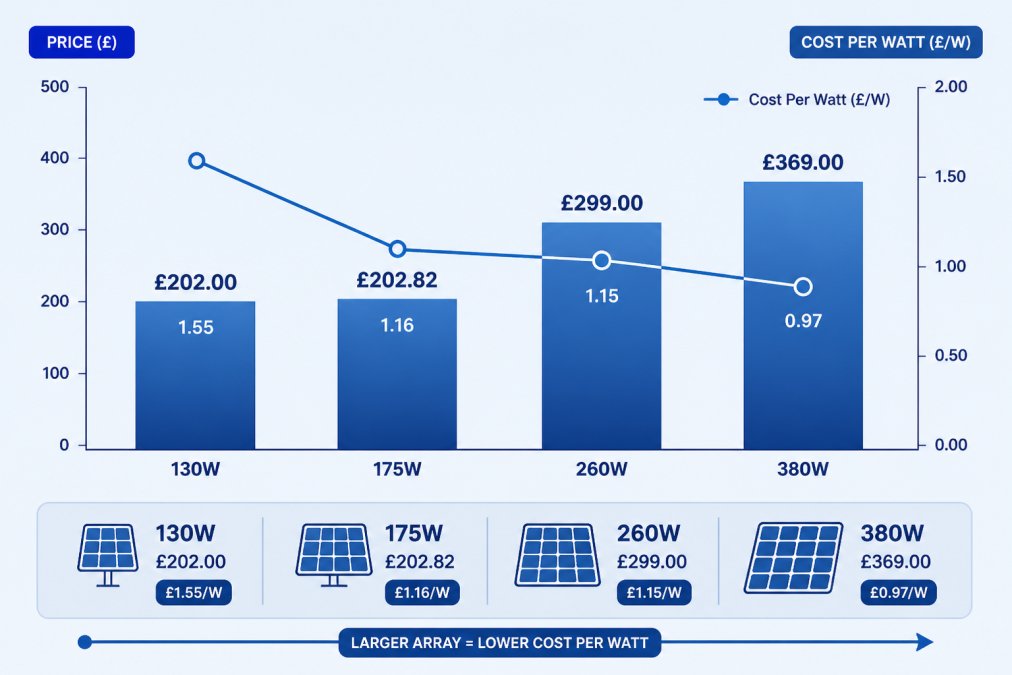
Notice the pattern. The 130W kit costs £1.56 per watt; the 380W kit costs £0.97. Array sizing is a budget decision as much as a technical one.

How Many Panels Does Your Home Need?
Panel count depends on daily consumption, peak sun hours and panel wattage. Divide your daily kilowatt-hour usage by your location's peak sun hours, then divide again by panel output.
A household using 8kWh daily in a region averaging 3.5 peak sun hours needs roughly 2,300W of capacity, or about nine 260W panels. Roof orientation matters: south-facing arrays in the UK capture the most solar irradiance, while east-west splits trade peak output for a flatter daily curve.

Sizing also depends on how much you want to self-consume. Most UK homes without battery storage export surplus generation rather than storing it.
Solar Battery Storage Systems: Lithium vs Lead-Acid
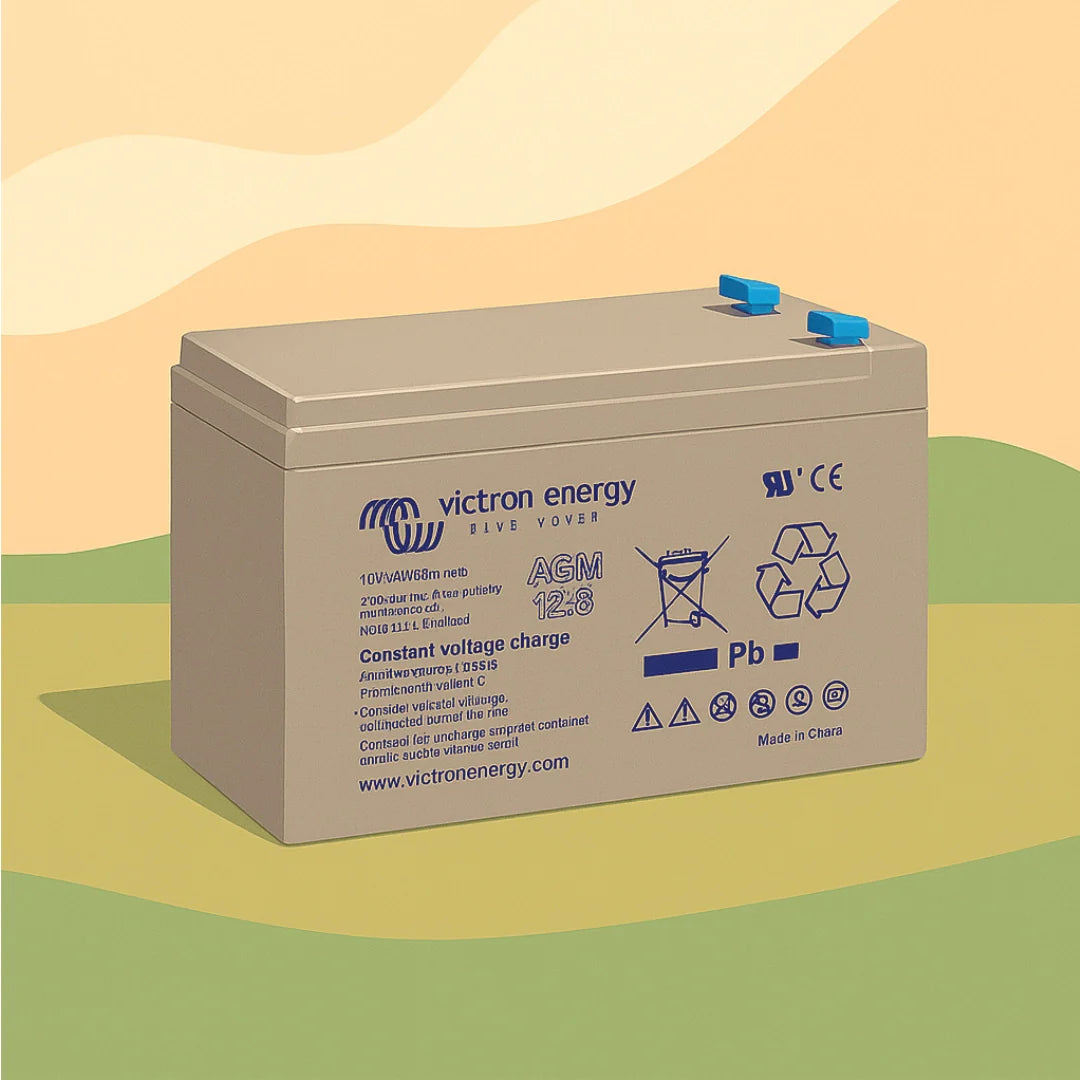
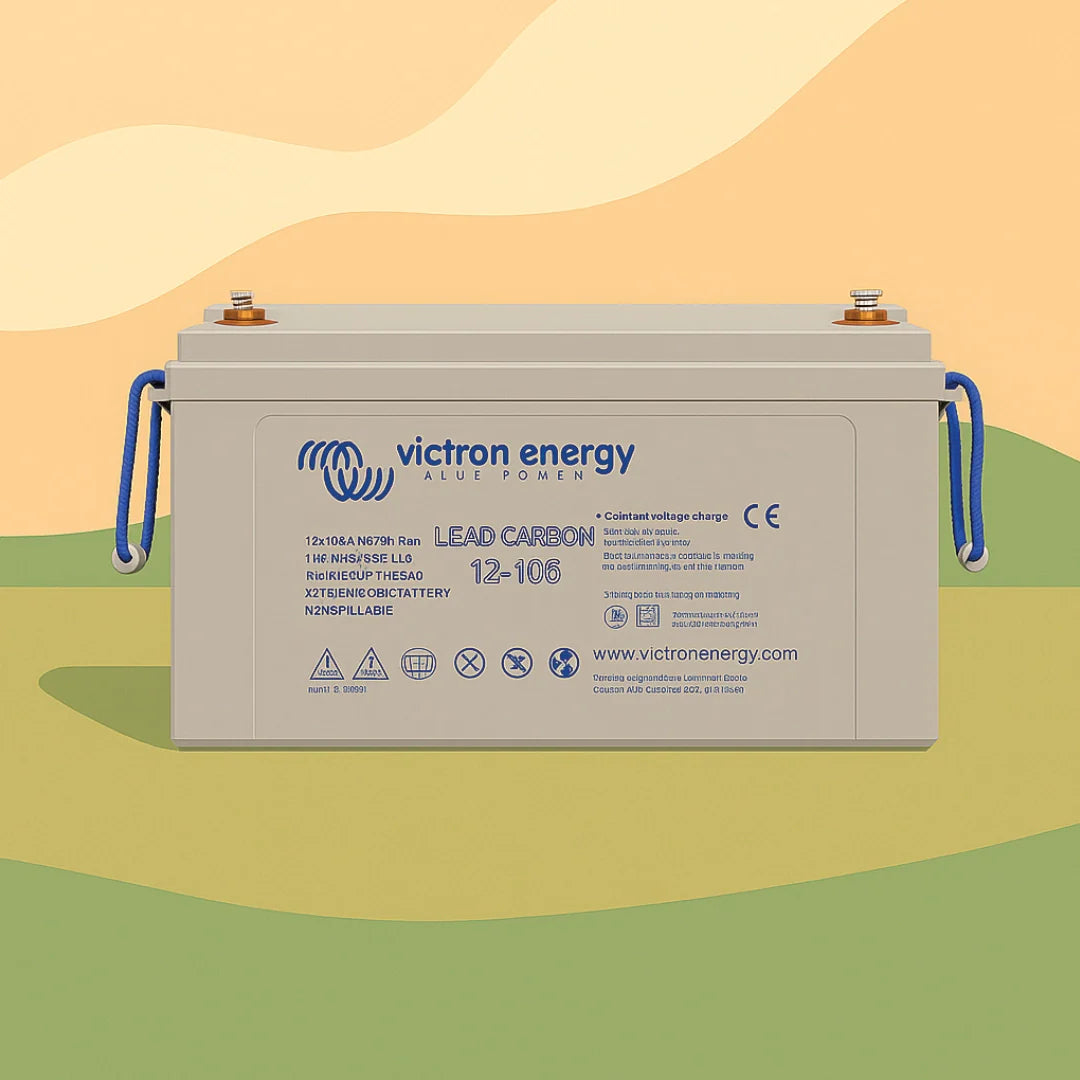
Lithium batteries win on usable capacity, cycle life and weight. Lead-acid is cheaper upfront but delivers only about half its rated capacity without damage. That much every guide tells you. The part most guides skip is what those numbers mean once you apply them to a real overnight load and a real UK tariff.
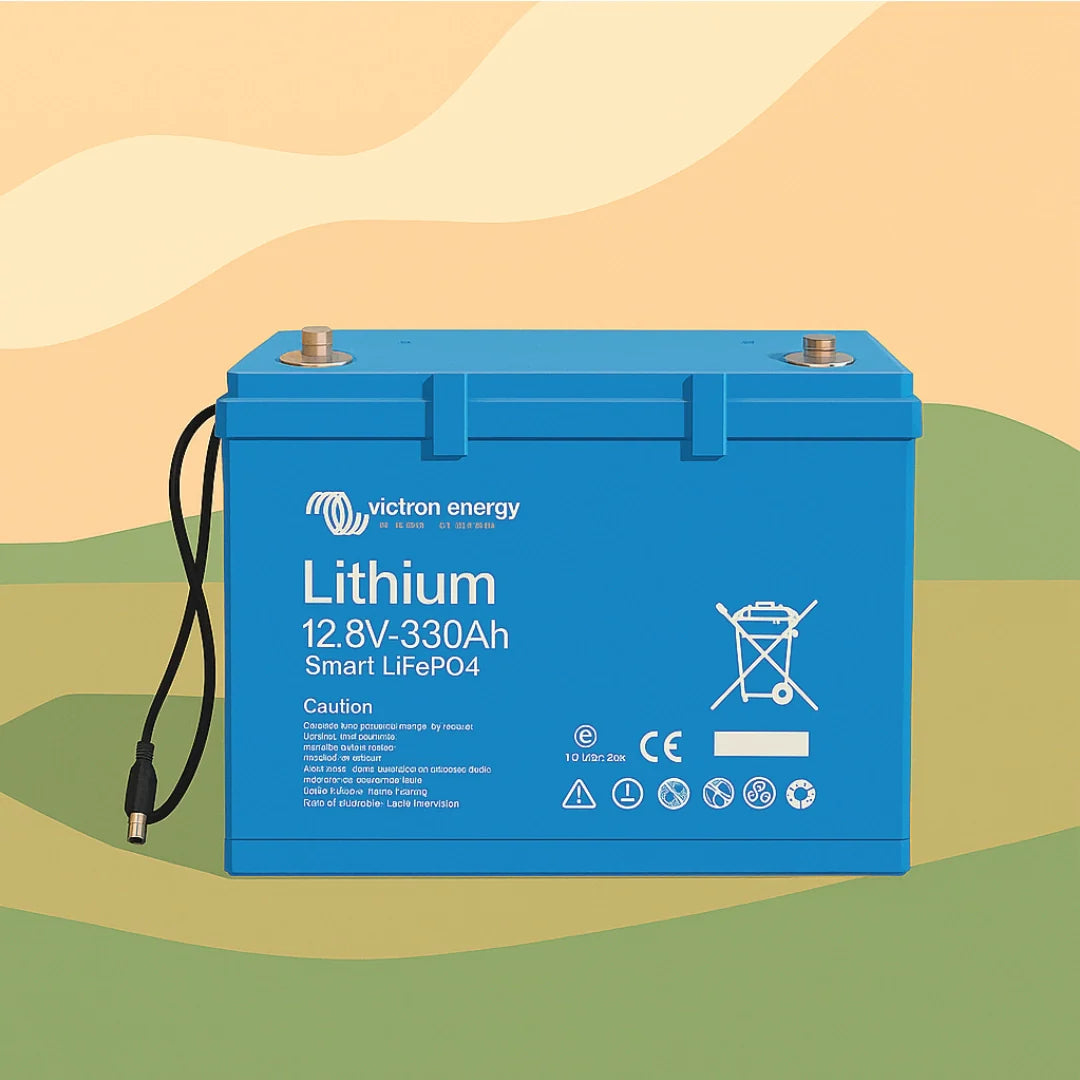
Lithium iron phosphate (LiFePO4) cells typically deliver 80-90% depth of discharge against lead-acid's 50%, and last several times longer in cycle terms (sciencedirect.com). For a home solar array, that gap decides whether storage pays for itself. A 10kWh LiFePO4 bank gives you roughly 8-9kWh of usable energy; the same nominal capacity in lead-acid gives you about 5kWh before you start shortening its life. If your evening and overnight load is 7kWh, the lead-acid bank is already undersized on day one.
| Attribute | LiFePO4 (lithium) | Lead-acid (AGM/gel) |
|---|---|---|
| Usable depth of discharge | 80-90% | 50% |
| Typical cycle life | 3,000-6,000 cycles | 500-1,200 cycles |
| Round-trip efficiency | 92-96% | 75-85% |
| Weight per kWh | ~6-8kg | ~25-30kg |
| Maintenance | None | Periodic equalisation, water top-up on flooded types |
| Behaviour in cold | Reduced but recoverable | Capacity and life drop sharply below 10°C |
That last row matters more than most buyers expect. A garage or outbuilding battery in a cold snap will underperform on lead-acid in a way that is permanent, not temporary. LiFePO4 loses capacity in the cold too, but recovers when temperatures rise.
Sizing around overnight consumption, not daily use
Size your battery around overnight consumption, not total daily use. A 10kWh battery that covers your evening and morning load costs far less than one sized for a full day, and the solar array refills it by mid-morning. A common pattern is a household using 8kWh daily, of which 5-6kWh falls between 4pm and 8am. That is the figure to size against.
Why the charge profile decides battery life
A battery is only as good as the controller managing it. LiFePO4 needs a constant-current/constant-voltage charge profile with a defined absorption voltage and no float overcharge. Get that wrong and you lose the cycle-life advantage you paid for. SRNE charging and monitoring systems manage this profile automatically, logging state of charge, cell balance and temperature so you can see whether the bank is being treated well or abused.
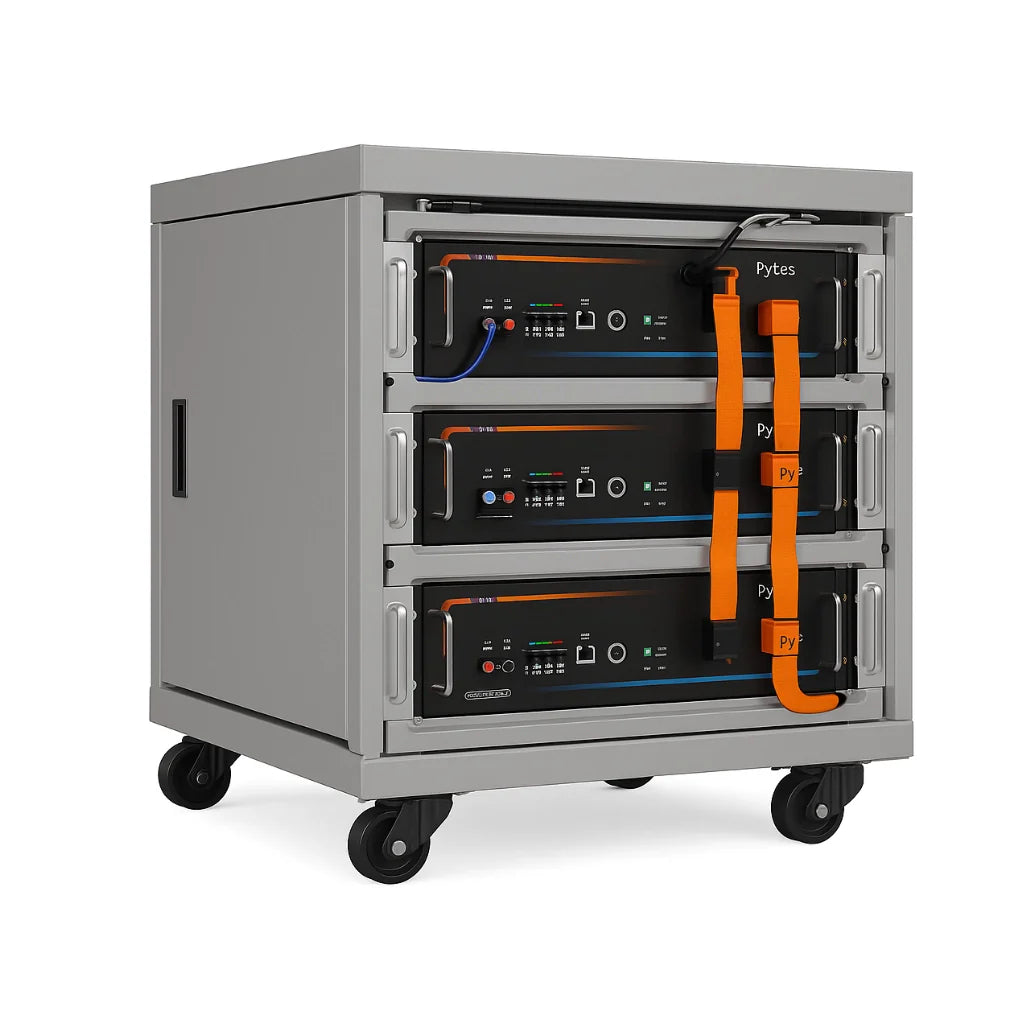
Skyenergi's Edge and Elite lithium batteries are built for this duty cycle, with SRNE charging and monitoring systems managing the charge profile.
MPPT Solar Charge Controller Benefits Explained
MPPT solar charge controller benefits come down to harvest efficiency. Maximum power point tracking constantly adjusts voltage and current to extract the most watts from a panel as irradiance and temperature shift.
A PWM controller simply clamps panel voltage to battery voltage, wasting the difference. MPPT recovers it, typically delivering 20-30% more charge in cool, cloudy conditions where voltage headroom is greatest (sciencedirect.com).
The Victron SmartSolar MPPT 75/15 included in our kits handles this automatically, with Bluetooth monitoring so you can see voltage, current and daily yield without extra hardware.
DIY Solar Installation Safety: What You Must Get Right
DIY solar installation safety hinges on three things: correct cable sizing, proper fusing, and safe roof work. Get any of them wrong and you risk fire, electrocution or a failed inspection. But the two areas most guides gloss over are the ones that cause the most expensive problems: whether your roof can actually take the load, and whether the system is compliant once it is up there. optimizing small roof areas.
Roof structural assessment before anything else
Panels, rails and mounting systems add load, and older roofs may need reinforcement before installation. A typical framed panel weighs around 18-22kg, and the rail and mounting hardware adds several kilograms per panel on top. Spread across a roof, that is a permanent dead load, plus wind uplift and snow loading in exposed areas. A chartered structural engineer or an experienced roofer can confirm whether your rafters and purlins are up to it. If they are not, reinforcement is far cheaper than a collapsed roof.
Orientation and pitch matter here too. A south-facing roof at 30-40° pitch captures the most annual irradiance in the UK. East-west splits trade peak output for a flatter daily curve, which suits self-consumption better if you have battery storage. Flat roofs need ballasted or angled mounting frames, which change the load profile entirely.
Electrical safety checklist
- Calculate voltage drop and use cable rated for the full array current
- Fit a DC isolator and fuse between array and controller
- Use IP-rated gland entries on every roof penetration
- Torque MC4 connectors to spec; loose connections arc
- Bond and earth the mounting system correctly
- Never work on a live array in daylight without isolating first
- Confirm the inverter or charge controller is rated for the array's open-circuit voltage at the coldest expected temperature
That last point catches people out. Panel open-circuit voltage rises as temperature falls, so a string that sits comfortably under the controller's limit in summer can exceed it on a frosty morning. Always size against the cold-temperature voltage, not the datasheet's standard test condition figure.
Compliance and notification
In the UK, most domestic solar installations fall under permitted development, but there are exceptions for listed buildings, conservation areas and flats. Grid-connected systems also need notification to your distribution network operator, and the work must be signed off by a competent person under the relevant building regulations. DIY electrical work in a dwelling is notifiable, and getting it wrong can invalidate home insurance. If you are not confident with the electrical side, use a registered installer for the connection and sign-off even if you do the mounting yourself.
Post-installation monitoring
Once the array is running, monitoring is what tells you whether it performs as modelled. An SRNE monitoring system or the inverter's own app will show daily yield, string voltage and current. A string producing noticeably less than its neighbours usually means shading, soiling or a failing connector. Catching that in week one saves a season of lost generation. Check the data monthly for the first year, then quarterly once you know the system's seasonal pattern.
Grid-Tied, Off-Grid or Hybrid: Choosing Your Home Solar Array Setup
Grid-tied systems export surplus to the grid and draw from it at night. Off-grid systems rely entirely on battery storage and generator backup. Hybrid systems combine both, keeping battery reserve while staying connected.
For most homes, hybrid offers the best balance: self-consumption with grid fallback. Off-grid suits remote properties where connection costs exceed storage costs.
Installation typically takes one to three days for a residential array, plus a certification sign-off. Post-installation monitoring through your inverter app or an SRNE monitoring system tells you whether the array performs as modelled, and flags underperforming strings before they cost you a season of generation.
Frequently Asked Questions
Can I install my own home solar array?
You can mount panels and route cables yourself, but a home solar array connected to the grid must be installed and signed off by a certified installer under the Microgeneration Certification Scheme, and any grid connection needs approval from your distribution network operator. Off-grid and leisure setups are more DIY-friendly. The critical safety points are DC isolation, correct cable sizing for voltage and current, and never working live. Pre-built kits with matched panels, an MPPT solar charge controller, cables and mounts remove most of the guesswork.
What is the role of lithium batteries in a home solar array?
Lithium batteries store the electricity your panels generate so you can use it after dark or during a power cut. They charge faster and accept a deeper discharge than lead-acid, so more of what you generate gets used rather than wasted. Skyenergi supplies Edge and Elite lithium batteries alongside SRNE charging and monitoring equipment for this kind of setup.
Do I need planning permission for a home solar array?
Most roof-mounted arrays fall under permitted development, so no application is needed. There are conditions: panels should not protrude significantly above the roof slope, and they cannot be fitted to a listed building or within a conservation area without consent. Flat-roof and ground-mounted arrays are treated differently, and ground-mounted systems above a certain size need approval. Check with your local planning authority before ordering, and confirm your installer handles the notification paperwork.
How does an MPPT charge controller improve solar efficiency?
An MPPT solar charge controller constantly adjusts the electrical load on your panels to keep them operating at their maximum power point, which shifts as light and temperature change. Compared with a basic PWM controller, that typically recovers a meaningful share of the power a panel produces but a PWM would discard. Pairing an MPPT controller with a Victron panel kit means the array and controller are matched from the start, so you are not losing output between the roof and the battery.
Choosing the right home solar array comes down to matching capacity, storage and charging equipment to how you actually use power. Skyenergi supplies complete Victron solar kits, MPPT charge controllers and Edge and Elite lithium batteries with fast UK delivery and specialist support. Get started with Skyenergi and build a system sized for your real consumption, not a guess.
Prev post

Benefits of Lithium for Off-Grid: 2026 Guide
Updated on 12 September 2026
Next post

How to Calculate Campervan Power Needs: 2026 Guide
Updated on 10 September 2026


