





Why use MPPT controllers for solar systems
Discover why use MPPT controllers for solar systems. Unlock 15-30% more energy, ensuring your batteries stay charged even in low sunlight.
MPPT (Maximum Power Point Tracking) controllers are defined as charge regulators that continuously adjust panel voltage and current to extract the maximum available power from a solar array. They deliver 15–30% more energy than traditional PWM (Pulse Width Modulation) controllers by converting excess panel voltage into additional charging current rather than wasting it as heat. For UK solar users running campervans, off-grid cabins, or leisure battery setups, that efficiency gap is the difference between a battery that stays charged through a grey October and one that doesn’t. Understanding why use MPPT controllers starts with knowing exactly what they do differently, and why that difference compounds over years of use.
Why use MPPT controllers: how the technology works
MPPT controllers function as DC-to-DC converters, stepping panel voltage down to battery voltage while simultaneously stepping current up. The energy that would otherwise be lost in a PWM system gets redirected into the battery as usable charge. That is the core mechanical reason MPPT outperforms PWM in almost every real-world condition.
A solar panel’s maximum power point shifts constantly. Temperature, cloud cover, and the angle of the sun all change the voltage and current a panel can produce at any given moment. An MPPT controller samples the panel’s output many times per second and adjusts its conversion ratio to keep the panel operating at peak output. A PWM controller, by contrast, simply switches the panel on and off at a fixed voltage, which means any voltage above the battery’s absorption level is discarded.

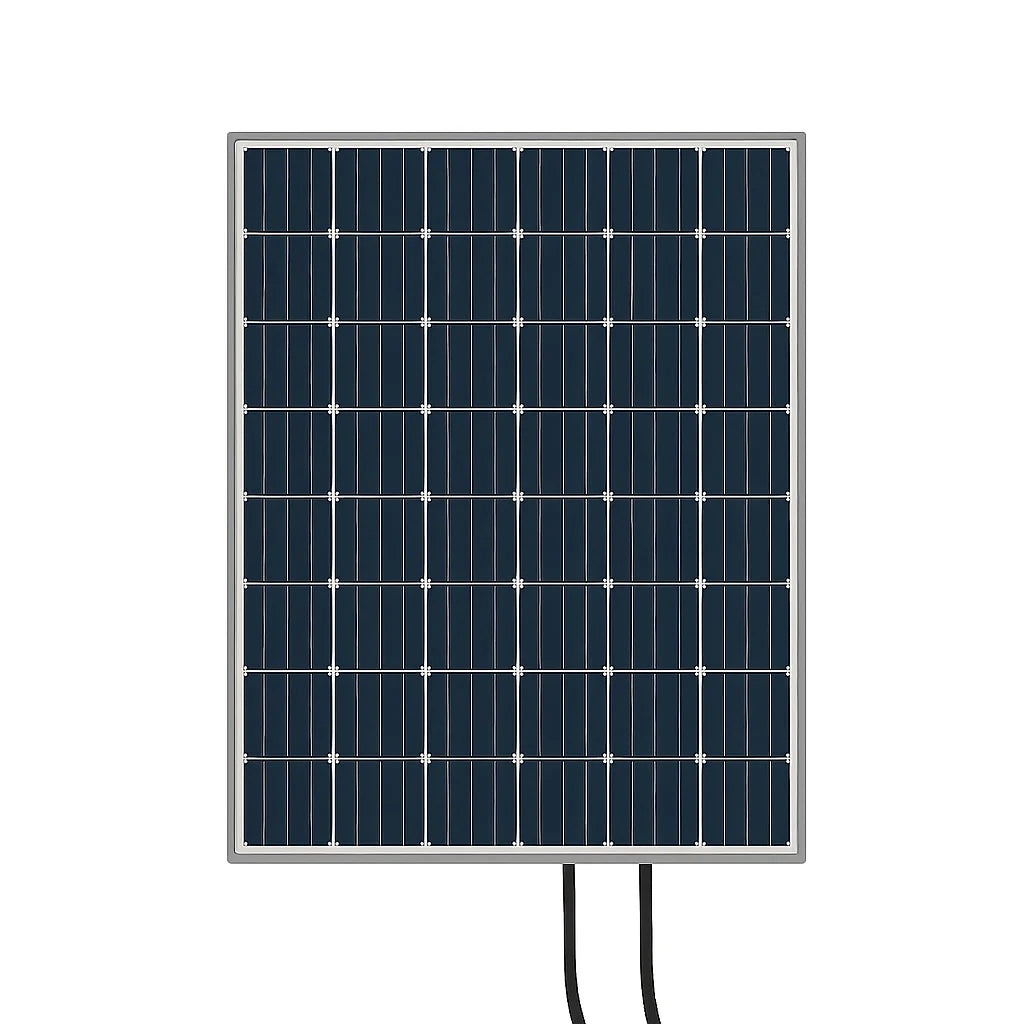
Pro Tip: If your panel’s open-circuit voltage is significantly higher than your battery voltage, an MPPT controller captures that gap as extra charging current. A 36-cell panel rated at 21V open-circuit feeding a 12V battery is a textbook case where MPPT pays for itself quickly.
The practical result is visible on any monitoring display. During a partly cloudy morning, an MPPT controller tracks the shifting power point and maintains a higher average charge rate than a PWM unit running the same panel. Over a full day, those incremental gains accumulate into a meaningfully fuller battery.
| Condition | PWM behaviour | MPPT behaviour |
|---|---|---|
| Cold, bright morning | Wastes high panel voltage | Converts voltage into extra current |
| Overcast afternoon | Fixed switching, low harvest | Tracks reduced power point efficiently |
| Peak midday sun | Adequate but inefficient | Operates at true maximum power point |
| Variable cloud cover | Harvest drops sharply | Adapts in real time, minimises loss |
What are the measurable benefits of MPPT controllers?
The efficiency advantage of MPPT controllers translates directly into energy and money. Real-world testing shows average annual gains of 15–30% over PWM, with peaks reaching 45% in cold, high-irradiance conditions. That figure is not theoretical. It reflects the voltage gap that MPPT captures and PWM discards every single day.
The cost difference between the two technologies is real but recoverable. MPPT controllers typically cost £100–£300, compared with £20–£60 for PWM units. The payback period in UK conditions is 2–3 years, after which every additional kilowatt-hour harvested is pure gain. Over a 20–25 year lifespan, MPPT controllers generate an estimated £300–£600 more energy value than an equivalent PWM setup. That figure assumes no change in panel size or battery capacity, so any system upgrade only improves the return.
Battery longevity is a secondary financial benefit that rarely appears in headline comparisons. MPPT controllers charge batteries more consistently and at the correct voltage profile for the battery chemistry in use. Fewer partial-charge cycles and fewer voltage spikes mean a lithium leisure battery or LiFePO4 pack lasts longer before capacity degrades. The cost of a replacement battery set makes the MPPT premium look modest by comparison.
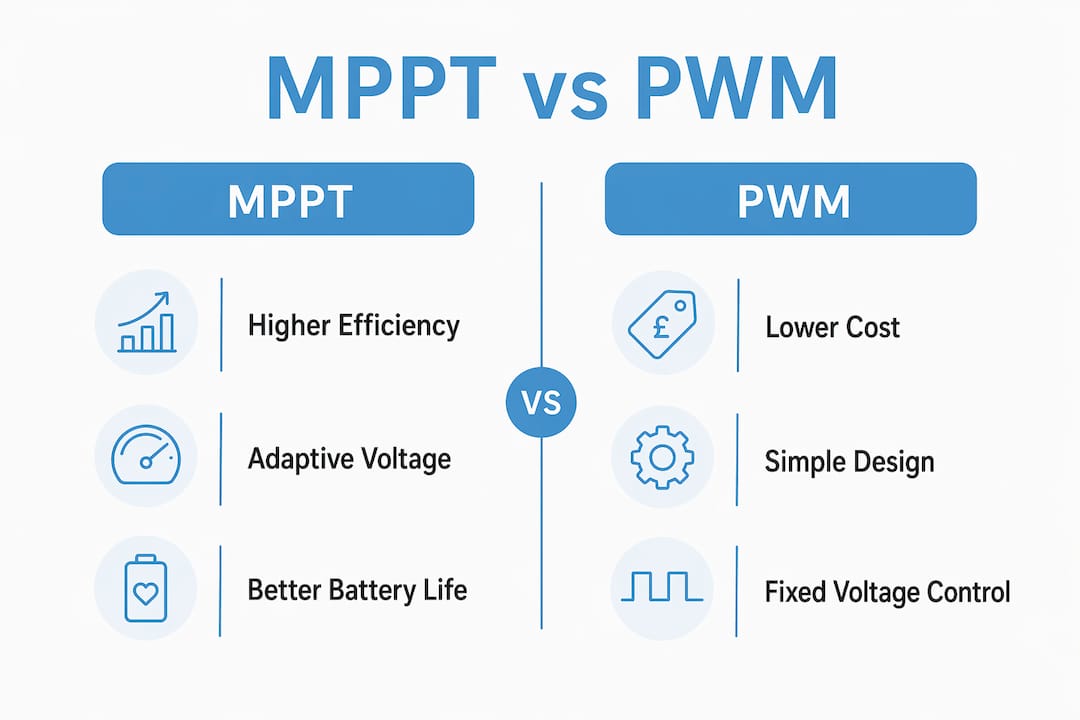
For users integrating MPPT with energy storage upgrades, the compounding effect is significant. A larger, well-charged battery bank paired with an MPPT controller extends off-grid autonomy without requiring additional panels.
Why does UK climate make MPPT controllers especially important?
The UK’s weather makes MPPT controllers more valuable here than in sunnier climates, not less. MPPT’s advantage peaks in cold temperatures and variable light, which describes the UK’s spring and autumn months precisely. Cold panels produce higher open-circuit voltages. MPPT captures that elevated voltage and converts it into charge current. PWM simply clips it.
A 100W panel with an MPPT controller can sustain basic off-grid amenities from april through september in the UK. That same panel with a PWM controller will underperform on every overcast day, which in the UK is most days outside of peak summer. The gap between the two technologies is widest precisely when you need reliable charging most.
Specific use cases where MPPT controllers deliver clear advantages include:
- Campervans and motorhomes: Variable parking positions and frequent shade from trees or buildings mean the panel’s power point shifts constantly. MPPT adapts; PWM does not.
- Off-grid cabins: Seasonal use in spring and autumn coincides with the period when MPPT’s cold-weather advantage is greatest.
- Marine applications: Reflected light from water and rapidly changing sky conditions create volatile panel output that MPPT handles more effectively.
- Leisure battery systems: Consistent, chemistry-correct charging from MPPT extends battery life, which matters when the battery is the heart of the system.
Pro Tip: For campervans specifically, pairing an MPPT controller with a Bluetooth-enabled battery monitor lets you track state of charge in real time without opening a hatch. Skyenergi’s range of Victron-compatible components is built for exactly this kind of integrated monitoring setup. Read more about MPPT for campervans on the Skyenergi blog.
MPPT’s adaptive voltage tracking consistently outperforms PWM’s fixed-voltage approach in the UK’s variable sunlight. For anyone relying on solar as a primary or significant secondary power source, that adaptability is not optional.
How to choose and configure an MPPT controller correctly
System size is the first selection criterion. Experts advise against PWM for systems above 200W. At that scale, the energy wasted by PWM switching becomes too large to ignore, and the cost difference between the two controller types becomes proportionally smaller.
Follow these steps when selecting and setting up an MPPT controller:
- Calculate your panel array’s maximum power and voltage. The controller’s input voltage rating must exceed the panel’s open-circuit voltage by a safe margin, particularly in cold conditions when Voc rises.
- Match the controller’s charge current rating to your battery bank. A 100Ah LiFePO4 battery charges safely at up to 50A; a controller rated below that will throttle your harvest unnecessarily.
- Select the correct battery chemistry profile. Incorrect battery type settings cause charging errors, BMS disconnects, and long-term battery damage. LiFePO4 mode is mandatory for lithium batteries and uses different absorption and float voltages than AGM or gel profiles.
- Enable remote monitoring if available. Modern MPPT controllers with WiFi or Bluetooth allow real-time performance tracking and fault diagnosis without physical access to the controller.
- Check wiring gauge and fusing. Higher charging currents from MPPT controllers require correctly rated cable. Undersized wiring creates resistance losses that partially offset the efficiency gains.
Battery chemistry configuration is the most common point of failure in MPPT installations. A controller set to AGM mode connected to a LiFePO4 battery will overcharge the pack or trigger repeated BMS shutdowns. Proper configuration is not a detail to revisit later. Set it correctly at installation and verify it after any firmware update.
For users sourcing components from a camping energy management guide, the configuration principles above apply regardless of panel brand or battery manufacturer.
Key takeaways
MPPT controllers deliver 15–30% more energy than PWM controllers by converting excess panel voltage into charging current, making them the correct choice for any solar system above 200W or operating in variable UK conditions.
| Point | Details |
|---|---|
| Efficiency advantage | MPPT harvests 15–30% more energy than PWM annually, with peaks to 45% in cold conditions. |
| Payback period | The higher upfront cost of £100–£300 recovers in 2–3 years through increased energy generation. |
| UK climate fit | Cold temperatures and variable light amplify MPPT’s advantage over fixed-voltage PWM switching. |
| Configuration matters | Setting the correct battery chemistry profile is critical; errors cause BMS faults and battery damage. |
| Long-term value | Over 20–25 years, MPPT controllers generate an estimated £300–£600 more energy value than PWM. |
MPPT controllers: my honest assessment after years in off-grid solar
The most common regret I hear from off-grid solar users is not buying an MPPT controller from the start. They chose PWM to save £60–£80, then spent the next two winters wondering why their battery never reached full charge before dark. The maths never favoured PWM for anything beyond a small, simple system.
What surprises people most is how much the UK climate specifically rewards MPPT. The cold, bright days in march and october, when panels run at their highest open-circuit voltages, are exactly when MPPT’s conversion advantage is greatest. PWM users are losing their best charging days to wasted voltage.
The technology has also matured considerably. Controllers with Bluetooth monitoring, like those in Victron Energy’s SmartSolar range, now give users granular data on harvest, battery state, and fault history without any additional hardware. That visibility changes how people manage their systems. Instead of guessing why the battery is low, they can see exactly what happened overnight or during a cloudy afternoon.
My advice is straightforward: if your system is above 200W, or if you are using lithium batteries, MPPT is not a premium option. It is the baseline. The extra cost is recovered quickly, and the battery longevity benefits alone justify the investment in most setups I have seen.
— John
Victron Energy SmartSolar MPPT controllers from Skyenergi
Skyenergi stocks the full Victron Energy SmartSolar MPPT range, covering systems from small leisure setups to larger off-grid arrays.
The SmartSolar MPPT 100/30 suits campervans and smaller off-grid builds, handling up to 30A charge current with built-in Bluetooth monitoring. The SmartSolar MPPT 100/50 steps up to 50A for larger battery banks and higher-output panels. For bigger arrays, the SmartSolar MPPT 150/35 supports higher panel voltages up to 150V input, making it suitable for series-connected panel configurations. All three models support LiFePO4, AGM, and gel battery profiles, and connect directly to the VictronConnect app for real-time monitoring and configuration.
FAQ
What does an MPPT controller do differently from PWM?
An MPPT controller uses DC-to-DC conversion to match panel voltage to battery voltage, redirecting excess voltage as additional charging current. A PWM controller simply switches the panel on and off at a fixed voltage, discarding any voltage above the battery level as heat.
Do MPPT controllers improve efficiency in cloudy conditions?
Yes. MPPT controllers track the panel’s shifting power point in real time, maintaining efficient charging even when irradiance drops. This makes them particularly effective in the UK’s frequently overcast conditions.
What size system needs an MPPT controller?
Systems above 200W require MPPT for efficient operation. Below that threshold, PWM may be adequate for simple setups, but MPPT remains the better choice for battery longevity and system health.
Can I use an MPPT controller with lithium batteries?
Yes, but the controller must be configured with the correct battery chemistry profile. Selecting LiFePO4 mode sets the correct charge voltages and prevents BMS disconnects or battery damage from overcharging.
How long does it take for an MPPT controller to pay for itself?
In UK conditions, the additional cost of an MPPT controller over a PWM unit recovers in approximately 2–3 years through increased energy harvest. Over a 20–25 year system lifespan, the cumulative energy gain is estimated at £300–£600.
Recommended
Prev post

How to Choose the Best Lithium Leisure Battery (Compared)
Updated on 15 July 2026
Next post

SRNE vs. Victron: Which Is Better For Your Off-Grid Build?
Updated on 14 July 2026


